By Larry Goldberg
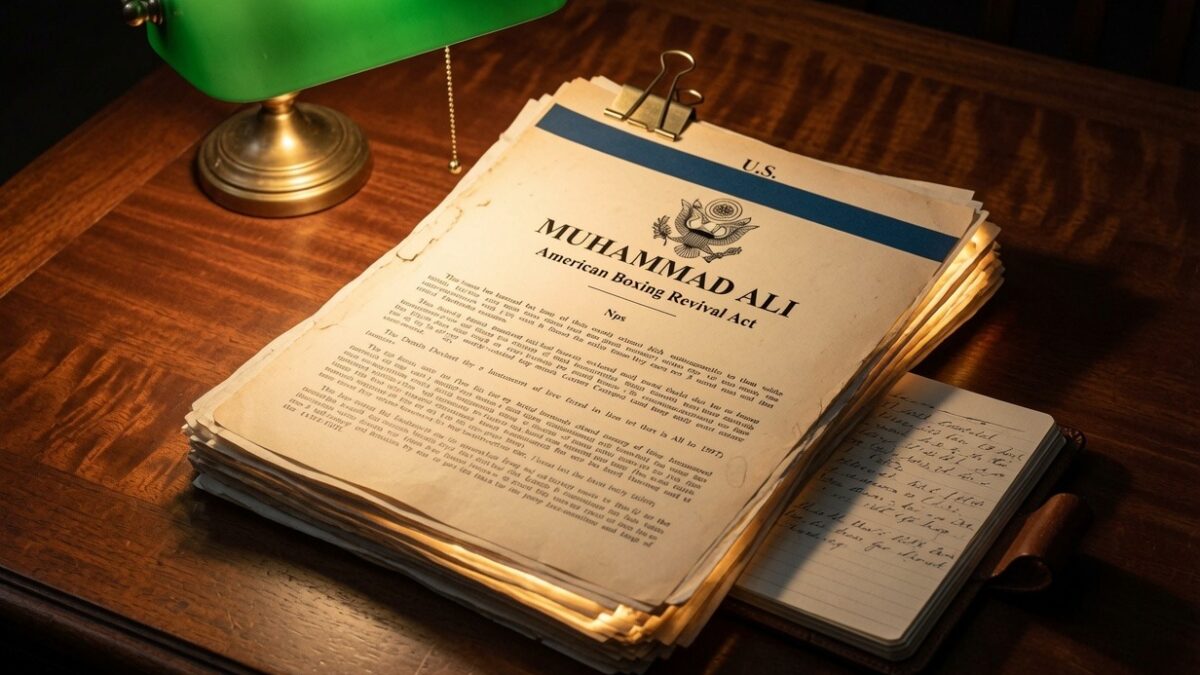
The Senate Commerce Committee marks up the Muhammad Ali American Boxing Revival Act on Wednesday, September 16. BoxingInsider.com has covered this bill longer and in more detail than any publication in the sport. This letter was sent to Chairman Cruz’s office and committee staff in advance of publication.
Dear Chairman Cruz and Senator Rosen,
Let me start with respect, because I mean it. Chairman, you won a national debate championship at Princeton, graduated Harvard Law with honors, clerked for the Chief Justice of the United States, and argued nine cases before the Supreme Court as Solicitor General of Texas. Senator Rosen, you co-authored this bill from the state that has hosted more championship boxing than any other, under one of the four commissions in America that actually run this sport at the highest level, and at the April hearing you were the one who kept steering the room back to fighter protections. Those are the two things this letter is about. Those records are exactly why I am writing, because this bill does not live up to them. The lawyer who stood before the Supreme Court nine times would never let a single misplaced “or” gut the most important safety provision in a piece of legislation carrying Muhammad Ali’s name. So here are the fixes, point by point, and then I am going to concede the biggest fight in the bill, because I want this legislation to pass. And if you want the medical half of this letter in one sentence before you read another word: New Jersey’s system, nationwide.
First, because the medical table is only as wide as the definition: define covered combat sports in the statute. The title says boxing, the medical table says boxer, and the sport has already moved past that word. On any given weekend in this country, one permit carries boxing, MMA, and kickboxing on the same card, in the same ring, on the same broadcast. Under your bill as written, the boxing bouts would have federal medical protection and the co-feature would have none, because those fighters were kicking as well as punching. It is the same brain taking the same punch. Write the definition now, one sentence: any state or tribal sanctioned event where blows to the head are permitted. Boxing, MMA, kickboxing, bare knuckle, slap fighting, all of it. New Jersey regulates every combat sport under one roof, and Congressman Mullin, a former professional MMA fighter, already wrote the federal version. If the committee needs to phase the application, phase the application. But a medical floor that stops at the word boxing is a floor with holes shaped like every other combat sport. A fighter is a fighter. The bill should know that.
Second, the medicals. The bill’s brain health table lets a fighter under 40 substitute a neurological exam for brain imaging. Strike the “or.” A doctor watching a fighter touch his nose cannot see a bleed, a lesion, or a vascular malformation. I have written the one-sentence fix. The neurological exam is an additional test, not a substitute, and at some point this is just arithmetic. Most states require no imaging at all. A basic scan is a CT. New York, the hardest standard in the country, requires a 1.5 tesla MRI with multiple sequences. Somewhere on that spectrum is a federal floor, and zero cannot be it. That matches the published guidance of the Association of Ringside Physicians, the same body your bill puts in charge of physician certification. And findings need consequences. New York treats a prior brain bleed of any kind, and lasik eye surgery, as disqualifying. The federal floor should authorize every commission to draw those lines, as presumptive disqualifiers with a documented medical waiver path, so that a finding in the scan actually means something.
Third, the imaging language. The bill recognizes only MRI. Write it the way the sport actually works: CT is the licensing baseline, MRI is preferred, and the requirement escalates to MRI as the risk does, with age, with findings, and after a serious knockout, when the fighter’s clearance should follow the Association of Ringside Physicians’ own published protocol, the one only five states enforce today. CT is standard of care in every emergency room in America, and an MRI-only rule with no pathway prices fighters out in the markets least able to absorb it. I have published the actual invoices. Your drafters never priced their own table.
Fourth, add a verified chain of custody for medical documents, from the imaging center to the commission, with audit authority, and connect it to a national medical registry, the piece Senator McCain understood twenty years ago. New Jersey already runs the chain of custody under its Attorney General’s office and catches forgeries every year. Here is why the registry matters. A fighter denied in New Jersey does not retire. He gets in a car, drives in almost any direction, and gets approved, with the failed medicals and consecutive knockout losses sitting on BoxRec for anyone to read. And give commissions a federal floor of matchmaking review factors to use with it. New York draws bright lines: no fighter with three straight knockout losses, six straight losses, or ten knockout losses in a career. New Jersey reviews and approves every matchup before it is made. In some states, a fighter who is 1-20 can be fed to an untested prospect with twenty knockouts in a row, and nobody in the building has the authority to stop it. Nobody is asking Congress to approve bout pairings. The ask is that every commission be required to look, with the registry in front of them, before a mismatch gets a license. That is the bottom of the sport, where the damage actually accumulates, and no television camera ever sees it.
Fifth, direct the Association of Boxing Commissions, the ABC, and the Association of Ringside Physicians to build the concussion protocol combat sports have never had, on the NFL model: independent evaluation, mandatory removal, graduated return. A fighter’s worst head trauma often happens in sparring, months before fight night, where no doctor is watching. The enforcement mechanism already exists: licensing. Every trainer and second working a New Jersey corner holds a commission license. A protocol triggered by any knockout in competition, with supervised return-to-sparring standards, means a licensed trainer who puts a concussed fighter back in before he is cleared is risking the thing that lets him work. For the first time, somebody in the gym would have a professional obligation to protect the fighter from the next punch instead of preparing him for it.
Sixth, clean up the provisions your own bill does not seem to know it contains. Section 21A(f)(3) quietly federalizes contract length for every promoter in the sport. The betting prohibitions apply only inside the UBO structure, while New Jersey’s integrity rules cover every fight the state licenses. And the title reform TKO’s own testimony asked for was deleted from your version entirely. These are fixable in markup, and they should be.
Seventh, the missing chapter. Your bill writes conduct rules for a UBO that does not exist yet while asking nothing new of the sanctioning bodies that run boxing today. Weeks ago, the WBA listed Jarrell Miller as its heavyweight mandatory, then erased it and called it an error, with no explanation of how, who, or what his twelve-round win earned instead. Under your bill that costs the WBA nothing. The tools are already in your text: mandatory public explanation of any ranking change, ABC audit authority over ranking procedures, and loss of federal recognition for any organization that cannot explain its own rankings. A ranking that can be revoked with a press release is not a ranking. It is a favor, and favors are what the original Ali Act was written to end.
Eighth, the officials. Your bill hands national certification of referees, judges, and ringside physicians to the ABC. Build that program on the states that do this right. Florida just showed the country how much room there is between commissions: on one permitted card in Orlando last month, a man with no record of a Florida official’s license stood in as referee over live punches, and a segment ran in the ring that never appeared on the state’s official results sheet. I have documented all of it. I do not write that to pile on Florida. I write it because it proves the point of this whole letter: the gap between the strongest commissions and the rest is enormous, and a national standard built on the average will inherit the average’s problems.
Now the part everyone is actually fighting about.
Give TKO their UBO.
I run a promotional company that competes in this sport, and I am telling you to give the company that spent its political capital the structure it asked for. Dana White has a vision for boxing. Let him chase it. A league model with real medicals and real minimums, running alongside traditional boxing, might be a renaissance. Fighters are smart. Let them see both models and choose.
But not everyone. Unlimited UBOs is not competition, it is a loophole, an escape hatch from the original Ali Act’s protections with a belt and a logo. Write a door with a high bar instead: a multi-year record of regularly scheduled professional events at the parent or affiliate level, sufficient to demonstrate purse, medical, and insurance capacity at league scale, and submission to a regulator with audit authority, subpoena power, and the ability to revoke certification. TKO clears that bar on the strength of the UFC’s two decades of operation. The legacy promoters of this sport, the Top Ranks and Matchrooms and PBCs and Golden Boys, operate at a scale that could build toward it tomorrow if the model ever suited them, and today it does not, because their business is traditional promotion. So the bar keeps nobody serious out. What it keeps out is the pretender, and a guarded door is not an insult to TKO. It is what makes their titles worth something. And here is the simplest test of whether the door is fair: their operation and mine should live under the same rules. In New Jersey, we basically already do. The medical table, the chain of custody, the integrity rules, the officials assigned without my input, none of it scales down because my show is in a ballroom instead of an arena. If I have to meet that standard to put eight fights in front of two thousand people, a company crowning national champions can meet it too. That is not a burden on anyone. That is the system working.
And one condition on the door itself, because it is the reason the original Act exists. The Ali Act was written to end the coercive contract: the option clause a fighter had to sign to get a title shot, the deal that extended itself every time he won. A UBO built on exclusive league contracts is, by design, the one structure that could bring that back with a federal blessing. Your Senate text already knows this. It moved further than the House on contract terms, with a cap on the first contract and a negotiation window. Make those the floor, not the ceiling, and write the rest plainly: no UBO contract extends because the fighter won, no title shot conditioned on signing away future fights, and a fighter who reaches the end of his term is free, full stop. Give TKO the league. Do not give anyone the option clause.
And finish the thought in both directions, because Jake Paul’s company already controls a UBO, it is just not allowed in boxing. MMA is full of organizations doing exactly what your bill spends forty pages defining, with no Ali Act, no federal medical table, and no oversight at all. The covered-sports definition puts the medical table, the registry, the officials standard, and the insurance floor over all of them, and that is the markup ask. Whether the Ali Act’s contract protections should extend to non-boxing organizations is a separate decision, and I will say plainly where I stand on it: a contract that extends automatically the moment the fighter becomes champion, which means winning the title costs him his freedom, has been illegal in boxing for 25 years, and no fighter in any sport should be under one. But that is a debate your committee should have in the open, on its own terms, not one to smuggle in through a definition. On sequence: the covered-sports definition, the medical fixes, the guarded UBO door with its contract condition, and the cleanup are markup items, ready now. The concussion protocol and the matchmaking floor can begin as report language directing the ABC and the physicians to build them. This bill is the foundation either way.
For your staff, here is the record. BoxingInsider.com has covered this legislation from every angle, starting with the history your committee inherits: a brief history of Congress trying and failing to fix boxing, the fifty-year fight from the mob’s monopoly to the Muhammad Ali Act, the two boxing bills your own committee produced twenty years apart, and the boxing America would have today if the McCain and Mullin bills had passed. From there, the current bill: what it requires medically and what it costs, how the medical table reaches every club show in America, why every fighter who gets hit in the head for a living should be covered, the betting rule that covers one class of company while New Jersey covers every fight, the April 22 hearing where the witnesses split, Nick Khan’s full pitch to your committee, TKO’s written answers to Congress, the House passage that put this bill in your hands, the Senate version in detail, what it means for independent promoters, the sanctioning body conduct your bill leaves untouched, what Florida’s commission permitted in Orlando, and the question that started it all: who is watching out for the fighters. We have now published the answer, the New Jersey model your committee can copy tomorrow.
One more thing, because at the end of the April hearing you invited stakeholders to send thoughts on how to make this bill better. This letter is mine, and so is this: look at who your committee heard from, and who it did not. One company’s executives, a famous name, and the association your bill relies on for officials certification. What the hearing did not have was an independent operator, a boxing lawyer, a ringside physician, a serious regulator, or a fighter who lived the club show economics this bill regulates. Nobody in that hearing room buys complete fight medicals out of a club show margin or promotes under both the toughest commission in America and the most expensive insurance mandate in America. I do, in New Jersey and New York, every show, and unlike most of the people your committee has heard from, I want this bill to pass.
So here is a small ask either office can say yes to, and it does not have to involve me. Before Wednesday, put boxing people in front of your staff. A ringside physician who has worked a thousand cards. A boxing lawyer who has lived with the original Ali Act since it passed. A working promoter who buys the medicals and files the paperwork. A regulator from one of the states that regulate this sport at the highest level, New York, New Jersey, California, or Nevada. And an injured fighter, because only someone who has lived it can tell your staff what the decade after the damage looks like, when the fight night insurance is long gone and no system anywhere is responsible for what comes next. Forty-five minutes with any of them will be worth more than the April hearing. And whoever sits in those chairs, have them do one thing with your staff: pull up one Saturday of American boxing on BoxRec, state by state, match by match, and look at the ages, the records, and the mismatches, and notice which states they happen in. It will teach the committee more in an afternoon than any witness table ever has.
Respectfully,
Larry Goldberg
Founder, Boxing Insider Promotions
Publisher, BoxingInsider.com
Licensed Promoter, New Jersey and New York
Correction, September 30, 2026: An earlier version of this letter described an “unlicensed referee” and a “bout” at the August 29 Orlando event. The wording has been updated to match what BoxingInsider can document: the person who stood in as referee has no record of a Florida official’s license, and the segment does not appear on the commission’s results sheet.