
Cruz Signals Support for UBO Framework, Announces Forthcoming Senate Version
By BoxingInsider Staff
WASHINGTON — The Senate Commerce Committee convened a full committee hearing Wednesday on the Muhammad Ali American Boxing Revival Act, the first Senate examination of federal boxing law since the committee last reported out boxing legislation in 2009. Chairman Ted Cruz (R-TX) gaveled in the hearing at 10:00 a.m. in room SR-253 of the Russell Senate Office Building, opening proceedings with a ring bell in place of a gavel and introducing the witnesses in the style of a ring announcer.
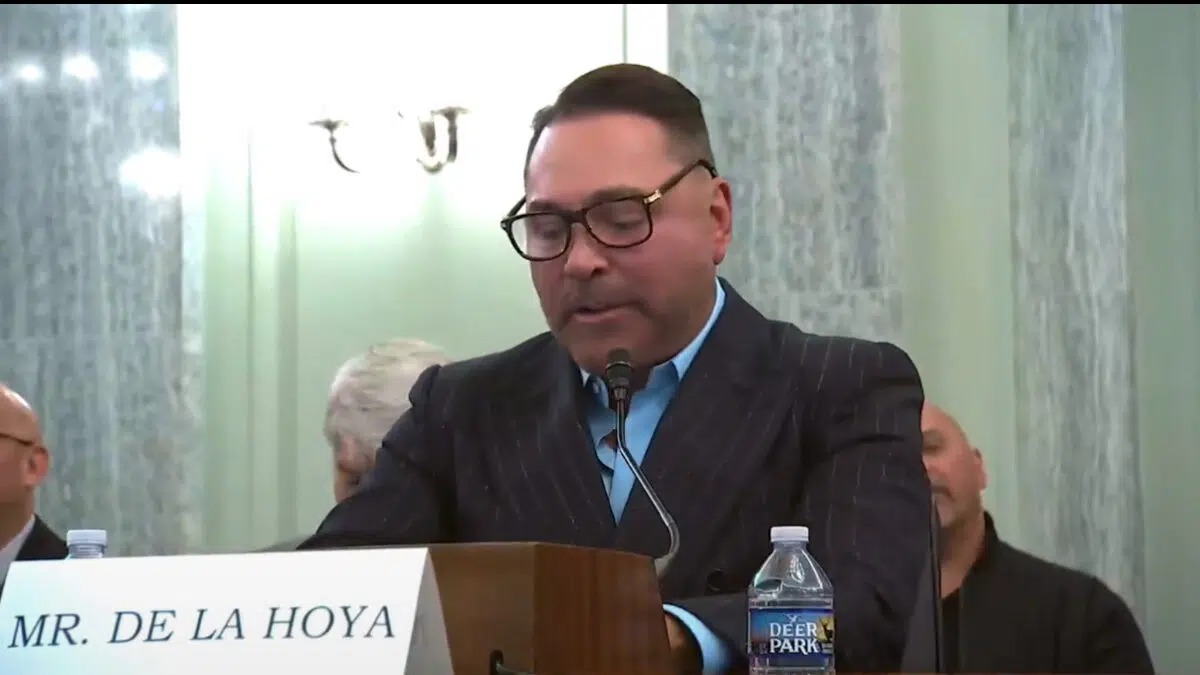
Four witnesses testified. Oscar De La Hoya, Chairman and CEO of Golden Boy Promotions. Timothy Shipman, President of the Association of Boxing Commissions and Combative Sports and Executive Director of the Florida Athletic Commission. Nico Ali Walsh, professional boxer and grandson of Muhammad Ali. Nick Khan, President of World Wrestling Entertainment, senior executive at Zuffa Boxing, and board member of TKO Group Holdings.
The hearing examined H.R. 4624, the Muhammad Ali American Boxing Revival Act of 2026, which passed the House on March 24 by voice vote and was referred to the Senate Commerce Committee the following day. The bill amends the Professional Boxing Safety Act of 1996 to establish a new category of professional boxing entity called a Unified Boxing Organization, or UBO, and strengthens medical, safety, and compensation requirements for professional boxers.
A Panel Split Three Ways
The four witnesses presented three distinct positions. De La Hoya and Ali Walsh opposed the bill in its current form. Khan supported it. Shipman focused on implementation and uniformity of standards without taking a strong position for or against.
Oscar De La Hoya argued that the bill would fundamentally restructure the power balance in professional boxing to the disadvantage of fighters. “This is a fundamental shift in power that, if enacted, would put corporate profits first and fighters second,” De La Hoya said. “Fighters deserve real protection and real opportunity, not to have to fight the system as well. If this bill passes, fighters will have fewer choices, less leverage, and less control over their careers. And when that happens, it will not be the sport that failed them. It will be us.”
De La Hoya also directly addressed the role of Saudi Arabian investment in the bill’s most likely beneficiary, drawing a comparison to LIV Golf. “Zuffa Boxing is fully funded by Saudi Arabia,” De La Hoya told the panel. “We’ve already seen how that kind of funding reshaped another sport through LIV Golf. We should be honest about what is happening here. That was sportswashing, a clear effort to use sports to reshape reputations.” He warned that reports of LIV Golf potentially losing its Saudi backing “should serve as a warning” for American boxing. Zuffa Boxing is a joint venture between TKO Group Holdings and Turki Al-Sheikh’s Sela.
Nico Ali Walsh delivered what became the most-quoted line of the hearing. “The Reform Act was built on a simple principle: the people controlling fighters should not also control the entire marketplace those fighters depend on. That separation exists to prevent conflicts of interest and exploitation,” Ali Walsh said. “The new Muhammad Ali Boxing Revival Act would undermine that principle. If this bill is passed in its current form, it should not have my grandfather’s name on it, as it would betray the principles his Act was created to protect.”
Ali Walsh also referenced his grandfather’s history of speaking out against the U.S. government, noting that “silence is part of the system,” and expressed optimism about the sport’s future if the underlying law is preserved: “I think we’re headed toward the golden age of boxing.”
Ali Walsh also cited specific revenue comparisons to argue that the UBO structure would reduce fighter earnings. “UFC fighters typically receive under 20 percent of the revenue,” he told the panel, “compared to boxing, where fighters can earn up to 80 percent.” The comparison echoes evidence from federal antitrust litigation against UFC’s parent company, in which expert analysis put UFC fighter compensation at roughly 18 percent of company revenue during the period at issue.
Nick Khan laid out the case for the UBO framework. “The existing Act, as it currently stands, would remain in place. This is an added option,” Khan said. “It creates the framework for Unified Boxing Organizations, otherwise known as UBOs, that can do what major sports do — promote competition, develop talent, and enforce consistent standards under one roof.”
Khan made a direct pitch to young boxers watching the hearing: “If you want a chance to be something bigger over a shorter period of time on a platform, we were able to secure a deal with Paramount, as I said, on a platform that has almost 80 million subscribers worldwide and has a network partner in CBS. If you want that exposure, if you want trading card deals, if you want merchandise deals, if you want video game deals, of which the fighters would all participate financially. If you want all of that, plus some more, come this way. If you don’t, that’s your choice.”
Khan also warned that American Olympic and college sports could face boxing’s fate if governance problems are not addressed. His written testimony noted that the United States has not won a men’s Olympic boxing gold medal in 22 years, citing Uzbekistan’s five boxing gold medals at the 2024 Paris Games as a contrast.
Timothy Shipman focused his testimony on safety, uniformity, and practical implementation rather than the structural debate. “I have seen firsthand how strong health and safety regulations can make a difference,” Shipman said, describing Florida’s ringside physician requirements and pre-fight medical protocols. On the bill itself: “The provisions in this legislation align with and in many cases exceed the standards we have in Florida.”
On the UBO concept, Shipman was practical rather than opposed: “UBOs represent a substantial shift. We will need clear guidance on how they integrate with state licensing and oversight to avoid duplication or conflicts.” He estimated a three-to-six-month timeline for state commissions to adapt to federal implementation, and in his written testimony called for “national minimum standards for medical examinations, drug testing, insurance coverage, and fighter compensation” that “would promote uniformity.”
In Q&A, Shipman agreed that fighters “should have the choice” between UBO and traditional sanctioning paths, noted that sanctioning body fees “could be reduced to benefit fighters,” and suggested the ABC and sanctioning organizations “collaborate on a single ranking.”
The Consensus Moment
Senator Bernie Moreno (R-OH) addressed the divided panel directly after hearing the pro and con arguments on the UBO structure. Rather than pressing witnesses for specific points of agreement, Moreno framed his comments as practical guidance for the path forward.
“I’ve listened to both sides here, and there are real concerns on safety, on fighter protections, but also on growing the sport,” Moreno said. “I would encourage all of you to figure out a consensus point of view. There’s an appetite to do something.”
The exchange was presented as a word of encouragement for the opposing camps to collaborate and bring forward agreed-upon changes that could be folded into the Senate bill, rather than an adversarial demand for immediate common ground.
In a lighter exchange, Moreno also asked Khan what it would take to bring WrestleMania to Cleveland.
Questions from Other Senators
Senator Jacky Rosen (D-NV), whose state hosts the highest concentration of major professional boxing in the United States, served as ranking member for the hearing and delivered the Democratic opening remarks. Her focus throughout was on fighter protections, uniformity of safety standards, and ensuring that any modernization of federal boxing law does not roll back the core safeguards established by the original Ali Act. She addressed the panel broadly on state-federal coordination and questioned witnesses on fighter leverage, health and safety impacts, and how the UBO model would affect smaller promoters and fighters.
Additional detailed exchanges from the Q&A portions of the hearing are expected to become available when the committee releases the full transcript.
Cruz Announces Senate Version, Invites Input
In his closing remarks, Chairman Cruz announced that he will soon introduce a Senate version of the Muhammad Ali American Boxing Revival Act and explicitly invited all witnesses and stakeholders to submit suggestions for improvements to the legislation. “Please send us your thoughts on how we can make this better,” Cruz said.
Cruz’s opening statement had already signaled broad support for the UBO framework. “I expect to soon introduce a Senate version of the House-passed Ali Revival Act,” Cruz said. “We need more predictable pathways for matchmaking, and simplified rankings. I believe allowing for a more unified structure to take hold could help the sport compete more effectively against other combat sport competitors.” The chairman described the current Ali Act framework as having “inadvertently created a fractured system” with “multiple sanctioning bodies, competing interests, and recurring challenges in organizing major fights,” and said the laws “may have also locked in place an arrangement that makes boxing harder for fans to follow.”
Cruz framed the hearing as an opportunity to refine the House-passed bill rather than to debate whether federal boxing law should change. “Today, the Committee gathered the right group of witnesses to help us create a final product that’s a win for fans and boxers alike,” Cruz said.
What Comes Next
The full official transcript of the hearing is expected to be released by the Government Printing Office in the coming months. The Senate Commerce Committee hearing video is archived on the committee website and on the committee’s YouTube channel at https://www.youtube.com/watch?v=pCaOUKd0JqM.
No timeline has been announced for the introduction of the Senate version of the bill. Under normal Commerce Committee procedure, the chairman’s bill introduction is typically followed by a period for stakeholder input and amendments before a committee markup. The committee has previously reported out boxing legislation unanimously on three occasions (2004, 2005, and 2009) under former Chairman John McCain, none of which became law.
H.R. 4624, as passed by the House, now sits with the Senate Commerce Committee pending action.