By Boxing Insider Staff
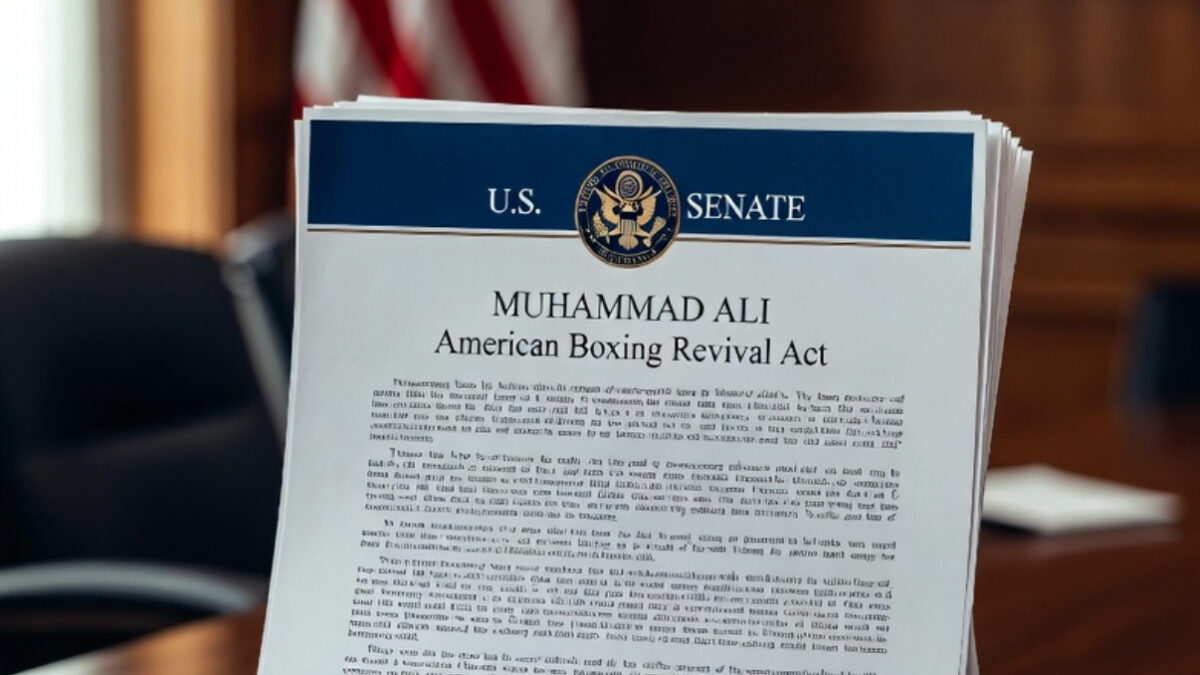
The Senate Commerce Committee has now produced two answers to the question of how the federal government should fix boxing, twenty years apart. The first, written by Chairman John McCain, passed the committee and the full Senate unanimously, twice, in 2004 and 2005, and died only because the House never voted on it. The second, written under Chairman Ted Cruz, was introduced Thursday. Set the two texts side by side, with the receipts, and a pattern emerges that neither bill’s supporters would put on a fact sheet. The Revival Act writes better rules than McCain ever did. McCain built an enforcer the Revival Act refuses to hire. One bill is a detailed rulebook with no cop. The other was a cop whose rulebook was left to be written. The sport needs both, and Congress has never passed either.
What Each Bill Gets Right
Start with the honest concession, because the comparison only means something if it is fair. The Revival Act, in both the House-passed and Senate versions, contains protections McCain’s bills never specified. McCain’s Professional Boxing Amendment Act set no minimum purse; the Revival Act guarantees $200 per scheduled round to every fighter in the country. McCain set no insurance figures; the Revival Act mandates $50,000 in medical coverage and $15,000 in accidental death coverage with premiums the fighter cannot be charged. McCain never wrote a medical examination table; the Revival Act’s table of annual physicals, eye exams, EKGs, and brain health requirements is the most detailed medical floor ever put in a federal boxing text. And McCain never capped contract lengths; the Senate Revival Act limits a first promotional agreement to three years and any contract to six, applied to every promoter in the sport, as this series has detailed. On the substance of what fighters are owed, the 2026 bill is the stronger document, and it is not close.
The question is what happens when someone breaks it. And on that question, the twenty-year-old bill wins on every enforcement question.
| Provision | McCain bills (2004-2005) | Revival Act (2026) |
|---|---|---|
| Who verifies compliance | Federal license, revocable, required for every boxer, promoter, and sanctioning organization | Self-designation via FTC filing or a public webpage |
| Penalty for violations | License revocation plus existing law | $20,000 misdemeanor, never prosecuted in the statute’s history |
| Mismatch protection | No presumed approval after 10 straight losses or 5 straight KOs | None in any version |
| Payment guarantee | Surety bond posted before the match | Fight-or-pay with carve-outs the UBO controls |
| Broadcaster disclosure | Monies, contracts, and income sources filed within 7 days | None |
| Medical records | National medical registry following the fighter across state lines | Fifty separate state filing cabinets |
Who Checks Compliance: A License vs. a Webpage
Under the Revival Act, an organization becomes a UBO, and claims the exemption from the original Ali Act, by filing three items with the FTC: state of incorporation, address, website. The bill lets it skip the FTC entirely by maintaining a public webpage instead. No one verifies the conditions are met. McCain’s bill worked the other way. Per the Congressional Research Service’s analysis of S. 148, every boxer, promoter, and sanctioning organization in America would have needed a license from a United States Boxing Commission. That license could be revoked for violating federal boxing law or any standard the commission set. That is the entire difference between the two eras in one contrast: self-designation versus a license someone can take away. A rule that costs you your license is a rule. A rule enforced by a $20,000 misdemeanor no prosecutor has ever brought is a suggestion, and the Revival Act’s sole enforcement provision, in both chambers, is exactly that misdemeanor.
The committee knew this in 2003, in writing. Its own report on the McCain bill, Senate Report 108-47, stated that both the Professional Boxing Safety Act and the Ali Act “have not been adequately enforced by Federal and State law enforcement officials,” and attributed the failure to “either a lack of resources in federal and state budgets or simply a lack of interest.” That finding is the reason the USBC existed. The Revival Act was drafted by the same committee, sitting on the same finding, and answers it by adding one more provision to the list nobody enforces.
The Mismatch Stop the New Bill Never Considered
The Mismatch Stop the New Bill Never Considered
Here is a receipt with particular relevance to anyone who reads a BoxRec schedule on a Friday. Under McCain’s bill, a match lost its presumption of federal approval if a participating boxer had suffered ten consecutive defeats or been knocked out five consecutive times. Read that again: twenty years ago, the Senate unanimously passed a federal brake on the opponent pipeline, the fighters brought in on long losing streaks to fill B-sides at club shows.
Strong commissions already police this on their own. New Jersey and New York review proposed matchups and reject fighters whose records or recent knockouts make a bout indefensible, and a matchmaker who sends a bad opponent to those states expects the phone call. But that protection is a state choice, not a national standard. The same fighter turned away in Newark can be approved somewhere else the following weekend. McCain’s provision would have made the floor federal.
The Revival Act, across every version in both chambers, contains no matchmaking standard of any kind. Its theory of safety is imaging, insurance, and ringside staffing. All of those matter, and none of them addresses who gets put in the ring in the first place. The most direct fighter safety intervention ever passed by the Senate is absent from the bill named for Muhammad Ali, and where a fighter is protected from a mismatch still depends on which state line he crossed to take it.
Getting Paid: A Surety Bond vs. Fight-or-Pay With Exits
The Revival Act’s economic guarantee for UBO fighters is the fight-or-pay clause: one bout every six months or a payment of ten times the one-round minimum, which at the floor is $2,000. The obligation disappears for injury, positive tests, and any refusal or inability “beyond the control” of the UBO, and since the UBO makes the matches, the UBO effectively decides what counts as a refusal. McCain’s answer to fighters not getting paid was blunter: promoters would have been required to post a surety bond before the match to ensure the boxer’s purse. Not a promise with exceptions. Money, posted in advance, guaranteed. Contracts themselves would have been filed with both the state commission and the USBC, with minimum contractual provisions developed federally, so the terms a fighter signed existed somewhere a regulator could read them.
The Broadcaster Blind Spot
McCain’s bill required the broadcaster holding television rights to a fight to file with the USBC, within seven days, a statement of all monies paid to the promoter, copies of any contracts between the broadcaster and the boxer or his manager, and a list of the broadcaster’s income sources from the match. The committee’s 2003 report noted testimony that networks “may be at times acting as de facto promoters and should be subject to the same requirements.” Twenty years later, in an era when Netflix, DAZN, and ESPN deals define the sport’s economics more than any gate, and when the line between platform and promoter has never been blurrier, the Revival Act imposes no disclosure obligation on broadcasters whatsoever. The word does not appear in the operative text.
Medical Records That Follow the Fighter
The Revival Act’s new medical table generates more fighter health paperwork than any law in boxing history, and then stores it in fifty separate state filing cabinets, because the bill creates no registry. McCain’s bill built one: a centralized federal medical registry tracking every boxer’s medical records, suspensions, and denials across state lines, alongside a national registry of boxing personnel. Under the Revival Act, a fighter denied clearance in one state on an MRI finding can still be licensed in a state that never sees the scan. Under McCain’s architecture, the scan followed the fighter. Even the definition of the examining doctor was stronger: where the Revival Act requires an MD or DO, McCain’s bill required a physician with experience in sports injuries, “particularly head trauma.”
What the Comparison Proves
The standard defense of the Revival Act’s approach is political realism: a new federal commission is a hard sell in any Congress, and self-certification with a criminal backstop is the version that can actually pass. Fair enough as far as it goes. But realism about what passes does not fill the gap in what passed; it just means the gap was chosen.
And none of this is an argument that the McCain bills were perfect. They left the dollar floors and exam specifics to the commission they created, and a commission is only as good as its appointees. It is an argument about what the two texts prove when combined: everything missing from the Revival Act has already passed the United States Senate, unanimously, through the exact committee where the Revival Act now sits, and everything missing from the McCain bills is now written, in detail, in the Revival Act’s floors and tables.
The rulebook exists. The cop exists. They have simply never been in the same bill, and the committee that produced both of them, across two decades of trying, is the only body in America that could put them there. Amendments are expected after the August recess. The template is not hiding. It is in the committee’s own files, under the name of its most famous chairman, with two unanimous votes attached.