By Larry Goldberg
Yesterday I wrote that somebody in Tallahassee looked at the Duel Arena card and said yes. I thought that was the story. Then the other clip started going around, and it turns out the hate was not the only thing that got into the ring at a Florida-permitted event on Saturday night.
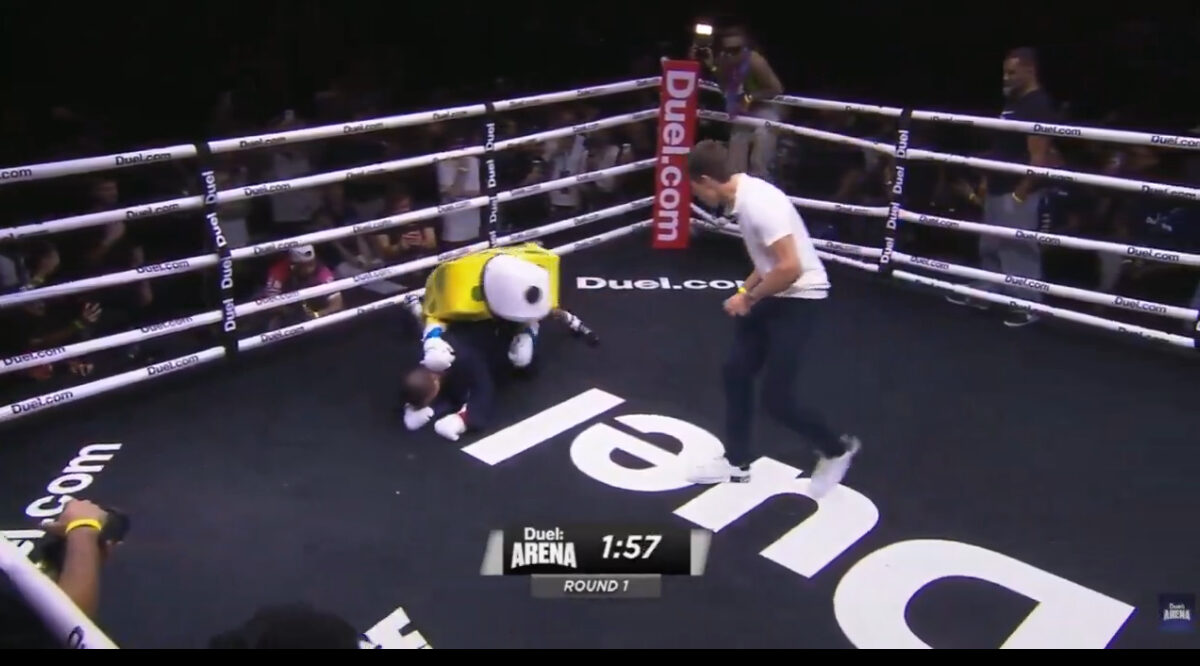
Here is what the video shows. A man in a costume, a mascot character from the crypto casino’s streams, throws punches at an opponent who is not in a costume and is overwhelmed from the first seconds. The exchange is one sided and poorly controlled. The man in the middle playing referee is the Kick streamer who goes by Clavicular. BoxingInsider found no record of him holding a Florida official’s license, and the commission has not said whether one was issued. He does not stop it. The broadcast crew, employed by the promotion, could not take it. One commentator called for the fight to be stopped on air and said he was “pretty embarrassed to have even been in the building.” Kevin Lee, a former UFC interim title challenger, watched the footage and said: “Bro, I’ve watched a man lose his life in a ring before. This is spitting on the grave of guys who have given everything to the sport.”
The promotion has not put the segment’s status on the record under any principal’s name. A recap published on duel.eu.com, a site that describes itself as an independent affiliate review site not affiliated with Duel, tells readers to “treat it as show content, not a sanctioned bout.” The official Duel Arena account has since described it the other way, recapping the segment as “the true main event and last fight of the evening” and saying Clavicular refereed it “very well, one should add.” No official result. No record.
If “not a sanctioned bout” is the defense, it is the indictment.
How does a fight that is not sanctioned end up inside a permitted event? Same building. Same ring. Same night. Same broadcast. Commission staff still in the building.
I know the answer the commission will give, so let me give it for them and then take it apart. The answer is that this was not a “match” under Chapter 548, so none of the rules attached. No purse, no license, no referee requirement, no problem. Entertainment.
Read the statute. Chapter 548, section 548.002, defines a match as a contest or an exhibition. An exhibition is a match. Florida already wrote the category for two people who trade blows to the head without necessarily trying to win. It is called an exhibition, and it is regulated. The costume does not change that. The word “entertainment” appears nowhere in the exemptions in section 548.007, which cover amateur matches that do not allow full contact, the National Guard, police charity events, schools, the Olympics, and traditional martial arts. This was full contact by the statute’s own definition, punches to the head that moved the man receiving them. Costume boxing on a crypto casino card is not on the list.
So there are two possibilities, and the statute closes both doors. If either person throwing punches received more than fifty dollars for it, they were professionals under Florida law, and every professional match requires a licensed promoter, commission approval, and a referee designated by the commission. Section 548.057(3) goes further: the commission “shall ensure that all referees, judges, and other officials are Florida-licensed officials” and that “no sanctioning organization or promoter has been permitted to influence the appointment of any officials.” A streamer acting as referee without a commission appointment is not a gap in that rule. It is the thing the rule prohibits. If neither man was paid, it was an amateur match involving blows to the head, and section 548.008 says no such match may be held in the state unless it is sanctioned and supervised by an amateur organization the commission has approved. Without that, it is a prohibited match, and the same section says anyone who holds, promotes, or sponsors a prohibited match commits a third-degree felony. No recap can write either requirement out of existence.
The broadcast sold a fight. Calling it a skit afterward does not change what happened in the ring. Chapter 548 does not let a promoter occupy both descriptions at once. And there is a cost to picking the second one after the fact: section 548.041 bars a Florida participant license for anyone who has taken part in a match in this state that was not sanctioned by the commission. If the commission’s position is that the segment was unsanctioned, then anyone who entered that ring as a participant is ineligible for a Florida license until that is resolved. That is what calling it entertainment costs.
Professional or amateur, paid or unpaid, costume or no costume, Chapter 548 does not contain an “it’s a meme” exemption.
Which leaves the commission with one honest set of questions to answer, on the record. Was this segment on the approved bout sheet? If it was, who was the licensed referee of record, and why was a streamer in the ring instead? If it was not, why did the commission representatives on site, whose job is to make sure the chapter is followed at a permitted event, allow an unregulated full-contact exhibition to take place on the same canvas the state had just been supervising? BoxingInsider.com is waiting on the commission to post that bout sheet.
The commission will answer part of that on its own. After every professional card in Florida, the commission posts an official results sheet on its website listing each approved bout, the official weights, the judges and the referee of record for every match, and which commissioners attended. The August 29 sheet had not been posted as of Monday, which is within the commission’s normal turnaround. When it is, it will show one of two things: the costume segment listed as an approved bout with a licensed Florida referee assigned to it, which raises the question of who was actually in the ring, or no such bout at all, which means a full-contact match ran on a state permit with no sanction, no licensed referee, and no record. BoxingInsider.com will publish that sheet, and the pre-event bout approval that preceded it, the day they are available.
This is the line the entire sport rests on. When two people trade punches in a ring at a state-permitted event, the public is entitled to assume that a trained, licensed official with the authority to stop it is standing between them. That assumption is the product. It is the reason a commission exists. Pro wrestling made its peace with this a century ago: it is a performance, everyone in the building knows it, and nobody is confused about what a referee is for. Saturday was neither. The punches were real. The mismatch was real. The referee was not. And the fans watching a free stream at home had no way to tell which fights carried Florida’s sanction and which did not, because Florida let them share the ring.
We cannot do fake fights and real fights in the same ring on the same night. That is not a preference. That is the whole regulatory premise, and Florida let it blur, by neglect unless a paper trail says otherwise, in front of an arena and a YouTube audience.
And nobody made them do it. That is why this is such an unforced error. The commission had the discretion to look at this promotion and this card and decline. It had representatives on site. It permitted the event, and the segment happened anyway.
Now the timing. The Senate Commerce Committee returns from recess next week with the Cruz-Rosen version of the Ali Revival Act waiting for amendments. The House-passed text designates the Association of Boxing Commissions as the body that would certify referees, judges, and ringside physicians for professional boxing nationwide, and the Senate version is still headed for markup. The ABC is currently led by the executive director of the Florida Athletic Commission, and Florida was presented to that committee in April as a model for health and safety regulation in this business.
This is not about any one regulator. It is about a system, and the system is what Saturday exposed. I hold promoter licenses in New Jersey and New York, and every time I run a card I sit across from a commission that asks hard questions and says no when the answer is no. That is what regulation is. It is not a permit and a bond. It is judgment. And what we saw on Saturday is precisely why this sport needs rules with teeth: rules that keep anyone without an official’s license from refereeing live punches at a permitted event, and a regulator willing to enforce them before the bell, not after the clip goes viral.
Which brings me to the ABC. If Congress is going to make one organization the arbiter of who is fit to officiate in every state, that organization should build its standard on the states that already do this right. New Jersey and New York have turned down far tamer bookings than Duel Arena 1. They license officials, assign them without promoter input, and treat the question of whether a card is fit for the state’s sanction as the first question, not the last. If the federal government wants a model for referee and judge certification, it already exists, and the ABC should look there before it looks anywhere else. Florida, for its part, owes the public an explanation, on the record, of who approved this event and what status that segment had, and it needs to fix its game before it is held up as anyone’s model again.
Part of the fix is structural, and Governor DeSantis should hear it. In New Jersey, the State Athletic Control Board sits inside the Department of Law and Public Safety, under the Attorney General. The commissioner answers to the state’s chief law enforcement officer. When that office says no to a card, it carries the weight of the Attorney General behind it. Combat sports in New Jersey are treated as a public safety function, because that is what they are.
In Florida, the Athletic Commission is assigned to the Department of Business and Professional Regulation “for administrative and fiscal accountability purposes only.” DBPR is the agency that licenses barbers, cosmetologists, real estate agents, contractors, hotels, restaurants, condo boards, and veterinarians. Boxing sits in the same building as the nail salon licenses. The Secretary of DBPR is appointed by the Governor and oversees more than 1.7 million licensees across more than thirty industries. One of those industries is people getting punched in the head. Under section 548.004, the executive director is a department employee who serves at the pleasure of that secretary, and that office approves matches and appoints event officials. The commission has inspectors and a ringside physician at every professional card, and on Saturday that supervision still did not keep a man with no record of a Florida official’s license from standing in as referee over live punches.
Saturday night is what that structure produces. A licensing bureau checks whether the promoter has a license and a bond. It does not ask whether the card is fit for the state’s sanction, because asking that question is not what a licensing bureau does. A commission under an Attorney General asks it every time.
Governor DeSantis, section 548.003 says each commissioner is accountable to you, and that you shall cause any complaint or unfavorable report about an action of the commission to be investigated. Consider this an unfavorable report. The office that approved this program of matches, and the commission representative who was in the building when that segment took place, should be in your office this week, with the tape and the bout sheet, answering the questions above. And when that meeting is over, look at how New Jersey does it and ask why Florida does not.
And do not let the costume bit crowd out what else happened on that permit. Same night, same building, a Nazi flag went up in the stands, a fighter threw salutes in the ring, and a co-feature was congratulated by the promotion’s own staff as a win for “the Anti-Jew.” A United States senator called it disturbing. The Holocaust Center of Florida called for accountability. Florida approved the card that produced all of it, and it has answered for none of it.
The fighters who did their jobs in Orlando deserved a commission that did its job. The sport deserved a regulator who understood that the line between a real fight and a fake one is the only line that matters. Florida let it disappear on Saturday. Fix the system, and look north for the model.
Correction, September 30: An earlier version of this article attributed a recap published on duel.eu.com to Duel. The site describes itself as an independent affiliate review site that is not affiliated with Duel. The article has been updated to correct the attribution, to add the official Duel Arena account’s own later description of the segment, and to clarify wording about the man who acted as referee.