
By Larry Goldberg
One of life’s biggest disappointments is when you believe in something with your best intentions and it doesn’t work. Then come the million I-told-you-sos. I have been hit hard this year, personally and professionally, and I am going to write about the hardest part of it anyway, because the person at the center of it deserves better than silence.
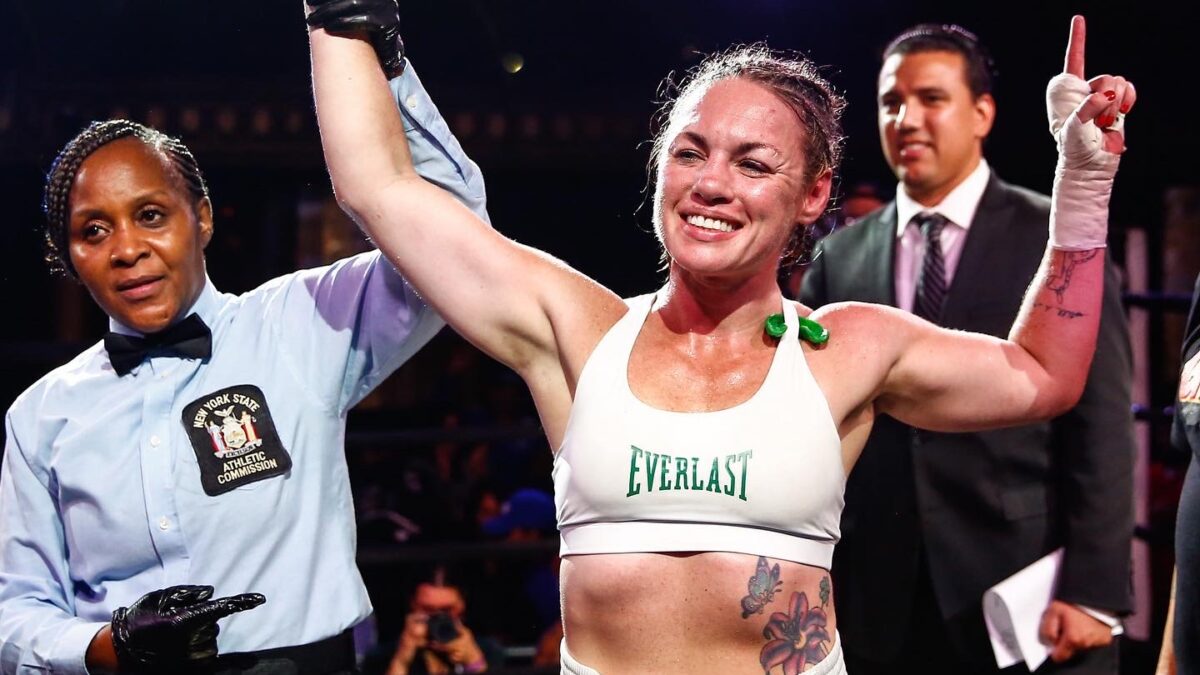
Heather Hardy was my trainer at Gleason’s Gym, and I paid for it happily, week after week. She loved to torture me. She listened to me complain about life and about boxing, which takes a specific kind of patience, and she saved my ass more than once. She was the headliner of the first and third club shows I promoted at Sony Hall and was a big part of this. Before that she built a career the hard way, selling her own tickets, promoting her own fights, going 24-3 as a professional and winning a world title while the sport paid her a fraction of what it paid men with lesser resumes. I considered her a friend for life, and then life got complicated between us.
Last September, Heather filed a lawsuit in New York that named, among others, my company. That matter has been resolved as it relates to us, and I am not going to relitigate any of it here. What it left me with is the question this sport has ducked for a hundred years, and that question matters more than my feelings.
Heather herself has put it better than anyone. The doctors told her she “was OK to fight”. That is the sentence to sit with. Every test came back clean enough, every license was issued, every box was checked. She thought that meant she was OK. It really meant she was damaged, but not damaged enough. Boxing is a sport whose entire object is inflicting damage, and when the fighter across the ring is Amanda Serrano, one shot can change everything. The paperwork says you are fine on Friday. The sport does not read the paperwork.
So what happens next? Not just the night of the fight, when the doctor is ringside and the ambulance is parked outside, but the next morning. The next year, when the fight-night insurance policy has typically lapsed. The next decade, when the symptoms surface far from any arena. A fighter passes every medical test a state athletic commission requires. In Texas, before she fought Serrano, that meant a full physical, an eye exam, negative blood work for HIV, Hepatitis B, and Hepatitis C, an EEG and an EKG because she was over 36, a day-of pre-fight physical by the ringside doctor, a pregnancy test, and mandatory drug testing because it was a title fight.
She had passed an MRI in New York in 2022, and Texas accepted it. There was no new MRI. No CT scan. No advanced brain imaging required by Texas.
What genius wrote a law that forces an older fighter to settle for an EEG instead of a real brain scan?
This was for all the titles — every single one of them — and not one of the sanctioning bodies asked for, or was willing to spend their sanctioning fees on, a proper pre- or post-fight medical. I personally lobbied both the WBC and WBO for help. The WBC stepped up. The WBO answered with complete silence.
If the new Ali Act had already been law, a fighter over 40 would have been forced to get a brain MRI every year. Heather would have been in a better spot. The doctors she hired signed the forms. The Texas ringside physicians checked her on fight day. The Texas commission reviewed the paperwork and issued the license. That is the entire system looking out for the fighter. Once the final bell rings, that system’s responsibility is essentially over. There is no real post-care. Texas never followed up with her. Texas is one of the better states — better than most — but it is still not New York, California, or New Jersey. The system failed her, and the system needs to be fixed. Given what happened why wasn’t she tested till she tried to fight again?
The show goes on. Then the damage this sport does to human beings arrives on its own schedule, in another state or another year. Who is responsible then? The commission that cleared her? The promoter who ran the card? The promoter who held her contract? Her trainer? Her gym? Her sparring partners? The boxer herself? The doctor on call that night? The gloves? The referee? Or the other fighter across the ring—the one who also made a choice to step in and do the job? Everyone in that chain can point at someone else, and while they point, the fighter is alone.
Heather passed her medicals in New York, one of the stricter states in the country. Her last fight was in Texas against the best featherweight of this era, and she took a beating that night. She has since described daily symptoms no 43-year-old should live with, and she has said publicly that she is permanently disabled. That human reality does not change no matter what anyone concludes about anything.
If you take one action after reading this, support her GoFundMe right now:
https://www.gofundme.com/f/helpheatherhardy
So who is looking out for Heather Hardy, and for the next Heather Hardy? Boxing has no league, no union, no pension, no aftercare. It has fifty commissions with fifty rulebooks, insurance built around fight night rather than the decade after, and a habit of forgetting fighters the moment the applause stops. Everyone who makes a living in this sport profits from that structure, and I am one of them. She passed the required tests. Did we, all of us, pass ours?
I don’t have the complete fix. But it isn’t another GoFundMe. It’s insurance that follows the fighter instead of the fight. It’s a real industry fund. It’s donors, boosters, or something permanent built into every promotional dollar—because the amount of money fighters actually take home compared with what the sport generates is the whole problem. Fighters without a platform are living with this right now, quietly. Heather has the voice loud enough to make the sport listen, and her voice, her life, and her health matter.
This story breaks my heart because this isn’t the ending of the story we all wanted for “The Heat”. Boxing owes Heather Hardy. It owes everyone like her. She deserved better.
Senator Cruz, you have a chance to save lives. This can be your legacy. This should be Heather’s legacy. The bill has improvements but it doesn’t go far enough.
Under the new Ali Act, a fighter over 40 would be required to get a brain MRI every year. But this case proves we need to do a lot more.