
By Larry Goldberg and Boxing Insider Staff
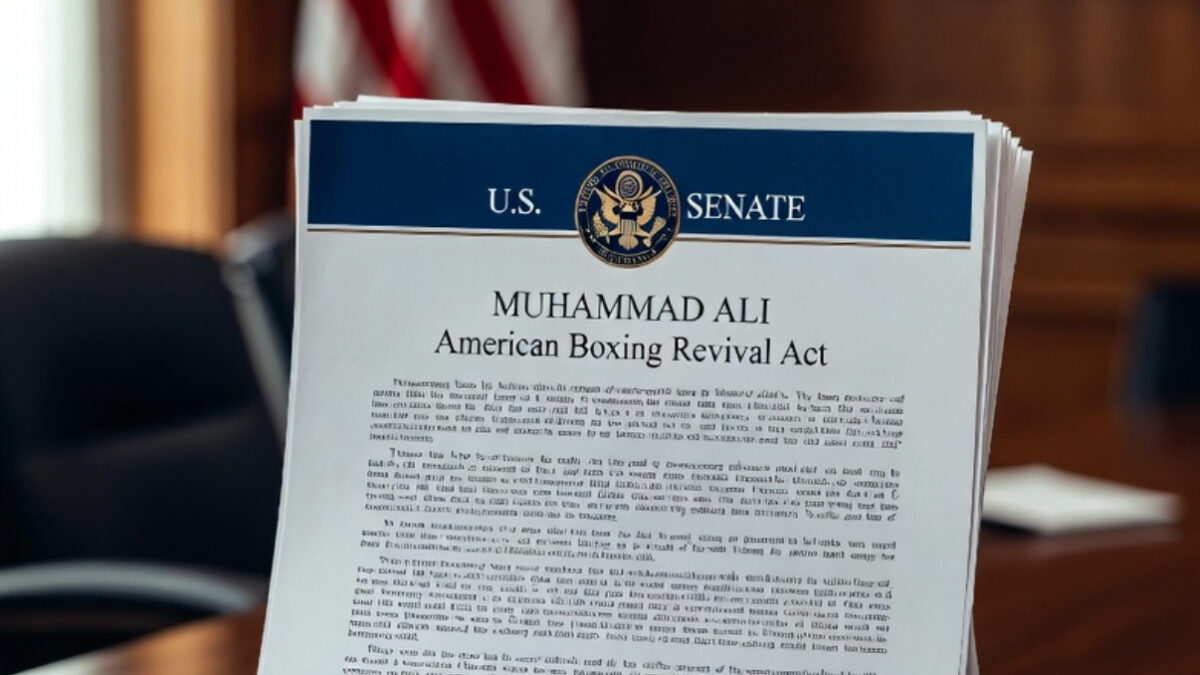
There is one word in the Senate’s Ali Revival Act that should not survive August, and the word is “or.”
The bill’s new medical table becomes the national floor for every professional boxer in America, and it requires annual brain health examinations. For fighters 40 and over, that means an MRI and an MRA of the brain every year, which is exactly right.
For fighters under 40, the text requires “an MRI of the brain or neurologic examination conducted by a neurologist.”
Or.
Read that the way a lawyer reads it, because that is how it will be applied. A fighter can turn pro at 18, box for 21 years, take thousands of punches in fights and tens of thousands more in sparring, and satisfy federal brain health law every single year with an office visit. Reflexes, balance, a light in the eyes, follow my finger. No scan, not once.
The first federally required image of that fighter’s brain arrives on his 40th birthday, and for most professional boxers, that is a birthday the sport never sees.
Notice what is missing from the table entirely: a CT scan. The bill’s under-40 choice is an MRI or an office exam, and CT appears nowhere, even though it is the cheaper, faster scan available in every hospital in America and the one New Jersey has accepted for years as a valid baseline image.
So the table gets it wrong in both directions at once. A fighter who skips imaging altogether satisfies federal law, while a fighter who goes out and gets an actual picture of his brain on a CT does not. Under this bill, an office exam counts and a brain scan doesn’t.
I say all of this as someone who pays for the scans. I have promoted 21 shows in Atlantic City and New York, and I have personally paid for 40 to 50 fighter MRIs to get cards licensed. I know exactly what they cost: anywhere from $400 to $1,500, depending on what hospital or imaging center is close to the fighter.
It is a big line item on a club show budget. It is also the only line item that matters if we want to save lives. And I can tell you something else from the matchmaking side: a fighter who shows up with a current scan versus one who doesn’t is a real selling point. The scan is not just protection, it is employability.
Our own invoices tell the whole story. A CT of the head that cleared a fighter in New Jersey: $200. The same CT at a community hospital in rural Oregon, where the only imaging in town sets the only price: $815. A brain MRI: $425 in Texas, $450 in Florida, closer to $1,200 in the New York market. A neurological exam: $140.
Look at what the bill does with those numbers. The office visit, the cheapest line on every invoice, is the only one that satisfies federal law by itself. The $200 brain scan does not count, and neither does the $815 one. The MRI counts, at three to eight times the price of the exam the law accepts instead.
The bill takes the one option that involves nobody looking inside the skull and makes it the cheapest legal path everywhere in America, and in the markets where imaging costs the most, the gap is widest exactly where the temptation to skip the scan is strongest. The “or” is not just a medical mistake, it is an economic instruction. Every fighter counting dollars will follow it.
I have seen these scans save lives. I have watched them get fighters immediate medical attention for problems nobody knew existed, and stop fighters from walking into the ring already injured. They have found cysts and other conditions that needed treatment right then, conditions boxing would have found the hard way, under the lights. I have also seen scans identify damage that made further fighting medically indefensible, and those fighters were forced to stop. That is not a failure of the system. That is the system working.
And this matters more than most people realize, because by the ABC’s own published survey of commission requirements, exactly five states require baseline brain imaging for every professional boxer: California, Nevada, New Jersey, New York, and Rhode Island. Roughly half a dozen more require a scan only once a fighter passes 35 or 40. One state, Connecticut, already runs the exact fighter’s choice structure this bill would make national. The rest require no scan at any age. Every fighter needs a baseline scan.
Here is the part of the current patchwork nobody talks about. When a scan finds something serious, the imaging center informs the fighter and the ordering physician. What happens next depends entirely on the commission.
In states that require the actual images and reports to be filed, the process stops the fighter. In states that do not, a concerning finding can simply never be submitted, and a fighter who wants to keep going can license in a jurisdiction that accepts only a neurologic exam. A national floor that keeps the “or” keeps that door open, federally, forever.
Now let me be precise about the neurological exam, because I am not dismissing it, and in the real world it has a defined job. Elements of it are already incorporated into fighter physicals. And after a knockout or a tough fight, commissions order a neuro exam before the fighter is cleared to compete again. That is the exam’s actual role: clearance and escalation.
What some weaker commissions do instead, requiring only a neuro exam and never any imaging, is exactly the shortcut this bill is about to write into federal law for the entire country.
Because here is what an office exam cannot do: see inside the skull. It cannot find the aneurysm that has never produced a symptom, the scarring from an old bleed, or the structural problem that turns an ordinary right hand into a catastrophe.
The deaths in this sport are overwhelmingly acute bleeds, and the conditions that make a brain vulnerable to them are, by definition, the ones a fighter walks around with while feeling fine and passing every office exam. A brain health rule that lets an office exam stand in for a scan is checking whether the smoke alarm beeps while never looking at the wiring.
And let’s say the quiet part plainly. We are in a sport whose explicit goal is to punch people in the head hard enough to knock them out. Pretending an office exam is an adequate substitute for a picture of the brain is not seriousness. It is theater.
You do not have to take my word for any of this. Take the word of the organization the bill itself deputizes. The Senate text requires every ringside physician in America to be certified within two years through a program run by the Association of Boxing Commissions in partnership with the Association of Ringside Physicians, and that same ARP published a consensus statement on neuroimaging in 2022.
Its position is clear. A brain MRI is “the recommended imaging modality of choice” at initial licensure for every professional combat sports athlete, a CT scan is acceptable when an MRI is not feasible, an MRA or CTA gets added at 40, and any abnormal finding gets escalated case by case with the athlete’s full history, a neurological examination, and cognitive assessment.
The neuro exam is what happens in addition to imaging, and especially after imaging finds something. It is the escalation, not the baseline. The bill hands the ARP the keys to physician certification, then writes an imaging rule that contradicts the ARP’s own published guidance and leaves out the backup scan the ARP explicitly endorses.
Here is what makes this genuinely frustrating: the fix costs almost nothing, and the cascade already exists. I watch it work in New Jersey, where I promote under the State Athletic Control Board.
It goes like this. A baseline scan for every fighter, CT or MRI, no exceptions and no substitutions. An MRI when something needs a closer look, whether that is a finding on the baseline, a bad knockout, or a bad run. A neuro exam for clearance after a KO, with its elements built into the regular physicals. At 40, the requirement steps up to MRI and MRA plus a stress echocardiogram with a cardiologist’s written clearance.
Imaging always, escalation when indicated. Cascading rules, each test doing the job it is actually built for. That is the correct architecture, and it is already working in the state where I stage fights.
Fighters will always want to fight. That is not a character flaw, it is the nature of the sport, and it is exactly why regulation exists: to set a floor that protects them from the worst consequences of that drive.
We talk constantly about fighters’ rights in this business. Here is the most basic one, the right of every boxer and every combat sports athlete who gets hit in the head for a living to have someone actually look at their brain before and while they do it. Requiring a baseline scan is not radical. It is the minimum that matches the risk we ask them to take.
The Senate got real things right in this table. Annual EKGs for everyone, a true insurance floor, certified ringside physicians, and a 40-and-over MRI and MRA requirement that is exactly right.
Which is what makes the under-40 clause stand out, because the fighters under 40 are the sport. They are the ones on the club shows, the ones absorbing the volume, the ones this bill exists to protect. Writing a brain health requirement that allows the entire population it covers to go unimaged is not a compromise. It is a mandate that mandates nothing.
Amendments are expected after the August recess, and this is the easiest one on the table. Every fighter gets a baseline scan at licensure, CT accepted, MRI preferred, before a single professional punch is thrown. Keep the neuro exam where the commissions already use it, for clearance and escalation. One sentence fixes it.
The senators asked stakeholders for suggestions. Here is mine, from someone who has paid for the scans 50 times over. It is not even mine. It belongs to the ringside physicians this bill just put in charge, and to every commission that already runs the cascade and watches it work.