This is Part 5 of BoxingInsider’s coverage of Duel Arena 1. Part 1 addressed the card the Florida Athletic Commission approved. Part 2 examined the unsanctioned costume segment against Florida law. Part 3 is the reported record of the event. Part 4 covered the commission’s results sheet and the fight missing from it.
State Rep. Anna V. Eskamani has formally asked the Florida Athletic Commission to revoke the promoter license behind the August 29 Duel Arena event at the Kia Center, the first such demand from a sitting lawmaker, and the first to put a date on the commission’s silence.
Her letter requests a written response by Monday, September 14.
The letter, addressed to Commission Chair Tina Pike and Executive Director Timothy Shipman and released by Eskamani’s office, asks the commission to revoke the promoter license for the August 29 program under section 548.071, which allows revocation where a licensee violates the chapter or engages in unprofessional or unethical conduct.
The commission’s results sheet lists the promoter as Duel Arena. The commission has not published the permit file identifying the licensed entity behind that name.
The letter further asks the commission to suspend or revoke the licenses of affiliated persons and entities, including the promotion’s principals, the matchmaker of record, and any licensed official or participant who knowingly took part in a contest held outside the permit, and to withhold any future Florida permit from the promotion, its principals, or a successor entity.
The successor-entity language matters to how far the request reaches. The licensee Florida can act against is whoever holds the promoter license. The event was financed and branded by Duel.com, the offshore crypto casino founded by Ossi Ketola, which holds no Florida license to revoke; the future-permit request is what would reach the operation behind the name.
Eskamani, an Orlando Democrat and candidate for mayor, separates the hate from the law in the letter’s opening. “I vehemently oppose these images and this rhetoric; this letter focuses on examples of violations of Florida law that merit clear license suspension and revocation,” she wrote, adding that she is sure further inspection by commission staff will identify more.
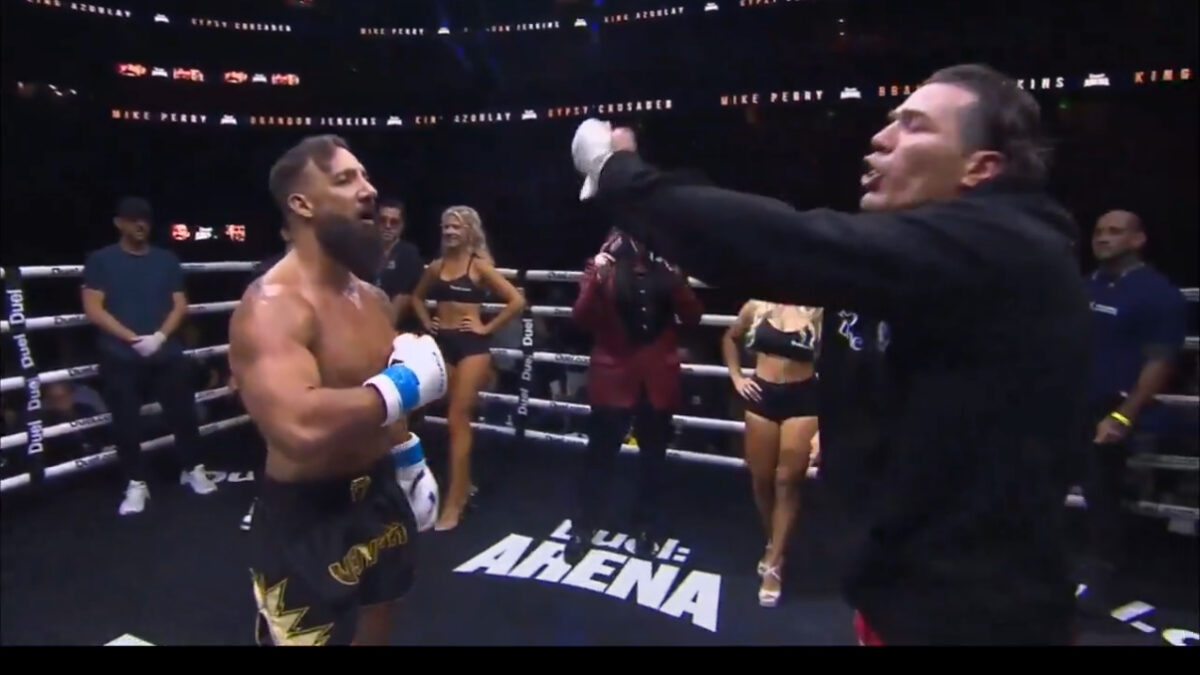
She put the central allegation plainly to WKMG News 6: “Only ten matches were approved and there were 11, and the 11th one had a referee that was not sanctioned to be a referee.”
The letter’s factual record tracks the commission’s own paperwork.
It states that the costumed bout billed as FreakBob against Daniel Cao was held outside the permitted card, conduct that, as she reads section 548.008(3)(b), is a third-degree felony; that provision is the promoter-side offense for holding, promoting, or sponsoring a prohibited match, while knowing participation is a misdemeanor under the same section.
It states that the man in the referee’s position, the Kick streamer known as Clavicular, is an online streamer for whom reporting found no record of Florida licensure; no Florida license for him appears in the records reviewed for this series. The four licensed referees the state assigned to the program, David Baggett, Isiah Cabal, Josh Rutgers, and Massimo Montanini, were in the building, and the letter cites section 548.057(3): “The power to assign officials belongs to the Commission and to no one else,” she wrote.
The letter notes the commission’s results sheet lists ten bouts from a night on which eleven contests took place, the discrepancy BoxingInsider documented in Part 4.
On the promotion’s defense that the segment was entertainment, the letter is direct: “That statement is not a defense; it is an admission by a licensee.” Either the exchange was a contest held without sanction or a licensed official, she argues, or it was presented to a paying audience as a contest when it was not, which in her reading implicates section 548.058.
On the announced exhibition between Ketola and Patrick Holden, billed at 202 pounds against 90, the letter cites section 548.042 on fictitious names, notes the promotion’s own accounts disputed whether the man who walked to the ring was Ketola at all, and concludes: “If the Commission cannot say with certainty who fought on a card it permitted, that alone is disqualifying.”
On the weight gap, she does not argue the arithmetic is automatically illegal; exhibitions are excepted from section 548.043’s twelve-pound cap. She asks instead who approved the exhibition designation and what medical review preceded it, because otherwise “the exception has swallowed the rule.”
Beyond revocation, the letter asks the commission to issue an emergency suspension order under section 548.07, a tool the statute already provides where there is immediate, serious danger to the public; to determine whether any licensee failed the written reporting duty section 548.058(2) imposes on those with knowledge of a prohibited contest; to refer potentially criminal conduct to the appropriate prosecuting authority; to refer the promotion’s financing by an offshore gaming operator to the Florida Gaming Control Commission; and to place the matter on the agenda of the commission’s next public meeting with a written staff report, “so that it is resolved on the record rather than in correspondence.”
As of Monday, no date for a next commission meeting was posted on the commission’s website.
Her accompanying public records request seeks the permit file, the pre-event approved bout sheet, all officials’ assignments, the licensure record of every official and participant who entered the ring, “including any license issued to the individual known as ‘Clavicular,'” the weigh-in and medical records for the announced exhibition, the competitiveness certification for the co-feature and the identity of the matchmaker who executed it, and all inspector and incident reports.
The request closes: “If a record does not exist, please say so directly.”
The letter ends on the commission’s national posture. It notes that Shipman submitted written testimony to the Senate Commerce Committee in April citing Florida as the national model for regulating the sport. “If that is truly the case,” Eskamani wrote, “then you will act immediately upon receipt of this letter.”
The promotion has not acknowledged the letter. As of Monday afternoon, neither the Duel Arena account nor any affiliated account had mentioned it, the commission, or the deadline.
What the account posted over the weekend instead was a sequel tease and a recap of the fight the state has no record of. “Dry run and a small budget, next ones will be COLOSSAL,” the account posted Sunday.
A day earlier, it recapped the costumed bout as “the true main event and last fight of the evening,” praised Clavicular by name as having refereed it “very well, one should add,” described Cao with an anti-Asian slur, and promised: “Duel Arena 2 should see the return of all three, by popular request.”
No date, venue, or state has been announced for a sequel, and the promotion’s Ticketmaster page lists no upcoming events. But the letter asks the commission to withhold any future Florida permit, which makes its answer the first ruling on whether there is a next time in the state that permitted the first one.
Revocation cannot happen by letter; it runs through notice, hearing, and findings under the chapter, which is why the emergency suspension order and the public meeting agenda are the requests to watch, and why September 14 is a response deadline rather than a decision date. A missed deadline would carry no legal consequence of its own; it would simply put the commission’s silence in writing, in front of the audience the letter assembled.
It was copied to Department of Business and Professional Regulation Secretary Melanie Griffin, State Attorney Monique Worrell, whose Ninth Judicial Circuit is where an Orange County criminal referral would ordinarily go, the members of the commission, and Orlando Mayor Buddy Dyer.
The commission has not answered the letter. Monday, September 14 is the date Eskamani set.
Correction, September 30: An earlier version of this article stated that the commission’s event calendar listed Ryan Toole Inc., doing business as Duel Arena, as the permit holder. That calendar entry is no longer published, BoxingInsider has not been able to verify the listing, and the reference has been removed.