By Boxing Insider Staff
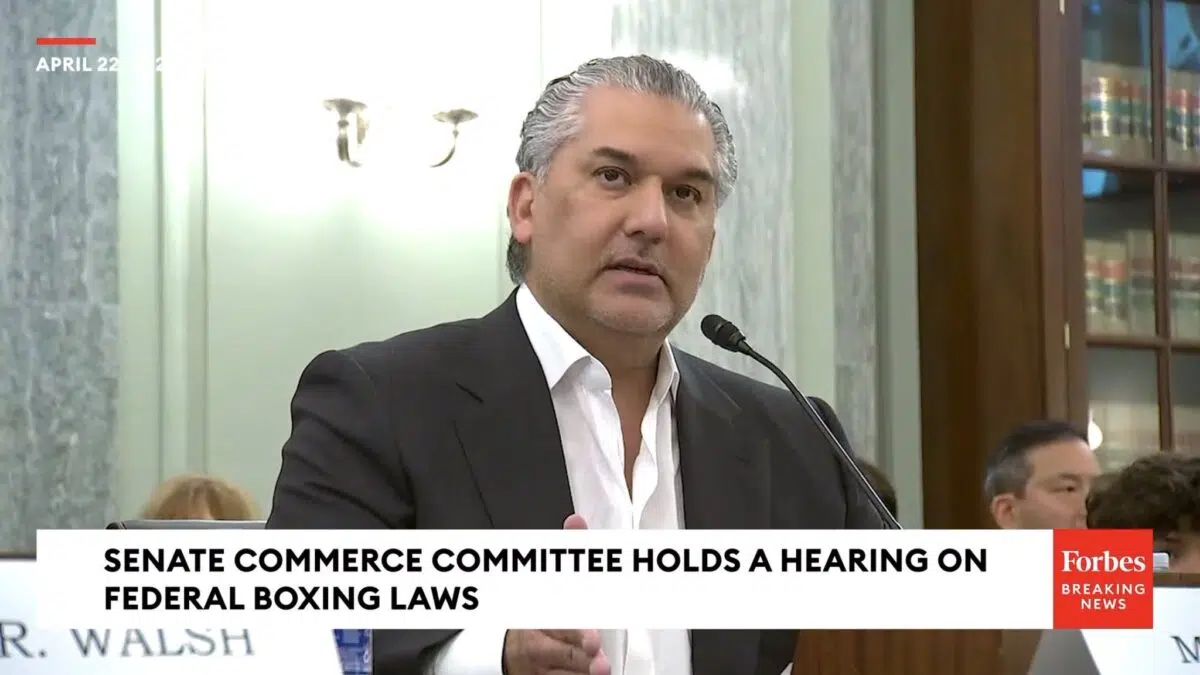
Nick Khan, the president of WWE and a senior executive at Zuffa Boxing, submitted detailed written testimony to the Senate Commerce Committee for the April 22 hearing on the Muhammad Ali American Boxing Revival Act. The full testimony is available on the Senate Commerce Committee website and runs 13 pages plus exhibits. Khan testified as a board member of TKO Group Holdings, the publicly traded parent company of WWE and the UFC. The submission is the most detailed public articulation of the case for H.R. 4624 currently on the record.
The centerpiece of Khan’s testimony is a list of specific fighter protections the bill would mandate for any boxer competing under a Unified Boxing Organization, or UBO. Khan presented the list as the practical answer to what he called “a sport in managed decline.”
What the Bill Would Provide for Boxers
According to Khan’s written testimony, the Muhammad Ali American Boxing Revival Act would establish the following requirements for any UBO operating under federal law.
A minimum payment of $200 per round, which Khan testified exceeds the floor in 49 states and matches the California minimum.
Mandatory injury insurance of $50,000 per bout, paid by the UBO at no cost to the boxer. Khan testified that “thousands of professional boxers compete with no insurance at all” under the current system.
A six-year cap on promotional contracts. Khan compared the term to rookie contracts in Major League Baseball, the NFL, and the NBA, and said the cap would “end the practice of binding boxers to promoters for their entire careers and give them a genuine path to free agency.”
The right for fighters to contact other promoters during the final 30 days of an existing contract.
An anti-benching provision requiring $2,000 in compensation for any boxer who goes six months without a scheduled bout. Khan called this “one of the most abused loopholes in the sport: the widespread practice of signing boxers only to keep them inactive.”
Standardized pre-fight medical clearances, including an annual physical, dilated eye exam, EKG, HIV and hepatitis antibody panels, and an annual brain MRI. Enhanced neurological protocols would apply to fighters age 40 and older.
Drug testing for all title bouts and random testing covering at least 50 percent of all other bouts, with mandatory public disclosure of test results and any sanctions.
Annual report cards from the Association of Boxing Commissions grading each state athletic commission on compliance with the standards.
Khan’s Diagnosis: A Sport in Managed Decline
Before laying out the proposed protections, Khan walked the committee through what he characterized as the measurable decline of American boxing over the past two decades.
He cited the loss of the Olympic pipeline, noting that the United States has not won a men’s Olympic boxing gold medal since Andre Ward in 2004. By contrast, he testified, Uzbekistan won five gold medals at the 2024 Paris Games. “My great respect to Uzbekistan, a country of 36 million people, but something has gone terribly wrong in American boxing that has dried up our previously prolific Olympic talent pipeline,” Khan testified.
He also walked through the collapse of boxing on linear American television. HBO ended its boxing coverage in 2018. NBCUniversal followed in 2021. Fox went dark on boxing in 2022. Showtime ended its boxing programming the following year. ESPN let its regularly scheduled boxing contract expire in the summer of 2025. Khan quoted boxing writer Dan Rafael, who wrote in 2025 that there would be “no regularly scheduled boxing on linear TV in the U.S. for the first time essentially since the 1940s.”
Khan tied the decline directly to a finding from the original 2000 Ali Act, which he reproduced in full in his testimony. The finding states that professional boxing “operates without any private sector association, league, or centralized industry organization to establish uniform and appropriate business practices and ethical standards.” Khan called the finding “both a diagnosis and a prophecy.”
The Crawford Stripping and the WBC Ticket Invoice
Khan used the Terence Crawford case as his central example of what he characterized as sanctioning body dysfunction. Crawford defeated Canelo Alvarez by unanimous decision in September 2025, winning all four major sanctioning body belts and The Ring Magazine championship at 168 pounds.
“He was the unanimous 168-pound champion of the world,” Khan testified, “until the WBC unilaterally stripped Crawford of his belt because Crawford refused to pay their $300,000 sanctioning fee.”
Khan offered a sports comparison. “Imagine the Los Angeles Dodgers winning the World Series only for Major League Baseball to strip them of their championship because the Dodgers didn’t pay MLB a fee for the honor of winning their title. That’s business as usual in boxing.”
Khan attached supporting documentation to his testimony. According to an Allegiant Stadium invoice dated August 25, 2025, and a Regions Bank wire confirmation dated August 27, 2025, both included as exhibits to Khan’s submission, the World Boxing Council purchased 54 tickets to Canelo vs. Crawford for a total of $263,222. The invoice lists tickets in sections A5, A7, A8, and 144. The wire was sent from a WBC account at Regions Bank to LV Stadium Events Company, LLC at Bank of America. The customer name on the invoice is Mauricio Sulaiman, the WBC president.
Khan offered a comparison to put the figure in context. “WWE Superstar John Cena has granted more wishes than any other human ever for Make-A-Wish, an outstanding non-profit,” Khan testified. “For a two-night WrestleMania event just this past weekend at Allegiant Stadium in Las Vegas, the same exact venue where the WBC purchased $263,000 in tickets for Canelo vs. Crawford, Make-A-Wish spent just $2,500 on tickets.”
The WBC has not publicly responded to the invoice exhibit at the time of publication.
The IBF and the Opetaia Stripping
Khan also cited the recent IBF stripping of cruiserweight champion Jai Opetaia, which occurred roughly a month before the hearing. Khan testified that the IBF removed Opetaia’s belt “not for anything he did in the ring, but because the IBF President felt his organization had been slighted at a press conference.”
How Khan Frames the UBO Model
Khan was specific about what a UBO is and is not under the proposed legislation.
“A UBO is not a governing body. It is not a mandate. It is an alternative, a higher-standard pathway. Boxers are free to participate or not,” Khan testified.
He emphasized that the UBO framework is open to any qualifying promoter. “Multiple UBOs can exist. Promoters including Golden Boy, Top Rank, and MVPW could each form a UBO. Any organization willing to meet the boxer-protection standards in this bill is eligible. This is not a bill written for a single company. It is written for a sport.”
Khan addressed the monopoly critique directly. “If TKO becomes the only UBO, that is because no one else built one. The bill does not prevent competition. It enables it.”
Industry figures opposed to the bill have argued that the practical bar to forming a UBO is cost prohibitive for any existing promoter. Building the operational infrastructure required to run a vertically integrated league, including in-house gyms, performance and training centers, full-time coaching, medical, and sports science staff, and a developmental pipeline of contracted fighters, requires the kind of capital scale only a publicly traded corporation can sustain. The model Khan cited as the parallel for boxing’s path forward, the UFC, took two decades and billions of dollars to build.
Khan referenced the UFC’s expansion as a parallel. “In the case of MMA, it was illegal or unregulated in many states just 20 years ago until the UFC embraced regulation and created an infrastructure,” he testified. “The UFC worked state by state, painstakingly helping to build the foundation of a sport: establishing safety standards, licensing requirements, uniform rules, athletic commission oversight, and consistent enforcement of those standards across jurisdictions. It took years. It was not glamorous.”
What the Testimony Does Not Address
The 13-page testimony focuses entirely on the UBO framework as the path forward. It does not propose improvements to the existing promotional system that operates under the current Ali Act, which would continue to govern any fighter who does not sign with a UBO. The fighter protections detailed in the testimony, including the $200 per round minimum, the $50,000 injury insurance, the six-year contract cap, and the standardized medical protocols, would apply only to UBO bouts.
The UBO framework has also drawn opposition from a broad cross-section of the existing boxing industry, including most of the established sanctioning bodies, several major promoters, and a number of active fighters. Industry figures who have spoken publicly against the bill have generally framed their objections around the integration of promotional, ranking, and sanctioning functions under a single corporate entity, and around the limited leverage independent promoters and sanctioning bodies have to oppose a publicly traded company of TKO’s scale.
Endorsements Khan Cited
Khan testified that the bill has been endorsed by the International Brotherhood of Teamsters, Madison Square Garden Entertainment Corp., and MGM Resorts International.
The Personal Note
Khan closed his testimony with a personal recollection.
“I so vividly recall being 10 years old and watching the 1984 Olympic team, captivated by boxers I knew by their first names: Meldrick, Evander, Pernell,” Khan testified. “It made me proud of my country. I am the child of immigrants. In many ways, boxing was the agent of my family’s assimilation, something I could talk to my grandfather and the kids at my school about.”
What Comes Next
Senator Ted Cruz announced at the close of the April 22 hearing that he will introduce a Senate version of the bill and invited stakeholders to submit suggestions for changes. Written questions for the witnesses are due April 29, with witness responses due May 13. No timeline has been announced for the introduction of the Senate version of the legislation.