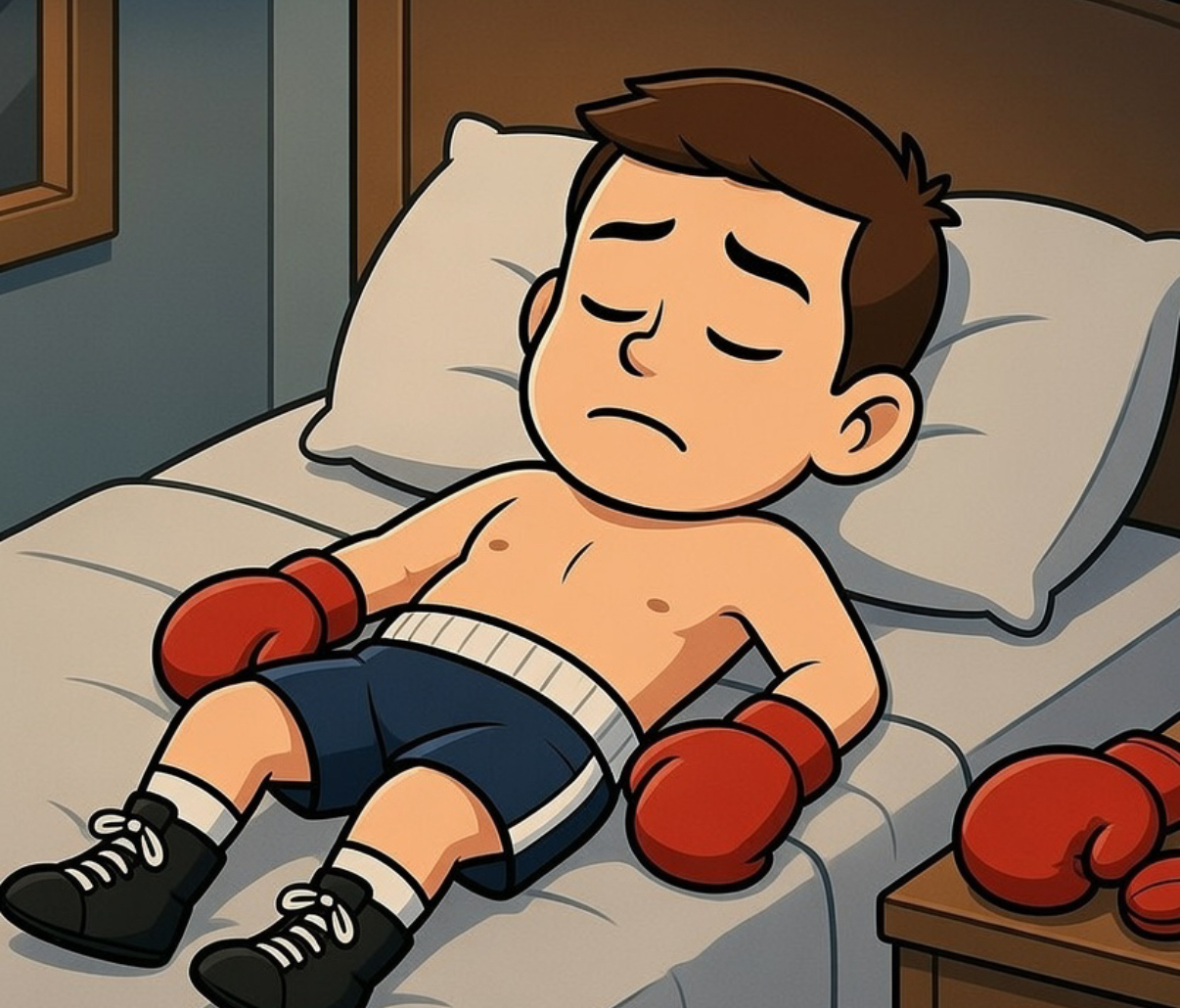
You can train six days a week. You can eat perfectly. You can take every supplement on the shelf. And if you’re sleeping five hours a night, you’re wasting most of it.
Sleep is when your body actually builds. Training tears muscle down. Food provides the raw materials. But the construction happens while you’re unconscious — hormone release, tissue repair, nervous system recovery, fat metabolism. Cut your sleep short and you’re walking out of the gym every day leaving results on the table.
This isn’t a soft wellness article about candles and bedtime routines. This is about the direct, measurable impact sleep has on muscle growth, fat loss, performance, and recovery — and what happens when you don’t get enough.
What Happens While You Sleep
Growth Hormone Release
Your body releases the majority of its daily growth hormone during deep sleep — specifically during the first few hours of the night. Growth hormone is responsible for muscle repair, cell regeneration, and fat metabolism. Miss that deep sleep window and your growth hormone output drops significantly.
Studies have shown that people who sleep less than 6 hours per night produce up to 70% less growth hormone than those sleeping 7-9 hours. That’s not a marginal difference. That’s the difference between recovering from yesterday’s training and carrying the damage into tomorrow’s session.
Testosterone Production
Testosterone — critical for muscle building, energy, mood, and recovery in both men and women — is primarily produced during sleep. Research from the University of Chicago found that men who slept 5 hours per night for one week had testosterone levels 10-15% lower than when they slept 8 hours. That’s the equivalent of aging 10-15 years in terms of hormonal output.
Low testosterone doesn’t just slow your gains. It affects your motivation to train in the first place.
Protein Synthesis
Muscle protein synthesis — the process of building new muscle tissue from the protein you eat — peaks during sleep. Your body takes the amino acids from the food and supplements you consumed during the day and uses them to repair and build muscle tissue overnight. If you’re cutting sleep short, you’re cutting the window where this process is most active.
This is why protein intake and sleep are directly linked. Eating 180 grams of protein on 5 hours of sleep is less effective than eating the same amount on 8 hours of sleep. The protein needs the sleep to do its job.
Fat Metabolism
Sleep deprivation increases cortisol — the stress hormone — and decreases insulin sensitivity. The combination tells your body to store fat, particularly around the midsection, and makes it harder to use stored fat for energy. A University of Chicago study found that people in a calorie deficit who slept 8.5 hours lost 55% more body fat than those who slept 5.5 hours — eating the exact same amount of food.
Same diet. Same deficit. The only variable was sleep. The well-rested group lost more fat and preserved more muscle. The sleep-deprived group lost more muscle and stored more fat. That should change how you think about sleep permanently.
What Bad Sleep Does to Your Training
Strength drops. Sleep-deprived lifters show measurable decreases in max strength, power output, and endurance. One bad night might not be noticeable. A week of 5-6 hour nights and your lifts will feel heavier, your rounds on the bag will feel longer, and your motivation will crater.
Reaction time slows. For anyone doing boxing training or sparring, this matters. Sleep deprivation impairs reaction time at a rate comparable to alcohol intoxication. After 17-19 hours awake, your reaction time is equivalent to a blood alcohol level of 0.05%. After 24 hours, it’s equivalent to 0.10% — legally drunk.
Injury risk increases. Tired muscles, slower reflexes, impaired coordination. A study of adolescent athletes found that those sleeping less than 8 hours were 1.7 times more likely to be injured than those sleeping 8+. The data on adult athletes shows similar patterns. Fatigue is the leading predictor of training injuries.
Appetite increases. Sleep deprivation raises ghrelin (the hunger hormone) and suppresses leptin (the fullness hormone). You wake up hungrier, crave higher-calorie foods, and have less willpower to resist them. This is why people who sleep poorly tend to gain weight even without changing their eating habits. Your brain is literally working against your diet.
How Much Sleep You Actually Need
7-9 hours for most adults. That’s not 7-9 hours in bed. That’s 7-9 hours asleep. If you get in bed at 11 and fall asleep at 11:45 and wake up at 6:30, that’s under 7 hours of actual sleep.
Athletes and people training hard may need more. Many professional fighters and serious athletes aim for 9-10 hours during heavy training periods. LeBron James reportedly sleeps 10-12 hours. Roger Federer aimed for 10. These aren’t lazy people — they understand that sleep is when the work pays off.
Minimum viable sleep is 7 hours. Anything consistently below 7 and the research is clear — you’re losing muscle, gaining fat, increasing injury risk, and shortening your lifespan. There is no hack, supplement, or training program that compensates for chronic sleep deprivation.
How to Sleep Better
This isn’t about becoming a sleep optimization guru. It’s about fixing the basic things most people get wrong.
Keep a consistent schedule. Go to bed and wake up at the same time every day — including weekends. Your body’s circadian rhythm runs on consistency. Shifting your sleep schedule by 2-3 hours on weekends is the equivalent of giving yourself jet lag every Monday.
Make the room dark. Truly dark. Blackout curtains, no LED lights from electronics, phone face down or in another room. Even small amounts of light suppress melatonin production and reduce sleep quality. Your bedroom should be a cave.
Cool the room down. 65-68 degrees Fahrenheit is the optimal range for sleep. Your body temperature needs to drop to initiate deep sleep. A hot room fights that process.
Cut caffeine by early afternoon. Caffeine has a half-life of 5-6 hours. That means half the caffeine from your 3pm coffee is still in your system at 9pm. If you’re sensitive to caffeine, cut it off by noon.
Screens off an hour before bed. Blue light from phones, tablets, and laptops suppresses melatonin. You’ve heard this before. You’re probably still scrolling at midnight. Stop. Read a book, stretch, do anything that doesn’t involve a screen.
Magnesium glycinate before bed. We cover this in the supplement guide, but it bears repeating here. 400mg of magnesium glycinate 30-60 minutes before bed promotes relaxation and improves sleep quality. It’s one of the simplest, most effective sleep interventions available.
Supplements 101: What You Actually Need and What’s a Waste of Money
The Hierarchy
Think of your results as a pyramid:
Sleep is the base. Without it, nothing above it works efficiently.
Nutrition is the next level. The raw materials your body needs.
Training is on top. The stimulus that tells your body to adapt.
Supplements are the tip. The finishing touches that optimize what’s already working.
Most people obsess over the top of the pyramid — the training program, the pre-workout, the new supplement stack — while ignoring the base. A perfect training program on 5 hours of sleep produces worse results than a mediocre program on 8 hours of sleep. That’s not opinion. That’s what the research consistently shows.
You want better gains? Sleep more. You want to lose fat faster? Sleep more. You want to recover between sessions and train harder? Sleep more. It’s the most effective performance enhancer available, it’s free, and almost nobody is getting enough of it.
The Short Version
Sleep is when muscle is built, fat is burned, hormones are produced, and your body recovers from training. Cutting it short undermines everything else you’re doing — your workouts, your diet, your supplements, all of it.
Get 7-9 hours. Keep it consistent. Make your room dark and cool. Take your magnesium. Stop looking at your phone in bed.
There is no supplement on earth that replaces a good night’s sleep. And no amount of training overcomes a bad one.
Getting in Shape at 40+: A Real Talk Guide
The Fighter’s Diet: How to Eat Clean Without Hating Your Life