By BoxingInsider Editorial
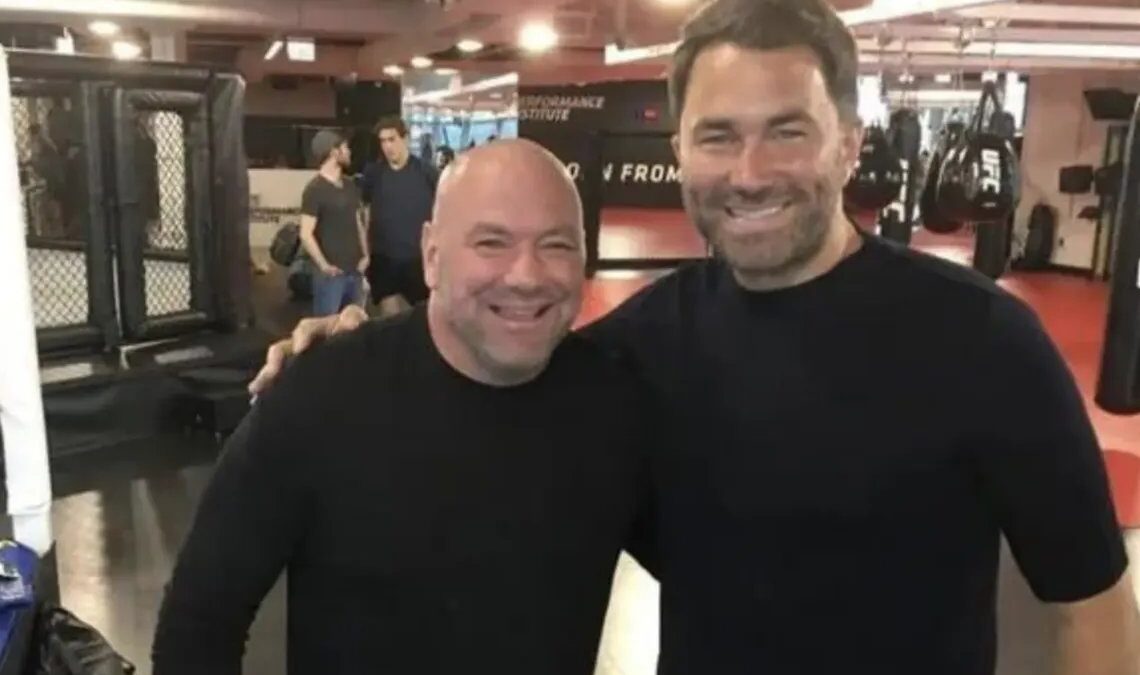
On Thursday, September 24, Netflix announced Tyson Fury vs. Anthony Joshua for December 11 in Cardiff. The release said Turki Alalshikh’s The Ring and Dana White “will collaborate to promote” the event. It did not mention Matchroom or Queensberry. Within minutes, Eddie Hearn was on iFL TV disputing the release for his own fight.
“Dana White cannot be involved with this fight promotionally. Netflix clearly didn’t get the memo. You see, no one talks to each other. I speak to Sela and Turki, ‘No, Dana White is not involved in the fight. You’ve got a contract that says that. He won’t be at the presser,’ blah, blah, blah. And Netflix say, ‘Oh yes, the fight is in conjunction with Dana White.’ It’s a little bit annoying, to be honest.”
He said he would be speaking to Netflix “just to remind them of their contractual obligations.” Asked about the press conference scheduled for the following week, he answered, “If there is a press conference next week,” and explained: “So far in the contract that we signed, there has been about six breaches. We keep letting these guys get away with it. We give them the benefit of the doubt, we act in good faith but they don’t.”
On Friday, Chris Mannix reported the fight was in peril over White’s involvement. The same day, White told Sky Sports, “I’m sitting here promoting the fight right now. Who’s going to stop me?” Fury posted a video saying the clause barring White had been in his contract and he took it out himself. On Saturday night in London, after the Zuffa card, White was asked about it again. “I’ve said it 150,000 times about my involvement. And here we are. I don’t know if the fight’s happening. I’m done. Eddie Hearn is full of f***ing shit. This thing’s a whole shitshow. I’m tired of it.”
Read those three days again as if you were Netflix.
Netflix does not have a boxing department. HBO had one, with a staff whose job was to sit in rooms like this and referee. Netflix has a checkbook and a programming calendar. It bought Canelo-Crawford. It bought Tyson-Paul. It bought this. What it did not buy, and did not budget for, is a promoter announcing on camera that the broadcaster’s own release is wrong, a fighter editing his contract on Instagram, a co-promoter cursing out the other side at a post-fight presser, and a fight in doubt before the weekend was over.
Imagine a studio announcing a film with Al Pacino attached, and the next morning Pacino’s manager going on television to say the release is wrong, the director cannot be involved, and the table read may not happen. The studio does not mediate. It remembers. Every public contract fight raises the price of the next check, or lowers the size of it, and that is the buyer problem Nick Khan described to the United States Senate five months ago.
Hearn was not there for that. If the committee wanted the sport’s dominant commercial voice on the record, it did not get him.
On April 22 the Senate Commerce Committee heard from Oscar De La Hoya, Khan, Timothy Shipman and Nico Ali Walsh on the Muhammad Ali American Boxing Revival Act. Hearn, the most recognizable promoter in the world, did not testify. He did not submit written testimony. He did not send a letter for the record. Asked about it days later at a club show in Florida, he told FightHub the decision was already made, and that the bill was about “control.” He spoke everywhere except the hearing record.
The hearing had three voices that mattered. Khan showed up with 13 pages and made TKO’s case for a Unified Boxing Organization. Oscar De La Hoya showed up and opposed it in the room, the only promoter in the sport who did, and his reward was to watch his biggest star run out the last fight on his Golden Boy deal while Dana White declined to even acknowledge him. Ali Walsh, who represents no fighters’ organization because none exists, showed up, opposed the bill, then blessed the version that advanced. On September 10 he wrote to the committee claiming credit for a three-year contract cap and a 90-day negotiation window. Both were already in S. 5188 as introduced on July 30. BoxingInsider.com spent the year pushing for stronger medical provisions and supported the medical table the committee added, then went on the record with nine fixes for the rest of it.
Here is the irony. Every time Hearn opened his mouth, he made Khan’s argument for him.
Khan’s testimony rested on a single finding from the original 2000 Ali Act, which he read back to the committee: that professional boxing operates without any centralized industry organization to set uniform business practices. He called it both a diagnosis and a prophecy. His pitch was that the sport cannot deliver a product because nobody is in charge of delivering it.
Now listen to Hearn in August, on the Punch Podcast, describing Zuffa. “Basically, [Zuffa] said we’re not going to work with the governing bodies. We’re going to create our own organization, our own belt.” And then: “The issue that Zuffa have got is Zuffa 100% want to get rid of the governing bodies, right? They want to do their own thing. But the problem they have is I think they underestimated the value of those belts to the fighter.”
The UBO debate, in two sentences, from the man who declined to have it in Washington. In April he went further, telling iFL TV that fighters who sign with Zuffa should not be allowed to hold recognized world titles at all. He meant it as a defense of the belts. Khan can use it as Exhibit A: a sport already fracturing into one system with the titles and one without, and no one with the authority to stop it.
The strangest part is that Hearn is not against a centralized boxing organization. He runs one. Matchroom in the UK is as close to a single-desk system as the sport has: one promoter, one broadcaster, one calendar, one stable of champions, and a decade of Sky and then DAZN treating it as the boxing department they did not have to build. His objection to the UBO is not the concept. It is that TKO would be the one running it.
A legitimate business position. It is not neutrality, and it is not standing up for fighters, which is what he told FightHub he was doing when he explained the bill was about control. Control is what he has been fighting for all September, clause by clause, on camera, while putting the biggest British fight in a generation on television as a contract dispute.
He may still win. The contract may hold, White may recede into whatever “assisting Turki in a personal capacity” means, and the fight may happen in Cardiff with Matchroom’s name where Hearn wants it. He won the venue fight. He may win this clause too.
But it is the wrong argument. The one that matters is being decided in Washington and at Netflix, not in front of an iFL TV camera, and the only case being made in either place right now is TKO’s. Nick Khan showed up and made it. Oscar De La Hoya showed up and fought it, and is losing his star for his trouble. Nico Ali Walsh showed up, opposed it, then blessed the version that advanced. Eddie Hearn stayed home, then spent five months making it for them.