
By Larry Goldberg
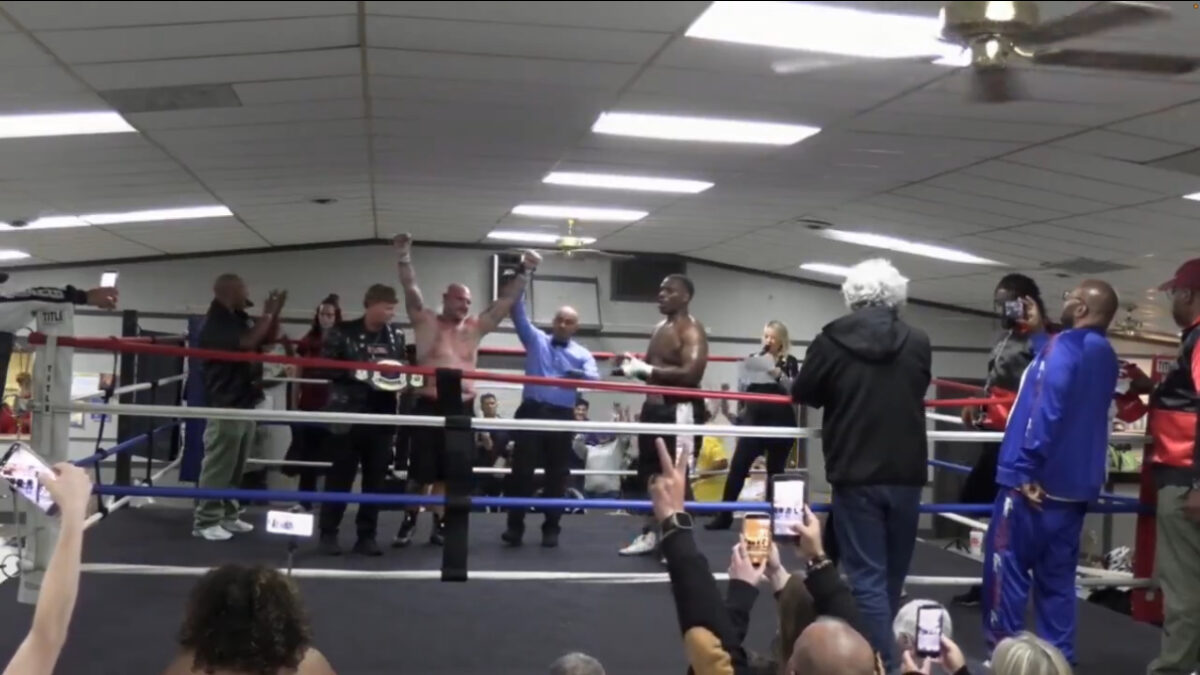
Early Friday morning in Lowell, Indiana, a 53-year-old former heavyweight champion of the world lost a six-round decision to a 40-year-old with four wins. The scores were 59-55 and 58-56 twice for Phil Triantafillo, who entered 4-4 and left 5-4. Hasim Rahman, the man who knocked out Lennox Lewis in 2001, was stopped in seven by Wladimir Klitschko in 2008 and in two by Alexander Povetkin in 2012, then lost a three-round decision to Anthony Nansen in 2014. He had not fought since.
Lou DiBella put it the way most of the industry was thinking it.
In the early hours of this morning, in Lowell, Indiana, 53 yr. old former heavyweight champion Hasim Rahman lost a six round sanctioned #boxing match to a 3-4 guy … a SANCTIONED fight. Every day, in many ways, across borders, from billionaire and corporate supported events to unsafe silliness in tiny venues, boxing is showing you what it is in 2026. You can have it!
— Lou DiBella (@loudibella) September 25, 2026
The card, announced for the Hammond Sportsplex and reported from Lowell on fight night, was regulated by the Athletic Division of the Indiana Gaming Commission. FightNews reported that Triantafillo “often backed Rahman up, landing several telling blows to the head and body.” This is not a column about Rahman’s judgment or Indiana’s. It is about what the state asked to see before it let him in the ring, and what the bill on the Senate floor right now would have required instead.
What Indiana Asked For
Indiana’s professional boxer license application, State Form 45727, revised June 2025, has a two-item medical section. A physician’s statement, not more than a year old, affirming the applicant is physically fit to box. And lab results for HIV, hepatitis B and hepatitis C. The fee is $50. The license runs two years.
That is the entire list. No brain scan. No EKG. No eye exam. No neurological examination. Nothing for a fighter inactive a decade, nothing for a fighter knocked out by two former world champions. The Association of Boxing Commissions’ medical requirements page lists Indiana the same way, line after line: none at this time. The one age provision says a fighter 35 and over may be asked for a second physical thirty days out. Indiana can ask an older fighter for another physical. It does not ask for a scan.
Rahman’s team originally wanted Rochester, New York. We reported in May that the New York State Athletic Commission had not announced sanctioning. The date slid once, then the whole card was cancelled less than a week out with no reason given. Two weeks later the fight resurfaced in Indiana. To be licensed in New York, Rahman would have had to submit a 1.5 Tesla brain MRI, an EKG and a dilated eye exam before the commission ever ruled on him. Whether he did, and what those results said, is not public. If the scans exist, they sit in a file in Albany. Indiana had no way to ask for them, no obligation to, and no registry to check. That is not a New York failure or an Indiana failure. It is the absence of a system.
New Jersey wants a CT or MRI, six-month EKGs and eye exams, and at 40 an MRI and MRA plus a stress echo with a cardiologist’s clearance. Even Florida, which we put in the have-not column last week, requires an MRI and EKG at 40. Indiana asked for a note from a doctor and three blood tests. Nothing in the published application required more, and the default is what got used.
What the Bill Would Have Required
The Muhammad Ali American Boxing Revival Act, S. 5188, cleared the Senate Commerce Committee on September 16. Its medical table applies to every professional boxer in every state, whoever promotes the card. Per House Report 119-524, a boxer 40 or older must submit, all within a year: a complete physical with blood work, a dilated eye exam, an EKG and a cardiac stress test, and an MRI and MRA of the brain. Every exam conducted in person by an MD or DO, with a written opinion that nothing contraindicates safe competition.
Rahman is 53. Under the bill, before any state could license him, a physician would have had to read an image of his brain, an image of the blood vessels in his brain, and the results of his heart on a treadmill, and sign his name to a letter saying none of it was a reason to keep him out. Indiana never saw any of that, because nobody was required to produce it.
What the Bill Would Not Have Done
Here is the honest part. The federal table forces the examinations. It does not decide the answer. If Rahman’s scans came back clean, the bill would not have stopped this fight. There is no age limit, no inactivity trigger, no rule about knockout losses, and no national registry that would have told Indiana what happened in New York. Those gaps are why we have asked for the bill to be fixed rather than killed.
But the difference between looking and not looking is the whole difference. Whether an MRI would have found anything, none of us know. That is the point. Nobody in Indiana was required to look.
The Have-Not Problem in One Fight
This is the pattern the federal floor exists to close. The strong states wrote their own standards. A fighter who cannot get through those doors, or chooses not to try, finds a state where the door has no lock, and the fight is sanctioned and legal. Lou is right that this is what boxing looks like in 2026. The part he left out is that Congress has a bill that would change the paperwork for this exact fight, and has spent its energy arguing over who owns a boxer’s contract. Indiana can fix its own form tomorrow. And the Senate can strike the “or” that lets fighters under 40 skip the scan, so the next Rahman, at 38 instead of 53, gets looked at too.
Rahman said in May he wanted two fights before a title shot. He got one. What he did not get was anyone required to look at his brain before the bell.
Larry Goldberg is the publisher of BoxingInsider.com and a licensed boxing promoter in New Jersey and New York.