By Larry Goldberg
A regional promoter posted something this week that is more correct than most of what has been said about this bill. People crying about what is bad for fighters, he wrote, never explain how we got here. Plenty of blame across the business, no accountability, and no ideas about how to fix it. The Ali Revival Act does not exist if boxing were not completely broken.
He is right. So let me explain how we got here.
Boxing from the 1930s through the 1970s was worse than anything anyone complains about today, and worse in ways that no longer exist. The mob ran it. Fighters were owned. Fights were bought. Congress has been trying to fix this sport since the Kefauver hearings in 1960, and federal law exists in boxing at all because the sport proved over decades that it could not regulate itself and would not.
What we have now is not a system anyone designed. It is what John McCain could get past a House that killed his best bill three times. The Professional Boxing Safety Act of 1996 and the Ali Act of 2000 are the leftovers of a much larger effort. The federal commission he wanted never existed. The national medical registry he wrote never got built.
So when people say boxing is overregulated compared to MMA, they have it backward. Boxing is the only sport in America regulated this way because it is the only sport that earned it. What MMA has is not less regulation because MMA is cleaner. What MMA has is boxing’s regulation, borrowed. The unified rules came out of a state athletic commission. The weight classes, the medical suspensions, the licensing structure, the entire framework MMA operates under was built by boxing commissions, most of it in New Jersey. MMA came in through a side door that boxing spent seventy years cutting into the wall.
This bill sits on that foundation. It writes a federal medical table for boxing and writes nothing for MMA, because the statute still says boxing.
The table itself is a floor and a low one. For fighters under 40, which is most of the sport, it accepts an MRI or a neurologic exam, and cheap jurisdictions will take the exam every time. But a low floor covering one discipline is still more than the zero that covers every adjacent one.
Now here is the part I want to say to MMA fans specifically, because you are the people this argument is being had in front of and nobody is talking to you.
If you are rooting for this bill because you think the UFC model is better and boxing’s four-belt circus deserves to lose, fine. That is an honest position and I am not going to pretend it has no merit.
And I know the objection. You trust your promotion’s doctors more than you trust an Arkansas commission or a Senate committee, and you are probably right about that. But trusting one company’s medical staff is not the same thing as wanting a standard that follows the undercard guy from Oklahoma to Alabama. Those are different questions, and only one of them is in front of Congress.
So answer that one. The fighter you watch every weekend has no federal medical standard of any kind. No imaging requirement, no baseline, no protocol, nothing that travels with him. Whatever his commission asks for is what he gets, and in most of this country his commission asks for a physical and blood work. When it goes wrong, the response is a GoFundMe. Twenty-five dollars and a share, and everybody feels like they did something.
That is not a system. That is a collection tin.
The bare knuckle fighter is outside all of it too. No gloves, which is the selling point, and no federal baseline requiring anyone to know what was already wrong with him before he walked in. Unless he happens to be fighting in New Jersey, where the state regulates every combat sport under one roof and a bare knuckle fighter gets the exact same medicals my boxers get. That is the exception, not the rule, and those shows mostly are not in New Jersey. So what testing is actually happening in the markets where they do run? Nobody outside those commissions can tell you, and that is the answer.
The protocols built for the NFL apply here and apply harder. Independent evaluation. Mandatory removal. A graded return to contact. Spotters whose only job is to watch for the thing everyone else misses. Every one of those exists because football finally admitted that repeated blows to the head do permanent damage, and in football the head trauma is a byproduct. In boxing it is the object of the contest. The whole point is to render another man unconscious.
Football has a concussion protocol. Hockey has one. Youth soccer associations have them. Combat sports have a patchwork of state rules and no federal protocol at all.
And to be clear about who this is and is not about. This is not about TKO. They exceed the standard. They are not going to put a concussed fighter in a cage, they have doctors and money and every reason to be careful, and anyone who says otherwise is not being serious.
It is about the next one. And the one after that. The company that gets certified in four years with worse people and a thinner balance sheet, running shows in states that never look. A structure is not built for the operator who would do the right thing anyway. It is built for the one who would not.
And it is about the system that should exist in case a doctor misses something. In New York, multiple commission physicians watch a fighter all night. Not one. Several, on the same card, because one person can miss a thing. That redundancy is the entire design, and it exists because a heavyweight named Magomed Abdusalamov was cleared in eighteen minutes after a fight at Madison Square Garden, took a cab to the hospital, and never came back the same. New York paid his family twenty-two million dollars and rebuilt its medical protocols from the ground up.
Why do you not want that for MMA fighters?
Am I saying the current system is good? No. It is a patchwork of fifty states, most of which do almost nothing, held together by a twenty-five-year-old statute nobody has ever enforced. The people who spent this year claiming the old Ali Act was working were wrong too. It was a deterrent at best and a dead letter at worst.
And I am not pretending the two halves of this bill are unrelated. The UBO is the reason the bill exists. But the contract fight will be settled by people with lawyers on both sides, and it will get settled either way. The medical floor will not, unless somebody without a lobbyist keeps talking about it.
Blindly supporting this bill because your side wins, or blindly opposing it because your side loses, both come at the expense of the only safety net the most vulnerable fighters in this sport have. Not the champions. Not the guys on the poster. The fighter working a four-round undercard bout for the two hundred dollars a round this bill sets as the floor, in a state where nobody looks, who has no idea what is already wrong with him and no way to find out.
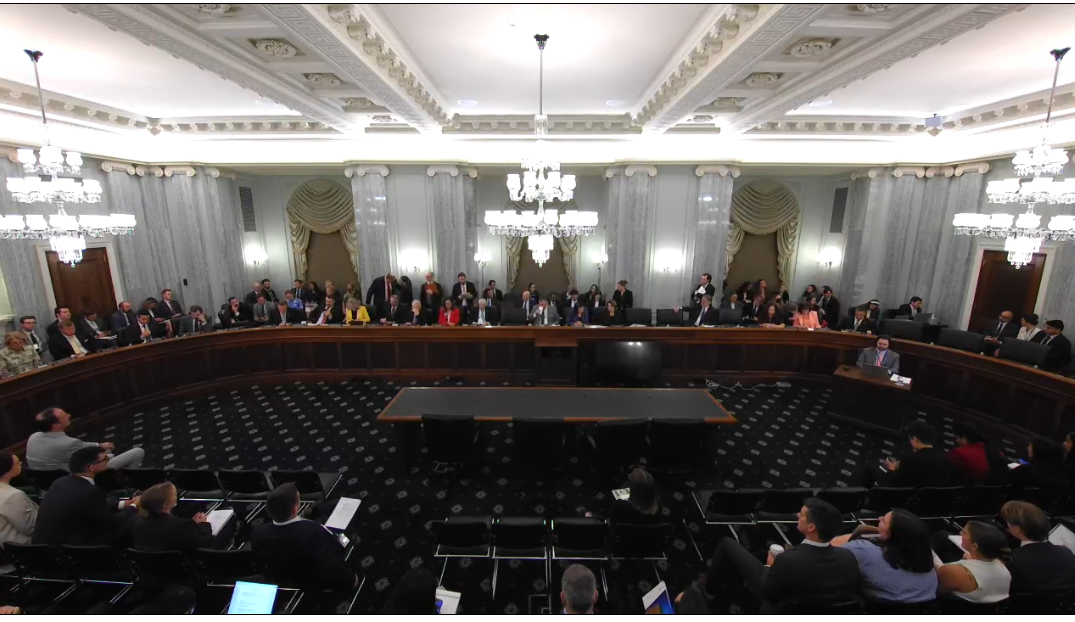
A Senate committee spent its markup this week on contracts, disclosure, and who certifies referees, all of it worth doing. It adopted a full substitute and four amendments. Not one of them touched the brain imaging line. Somebody should be looking out for that fighter. After Wednesday we know who is not.
Larry Goldberg is the publisher of BoxingInsider.com and a licensed boxing promoter in New Jersey and New York.