By Larry Goldberg
Two chairmen of the Senate Commerce Committee. Two boxing bills. Twenty years apart, same gavel, same jurisdiction. Here is how they measure up.
First, my interest. I promote club shows under the current system and I own this publication, which means I have a stake in how this sport gets regulated. Here is the comparison anyway, because it is built on the public record and anyone can check it.
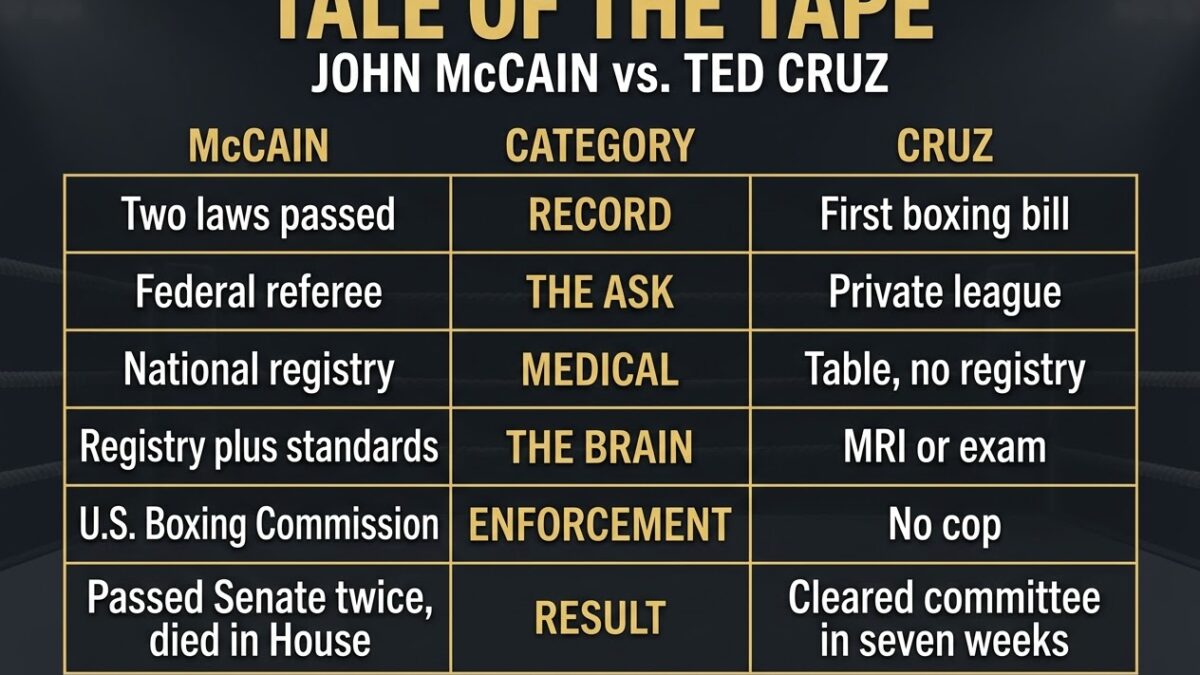
The Record and the Ask. John McCain boxed at the Naval Academy and spent nearly two decades on boxing legislation. He wrote the Professional Boxing Safety Act of 1996 and the Muhammad Ali Boxing Reform Act of 2000, both of which became law and both of which still govern the sport. His Professional Boxing Amendments Act would have created a United States Boxing Commission to administer federal boxing law, oversee every professional match in the country, and enforce the statutes Congress had already passed. Ted Cruz became chairman in 2025, and the Muhammad Ali American Boxing Revival Act is his first boxing bill. It creates a Unified Boxing Organization, a private structure that lets one company sign fighters, rank them, and hang its own belts. McCain wanted a referee. Cruz wanted a league.
What Cruz’s Bill Does That McCain’s Never Did. This bill writes a federal medical table that applies in every state and a $200-per-round minimum purse that applies to the whole sport, not just to UBOs. It caps a fighter’s first promotional contract at three years and opens a 90-day negotiation window before a contract expires. The committee’s substitute added per-event financial disclosure to the fighter and a conflict-of-interest bar between UBOs and commission officials. McCain never specified any of that. Those provisions are real, and they are why this publication has argued all year that the medical table should become law. They are also unenforced on arrival, which is the rest of this column.
Medical Standards. McCain’s bill established a centralized national medical registry, a confidential database of medical and statistical information for every licensed boxer in America, for state commissions to use when making licensing decisions. Cruz’s bill has the table and no registry. A fighter denied a license in one state can still drive to the next one, exactly as he could in 1996, because nothing connects his record in New Jersey to his license in Oklahoma.
The Brain. Cruz’s bill requires an annual MRI for fighters 40 and over, plus an MRA and a cardiac stress test. For fighters under 40, which is most of the sport, it requires an MRI or a neurological exam. One word, and imaging becomes optional. The committee opened the bill on Wednesday, adopted a substitute and four amendments, and left that row exactly as written.
The Sanctioning Bodies. McCain’s bill went after them directly: reduce arbitrary practices, impose uniform ranking criteria, require notice and appeals, and put a federal commission behind it with authority to enforce. Cruz’s bill asks a UBO to file its ratings criteria with the Federal Trade Commission every January and asks nothing of the WBC, WBA, IBF, or WBO. The obvious defense is that the Ali Act already regulates those organizations. It does, on paper, and it has for twenty-five years without a single enforcement action. That is the point. The old statute has no cop, and this bill does not hire one.
Enforcement. McCain’s commission would have had subpoena power. The Congressional Budget Office scored it, noting that private parties could be compelled to testify and produce evidence in its investigations. Cruz’s bill creates no commission, no enforcement body, and no new penalty. In twenty-five years the Department of Justice has never brought a case under the Ali Act.
The Hearings. McCain’s committee spent more than a decade on this, bringing promoters, managers, and sanctioning body officials into the room and making them answer. Muhammad Ali supported the bill and McCain thanked him publicly for it. Cruz’s committee held one hearing, on April 22. Wednesday’s markup was an executive session where the bill was item eight of ten.
The Result. McCain’s bill passed the Senate by unanimous consent in 2004. He reintroduced it and the Senate passed it again in 2005. He introduced it again in 2009. The House killed it every time and he kept coming back. Cruz’s bill cleared his committee seven weeks after introduction, by voice vote, and heads to the floor with a matching House version expected.
The Scorecard. McCain spent nearly twenty years trying to fix boxing and failed. Cruz cleared committee in seven weeks. The difference is not skill and it is not effort. It is what each of them was trying to do. A bill that takes power away from the people who have it is hard to pass. A bill that gives power to a TKO-style league is easy.
That is not an accusation. It is arithmetic, and every legislator in Washington understands it. McCain’s bill made enemies of the promoters, the sanctioning bodies, and the state commissions all at once, which is why the House killed it three times. Cruz’s bill has TKO, two unions, arena operators, the Association of Boxing Commissions, and, as of last week, Nico Ali Walsh, the grandson of the man whose name is on it.
McCain understood something this bill does not: the problem in boxing is not the absence of a structure, it is the absence of anyone with authority to enforce one. He wanted a federal commission because he had already watched two of his own laws go unenforced. He was right.
McCain’s registry was never built. His commission never existed. The Ali Act has sat unenforced for twenty-five years. This bill will add the most important medical table in a generation and leave it with the same cop the last two laws had, which is none. We asked the committee for ten fixes and got none of them. The floor amendment is still available. It is one word.
Larry Goldberg is a licensed boxing promoter in New Jersey and New York and a two-time New York State Boxing Hall of Fame Promoter of the Year.