By Larry Goldberg
Updated September 17, 2026. An earlier version of this article reported that the Senate Commerce Committee advanced S. 5188 without amendments, and that two senators voted no. Both were wrong. The committee adopted a Cruz-Rosen substitute and four Cantwell amendments and advanced the bill by voice vote. The roll call with two Democratic senators voting no was on a separate bill. The article has been rewritten with the substitute text.
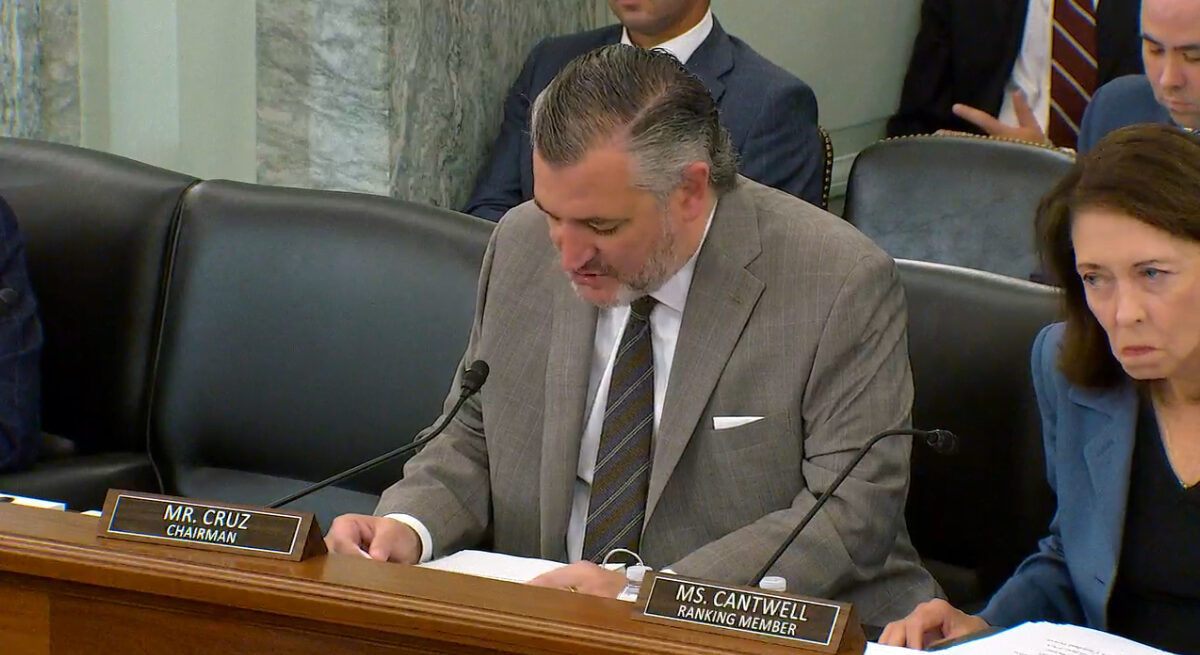
The Senate Commerce Committee rewrote the Muhammad Ali American Boxing Revival Act on Wednesday and sent it to the Senate floor. A Cruz-Rosen substitute replaced the bill as introduced. Four amendments from Ranking Member Maria Cantwell were adopted on top of it. The committee had the text open, made changes, and advanced it by voice vote.
The word that lets a fighter under 40 skip a brain scan is still in it.
Page 24 of the substitute, the required examinations table, brain health row: for a boxer age 40 or older, an MRI and an MRA of the brain. For a boxer under age 40, “an MRI of the brain or neurologic examination conducted by a neurologist.” Identical to the July text. Not touched.
That is not a drafting quirk anymore. It is a choice. It is the cheapest way to satisfy a federal medical table, and cheapest is what gets used. A neurologist in an office can check reflexes, balance, and coordination. He cannot see a bleed, a lesion, or a vascular malformation. The bill treats the two as equals for every fighter who has not turned 40, which is most of the sport, and it will be used that way on exactly the cards where nobody is watching. The fix is to strike “or” and write “and.” Imaging is the baseline. The exam is additional.
The registry, the chain of custody, and the fighters this floor does not cover went out of committee too. Those are later fights. This one is a word.
Here is what the committee did change.
The Cantwell amendments are real, and they are mostly about money. Cantwell 2 requires a UBO to disclose to each fighter his compensation for the bout, an itemized statement of every fee, charge, expense, and deduction taken out of it, the final net after all of it, and everything the organization filed with the state commission. That is per-event disclosure to the fighter, which is what the original Ali Act requires of promoters and what the bill as introduced did not require of UBOs. Cantwell 3 bars UBO officers, employees, and representatives from contracting with or paying any member or employee of a boxing commission, anyone who administers state boxing laws, or any member of the Association of Boxing Commissions, with an exception for ordinary supervision and officiating fees. Cantwell 4 closes an obvious workaround: any entity that creates boxer ratings and has a financial tie to a UBO must file its criteria, appeals procedure, and voting officials with the Federal Trade Commission every January, and attest to the tie.
Cantwell 5 struck a provision entirely. Page 27, lines 6 through 17 of the substitute would have amended the Professional Boxing Safety Act to require that every referee and judge in a professional boxing match be certified and approved by either the state commission or the Association of Boxing Commissions. The ranking member took it out. Certification stays with the states.
That one matters, and it went the way this publication asked. Our eighth fix said officials certification should not rest solely with one association. The struck provision would have made the ABC an alternative national certifier, which means a promoter could have used ABC-approved officials in a state that never approved them. It is gone.
So the committee spent its markup on disclosure, conflicts of interest, ratings, and who certifies officials. Every one of those is worth doing. Not one of them is medical.
The same morning, Chairman Cruz posted a letter from Nico Ali Walsh, who testified against this bill in April, and treated it as the fighter’s blessing. Walsh listed five changes he fought for: shorter promotional contracts, a path to free agency, transparent rankings, a firewall between promoters, UBOs, and managers, and financial disclosure. All five are contract terms. None is medical.
That is the whole story of this bill’s trip through the Senate. The business fight got a fighter, a chairman, a ranking member, four amendments, ten months of meetings, and a public thank-you. The scan got nothing, because there is no money in a brain scan and nobody with a lobbyist was asking.
The last time this committee wrote a boxing bill, John McCain put a national medical registry in the text, because he knew a license in one state is worthless if the fighter can drive to the next one. That is a later fight. The fight in front of the Senate is one word.
The bill is not law. The Senate floor and the reconciliation with the House are both still ahead, and a new matching House version is expected. Any of those is a place to strike one word. No delay, no politics, no fight with anyone. Ten minutes of drafting.
The medical table in this bill is the biggest step forward for federal fighter safety since 1996. That is precisely why the hole in it matters. A weak bill with a gap is ordinary. The first real floor in thirty years, with a door cut into it, is something else. Pass it without the door. A brain scan is not a bargaining chip.
Larry Goldberg is the publisher of BoxingInsider.com and a licensed boxing promoter in New Jersey and New York.