
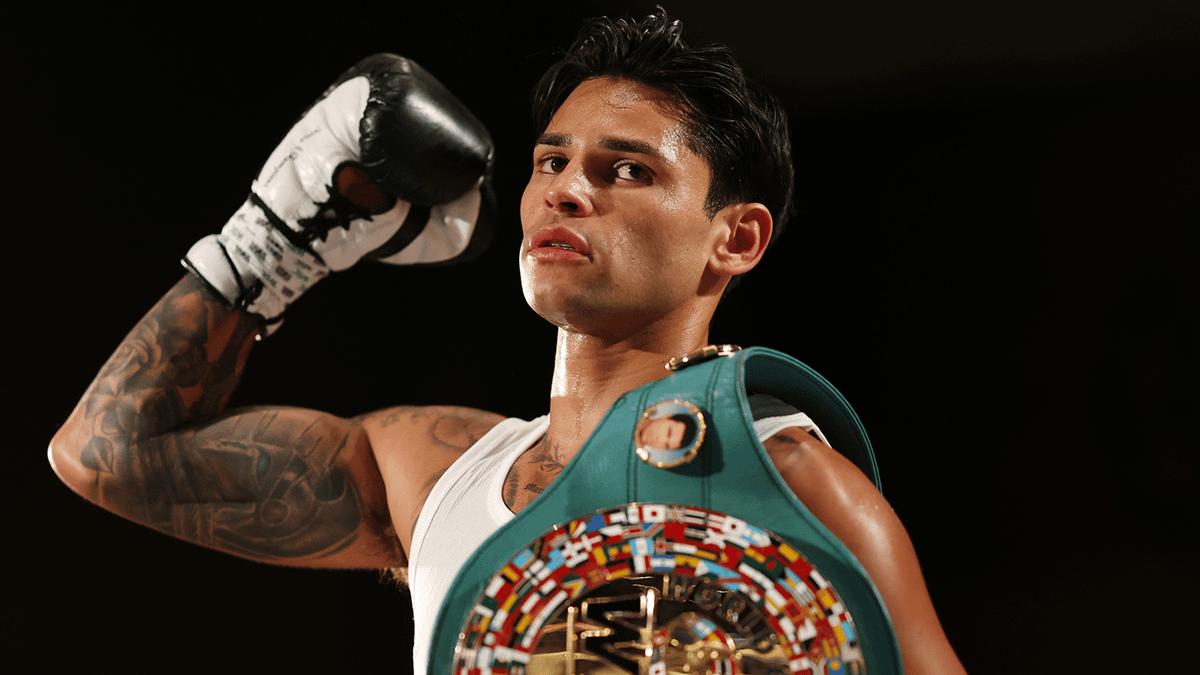
Ryan Garcia went on Ariel Helwani’s show with the WBC belts in his lap and buried his promoter without raising his voice. He wished Oscar had walked him out, wished he’d been ringside no matter what, the way someone who has been there the whole time is supposed to be.
Then came the colder truth of how fight night actually stood: “Nobody wanted him there… They did have a seat for you though and you didn’t take that seat. I don’t respect that, and that disappointed me.” And then the eulogy: “It’s just kind of sad that he didn’t show up. He just doesn’t want to show up for the people he’s supposed to love. He’s weird, bro.”
Ryan Garcia on Oscar De La Hoya not attending the Benn fight: “They did have a seat for you, and you didn’t take that seat.”
— Ariel Helwani (@arielhelwani) September 13, 2026
Read that sequence again, because both halves matter. Nobody wanted him there, and a seat was held for him anyway. That is the whole relationship in two sentences: the obligation survived, the affection didn’t.
Set aside, for one column, the question of what actually happened at the credential desk. Golden Boy says its people were denied. Dana White says nobody was banned and he’d have called Oscar to warn him off if that were the plan. Someone’s account will collapse eventually, and we will cover it when it does.
What matters today is what the fighter believes, because the fighter is the asset, and the fighter just told the biggest platform in combat sports that his promoter abandoned him on the biggest night of his life. Whether the seat was real or the credential was denied, Ryan Garcia has chosen his version, and his version is the only one with a contract attached.
We have seen this exact movie, and it just finished its final scene in the same building. Conor Benn spent his whole career as Eddie Hearn’s project, then left for Zuffa’s $15 million when the moment came. All fight week, Benn thanked Zuffa for sticking true to their word and praised Dana White for putting ego aside, while his old promoter gave him zero chance against Garcia from a studio somewhere.
Hearn built Benn, weathered the clomifene years with him, and watched his redemption arc from the outside because the machine paid more and complained less. Benn didn’t burn Eddie down. He just left him behind, politely, thanking everyone on the way out. That’s how it happens now. Not with a lawsuit. With gratitude, aimed elsewhere.
Garcia is one fight from the same door, and every signal says he’s already through it. He fought Saturday as the centerpiece of Zuffa’s biggest card, on Zuffa’s broadcast, at Zuffa’s arena, with Dana White calling him the golden goose from the podium and building the young-audience future of the whole enterprise around his face. He is not a Zuffa fighter. He is something more useful: the face of the Zuffa era on someone else’s paper, with the paper running out.
One fight left, by Dana’s own on-camera accounting. And now, on the record, a grievance. Fighters don’t leave over money alone. They leave over money plus a story, and “my promoter didn’t take the seat on the biggest night of my life” is the best exit story anyone has ever handed him. It doesn’t even matter if the seat was real. It’s real to him.
This is not one of those access-media Ryan stories, the careful kind written by people protecting a credential. This is just the arithmetic. Nine years of war between Oscar and Dana ends with Dana holding the platform, the checkbook behind it, and now the fighter’s heart.
Oscar holds a contract with one fight on it and a champion telling the world he felt unloved. Golden Boy can win the credential argument in the press and lose the only argument that pays. Ask Eddie Hearn how that feels. He built the man who won the co-feature slot in the sport’s new world, and on Saturday he was a pundit with an opinion about it.
Oscar has been quiet since Saturday, which for Oscar is its own headline. Clapback Thursday is coming, and whatever he posts, the math doesn’t move: the last great fighter on his roster just publicly grieved him while holding the belt, in the house his enemy built.
The suffering Conor put on Eddie was quick, a signature and a press release. The version coming for Oscar will be slower, one fight long, played out in front of everyone, with the whole sport already knowing the ending.
Twenty years ago Oscar De La Hoya was the most beloved man in boxing. On Sunday his own champion summed him up in three words: “He’s weird, bro.”
In this business you can survive being hated. You don’t survive being left.