How casino money, TV deals, and legendary fighters made the Jersey Shore boxing’s epicenter for three decades
For nearly 30 years, Atlantic City wasn’t just a gambling town—it was the undisputed boxing capital of the world.
Between 1978 and 2007, the Jersey Shore hosted more world championship fights than any city on Earth. The numbers are staggering: 521 fight cards in just four years (1982-1985). 196 shows at the Tropicana alone. Nearly 1,000 boxing events in the 1980s. Champions from Mike Tyson to Arturo Gatti made their names on the Boardwalk.
This is the story of how Atlantic City became the center of the boxing universe.
The Beginning: Casino Gambling Changes Everything (1978-1980)
Before 1978, Atlantic City was dying. John McPhee’s 1972 New Yorker essay “The Search for Marvin Gardens” described a city “disorienting in its decrepitude”—a place with more broken windows than visitors.
Everything changed on May 26, 1978, when legalized gambling arrived. Resorts International opened its doors as the first legal casino outside Nevada, drawing crowds of 500,000 on opening weekend. Within three years, Caesars, Bally’s, Harrah’s, the Sands, and the Playboy Club had all opened.
The casinos needed entertainment to draw gamblers. Boxing was the perfect fit.
On November 14, 1978, Resorts International staged the first boxing event at an Atlantic City casino. Howard Davis Jr. won a ten-round decision over Luis Davilla. The casino boxing era on the East Coast had begun.
By January 1980, Resorts International was staging monthly boxing cards—sometimes three events per month. New Jersey Athletic Control Board Commissioner Larry Hazzard oversaw the sport’s explosive growth.
The Golden Years: 521 Fight Cards in Four Years (1982-1985)
The early 1980s were unlike anything boxing had ever seen. According to the Atlantic City Boxing Hall of Fame, the resort hosted an astonishing 521 fight cards between 1982 and 1985:
- 1982: 139 cards
- 1983: 119 cards
- 1984: 120 cards
- 1985: 143 cards
Virtually every Atlantic City casino hosted boxing shows. But one venue stood out.
Don Elbaum and “Tuesday Night at the Trop”
Legendary promoter Don Elbaum (inducted into the International Boxing Hall of Fame in 2019) staged 196 shows at the Tropicana between 1982 and 1986. His “Tuesday Night Fights” became a weekly institution, featuring future champions and hungry contenders.
Elbaum, who passed away in 2025 at age 94, is also credited with giving Michael Buffer his first ring announcing job in 1982. “I was working as a model and pitching myself to casinos,” Buffer recalled. “Don said I could work one of his fight cards at the Tropicana. He didn’t pay me, but he said it would be an incredible opportunity.”
The Trump Era: Big Money, Bigger Fights (1984-1991)
In 1984, Donald Trump opened Trump Plaza, a $210 million casino-hotel that would transform Atlantic City boxing. Trump Castle followed in 1985, and Trump Taj Mahal in 1990.
Trump aligned himself with promoter Don King and became a major player in heavyweight boxing. His properties hosted WrestleMania, world championship fights, and the most anticipated boxing events of the decade.
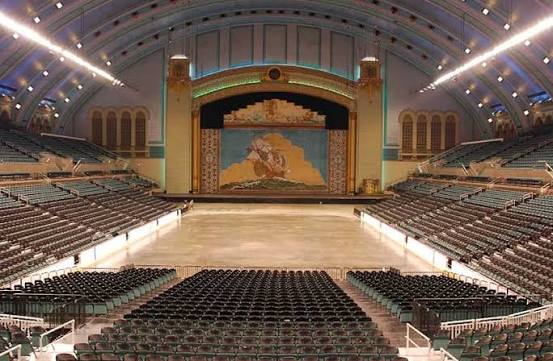
The centerpiece was Mike Tyson. Between 1985 and 1990, Tyson fought 13 times in Atlantic City—more than any location outside New York—winning all 13 by knockout. His fights at Jim Whelan Boardwalk Hall became must-see events.
The Mike Tyson Fights That Defined an Era
Larry Holmes (January 22, 1988): Tyson handed the legendary Holmes his first knockout loss in 75 fights—three knockdowns in the fourth round. “Tyson is a lot better than I thought,” Holmes admitted. “A lot better.”
Michael Spinks (June 27, 1988): The richest fight in boxing history at the time ($70 million). A record 21,785 fans packed Boardwalk Hall. Tyson knocked out the undefeated Spinks in 91 seconds. Jack Nicholson, Kirk Douglas, and Jesse Jackson watched from ringside.
Carl Williams (July 21, 1989): Another first-round demolition—93 seconds. Tyson’s combined time in his three Atlantic City title defenses: under 8 minutes.
Transition and Competition: The 1990s
After Tyson’s 1990 loss to Buster Douglas in Tokyo, the heavyweight landscape shifted. But Atlantic City adapted.
The 1990s saw fewer cards overall—costs had risen dramatically—but the quality remained elite. New stars emerged: Ray Mercer, Bernard Hopkins, David Tua, and a young Arturo Gatti began making names for themselves on the Boardwalk.
Evander Holyfield vs. George Foreman (April 19, 1991):The 42-year-old Foreman’s improbable comeback brought another mega-fight to Atlantic City. Holyfield won by decision, but Foreman’s gutsy performance proved age was just a number.
Roberto Duran vs. Iran Barkley (February 24, 1989):Approximately 7,000 fans braved a snowstorm to watch Duran win the WBC middleweight title. Ring Magazine‘s Fight of the Year.
Competition emerged from Connecticut’s Mohegan Sun and Foxwoods casinos, giving New York-area fans new options. But Atlantic City’s core advantage remained: world-class venues, casino money, and proximity to the East Coast’s population centers.
The Gatti Era: Thunder Returns (1998-2007)
By the late 1990s, big-time boxing had largely migrated to Las Vegas. Then Arturo Gatti arrived “I’d say that Arturo Gatti singlehandedly revived boxing in the state of New Jersey and especially in Atlantic City,” said a noted official.
Gatti fought 23 times in Atlantic City—going 17-6—and became the face of Boardwalk Hall boxing. His final nine fights were all at that venue, and all nine drew crowds exceeding 10,000. The main dressing room at Boardwalk Hall was later named in his honor.
The Gatti-Ward Trilogy
The defining moment came in the Gatti-Ward trilogy (2002-2003). Two of those fights took place at Boardwalk Hall, with fans from New England chanting “Micky! Micky!” against the Jersey faithful roaring “Gatti! Gatti!”
The rubber match on June 7, 2003, sold out completely. Both fights earned Ring Magazine‘s Fight of the Year honor. Unlike most boxing rivalries, Gatti and Ward became close friends afterward—Ward even became Gatti’s trainer.
“Arturo Gatti generated more money for Atlantic City than any other boxer in history,” said his friend Chuck Zito.
Gatti’s last fight came on July 14, 2007, at Boardwalk Hall. When he retired, an era ended.
The Decline: 2007-2014
After Gatti, Atlantic City struggled to find another headliner. Fighters like Kelly Pavlik and Sergio Martinez drew crowds, but nothing matched the Gatti-era electricity.
The city’s casino industry collapsed. Trump’s properties went through multiple bankruptcies. Five casinos closed between 2014 and 2016, including Trump Plaza (demolished in 2021) and Trump Taj Mahal (now Hard Rock Hotel & Casino).
The last major Boardwalk Hall fight came on November 8, 2014: Sergey Kovalev defeated Bernard Hopkins by unanimous decision in a light heavyweight unification. Then nothing—for over a decade.
From November 2014 to August 2018, Atlantic City didn’t host a single world title fight. The town that once produced dozens of championship fights yearly had become a boxing ghost town.
The Legacy: By the Numbers
Atlantic City’s boxing legacy is preserved at the Atlantic City Boxing Hall of Fame, established in 2017 by Ray McCline. Its inaugural class included Mike Tyson, Larry Holmes, and Arturo Gatti.
Atlantic City Boxing: Key Statistics
- 521 fight cards (1982-1985)
- 196 shows at Tropicana alone (1982-1986)
- 21,785 record attendance (Tyson-Spinks, 1988)
- 12,675 largest non-heavyweight crowd (Gatti-Mayweather, 2005)
- Hall of Fame inductees: Mike Tyson, Arturo Gatti, Larry Holmes, Bernard Hopkins, Evander Holyfield, and dozens more
For anyone who wants to understand why Atlantic City was once called the Boxing Capital of the World, the evidence is in the record books, the Hall of Fame plaques, and the memories of fans who saw it all.