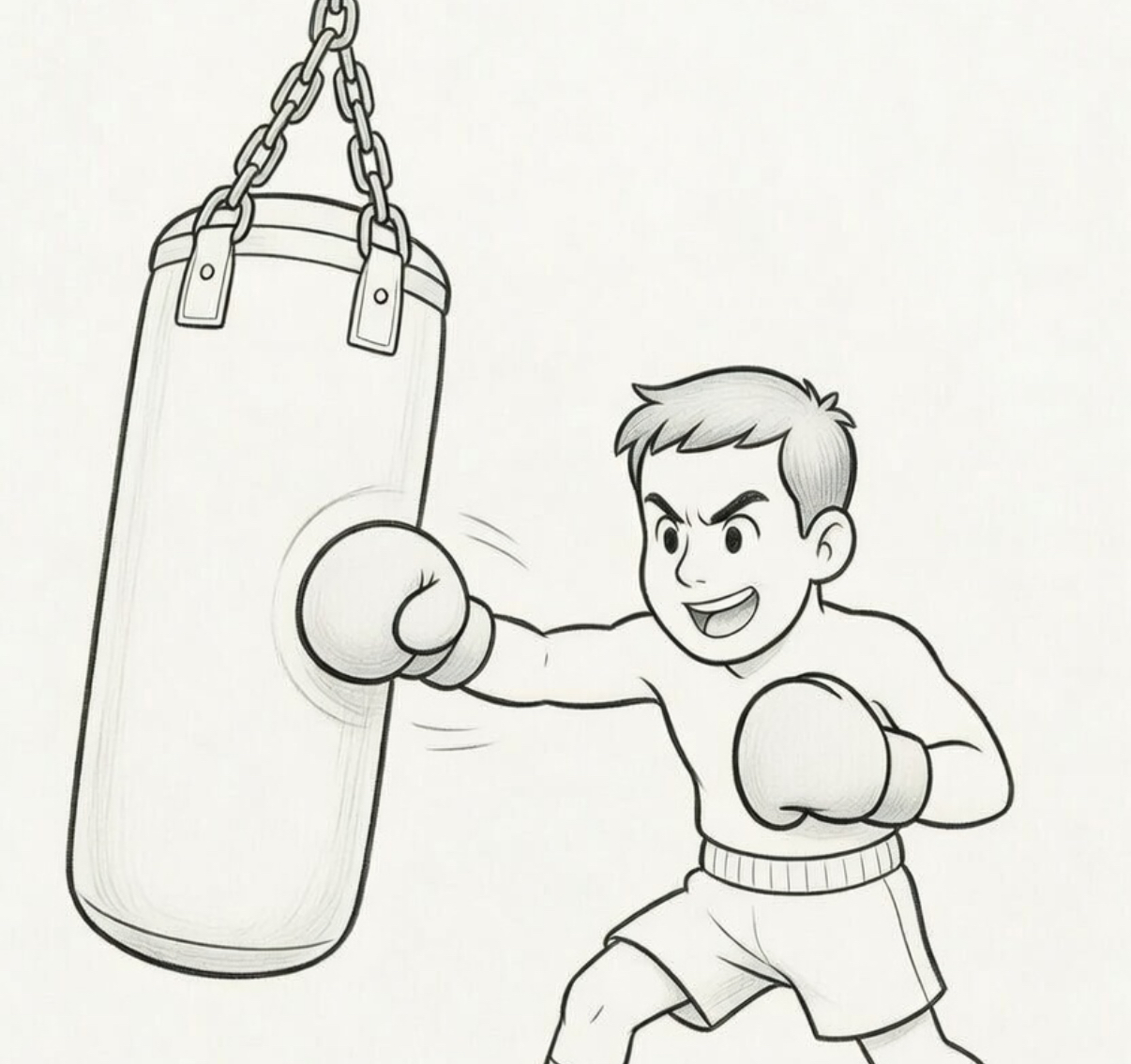

You’ve seen the guy. He walks into the gym for the first time with 18-inch arms, a chest that stretches his shirt, and traps up to his ears. He looks like he could knock someone through a wall. Then he gets on the heavy bag and gasses out in 90 seconds. Or worse, he gets in the ring with a 155-pound fighter who’s been training for two years and gets picked apart for three rounds without landing a clean shot.
Big muscles don’t mean you can fight. They don’t even mean you’re in shape. As a coach once told us: “You see all these strong muscle heads come into the gym thinking they’re gonna knock the heavy bag off its stand. The bag is undefeated.”
Arnold Schwarzenegger couldn’t box. The most perfectly sculpted physique in bodybuilding history wouldn’t last two rounds with a club fighter. That’s not disrespect — it’s a different sport built on a completely different foundation.
There is a fundamental difference between muscle built for appearance and muscle built for function — and combat sports expose that difference faster than anything else on earth. Meanwhile, some of the most aesthetic bodies in sports belong to fighters who never touched a cable crossover machine. Being lean and in boxing shape produces a physique that looks better than most gym bodies — and it can actually do something.
Show Muscle vs Go Muscle
Walk into any commercial gym and watch what people train. Chest. Biceps. Shoulders. Abs. The mirror muscles. The muscles that look good at the beach, in a fitted shirt, on Instagram. The entire bodybuilding industry is built around isolating individual muscles and making them as big as possible.
Now walk into a boxing gym. Watch what fighters train. Everything moves together. A punch is legs, hips, core, shoulder, arm — all firing in sequence. A slip is core, legs, neck. Footwork is calves, quads, hip flexors. There is no “chest day” in a boxing gym because no movement in boxing isolates the chest.
Show muscle is built through isolation. Bicep curls, chest flys, lateral raises, leg extensions. Each exercise targets one muscle group and makes it bigger. The result looks impressive but the muscles don’t know how to work together under stress. They’re decorations. Strong individually, disconnected collectively.
Go muscle is built through movement. Hitting the bag, sparring, sprinting, jumping rope, bodyweight circuits. Every exercise involves multiple muscle groups working as a chain. The result might not turn heads at the beach the same way, but it performs. It generates power. It sustains output. It recovers between rounds. It works.
Why Size Doesn’t Equal Power
A punch doesn’t come from your arms. The hardest punchers in boxing history weren’t the most muscular. Thomas Hearns was a stick figure who knocked out middleweights. Pacquiao weighed 147 pounds and put people to sleep. Julian Jackson might have had the most devastating power in boxing history and he looked like a regular person with his shirt on.
Power comes from the kinetic chain — the sequential transfer of energy from the ground through the legs, hips, core, and out through the fist. A 260-pound bodybuilder with 20-inch arms who punches with just his arm generates less force than a 160-pound fighter who sits into his shots and rotates his entire body.
Big muscles can actually inhibit this process. Overdeveloped pecs restrict shoulder rotation. Huge biceps slow hand speed. A thick, stiff torso limits the rotational flexibility that generates torque. The bodybuilder’s muscles are fighting each other — one muscle group restricting the movement that another needs to generate power.
Being big means you are slow. That’s not an insult — it’s physics. More mass requires more energy to accelerate. A 260-pound arm takes longer to extend than a 160-pound arm. In a sport measured in fractions of seconds, that difference is everything.
This is why fighters tend to have lean, functional physiques rather than bulky ones. Their bodies are built for movement, not display.
The Cardio Problem
This is where big gym bodies fall apart the fastest. Muscle is metabolically expensive — it requires oxygen and fuel to function. The more muscle mass you carry, the more oxygen your cardiovascular system has to deliver. If your heart and lungs haven’t been trained to support that demand under sustained stress, you’re carrying dead weight.
A 220-pound bodybuilder’s cardiovascular system is working overtime just to keep that muscle alive at rest. Add the demands of three-minute rounds — constant movement, punching, defensive work, the stress of someone trying to hit you — and the system crashes fast. You’ve seen it. The big guy comes out firing for 30 seconds, looks terrifying, and then spends the rest of the round with his hands on his knees trying to breathe.
Fighters build their cardio specifically to sustain output over rounds. Roadwork, sprints, bag rounds, sparring — all designed to train the heart and lungs to keep up with the demands of the sport. A fighter’s cardiovascular system is a Ferrari engine. A bodybuilder’s is a truck engine trying to haul too much weight.
The Flexibility Problem
Combat sports require range of motion that bodybuilding actively restricts. Tight pecs pull your shoulders forward. Tight lats limit overhead movement. Overdeveloped quads without corresponding hamstring and hip flexor flexibility limit your ability to level change, duck punches, and move laterally.
Boxing requires you to slip punches by bending at the waist and rotating your torso. It requires you to throw hooks with full hip rotation. It requires you to maintain a low, athletic stance for extended periods. Muay Thai requires high kicks, clinch work, and knee strikes. Wrestling and BJJ require extreme hip flexibility and the ability to move your body in positions that rigid, overdeveloped muscles simply won’t allow.
The most common injury you see when bodybuilders start combat sports isn’t bruises or cuts — it’s pulled muscles and tweaked joints. Their muscles aren’t conditioned for the dynamic, multi-directional movements that fighting demands.
What Actually Works for Combat Sports
If you want to lift weights and train combat sports — and you should, strength training is valuable for fighters — the approach needs to change.
Compound Movements Over Isolation
Do more of: Squats, deadlifts, overhead press, pull-ups, rows, cleans, kettlebell swings. These movements train multiple muscle groups working together through full ranges of motion. They build functional strength that translates directly to punching power, clinch work, takedown defense, and sustained output.
Do less of: Bicep curls, cable crossovers, leg extensions, concentration curls, lateral raises. These have their place in a bodybuilding program but they don’t build the kind of strength that makes you better in a fight. If you’re doing these, do them at the end of a session as accessories — not as the foundation of your program.
Explosive Over Slow
Fighters need to generate force quickly. A slow, controlled bench press rep doesn’t train the same quality as a medicine ball throw or a clap push-up. Power is force multiplied by speed. If you’re only training force (heavy, slow lifts), you’re missing half the equation.
Add: Box jumps, medicine ball throws, kettlebell swings, clap push-ups, hang cleans. These train your muscles to fire fast, which is what throwing a punch or shooting a takedown actually demands.
Endurance Over Size
Keep your rep ranges moderate to high. Sets of 8-15 reps build muscular endurance — the ability to sustain output over time. Sets of 1-5 reps build maximum strength, which has its place, but a fighter who can bench 400 pounds once isn’t better off than a fighter who can throw 400 hard punches in a session.
The goal isn’t to get as big as possible. The goal is to get as strong, fast, and durable as possible without adding unnecessary mass. Every pound you carry has to be fed with oxygen and fuel. If it’s not contributing to your performance, it’s slowing you down.
Core Over Everything
The core is the transmission — it transfers power from your lower body to your upper body. Without a strong, functional core, power generated by your legs dies before it reaches your fists.
Fighters train core differently than bodybuilders. Bodybuilders do crunches and cable work to make their abs visible. Fighters do rotational work — Russian twists, woodchops, medicine ball throws, anti-rotation holds — because fighting is a rotational sport. Every punch, every slip, every defensive movement involves the core rotating, bracing, or resisting rotation.
Planks, pallof presses, hanging leg raises, ab wheel rollouts, medicine ball rotational throws — these build a core that performs. Crunches build a core that looks good lying down.
The Ego Check
This is the hardest part for lifters who transition to combat sports. You walk into the gym feeling strong and confident. You’ve been the biggest person in every room for years. Then a 160-pound fighter who looks like an accountant makes you look foolish for three rounds.
It’s humbling. And it’s the best thing that can happen to you.
The skills, timing, conditioning, and functional fitness that combat sports build take time. You can’t shortcut them with muscle. The gym ego — the one that knows exactly how much you bench and how big your arms are — is useless in a boxing ring. The sooner you let it go, the sooner you start actually learning.
The good news: your strength base is an asset once you learn how to use it. A strong person who develops boxing skills is more dangerous than a skilled person with no strength. But the skills come first. The strength is the bonus, not the foundation.
The Bottom Line
There’s nothing wrong with wanting to look good. Build your beach muscles if that matters to you. But understand that the body you build in front of a mirror and the body you build hitting a heavy bag are different machines built for different purposes.
If you want a body that performs — that generates power, sustains output, moves fluidly, recovers quickly, and can handle real physical adversity — train like a fighter. The physique will follow. And it’ll be the kind of physique that actually does something, not just one that looks like it should.
Boxing for Weight Loss: Why It Works Better Than Almost Anything Else
The Heavy Bag: The Best Piece of Fitness Equipment You Can Own
How to Build a Home Gym That’s Actually Worth Training In