How boxing scoring works, what the 10-Point Must System actually means, the role of the referee and judges, every foul you need to know, and how fights are won and lost — explained for fans watching their first (or fiftieth) fight.
Boxing Rules and Scoring: Why This Matters on Fight Night
Every major fight night, the same questions flood social media: “How do the judges score rounds?” “What’s a split decision?” “Why didn’t the ref take a point?” Boxing rules and scoring can seem opaque if nobody has ever walked you through them, but the system is more logical than it looks. Understanding it transforms how you watch fights — suddenly you’re not just seeing punches, you’re reading the fight the way the judges do.
This guide covers everything from the basic rules of boxing to the 10-Point Must System, the role of officials, every common foul, and how a winner is actually determined. Whether you’re watching your first fight or your five hundredth, this is the reference you’ll keep coming back to.
The Basic Rules of Professional Boxing
Professional boxing operates under the Unified Rules of Boxing, maintained by the Association of Boxing Commissions (ABC). While individual state athletic commissions may have minor variations, these rules are the standard across the United States and serve as the foundation worldwide.
The Ring
Professional bouts take place in a square ring (yes, it’s called a “ring” despite being square) that measures between 16 and 24 feet per side, enclosed by ropes. The ring is elevated on a platform with padded corners — one red, one blue, and two white neutral corners.
Rounds and Duration
Each round lasts three minutes with a one-minute rest period between rounds. Championship and main event bouts are typically scheduled for 12 rounds, though the number varies by the significance of the fight. Undercard bouts may be scheduled for 4, 6, 8, or 10 rounds. Female professional bouts are typically scheduled in two-minute rounds for up to 10 rounds, per ABC regulatory guidelines.
Legal Punches
Boxers may only strike with the knuckle portion of a closed fist. Legal target areas are the front and sides of the head and the body above the belt line (the top of the hips). That’s it. No open-glove slaps, no backhand strikes, no hitting with the wrist, elbow, shoulder, or forearm.
Equipment
Professional boxers wear padded gloves (typically 8-10 oz depending on weight class), a fitted mouthpiece, an abdominal guard (foul protector), and hand wraps beneath the gloves. Hand wraps are restricted to no more than 20 yards of soft gauze and 8 feet of adhesive tape, applied under supervision of a commission representative. Headgear is not worn in professional boxing.
How Boxing Scoring Works: The 10-Point Must System
The 10-Point Must System is the standard scoring method used in professional boxing worldwide. It was first formally adopted by the World Boxing Council (WBC) in 1968 and is now mandated under the ABC Unified Rules. If you understand this system, you understand how every decision in boxing is reached.
The Core Principle
Three judges sit at ringside on three different sides of the ring. After each round, every judge independently scores that round on a 10-point scale. The word “must” in the name means one fighter must receive 10 points for the round (unless a point deduction changes this). The other fighter receives 10 or fewer, depending on how the round played out. Judges are not permitted to interact with each other during the fight.
What Each Score Means
| Score | What It Means |
|---|---|
| 10-9 | The most common score. One fighter won the round by a clear but not overwhelming margin. The vast majority of rounds in boxing are scored 10-9. |
| 10-10 | An even round — both fighters performed equally. Rare, but judges have the option when a round is genuinely too close to separate. |
| 10-8 | A dominant round. Awarded when one fighter overwhelms the other OR when a knockdown is scored. A knockdown automatically costs the downed fighter one point. A dominant round without a knockdown can also be scored 10-8 at the judge’s discretion. |
| 10-7 | Two knockdowns in a single round, or a knockdown combined with total dominance for the rest of the round. Extremely rare. |
| 9-9 | Can occur when the fighter who won the round also got knocked down — the knockdown deduction evens it out. |
The Four Scoring Criteria
Judges evaluate each round based on four criteria, weighted roughly in this order of priority:
1. Clean, Effective Punching — This is the most important factor. Judges are looking for punches that land cleanly on legal target areas with the knuckle portion of the glove. A hard, clean shot to the chin counts for more than three arm punches that barely connect. Quality over quantity.
2. Effective Aggressiveness — Not just walking forward, but walking forward and landing. A fighter who presses the action and gets positive results from it earns credit. Simply charging in recklessly while getting countered does not count as effective aggression.
3. Ring Generalship — Controlling the pace, distance, and positioning of the fight. The fighter who dictates where the action takes place, who uses the ring intelligently, and who executes a clear tactical game plan earns credit here. This is often the tiebreaker in very close rounds.
4. Defense — Making an opponent miss, slipping punches, blocking, and overall defensive skill. However, defense alone cannot win a round. A fighter must combine defense with effective counter-punching to earn scoring credit.
Knockdowns and the Mandatory Eight Count
When a fighter is knocked down (touches the canvas with anything other than their feet as a result of a legal blow), the referee administers a Mandatory Eight Count. Even if the downed fighter jumps right back up, the referee counts to at least eight before allowing the action to resume. This gives the referee time to assess whether the fighter is fit to continue.
Key rules around knockdowns: a fighter who has been knocked down cannot be saved by the bell in any round — the count continues regardless. If a fighter is knocked out of the ring entirely, they receive a 20-second count to return unassisted. Some state commissions enforce a Three Knockdown Rule, where three knockdowns in a single round result in an automatic TKO, though the four major sanctioning bodies (WBC, WBA, IBF, WBO) do not apply this rule.
How Fights Are Won: Every Possible Outcome
Knockout (KO)
A fighter is knocked down and cannot rise before the referee’s count reaches 10. The cleanest, most definitive result in boxing.
Technical Knockout (TKO)
The referee stops the fight because one fighter is taking too much punishment, is unable to defend themselves, or is otherwise unfit to continue. A TKO can also be called by the ringside physician or by a fighter’s corner throwing in the towel (corner stoppage).
Decision (When the Fight Goes the Distance)
If no stoppage occurs, the three judges’ scorecards determine the winner. The possible outcomes are:
| Result | What It Means |
|---|---|
| Unanimous Decision (UD) | All three judges score the fight for the same fighter. Example: 116-112, 115-113, 117-111. |
| Split Decision (SD) | Two judges score for one fighter, the third scores for the other. The fighter with two cards wins. |
| Majority Decision (MD) | Two judges score for one fighter, the third scores it a draw. The fighter with two cards wins. |
| Unanimous Draw | All three judges score the fight even. |
| Split Draw | One judge scores for Fighter A, one for Fighter B, one scores it even. |
| Majority Draw | Two judges score the fight even, the third scores for one fighter. |
Technical Decision
If an accidental foul (like an unintentional headbutt) causes an injury that stops the fight after four completed rounds, the scorecards are tallied and the fighter ahead wins by technical decision. If stopped before four completed rounds, the fight is ruled a No Decision or No Contest.
Disqualification (DQ)
A fighter who commits flagrant or repeated intentional fouls can be disqualified by the referee. Their opponent wins by DQ.
The Role of Officials
The Referee
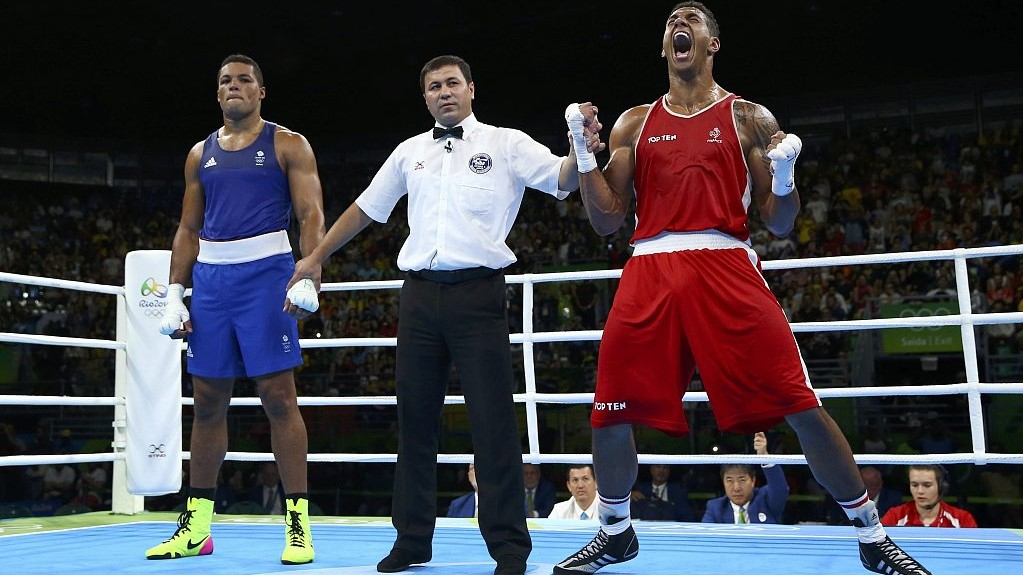
The referee is the sole authority inside the ring. Their responsibilities include enforcing the rules, issuing warnings and point deductions for fouls, administering the count after knockdowns, determining when a fighter can no longer safely continue, and stopping the fight when necessary. The referee is the only person authorized to stop a contest — not the judges, not the commission, and not the corners (though a corner can throw in the towel to request a stoppage).
Referees are certified through programs like the ABC’s official certification courses, and they are assigned to bouts by the state athletic commission overseeing the event. Under the Muhammad Ali Boxing Reform Act, all referees and judges must be certified and approved by the commission responsible for regulating the match.
The Judges
Three judges sit on three different sides of the ring to ensure varied viewing angles. They score each round independently on their scorecards using the 10-Point Must System. Judges do not communicate with each other during the fight, and they submit their scorecards after the final round (or when the fight is stopped). Like referees, judges must be certified by the state athletic commission.
The Ringside Physician
A licensed doctor sits at ringside for every professional bout. The physician can be called into the ring by the referee to examine a fighter (typically for cuts or swelling). If the physician determines a fighter cannot safely continue, they can recommend the fight be stopped — though the final call belongs to the referee.
Fouls: What You Can’t Do in Boxing
The ABC Regulatory Guidelines list 24 specific fouls. Here are the ones you’re most likely to see (or hear about) on fight night:
The Most Common Fouls
Low blows (hitting below the belt): Any punch that lands on or below the belt line (top of the hips). The fouled fighter can receive up to five minutes of recovery time. Repeated low blows result in point deductions or disqualification.
Rabbit punches (hitting the back of the head): Strikes to the back of the head or neck are strictly prohibited due to the risk of catastrophic spinal cord and brain stem injuries. The dangers are not theoretical — the tragic case of Prichard Colón, who suffered permanent brain damage from repeated rabbit punches in 2015, remains a stark reminder of why this rule exists.
Holding and hitting: Grabbing an opponent with one hand and punching with the other. Illegal, but enforcement varies — experienced fighters frequently push the boundaries here.
Excessive clinching: While brief clinches are a natural and tolerated part of boxing, deliberately holding an opponent to prevent them from fighting is a foul. The referee will break up clinches and can deduct points for repeated offenses.
Headbutts: Whether intentional or accidental, headbutts can cause fight-altering cuts. Intentional headbutts result in point deductions or disqualification. Accidental headbutts that cause injury follow the technical decision rules described above.
Hitting after the bell: When the bell sounds, the round is over. Punches thrown after the bell can result in warnings or point deductions.
Hitting on the break: When the referee separates fighters from a clinch, both must take a full step back before resuming. Throwing punches during the break is a foul.
Other Notable Fouls
Hitting a downed opponent — striking a fighter who is on the canvas or getting up from a knockdown. Kidney punches — targeting the back of the body over the kidneys. Using the ropes — holding the ropes for leverage while punching. Spitting out the mouthpiece — intentionally doing so to buy recovery time. Hitting with an open glove — including the wrist, inside, back, or side of the hand. Ducking below the opponent’s belt — dropping your head dangerously low.
How Fouls Are Penalized
The referee has discretion in how fouls are handled. The typical escalation is: verbal warning on the first offense, followed by a point deduction for repeated violations. For intentional fouls that cause injury, the Unified Rules mandate an automatic two-point deduction. Flagrant or persistent fouling can result in disqualification at the referee’s discretion.
Point deductions are applied after the judge’s initial round score. So if a fighter wins the round 10-9 but loses a point for a foul, the round becomes 9-9 on that card.
Reading the Scorecards: What the Numbers Mean
When the ring announcer reads “116-112, 115-113, 114-114,” here’s what those numbers represent. Take a 12-round fight scored 116-112 for Fighter A: that judge gave Fighter A ten rounds (10 points each = 100) and Fighter B two rounds (10 points each = 20), while giving Fighter B 9 points in the ten rounds they lost (9 × 10 = 90) plus their 20 for the rounds they won. So: Fighter A gets 100 + (2 × 9) = 118… actually, the simplest way to think about it:
In a 12-round fight with no knockdowns or deductions, the “baseline” score is 120-108 (if one fighter won every round 10-9). A score of 114-114 means the judge saw it dead even — six rounds each. Every point above or below 114 represents a round swinging one way or the other. A 10-8 round (from a knockdown) creates a two-point gap instead of one, which is why a single knockdown can be the difference in a close fight.
Why Scoring Controversies Happen
Boxing judging is inherently subjective. Two reasonable people can watch the same round and disagree on who won it. The scoring criteria are listed in order of priority, but the Unified Rules don’t assign hard percentages to each factor, leaving room for interpretation. Some judges favor volume punching; others reward the fighter who lands fewer but harder shots. Some credit ring generalship heavily in close rounds; others barely consider it.
Common sources of controversy include: hometown bias (fighters competing in their home market sometimes receive favorable scoring in close rounds), inconsistent application of 10-8 rounds (some judges reserve this score exclusively for knockdown rounds, while others use it for total domination without a knockdown), and the fundamental challenge of three people watching the same fight from different angles and reaching different conclusions about what they saw.
This is why knockouts are valued so highly in boxing — they remove all ambiguity. And it’s why the push for additional scoring transparency (open scoring, real-time scorecards, even technology-assisted judging) remains an active conversation in the sport.
Amateur vs. Professional: Key Differences
| Rule | Professional | Amateur (Olympic-style) |
|---|---|---|
| Rounds | 4-12 rounds, 3 minutes each | 3 rounds, 3 minutes each (men) / 2 minutes (women) |
| Headgear | Not allowed | Optional for elite men; required for youth |
| Gloves | 8-10 oz (varies by weight) | 10 oz for all divisions |
| Scoring | 10-Point Must, 3 judges | 10-Point Must, 5 judges |
| Standing 8 Count | Varies by commission | Used in most competitions |
| Governing Body | State commissions + WBC/WBA/IBF/WBO | World Boxing / National federations |
Essential Links & Resources
Official Rules & Regulatory Bodies
- ABC Unified Rules of Boxing: abcboxing.com/unified-rules-boxing — The official rules that govern professional boxing in the United States.
- ABC Regulatory Guidelines: abcboxing.com/abc-regulatory-guidelines — Complete list of fouls, referee procedures, equipment requirements, and medical standards.
- Association of Boxing Commissions (ABC): abcboxing.com — The umbrella organization for state and tribal athletic commissions across the U.S. and Canada.
- Muhammad Ali Boxing Reform Act: abcboxing.com/boxing-acts — The federal legislation establishing safety standards and anti-corruption measures for professional boxing.
- New Jersey State Athletic Control Board: njoag.gov/sacb — Regulates all unarmed combat in New Jersey; developed the original Unified Rules of MMA adopted nationwide.
- USA Boxing: usaboxing.org — The national governing body for Olympic-style amateur boxing in the United States.
Sanctioning Bodies
- World Boxing Council (WBC): wbcboxing.com
- World Boxing Association (WBA): wbaboxing.com
- International Boxing Federation (IBF): ibf-usba-boxing.com
- World Boxing Organization (WBO): wboboxing.com
Boxing Insider covers professional boxing from the inside — promotions, rules, rankings, and the business behind the sport. For our companion cornerstone article, see Boxing Weight Classes Explained: The Complete Guide.