
Las Vegas wasn’t built for boxing, but boxing helped build Las Vegas. What began as a desert gamble in the 1950s — a single fight at a dusty ballpark — evolved into a relationship that transformed both the sport and the city. Today, Las Vegas is the undisputed boxing capital of the world, the place where the biggest fights happen, the richest purses are paid, and the most memorable moments in modern boxing history have unfolded. The story of how it got there is a story of vision, money, spectacle, and a city that understood the fight game better than any other.
Before the Strip: Nevada’s Early Boxing History
Boxing in Nevada predates Las Vegas itself. In the late 19th and early 20th centuries, when most states had outlawed prizefighting, Nevada was one of the few places in America where two men could legally step into a ring and settle things with their fists. The state’s permissive laws attracted some of the sport’s biggest events long before the Strip existed.
The most significant early fight took place in Carson City in 1897, when Bob Fitzsimmons knocked out “Gentleman Jim” Corbett to win the heavyweight championship — one of the landmark bouts in boxing history. In 1910, promoter Tex Rickard staged the infamous Jack Johnson vs. James J. Jeffries fight in Reno, a racially charged event billed as the search for a “Great White Hope” that drew national attention and triggered race riots across the country after Johnson’s victory. Rickard would later leave Nevada for New York, where he built Madison Square Garden into boxing’s premier venue — but the seeds of Nevada’s relationship with the sport had already been planted.
For the next four decades, boxing in Nevada was relatively quiet. The state’s small population and remote location couldn’t compete with the massive audiences in New York, Chicago, and Philadelphia. But everything was about to change.
The 1955 Fight That Started It All
The event widely cited as the birth of big-time boxing in Las Vegas took place on May 2, 1955, at Cashman Field. Former light heavyweight champion Archie Moore fought Cuban heavyweight contender Nino Valdes in a bout that was supposed to position the winner for a shot at Rocky Marciano’s heavyweight title.
Promoter Doc Kearns had convinced local casino operators to put up $100,000 to bankroll the fight — an early example of the casino-funded model that would come to define Las Vegas boxing. Former heavyweight champion James J. Braddock served as referee. The fight itself was competitive, with Moore winning a 15-round decision, but the attendance was disappointing — roughly 6,000 fans, less than half of what Kearns had projected. The outdoor setting at Cashman Field didn’t help: Moore cleverly kept his back to the setting sun, forcing Valdes to squint into the glare.
Kearns never promoted in Las Vegas again. But the concept had been proven. Casinos were willing to invest in boxing as a vehicle to attract visitors, fill hotel rooms, and drive gambling revenue. The sport just needed a better venue.
The Convention Center Era: Boxing Finds a Home
In 1960, boxing moved indoors to the brand-new Las Vegas Convention Center, and the sport’s presence in the city became permanent. The first championship fight in Las Vegas history took place there on May 27, 1960, when Benny “Kid” Paret outpointed Don Jordan for the welterweight title. Fewer than 5,000 fans attended a forgettable fight — but the door was open.
Throughout the 1960s, the Convention Center hosted increasingly significant bouts as Las Vegas began to attract the biggest names in boxing. Sonny Liston fought Floyd Patterson there in their second meeting. Muhammad Ali appeared on multiple cards. The venue offered everything the outdoor Cashman Field couldn’t: climate control, proper seating, professional lighting for television cameras, and proximity to the growing cluster of casinos along the Strip.
The casino operators understood something that would shape the next six decades of boxing: the fights themselves didn’t need to be profitable. What mattered was getting high-rollers into town. A championship fight was the ultimate lure — an event that could fill hotel rooms for an entire weekend, pack restaurants, and keep the casino floors humming. The casinos were willing to pay enormous site fees to promoters, subsidizing purses that no other city could match. It was an economic model that New York, with its union halls and garden arenas, simply couldn’t replicate.
Caesars Palace: The Cathedral of 1980s Boxing
If one venue defined Las Vegas boxing, it was the outdoor arena at Caesars Palace. The first boxing event at Caesars was a 1969 amateur exhibition between the United States and Soviet Union teams, but it was during the 1980s that the hotel became the most famous fight venue on earth.
The arena was temporary — a specially constructed outdoor stadium erected on the Caesars Palace tennis courts and parking areas for each major fight, then dismantled afterward. But there was nothing temporary about the atmosphere. Under the desert sky, with the lights of the Strip shimmering in the background and the biggest celebrities in the world packed into ringside seats, a championship fight at Caesars Palace was the most glamorous event in all of sports.
The fights staged there read like a greatest-hits album of the era. Larry Holmes fought Muhammad Ali under the Caesars lights in 1980, in the sad spectacle that marked Ali’s decline. Holmes then defended his title against Gerry Cooney in 1982 before 29,214 fans — still the largest crowd ever for a fight in Southern Nevada. But it was the rivalry between Sugar Ray Leonard, Marvelous Marvin Hagler, Thomas “Hitman” Hearns, and Roberto Duran — the “Four Kings” — that elevated Caesars Palace to legendary status.
Leonard stopped Hearns in the 14th round of their first fight in September 1981, in what Ring magazine named Fight of the Year — a bout that grossed $38 million, a record at the time. Hagler and Hearns produced what many consider the greatest three rounds in boxing history on April 15, 1985 — eight minutes and one second of pure fury that ended with Hagler’s third-round knockout and earned another Fight of the Year. Leonard came out of retirement to upset Hagler in a controversial 1987 split decision that is still debated today. All of it happened outdoors at Caesars Palace.
There were other unforgettable moments. Ray Mancini’s 1982 fight with Duk Koo Kim ended in tragedy when Kim collapsed after 14 brutal rounds and died from his injuries — a fight that led directly to the reduction of championship bouts from 15 rounds to 12. Evander Holyfield and Riddick Bowe staged their wild 1993 rematch at Caesars, the one where a paraglider known as the “Fan Man” descended from the sky and crashed into the ring during the seventh round.
Caesars Palace eventually ceded its boxing throne to newer venues, but its place in the sport’s history is permanent. As former Nevada Athletic Commission executive director Marc Ratner put it: “Outside, under the stars, big fights in a great era for boxing. That’s what made it special. There was no other venue in the world like that.”
The MGM Grand: Tyson, Mayweather, and the Pay-Per-View Explosion
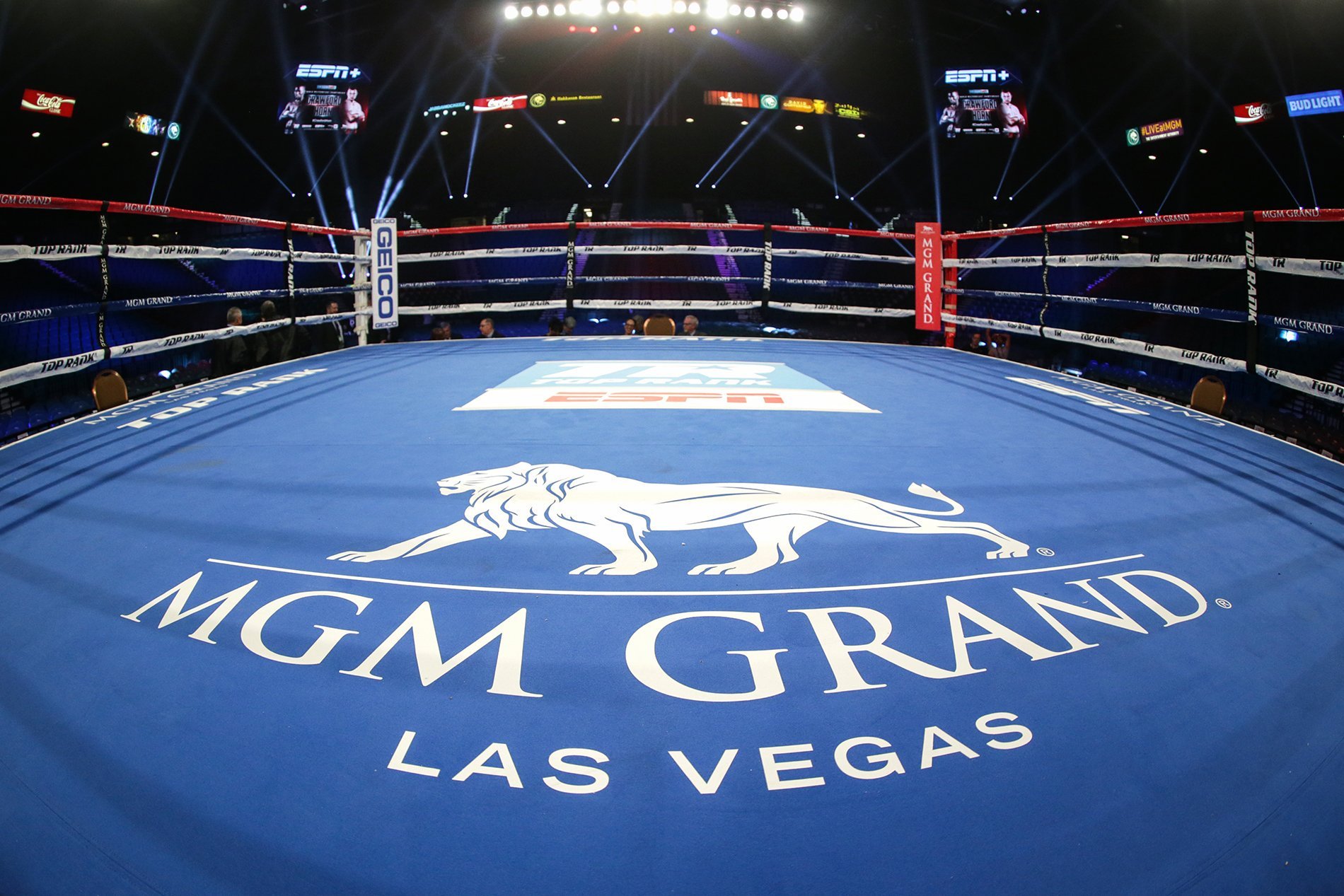
The MGM Grand Garden Arena opened in the early 1990s inside the largest hotel in the United States, and quickly became the default home for boxing’s biggest pay-per-view events. If Caesars Palace was the cathedral of 1980s boxing, the MGM Grand was its modern throne room.
Mike Tyson was the first superstar to make the MGM his stage. His fights there drew massive pay-per-view audiences and turned fight weekends into citywide events. But Tyson also produced the MGM Grand’s most infamous moment: on June 28, 1997, during his rematch with Evander Holyfield, Tyson bit a chunk out of Holyfield’s ear in the third round, then bit the other ear moments later. Referee Mills Lane disqualified Tyson, and the “Bite Fight” became one of the most shocking incidents in sports history. It was Lane’s final championship bout.
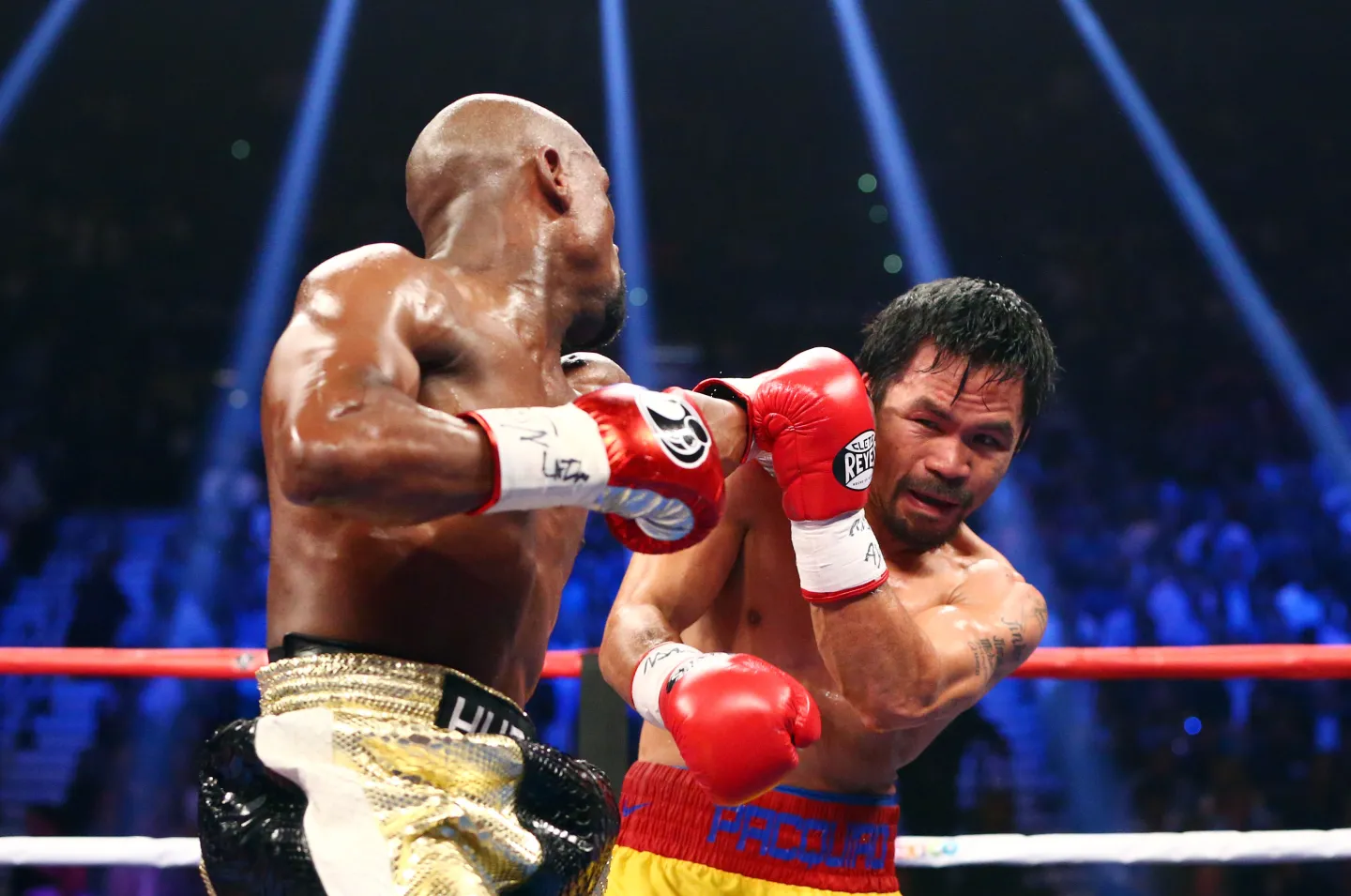
Floyd Mayweather Jr. then turned the MGM Grand into his personal fortress. Fighting there more than a dozen times, Mayweather headlined card after card as the sport’s biggest attraction, including the long-awaited showdown with Manny Pacquiao on May 2, 2015 — billed as “The Fight of the Century.” The fight generated 4.6 million pay-per-view buys, a $72 million live gate, and approximately $600 million in total revenue, making it the richest event in boxing history. Mayweather won a unanimous decision in a tactical, if not action-packed, performance that capped the most commercially successful career the sport has ever seen.
Oscar De La Hoya, Canelo Alvarez, Lennox Lewis, and virtually every major name of the past three decades has fought under the MGM Grand’s roof. The arena’s location on the Strip, surrounded by casinos and nightlife, creates an event atmosphere that extends well beyond the arena walls. Fight week at the MGM Grand is an experience unto itself.
T-Mobile Arena: The New King of the Strip
Opened in 2016, T-Mobile Arena wasted no time establishing itself as the next great Las Vegas fight venue. The 20,000-seat arena, located between the New York-New York and Park MGM resorts, hosted Canelo Alvarez knocking out Amir Khan in one of its first events.
The arena’s signature moment came quickly. Floyd Mayweather Jr. vs. Conor McGregor in August 2017 was a crossover spectacle that generated 4.3 million pay-per-view buys and saw Mayweather finish his career 50-0. The Canelo-Golovkin rivalry played out across multiple fights at T-Mobile. Perhaps most memorably, Tyson Fury and Deontay Wilder delivered an instant classic in their third meeting in October 2021, with Fury scoring an 11th-round knockout in a fight named Ring magazine’s Fight of the Year.
With state-of-the-art production capabilities and a prime Strip location, T-Mobile Arena has inherited much of the MGM Grand’s crown as the go-to venue for boxing’s biggest nights.
The Thomas & Mack, Mandalay Bay, and the Supporting Cast
Las Vegas’s boxing ecosystem has never been a one-venue story. The Thomas & Mack Center on the UNLV campus hosted some of the sport’s most significant fights for decades, including Evander Holyfield vs. Lennox Lewis in their 1999 rematch. At 19,500 seats, it offered a larger capacity than the casino arenas and was ideal for mega-events expected to draw massive crowds.
Mandalay Bay Events Center (now Michelob Ultra Arena) earned its place in history by hosting Oscar De La Hoya vs. Felix Trinidad in 1999 — “The Fight of the Millennium” — along with numerous other championship bouts. The Las Vegas Hilton (now the Westgate) was another important venue, hosting Ali’s 1978 rematch with Leon Spinks where Ali regained the heavyweight title for an unprecedented third time.
Even smaller venues have played roles. The Showboat Casino, the Riviera, the Mirage — which hosted the final chapter of the Leonard-Duran trilogy just 15 days after the mega-resort opened its doors in 1989 — all contributed to the fabric of Las Vegas boxing. The city’s ability to host fights at every level, from 2,000-seat casino showrooms to 20,000-seat arenas, has kept it relevant across every era of the sport.
Don King, Bob Arum, and the Promoters Who Built Vegas Boxing
Las Vegas didn’t become the boxing capital by accident. Two promoters, more than anyone else, built the infrastructure that made it happen: Don King and Bob Arum.
King, the flamboyant, electric-haired impresario from Cleveland, brought Mike Tyson, Evander Holyfield, Julio César Chávez, and dozens of other champions to Las Vegas. His relationship with the city’s casinos was symbiotic — King delivered the fighters and the spectacle, the casinos delivered the site fees and the infrastructure. King’s promotional style was bombastic, controversial, and often legally questionable, but there’s no denying his impact on making Las Vegas the center of the boxing world during the 1980s and 1990s.
Arum, the Harvard-educated lawyer who founded Top Rank Promotions, brought a different but equally significant approach. Where King was chaos, Arum was calculation. Top Rank promoted fighters including Oscar De La Hoya, Manny Pacquiao, Floyd Mayweather Jr. (early in his career), and more recently Tyson Fury, Terence Crawford, and Canelo Alvarez. Arum’s long-standing relationships with Las Vegas venues and his television deals with HBO, ESPN, and other networks helped ensure a steady pipeline of major events to the city for decades.
The rivalry between King and Arum — and later with Al Haymon’s Premier Boxing Champions — shaped the competitive landscape that kept Las Vegas at the forefront. Promoters fought over venues, television slots, and fighters, but the end result was a constant flow of world-class boxing to the city.
The Casino Model: How Money Changed Everything
The genius of Las Vegas boxing was always the money — specifically, the casino site fee model that no other city could replicate. Caesars Palace president Bob Halloran explained the logic simply: “We’re in the business of filling hotel rooms, selling food, entertaining people, selling merchandise and gambling. Boxing gives Caesars Palace worldwide exposure, and you can’t measure what that means for us.”
Under this model, casinos paid promoters millions of dollars in site fees to host fights, essentially subsidizing fighter purses in exchange for the economic activity a major fight weekend generated. High-rollers — the “whales” — received complimentary tickets, free hotel suites, and other perks designed to keep them gambling. A single weekend built around a championship fight could generate tens of millions of dollars in casino revenue, making the site fee a bargain by comparison.
This model had enormous consequences for the sport. It pushed purses far beyond what traditional gate revenue could support, making Las Vegas the only place where fighters could earn truly life-changing money. It also concentrated the sport’s biggest events in a single city, giving Las Vegas a monopoly on the megafight that lasted for decades. Nevada’s legal sports betting added another layer — fans could walk from ringside to the sportsbook and wager on the fights, creating an integrated entertainment experience that no other jurisdiction could match during the decades before sports betting spread nationwide.
HBO, Pay-Per-View, and the Television Revolution
Las Vegas boxing didn’t just happen in arenas — it happened on television, and the city’s relationship with HBO and the pay-per-view model fundamentally reshaped the sport’s economics.
HBO’s boxing programming, which ran from 1973 to 2018, was inseparable from Las Vegas. Shows like HBO World Championship Boxing, Boxing After Dark, and later the groundbreaking 24/7 docuseries (which debuted with De La Hoya-Mayweather in 2007) turned fight weeks into media events that built anticipation for weeks before the opening bell. The 24/7 format — following fighters through training camp with cinematic production values — became the template for modern fight promotion and helped push pay-per-view buys to record levels.
Pay-per-view itself was the economic engine that powered the megafight era. When Mayweather-Pacquiao generated 4.6 million buys in 2015, it produced more revenue in a single night than most sports franchises generate in a season. That kind of money was only possible because Las Vegas provided the stage — the venues, the celebrity culture, the media infrastructure, and the brand recognition that made a “championship fight in Vegas” the ultimate premium entertainment product.
HBO ended its boxing programming in 2018, but the model has survived through ESPN, DAZN, Showtime (before its closure), and streaming platforms. Las Vegas remains the default location for the sport’s biggest broadcasts.
The Fights That Defined Las Vegas
Any list of the greatest fights in Las Vegas history could fill an article of its own, but certain moments stand above the rest.
Leonard vs. Hearns I (1981) was the first true megafight on the Strip, a welterweight unification classic that put Caesars Palace on the global boxing map. Hagler vs. Hearns (1985) produced the most electrifying three rounds the sport has ever seen. Leonard vs. Hagler (1987) delivered one of the most controversial decisions in history. Together, the “Four Kings” era defined what a Las Vegas superfight could be.
Tyson vs. Holyfield II (1997) — the Bite Fight — was the most shocking moment in the city’s boxing history. Mayweather vs. Pacquiao (2015) was the richest. Julio César Chávez vs. Meldrick Taylor (1990), where Chávez knocked out the leading Taylor with just two seconds remaining in the fight, was one of the most dramatic finishes ever — though it took place at the Las Vegas Hilton, not the more famous Strip venues.
More recently, Fury vs. Wilder III (2021) at T-Mobile Arena delivered the kind of heavyweight drama that the sport had been missing, with Fury surviving two knockdowns to stop Wilder in the 11th round. Canelo Alvarez has headlined numerous Las Vegas cards, including his undisputed super middleweight unification against Caleb Plant at the MGM Grand in 2021.
Boxing in Las Vegas Today
Las Vegas in the 21st century faces more competition for major fights than ever before. Saudi Arabia’s Public Investment Fund has poured enormous money into boxing, luring events like Fury vs. Usyk and other megafights to Riyadh. The UK stadium circuit — Wembley, Tottenham Hotspur Stadium — has demonstrated that outdoor events can draw 90,000-plus fans. AT&T Stadium in Arlington, Texas has set American attendance records.
But Las Vegas retains advantages that no other city can fully replicate. The concentration of world-class venues within walking distance of each other. The hotel infrastructure that can absorb tens of thousands of fight fans on short notice. The media ecosystem built over decades. The brand itself — “championship fight in Las Vegas” still carries a weight that no other location matches.
The MGM Grand and T-Mobile Arena continue to host the sport’s biggest events. The Resorts World Theatre and other newer venues have added capacity. And the fundamental economic logic — casinos subsidizing fights to drive broader revenue — remains intact, even as the specific mechanisms have evolved.
Zuffa Boxing and the Meta Apex: A New Chapter
In 2026, the Las Vegas boxing landscape gained a new player when Zuffa Boxing — the promotion launched by UFC parent company TKO Group Holdings in partnership with Saudi Arabia’s Sela Sport — began staging regular fight cards at the Meta Apex, a purpose-built live events and production facility near UFC headquarters in Enterprise, Nevada. Originally opened in 2019 as the UFC Apex, the venue was rebranded following a naming rights deal with Meta and expanded to accommodate approximately 1,000 fans with public ticket sales for the first time. The Zuffa Boxing model borrows heavily from the UFC playbook: centralized matchmaking, in-house production, a streaming-first distribution strategy, and a high-volume schedule designed to develop talent and build a roster. The intimate Meta Apex setting is a deliberate departure from the arena-scale spectacles that defined Las Vegas boxing for decades, functioning more as a proving ground and content engine than a destination venue. Whether the promotion evolves into a major force in the sport remains to be seen, but its arrival adds another layer to a city that has reinvented its relationship with boxing in every era — from outdoor bleachers at Cashman Field to the temporary grandstands at Caesars Palace to the neon-lit arenas of the modern Strip.
From a dusty outdoor bleacher at Cashman Field in 1955 to the neon-lit spectacles of the modern Strip to a tech-branded production studio just off the highway, Las Vegas has been boxing’s stage for seven decades. The city didn’t invent the sport — New York holds that claim — but it perfected the art of presenting it. When people around the world picture a championship fight, they picture Las Vegas. That image was earned one bout at a time, from Moore-Valdes to Mayweather-Pacquiao, and with Zuffa Boxing adding a new chapter, the story is still being written.
For more boxing history, check out our complete guides to The Top Boxing Venues of All Time, The History of Boxing in New York City, Boxing Weight Classes Explained, and Boxing Rules & Scoring: The 10-Point Must System.
Vegas wasn’t built for boxing, but boxing helped build Las Vegas. What began as a desert gamble in the 1950s — a single fight at a dusty ballpark — evolved into a relationship that transformed both the sport and the city. Today, Las Vegas is the undisputed boxing capital of the world, the place where the biggest fights happen, the richest purses are paid, and the most memorable moments in modern boxing history have unfolded. The story of how it got there is a story of vision, money, spectacle, and a city that understood the fight game better than any other.
Before the Strip: Nevada’s Early Boxing History
Boxing in Nevada predates Las Vegas itself. In the late 19th and early 20th centuries, when most states had outlawed prizefighting, Nevada was one of the few places in America where two men could legally step into a ring and settle things with their fists. The state’s permissive laws attracted some of the sport’s biggest events long before the Strip existed.
The most significant early fight took place in Carson City in 1897, when Bob Fitzsimmons knocked out “Gentleman Jim” Corbett to win the heavyweight championship — one of the landmark bouts in boxing history. In 1910, promoter Tex Rickard staged the infamous Jack Johnson vs. James J. Jeffries fight in Reno, a racially charged event billed as the search for a “Great White Hope” that drew national attention and triggered race riots across the country after Johnson’s victory. Rickard would later leave Nevada for New York, where he built Madison Square Garden into boxing’s premier venue — but the seeds of Nevada’s relationship with the sport had already been planted.
For the next four decades, boxing in Nevada was relatively quiet. The state’s small population and remote location couldn’t compete with the massive audiences in New York, Chicago, and Philadelphia. But everything was about to change.
The 1955 Fight That Started It All
The event widely cited as the birth of big-time boxing in Las Vegas took place on May 2, 1955, at Cashman Field. Former light heavyweight champion Archie Moore fought Cuban heavyweight contender Nino Valdes in a bout that was supposed to position the winner for a shot at Rocky Marciano’s heavyweight title.
Promoter Doc Kearns had convinced local casino operators to put up $100,000 to bankroll the fight — an early example of the casino-funded model that would come to define Las Vegas boxing. Former heavyweight champion James J. Braddock served as referee. The fight itself was competitive, with Moore winning a 15-round decision, but the attendance was disappointing — roughly 6,000 fans, less than half of what Kearns had projected. The outdoor setting at Cashman Field didn’t help: Moore cleverly kept his back to the setting sun, forcing Valdes to squint into the glare.
Kearns never promoted in Las Vegas again. But the concept had been proven. Casinos were willing to invest in boxing as a vehicle to attract visitors, fill hotel rooms, and drive gambling revenue. The sport just needed a better venue.
The Convention Center Era: Boxing Finds a Home
In 1960, boxing moved indoors to the brand-new Las Vegas Convention Center, and the sport’s presence in the city became permanent. The first championship fight in Las Vegas history took place there on May 27, 1960, when Benny “Kid” Paret outpointed Don Jordan for the welterweight title. Fewer than 5,000 fans attended a forgettable fight — but the door was open.
Throughout the 1960s, the Convention Center hosted increasingly significant bouts as Las Vegas began to attract the biggest names in boxing. Sonny Liston fought Floyd Patterson there in their second meeting. Muhammad Ali appeared on multiple cards. The venue offered everything the outdoor Cashman Field couldn’t: climate control, proper seating, professional lighting for television cameras, and proximity to the growing cluster of casinos along the Strip.
The casino operators understood something that would shape the next six decades of boxing: the fights themselves didn’t need to be profitable. What mattered was getting high-rollers into town. A championship fight was the ultimate lure — an event that could fill hotel rooms for an entire weekend, pack restaurants, and keep the casino floors humming. The casinos were willing to pay enormous site fees to promoters, subsidizing purses that no other city could match. It was an economic model that New York, with its union halls and garden arenas, simply couldn’t replicate.
Caesars Palace: The Cathedral of 1980s Boxing
If one venue defined Las Vegas boxing, it was the outdoor arena at Caesars Palace. The first boxing event at Caesars was a 1969 amateur exhibition between the United States and Soviet Union teams, but it was during the 1980s that the hotel became the most famous fight venue on earth.
The arena was temporary — a specially constructed outdoor stadium erected on the Caesars Palace tennis courts and parking areas for each major fight, then dismantled afterward. But there was nothing temporary about the atmosphere. Under the desert sky, with the lights of the Strip shimmering in the background and the biggest celebrities in the world packed into ringside seats, a championship fight at Caesars Palace was the most glamorous event in all of sports.
The fights staged there read like a greatest-hits album of the era. Larry Holmes fought Muhammad Ali under the Caesars lights in 1980, in the sad spectacle that marked Ali’s decline. Holmes then defended his title against Gerry Cooney in 1982 before 29,214 fans — still the largest crowd ever for a fight in Southern Nevada. But it was the rivalry between Sugar Ray Leonard, Marvelous Marvin Hagler, Thomas “Hitman” Hearns, and Roberto Duran — the “Four Kings” — that elevated Caesars Palace to legendary status.
Leonard stopped Hearns in the 14th round of their first fight in September 1981, in what Ring magazine named Fight of the Year — a bout that grossed $38 million, a record at the time. Hagler and Hearns produced what many consider the greatest three rounds in boxing history on April 15, 1985 — eight minutes and one second of pure fury that ended with Hagler’s third-round knockout and earned another Fight of the Year. Leonard came out of retirement to upset Hagler in a controversial 1987 split decision that is still debated today. All of it happened outdoors at Caesars Palace.
There were other unforgettable moments. Ray Mancini’s 1982 fight with Duk Koo Kim ended in tragedy when Kim collapsed after 14 brutal rounds and died from his injuries — a fight that led directly to the reduction of championship bouts from 15 rounds to 12. Evander Holyfield and Riddick Bowe staged their wild 1993 rematch at Caesars, the one where a paraglider known as the “Fan Man” descended from the sky and crashed into the ring during the seventh round.
Caesars Palace eventually ceded its boxing throne to newer venues, but its place in the sport’s history is permanent. As former Nevada Athletic Commission executive director Marc Ratner put it: “Outside, under the stars, big fights in a great era for boxing. That’s what made it special. There was no other venue in the world like that.”
The MGM Grand: Tyson, Mayweather, and the Pay-Per-View Explosion
The MGM Grand Garden Arena opened in the early 1990s inside the largest hotel in the United States, and quickly became the default home for boxing’s biggest pay-per-view events. If Caesars Palace was the cathedral of 1980s boxing, the MGM Grand was its modern throne room.
Mike Tyson was the first superstar to make the MGM his stage. His fights there drew massive pay-per-view audiences and turned fight weekends into citywide events. But Tyson also produced the MGM Grand’s most infamous moment: on June 28, 1997, during his rematch with Evander Holyfield, Tyson bit a chunk out of Holyfield’s ear in the third round, then bit the other ear moments later. Referee Mills Lane disqualified Tyson, and the “Bite Fight” became one of the most shocking incidents in sports history. It was Lane’s final championship bout.
Floyd Mayweather Jr. then turned the MGM Grand into his personal fortress. Fighting there more than a dozen times, Mayweather headlined card after card as the sport’s biggest attraction, including the long-awaited showdown with Manny Pacquiao on May 2, 2015 — billed as “The Fight of the Century.” The fight generated 4.6 million pay-per-view buys, a $72 million live gate, and approximately $600 million in total revenue, making it the richest event in boxing history. Mayweather won a unanimous decision in a tactical, if not action-packed, performance that capped the most commercially successful career the sport has ever seen.
Oscar De La Hoya, Canelo Alvarez, Lennox Lewis, and virtually every major name of the past three decades has fought under the MGM Grand’s roof. The arena’s location on the Strip, surrounded by casinos and nightlife, creates an event atmosphere that extends well beyond the arena walls. Fight week at the MGM Grand is an experience unto itself.
T-Mobile Arena: The New King of the Strip
Opened in 2016, T-Mobile Arena wasted no time establishing itself as the next great Las Vegas fight venue. The 20,000-seat arena, located between the New York-New York and Park MGM resorts, hosted Canelo Alvarez knocking out Amir Khan in one of its first events.
The arena’s signature moment came quickly. Floyd Mayweather Jr. vs. Conor McGregor in August 2017 was a crossover spectacle that generated 4.3 million pay-per-view buys and saw Mayweather finish his career 50-0. The Canelo-Golovkin rivalry played out across multiple fights at T-Mobile. Perhaps most memorably, Tyson Fury and Deontay Wilder delivered an instant classic in their third meeting in October 2021, with Fury scoring an 11th-round knockout in a fight named Ring magazine’s Fight of the Year.
With state-of-the-art production capabilities and a prime Strip location, T-Mobile Arena has inherited much of the MGM Grand’s crown as the go-to venue for boxing’s biggest nights.
The Thomas & Mack, Mandalay Bay, and the Supporting Cast
Las Vegas’s boxing ecosystem has never been a one-venue story. The Thomas & Mack Center on the UNLV campus hosted some of the sport’s most significant fights for decades, including Evander Holyfield vs. Lennox Lewis in their 1999 rematch. At 19,500 seats, it offered a larger capacity than the casino arenas and was ideal for mega-events expected to draw massive crowds.
Mandalay Bay Events Center (now Michelob Ultra Arena) earned its place in history by hosting Oscar De La Hoya vs. Felix Trinidad in 1999 — “The Fight of the Millennium” — along with numerous other championship bouts. The Las Vegas Hilton (now the Westgate) was another important venue, hosting Ali’s 1978 rematch with Leon Spinks where Ali regained the heavyweight title for an unprecedented third time.
Even smaller venues have played roles. The Showboat Casino, the Riviera, the Mirage — which hosted the final chapter of the Leonard-Duran trilogy just 15 days after the mega-resort opened its doors in 1989 — all contributed to the fabric of Las Vegas boxing. The city’s ability to host fights at every level, from 2,000-seat casino showrooms to 20,000-seat arenas, has kept it relevant across every era of the sport.
Don King, Bob Arum, and the Promoters Who Built Vegas Boxing
Las Vegas didn’t become the boxing capital by accident. Two promoters, more than anyone else, built the infrastructure that made it happen: Don King and Bob Arum.
King, the flamboyant, electric-haired impresario from Cleveland, brought Mike Tyson, Evander Holyfield, Julio César Chávez, and dozens of other champions to Las Vegas. His relationship with the city’s casinos was symbiotic — King delivered the fighters and the spectacle, the casinos delivered the site fees and the infrastructure. King’s promotional style was bombastic, controversial, and often legally questionable, but there’s no denying his impact on making Las Vegas the center of the boxing world during the 1980s and 1990s.
Arum, the Harvard-educated lawyer who founded Top Rank Promotions, brought a different but equally significant approach. Where King was chaos, Arum was calculation. Top Rank promoted fighters including Oscar De La Hoya, Manny Pacquiao, Floyd Mayweather Jr. (early in his career), and more recently Tyson Fury, Terence Crawford, and Canelo Alvarez. Arum’s long-standing relationships with Las Vegas venues and his television deals with HBO, ESPN, and other networks helped ensure a steady pipeline of major events to the city for decades.
The rivalry between King and Arum — and later with Al Haymon’s Premier Boxing Champions — shaped the competitive landscape that kept Las Vegas at the forefront. Promoters fought over venues, television slots, and fighters, but the end result was a constant flow of world-class boxing to the city.
The Casino Model: How Money Changed Everything
The genius of Las Vegas boxing was always the money — specifically, the casino site fee model that no other city could replicate. Caesars Palace president Bob Halloran explained the logic simply: “We’re in the business of filling hotel rooms, selling food, entertaining people, selling merchandise and gambling. Boxing gives Caesars Palace worldwide exposure, and you can’t measure what that means for us.”
Under this model, casinos paid promoters millions of dollars in site fees to host fights, essentially subsidizing fighter purses in exchange for the economic activity a major fight weekend generated. High-rollers — the “whales” — received complimentary tickets, free hotel suites, and other perks designed to keep them gambling. A single weekend built around a championship fight could generate tens of millions of dollars in casino revenue, making the site fee a bargain by comparison.
This model had enormous consequences for the sport. It pushed purses far beyond what traditional gate revenue could support, making Las Vegas the only place where fighters could earn truly life-changing money. It also concentrated the sport’s biggest events in a single city, giving Las Vegas a monopoly on the megafight that lasted for decades. Nevada’s legal sports betting added another layer — fans could walk from ringside to the sportsbook and wager on the fights, creating an integrated entertainment experience that no other jurisdiction could match during the decades before sports betting spread nationwide.
HBO, Pay-Per-View, and the Television Revolution
Las Vegas boxing didn’t just happen in arenas — it happened on television, and the city’s relationship with HBO and the pay-per-view model fundamentally reshaped the sport’s economics.
HBO’s boxing programming, which ran from 1973 to 2018, was inseparable from Las Vegas. Shows like HBO World Championship Boxing, Boxing After Dark, and later the groundbreaking 24/7 docuseries (which debuted with De La Hoya-Mayweather in 2007) turned fight weeks into media events that built anticipation for weeks before the opening bell. The 24/7 format — following fighters through training camp with cinematic production values — became the template for modern fight promotion and helped push pay-per-view buys to record levels.
Pay-per-view itself was the economic engine that powered the megafight era. When Mayweather-Pacquiao generated 4.6 million buys in 2015, it produced more revenue in a single night than most sports franchises generate in a season. That kind of money was only possible because Las Vegas provided the stage — the venues, the celebrity culture, the media infrastructure, and the brand recognition that made a “championship fight in Vegas” the ultimate premium entertainment product.
HBO ended its boxing programming in 2018, but the model has survived through ESPN, DAZN, Showtime (before its closure), and streaming platforms. Las Vegas remains the default location for the sport’s biggest broadcasts.
The Fights That Defined Las Vegas
Any list of the greatest fights in Las Vegas history could fill an article of its own, but certain moments stand above the rest.
Leonard vs. Hearns I (1981) was the first true megafight on the Strip, a welterweight unification classic that put Caesars Palace on the global boxing map. Hagler vs. Hearns (1985) produced the most electrifying three rounds the sport has ever seen. Leonard vs. Hagler (1987) delivered one of the most controversial decisions in history. Together, the “Four Kings” era defined what a Las Vegas superfight could be.
Tyson vs. Holyfield II (1997) — the Bite Fight — was the most shocking moment in the city’s boxing history. Mayweather vs. Pacquiao (2015) was the richest. Julio César Chávez vs. Meldrick Taylor (1990), where Chávez knocked out the leading Taylor with just two seconds remaining in the fight, was one of the most dramatic finishes ever — though it took place at the Las Vegas Hilton, not the more famous Strip venues.
More recently, Fury vs. Wilder III (2021) at T-Mobile Arena delivered the kind of heavyweight drama that the sport had been missing, with Fury surviving two knockdowns to stop Wilder in the 11th round. Canelo Alvarez has headlined numerous Las Vegas cards, including his undisputed super middleweight unification against Caleb Plant at the MGM Grand in 2021.
Boxing in Las Vegas Today
Las Vegas in the 21st century faces more competition for major fights than ever before. Saudi Arabia’s Public Investment Fund has poured enormous money into boxing, luring events like Fury vs. Usyk and other megafights to Riyadh. The UK stadium circuit — Wembley, Tottenham Hotspur Stadium — has demonstrated that outdoor events can draw 90,000-plus fans. AT&T Stadium in Arlington, Texas has set American attendance records.
But Las Vegas retains advantages that no other city can fully replicate. The concentration of world-class venues within walking distance of each other. The hotel infrastructure that can absorb tens of thousands of fight fans on short notice. The media ecosystem built over decades. The brand itself — “championship fight in Las Vegas” still carries a weight that no other location matches.
The MGM Grand and T-Mobile Arena continue to host the sport’s biggest events. The Resorts World Theatre and other newer venues have added capacity. And the fundamental economic logic — casinos subsidizing fights to drive broader revenue — remains intact, even as the specific mechanisms have evolved.
Zuffa Boxing and the Meta Apex: A New Chapter
In 2026, the Las Vegas boxing landscape gained a new player when Zuffa Boxing — the promotion launched by UFC parent company TKO Group Holdings in partnership with Saudi Arabia’s Sela Sport — began staging regular fight cards at the Meta Apex, a purpose-built live events and production facility near UFC headquarters in Enterprise, Nevada. Originally opened in 2019 as the UFC Apex, the venue was rebranded following a naming rights deal with Meta and expanded to accommodate approximately 1,000 fans with public ticket sales for the first time. The Zuffa Boxing model borrows heavily from the UFC playbook: centralized matchmaking, in-house production, a streaming-first distribution strategy, and a high-volume schedule designed to develop talent and build a roster. The intimate Meta Apex setting is a deliberate departure from the arena-scale spectacles that defined Las Vegas boxing for decades, functioning more as a proving ground and content engine than a destination venue. Whether the promotion evolves into a major force in the sport remains to be seen, but its arrival adds another layer to a city that has reinvented its relationship with boxing in every era — from outdoor bleachers at Cashman Field to the temporary grandstands at Caesars Palace to the neon-lit arenas of the modern Strip.
From a dusty outdoor bleacher at Cashman Field in 1955 to the neon-lit spectacles of the modern Strip to a tech-branded production studio just off the highway, Las Vegas has been boxing’s stage for seven decades. The city didn’t invent the sport — New York holds that claim — but it perfected the art of presenting it. When people around the world picture a championship fight, they picture Las Vegas. That image was earned one bout at a time, from Moore-Valdes to Mayweather-Pacquiao, and with Zuffa Boxing adding a new chapter, the story is still being written.
For more boxing history, check out our complete guides to The Top Boxing Venues of All Time, The History of Boxing in New York City, Boxing Weight Classes Explained, and Boxing Rules & Scoring: The 10-Point Must System.