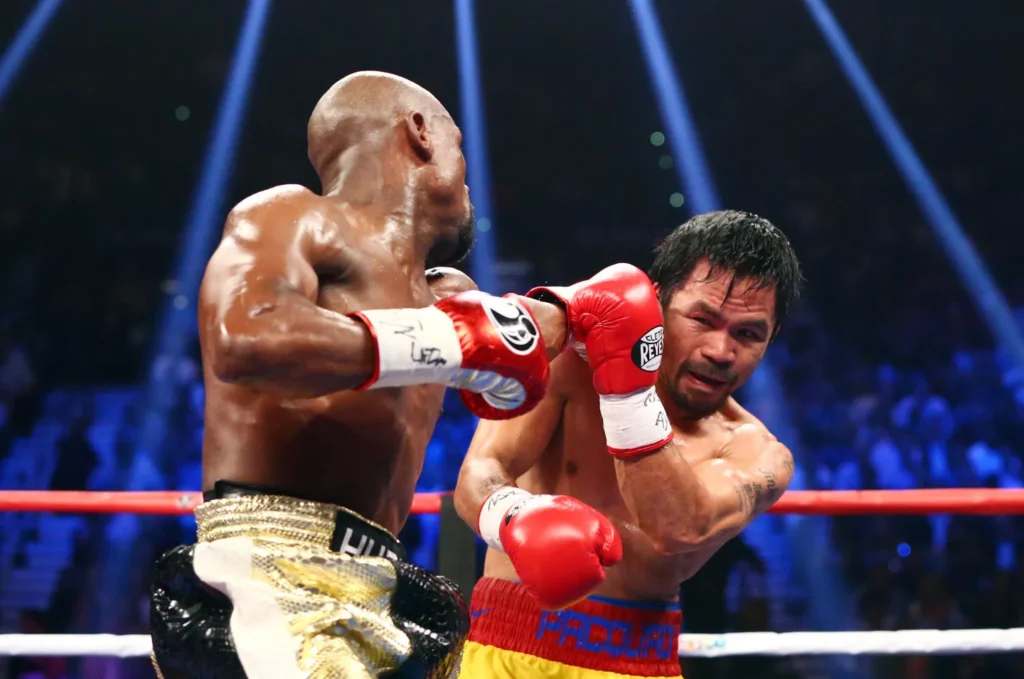
On May 2, 2015, Floyd “Money” Mayweather Jr. and Manny “Pac-Man” Pacquiao finally stepped into the ring together at the MGM Grand Garden Arena in Las Vegas. The fight had been five years in the making — derailed by drug testing disputes, dueling promoters, network rivalries, defamation lawsuits, and the stubbornness of two camps that couldn’t agree on anything except how much money was at stake. When the opening bell finally rang, the event shattered every financial record in boxing history: 4.6 million pay-per-view buys, a $72 million live gate, and more than $600 million in total revenue. What it didn’t deliver was the action fans had spent half a decade dreaming about. Mayweather won a clear unanimous decision in a tactical, defense-oriented performance that left the boxing world simultaneously awed by the money and frustrated by the fight. It remains the richest single sporting event ever staged — and one of the most debated.
Six Years of Failed Negotiations
The Mayweather-Pacquiao saga didn’t start on fight night. It started in 2009, when both men sat atop boxing’s pound-for-pound rankings and the entire sport was demanding they meet. Understanding how the fight almost never happened is essential to understanding why it mattered so much when it finally did.
By late 2009, the two biggest fighters in the world occupied parallel tracks. Mayweather had returned from a 21-month retirement to dominate Juan Manuel Marquez that September. Eight weeks later, Pacquiao demolished Miguel Cotto, stopping the former champion in the 12th round. Public demand for the fight reached fever pitch. An eight-page contract was drafted in December 2009 proposing a March 13, 2010 fight date, a 50-50 purse split, and HBO pay-per-view distribution at $59.95. The contract was so detailed it specified who would weigh in first (Pacquiao), who would walk to the ring first (Pacquiao), and who would be introduced first (Mayweather).
Then it all collapsed over drug testing. Mayweather demanded Olympic-style random blood and urine testing administered by the United States Anti-Doping Agency — a protocol that had never been used in professional boxing. Pacquiao’s camp objected, citing his belief that drawing blood too close to a fight would weaken him. Negotiations spiraled. Bob Arum, Pacquiao’s promoter, called Mayweather’s demand “a sham.” Leonard Ellerbe, Mayweather’s CEO, countered: “If you have nothing to hide, why not comply?” On December 30, 2009, Pacquiao filed a defamation lawsuit against Mayweather and Golden Boy Promotions over PED accusations. Mediation failed. On January 6, 2010, Arum declared the fight dead.
Pacquiao’s trainer Freddie Roach would later admit the mistake bluntly: “The first fight was our fault. We just should have said, ‘F— it,’ and done the testing. It was 100% our fault.”
Over the next five years, the fight was perpetually one handshake away and a million miles from reality. In June 2010, Arum announced the drug testing issue had been resolved — Mayweather’s camp denied negotiations were even happening. HBO Sports president Ross Greenburg inserted himself as a mediator, scribbling deal points on a legal pad that would become a piece of boxing history. Mayweather moved to Showtime in February 2013 with a six-fight deal reportedly worth over $200 million. Pacquiao stayed with HBO. The network rivalry added yet another obstacle to a fight that already had too many.
The breakthrough came from an unlikely source. CBS president Les Moonves, whose network owned Showtime, became the primary dealmaker. A Hollywood waiter and part-time actor named Gabriel Salvador made a key introduction between Freddie Roach and Moonves. A chance encounter between Mayweather and Pacquiao at a Miami Heat game in January 2015 produced a direct exchange of phone numbers. Within weeks, the framework was in place. Pacquiao agreed to USADA testing. The purse was set at 60-40 in Mayweather’s favor. HBO and Showtime would co-produce the pay-per-view — the first joint venture between the rival networks. On February 20, 2015, Mayweather announced on social media that the fight was official.
The Buildup: Restraint Over Spectacle
Unlike the circus atmosphere that would surround Mayweather-McGregor two years later, the promotion for Mayweather-Pacquiao was comparatively subdued. There was no multi-city trash-talk tour, no viral social media moments, no profanity-laced press conferences. Both fighters were mature, accomplished champions in their late thirties. They had already proven everything there was to prove — except whether one could beat the other.
The single official press conference in Los Angeles on March 11, 2015 was polite, almost corporate. Mayweather and Pacquiao shook hands, exchanged brief words, and posed for photos. The restraint made sense given the demographics: this wasn’t a fight being sold to casual fans on personality. It was being sold to an entire sporting world on anticipation. Five years of failed negotiations had generated more hype than any promotional campaign could.
HBO produced a documentary special, Mayweather/Pacquiao: At Last, narrated by Liev Schreiber, that chronicled the six-year journey to get the fight made. Showtime countered with its All Access series providing behind-the-scenes looks at both training camps. The combined media coverage was staggering — fight week in Las Vegas took on the atmosphere of a Super Bowl, with celebrities, athletes, and politicians filling the MGM Grand. Jay-Z, Clint Eastwood, Michael Jordan, Donald Trump, and dozens of other A-list figures were ringside. For a look at the party atmosphere surrounding the event, see BoxingInsider’s coverage of the Las Vegas fight weekend scene.
The Undercard
The undercard was stacked with meaningful bouts. Leo Santa Cruz defended his WBC super bantamweight title against Jose Cayetano, stopping him in the ninth round. Vasyl Lomachenko, already recognized as one of the sport’s brightest talents, made the second defense of his WBO featherweight title with a masterful ninth-round TKO of Gamalier Rodriguez. The Ukrainian two-time Olympic gold medalist was magnificent, showcasing the angles, speed, and ring intelligence that would carry him to pound-for-pound status within a few years. Amir Khan scored a shutout decision over Chris Algieri on the pay-per-view portion of the card.
Fight Night: A Masterclass in Defense
The main event was delayed 45 minutes past its scheduled start time to allow cable providers to process the unprecedented volume of pay-per-view orders. The system was overwhelmed — a sign of just how massive the demand was. When the bell finally rang, 16,219 fans inside the MGM Grand Garden Arena fell quiet, leaning forward for a fight that had been discussed, debated, and dissected for half a decade.
What they got was a Floyd Mayweather performance. That statement is both compliment and criticism, depending on your perspective.
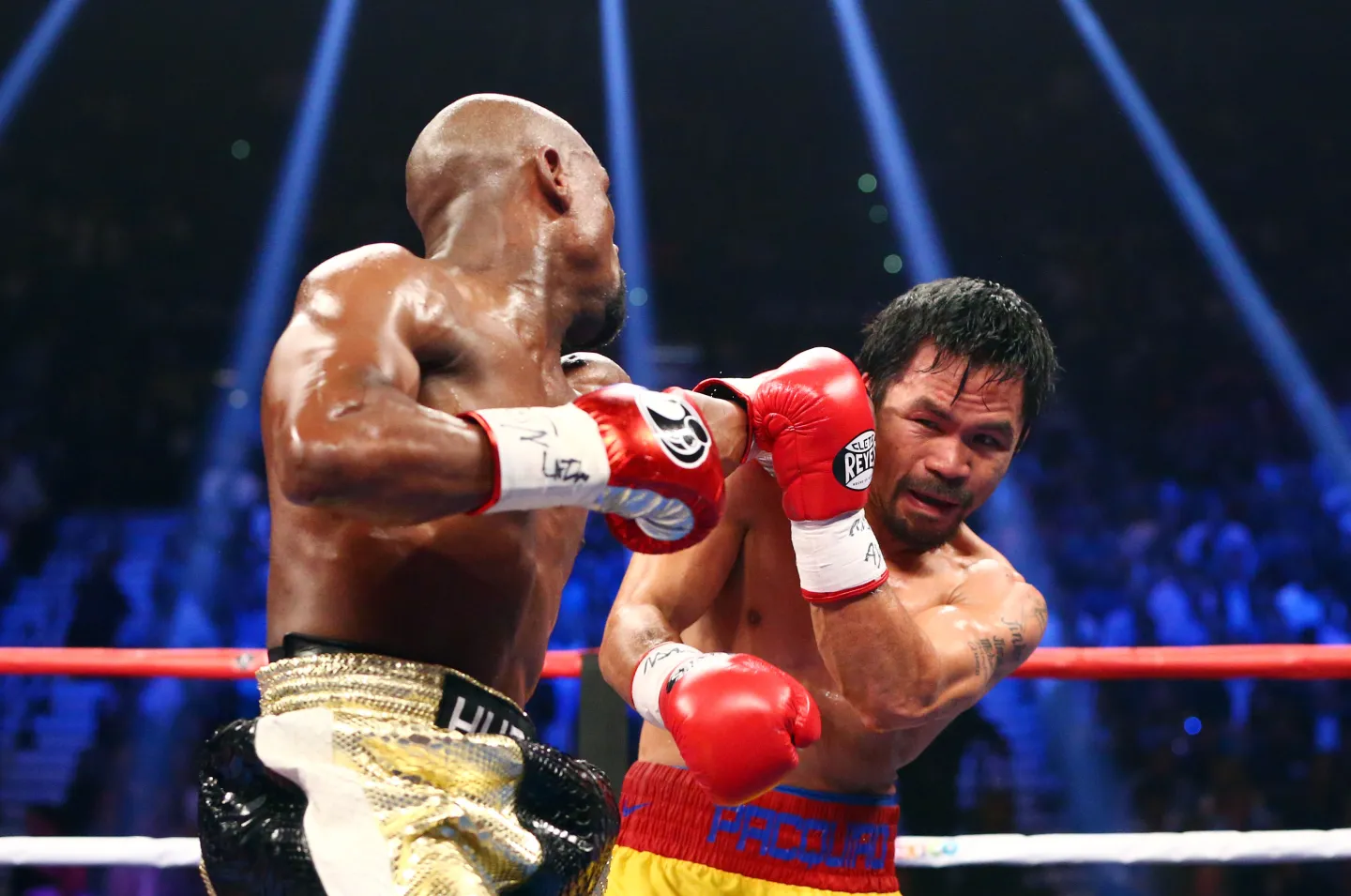
Mayweather won the first three rounds on all three scorecards, establishing range with his jab and timing Pacquiao’s rushes with sharp right hands. Pacquiao, the aggressor by nature and by game plan, pressed forward throughout but struggled to find Mayweather’s chin. The Filipino star landed his biggest punch of the fight in the fourth round — a flush left hand that buckled Mayweather momentarily and electrified the crowd. It was the kind of moment fans had waited five years to see.
But Mayweather recovered instantly, put his high guard up, and went back to work. From the fifth round onward, he controlled distance, dictated pace, and forced Pacquiao to chase a target that simply wouldn’t stay still. Mayweather’s shoulder roll defense was in peak form. He dipped, darted, and pivoted away from Pacquiao’s combinations, then countered with clean right hands that snapped the challenger’s head back.
Pacquiao had bursts of activity — the third, fourth, and sixth rounds were competitive, and the ninth round featured a late exchange that brought the crowd to its feet. But the overall pattern was one-directional: Mayweather boxing, Pacquiao chasing, and the distance between them growing with each round. The final rounds were especially dominant for Mayweather, who won rounds 11 and 12 on all three scorecards, closing the fight with authority.
The Decision
The final scorecards were emphatic. Judge Dave Moretti scored it 118-110. Judges Glenn Feldman and Burt Clements both scored it 116-112. All three had Mayweather winning eight rounds unanimously. Of 19 ringside media members, 17 scored the fight for Mayweather. There was no robbery. There was barely a controversy — at least on the scorecards.
Floyd Mayweather Jr. improved to 48-0, retaining his WBC and WBA welterweight titles while adding Pacquiao’s WBO belt to his collection. It was a welterweight unification — three belts consolidated in one ring — and Mayweather had done it with surgical precision.
“I knew I had him from the start,” Mayweather said at the post-fight press conference, where he compared himself to Muhammad Ali and carried a $100 million check in the pocket of his sweat suit.
Pacquiao saw it differently: “I thought I won the fight. He’s moving around. It’s not easy to throw punches when he’s moving around so much. I thought I caught him many more times than he caught me.”
The Shoulder Controversy
Within minutes of the final bell, the narrative shifted from what happened in the ring to what happened before it. Pacquiao revealed he had torn his right rotator cuff approximately three weeks before the fight during training. His camp said the injury had healed enough to proceed but that Pacquiao re-injured the shoulder during the fourth round — the same round he landed his biggest punch.
Bob Arum disclosed that his team had considered requesting a postponement but ultimately chose not to disclose the injury, fearing it would jeopardize the fight. That decision backfired when the Nevada State Athletic Commission denied Pacquiao an anti-inflammatory injection before the bout because the injury had not been disclosed on his pre-fight medical questionnaire.
The fallout was immediate and severe. More than 30 class-action lawsuits were filed by fans alleging they had been defrauded — that paying $100 for a pay-per-view featuring an injured fighter constituted a breach of their expectations. The lawsuits were eventually consolidated and settled. The Nevada Attorney General’s office investigated whether the failure to disclose the injury constituted a violation of commission regulations.
Whether the shoulder meaningfully affected the outcome remains debated. Mayweather dismissed it: “I was fighting with injuries too. I’m 38 years old.” Freddie Roach was more measured: “I thought we pulled it out. I asked him to throw more combinations between rounds but maybe he fought flat-footed a little too much.” For Pacquiao’s own reflections on the injury, read BoxingInsider’s coverage of Pacquiao’s regret about not postponing the fight.
The CompuBox Numbers
The punch statistics told a story that was more lopsided than even the scorecards suggested. Mayweather connected on 148 of 435 punches (34 percent). Pacquiao landed just 81 of 429 (19 percent) — his lowest output in any 12-round fight in the previous seven years. Mayweather’s power-punch accuracy was 48 percent (81 of 168). Pacquiao landed 63 of 236 power punches (27 percent).
Perhaps the most telling statistic: Mayweather’s 81 power punches alone equaled Pacquiao’s total landed punches across all categories. Pacquiao landed in double figures in only three of the 12 rounds. Mayweather landed at least 10 punches in nine rounds. The jab differential was devastating — Mayweather connected on 67 of 267 jabs while Pacquiao hit just 18 of 193, a 9 percent success rate that reflected Mayweather’s ability to control distance and deny Pacquiao any rhythm.
The Money: Boxing’s Richest Night
Whatever disappointment fans felt about the action inside the ring, the numbers outside it were staggering. Mayweather-Pacquiao was, and remains, the richest single-event combat sports production in history.
The fight generated 4.6 million pay-per-view buys domestically (with an additional 700,000 in the United Kingdom), nearly doubling the previous record of 2.48 million set by Mayweather-De La Hoya in 2007. At $89.95 standard ($99.95 HD), domestic PPV revenue alone exceeded $400 million. The live gate of $72,198,500 from the sale of 16,219 tickets at the MGM Grand shattered the previous boxing record of $20 million set by Mayweather-Canelo in 2013. International television distribution reached 175 countries. Closed-circuit viewing generated nearly 46,000 admissions at MGM Resorts properties in Las Vegas alone. Total revenue exceeded $600 million — triple the previous high for a prize fight and comparable to the Super Bowl’s annual economic output.
The purse split was 60-40 in Mayweather’s favor. Mayweather’s total earnings were estimated at $240 million, with Pacquiao taking home approximately $120-125 million. Mayweather promoted himself through Mayweather Promotions, meaning he kept his full share without paying a promotional fee. Pacquiao’s earnings were split with Top Rank.
For the full financial breakdown, see BoxingInsider’s press release: Mayweather vs. Pacquiao Shatters PPV Records. For additional perspective on the astounding PPV numbers and Mayweather’s rematch stance, read BoxingInsider: 5 Million PPV Buys Astounds While Floyd Says No Rematch.
The Fight on Second Viewing
Time has been somewhat kinder to Mayweather-Pacquiao than the initial reaction suggested. In the immediate aftermath, the fight was widely panned — called a waste of money, a defensive exhibition unworthy of the price tag, and an event that arrived five years too late. Oscar De La Hoya tweeted, “Sorry boxing fans.” The hashtag #BetterNeverThanLate trended on social media.
But rewatching the fight removed from the $100 price tag and five years of inflated expectations reveals something different: a technically brilliant performance by one of the most skilled defensive fighters in history. Mayweather made a generational offensive talent look ordinary. He neutralized Pacquiao’s speed, nullified his combinations, and won every meaningful statistical category. It wasn’t exciting in the way fans wanted, but it was masterful in a way that boxing purists could appreciate. ESPN revisited the fight years later and found its reputation improving with distance. Read BoxingInsider’s take on ESPN’s second look at the fight.
Legacy: The Fight That Came Too Late
The central question hanging over Mayweather-Pacquiao is not who won — that was never really in doubt for anyone watching objectively. The central question is what might have been if the fight had happened in 2009 or 2010, when both men were at or near their physical peaks.
In 2009, Pacquiao was coming off three consecutive knockout victories — Ricky Hatton in two rounds, Oscar De La Hoya in eight, Miguel Cotto in twelve. He was moving through weight classes like no fighter in history, winning titles from flyweight to welterweight with the kind of speed and power that seemed to defy physics. Mayweather, meanwhile, was 32 and had just returned from retirement looking sharper than ever against Marquez. A fight between them at that moment — the most explosive offensive fighter of his generation against the most technically perfect defensive fighter — would have been a genuine 50-50 proposition with the potential to be one of the greatest fights ever contested.
By 2015, both men were diminished. Mayweather was 38. Pacquiao was 36. The speed that made Pacquiao so dangerous had slowed a step. The legs that let Mayweather circle and pivot for 12 rounds were a beat slower. The fight was still a massive event, but the version of it that could have been a classic was no longer available.
For a full retrospective on the fight’s place in history, read BoxingInsider: Mayweather-Pacquiao Ten Years Later — The Superfight That Couldn’t Live Up to the Hype.
What Happened Next
Mayweather fought once more after Pacquiao, defeating Andre Berto by unanimous decision in September 2015 to push his record to 49-0. He then retired — until the Conor McGregor spectacle in 2017 brought him back for the 50-0 milestone. Since then, Mayweather has competed only in exhibition bouts, facing opponents like Logan Paul and various international challengers for guaranteed paydays without risking his perfect record.
Pacquiao’s post-Mayweather career was far more eventful. After surgery to repair his torn rotator cuff, he returned in 2016 and won the WBO welterweight title for a third time by defeating Jessie Vargas. He scored a stunning upset knockout of Lucas Matthysse in 2018, then defeated Keith Thurman — a younger, undefeated champion — by split decision in 2019 to become the oldest welterweight world champion in history at age 40. Pacquiao lost to Yordenis Ugas in August 2021 in what proved to be his final professional fight before pursuing a presidential campaign in the Philippines. In June 2025, Pacquiao was inducted into the International Boxing Hall of Fame — becoming just the third Filipino boxer to receive the honor.
Rematch talk has never fully disappeared. Read BoxingInsider’s coverage of the ongoing rematch speculation.
The Full Fight Card
The complete HBO/Showtime PPV card from May 2, 2015:
- Floyd Mayweather Jr. def. Manny Pacquiao — Unanimous Decision (118-110, 116-112, 116-112), welterweight unification (WBC/WBA/WBO, 147 lbs)
- Amir Khan def. Chris Algieri — Unanimous Decision
- Vasyl Lomachenko def. Gamalier Rodriguez — TKO, Round 9, WBO featherweight title
- Leo Santa Cruz def. Jose Cayetano — TKO, Round 9, WBC super bantamweight title
By the Numbers
- Venue: MGM Grand Garden Arena, Las Vegas
- Attendance: 16,219
- Live gate: $72,198,500 (record)
- PPV buys: 4.6 million (record)
- PPV price: $89.95 ($99.95 HD)
- Total revenue: $600 million+ (record)
- Mayweather earnings: ~$240 million
- Pacquiao earnings: ~$120-125 million
- Purse split: 60-40 (Mayweather)
- Mayweather record after fight: 48-0 (26 KOs)
- Pacquiao record after fight: 57-6-2 (38 KOs)
- Judges: Dave Moretti (118-110), Glenn Feldman (116-112), Burt Clements (116-112)
- Referee: Kenny Bayless
- Broadcast: HBO/Showtime co-production PPV
- Closed-circuit admissions (Las Vegas): ~46,000
- International distribution: 175 countries
Further Reading
BoxingInsider Coverage:
- Press Release: Mayweather vs. Pacquiao Shatters PPV Records, 4.4 Million Buys
- 5 Million PPV Buys Astounds While Floyd Says No Rematch
- Ten Years Later: The Superfight That Couldn’t Live Up to the Hype
- ESPN Offered Another Look at Mayweather-Pacquiao. It Was Enlightening.
- Pacquiao Regrets Not Postponing Mayweather Fight
- Mayweather vs. Pacquiao? What Fight? It’s the Parties That Weekend
- HBO Sports: Mayweather/Pacquiao At Last Debuts
- Mayweather-Pacquiao 2? It Just May Happen.
Mainstream Coverage:
- ESPN: Mayweather Dominates Pacquiao in Impressive Victory (Dan Rafael Scorecard)
- Sports Illustrated: The Six-Year Negotiation for Mayweather-Pacquiao
- Sports Illustrated: Mayweather-Pacquiao Aftermath and PPV Numbers
- Wikipedia: Floyd Mayweather Jr. vs. Manny Pacquiao
For more boxing history and analysis, check out our complete guides to The History of Boxing in Las Vegas, Mayweather vs. McGregor, The Top Boxing Venues of All Time, The History of Boxing in New York City, Boxing Weight Classes Explained, and Boxing Rules & Scoring: The 10-Point Must System.