The Complete Boxing Movie List
Nobody agrees on the best boxing movie ever made. Rocky people and Raging Bull people have been having that argument since 1980, and they’ll still be having it when the sun burns out. So we’re not ranking anything. What we’ve done instead is put together every boxing movie worth your time — organized by what kind of movie you’re in the mood for. The classics, the true stories, the documentaries, the hidden gems your film-snob friend hasn’t even seen, and the old Hollywood stuff that started it all.
If it involves gloves and a ring and it’s worth watching, it’s here.
The Ones Everybody Knows
These are the films that defined boxing in popular culture. If you haven’t seen them, start here. If you have, you already know why they’re on the list.
Rocky (1976) — The one that started a franchise and an entire subgenre. Sylvester Stallone wrote the script and starred as Rocky Balboa, a small-time Philadelphia club fighter who gets a shot at the heavyweight championship. Won Best Picture. The training montage, the steps, the raw eggs — it’s all here, and it still works. What people forget is that Rocky doesn’t win the fight. He goes the distance. That’s the whole point.
Raging Bull (1980) — Martin Scorsese directed Robert De Niro as Jake LaMotta in what many consider the greatest sports film ever made. Shot in black and white, brutally honest about LaMotta’s violence inside and outside the ring. De Niro gained 60 pounds for the later scenes. Joe Pesci is devastating as LaMotta’s brother Joey. The fight scenes remain the most visceral ever filmed — Scorsese used chocolate syrup for the blood splatter on the ropes because it photographed better in black and white.
Creed (2015) — Ryan Coogler revived the Rocky franchise by shifting the focus to Adonis Creed, Apollo’s son, trained by an aging Rocky Balboa. Michael B. Jordan’s performance silenced every skeptic who thought this was a cash grab. The one-take fight sequence in the middle of the film is a technical marvel. Stallone earned his first Oscar nomination since the original Rocky.
Million Dollar Baby (2004) — Clint Eastwood directed and starred alongside Hilary Swank and Morgan Freeman. Won Best Picture. Starts as a straightforward boxing story about a woman fighting her way up from nothing, then takes a devastating turn in the third act that nobody sees coming the first time. If you somehow don’t know the ending, we won’t spoil it.
Rocky IV (1985) — The most purely entertaining Rocky sequel. Dolph Lundgren as Ivan Drago. Apollo Creed’s death. The Cold War reduced to a boxing match. The training montage in Siberia. It’s absurd and it knows it, and it doesn’t care. Rocky IV made more money than any other film in the franchise.
Rocky II (1979) — The rematch. Stallone directs and stars. Rocky and Apollo run it back, and this time the ending is different. The final sequence is one of the most crowd-pleasing moments in the franchise.
Rocky III (1982) — Mr. T as Clubber Lang. Rocky loses the title, loses Mickey, and has to reinvent himself with Apollo Creed as his trainer. “Eye of the Tiger” lives here. The beach running scene with Apollo is unintentionally iconic for entirely different reasons now.
Rocky Balboa (2006) — Stallone brought Rocky back after a 16-year gap and delivered a surprisingly effective late-career entry. The fight against Mason Dixon is less important than the speech Rocky gives his son about getting hit and keeping moving forward.
Rocky V (1990) — Rocky loses his money, goes back to the neighborhood, trains a young fighter (Tommy Gunn, played by real boxer Tommy Morrison), and ends up in a street fight. The weakest entry in the franchise, but it’s part of the canon.
Creed II (2018) — Adonis fights Viktor Drago, the son of the man who killed his father. The generational angle works. Dolph Lundgren’s return as Ivan Drago is more nuanced than anyone expected.
Creed III (2023) — Michael B. Jordan directed. Jonathan Majors plays Damian Anderson, a childhood friend turned rival. The most stylistically ambitious Creed film — Jordan used anime-inspired visual techniques for the fight sequences.
The True Stories
Boxing has produced more unbelievable real-life stories than any other sport. These films take actual fighters and put their lives on screen.
The Fighter (2010) — The true story of Micky Ward and his half-brother Dicky Eklund, set in Lowell, Massachusetts. Mark Wahlberg is solid as Ward, but Christian Bale’s Oscar-winning performance as the crack-addicted Dicky is the reason to watch. Melissa Leo also won an Oscar as their overbearing mother. The family dynamics are more brutal than anything in the ring.
Ali (2001) — Will Smith as Muhammad Ali, covering the decade from the Liston fight through the Rumble in the Jungle. Smith earned an Oscar nomination and physically transformed for the role. Michael Mann directed with his usual visual precision. The film is better at capturing Ali’s political courage than his ring genius, but the Foreman fight sequence is tremendous.
Cinderella Man (2005) — Russell Crowe as James J. Braddock, the Depression-era heavyweight who went from breadlines to the championship. Ron Howard directed. The film flopped at the box office despite excellent reviews, which is a shame because Crowe’s performance is one of the most believable portrayals of a fighter’s physicality ever put on screen. Paul Giamatti is outstanding as his manager Joe Gould.
Bleed for This (2016) — Miles Teller as Vinny Pazienza, who broke his neck in a car accident and came back to fight with a halo screwed into his skull. The real story is so insane that the movie actually tones it down. Aaron Eckhart plays trainer Kevin Rooney in a role that’s impossible not to associate with Rooney’s more famous student, Mike Tyson.
The Hurricane (1999) — Denzel Washington as Rubin “Hurricane” Carter, the middleweight contender who was wrongly convicted of murder and spent nearly 20 years in prison. Washington’s performance earned him an Oscar nomination. The film takes liberties with the timeline and some facts, as biopics do, but the core story of injustice and resilience is powerful.
Hands of Stone (2016) — Edgar Ramirez as Roberto Durán, with Robert De Niro returning to boxing movies as trainer Ray Arcel. Covers the Leonard-Durán rivalry, including the infamous “No Más” fight. The film tries to do too much — Durán’s life is too big for one movie — but Ramirez captures the feral intensity that made Durán one of the most feared fighters who ever lived.
Somebody Up There Likes Me (1956) — Paul Newman as Rocky Graziano. This was the role that made Newman a star. Based on Graziano’s autobiography about growing up on the streets of New York and fighting his way to the middleweight championship. Old Hollywood style, but Newman’s charisma makes it timeless.
Southpaw (2015) — Jake Gyllenhaal as Billy Hope, a reigning light middleweight champion whose life unravels after a personal tragedy. Gyllenhaal physically transformed for the role and trained for months at a real boxing gym. The fight scenes are among the most realistic in any Hollywood boxing film. Forest Whitaker plays his new trainer.
Against the Ropes (2004) — Meg Ryan as Jackie Kallen, the real-life female boxing manager who broke into the sport’s boys’ club in Detroit during the 1990s. Tony Shalhoub and Charles S. Dutton co-star. Kallen’s actual story — a woman forcing her way into one of the most male-dominated businesses in sports — is a film waiting to be remade.
The Hidden Gems
These are the films that don’t show up on most mainstream lists. They should.
Diggstown (1992) — James Woods plays a con man fresh out of prison who bets a corrupt small-town boss (Bruce Dern) that his fighter can beat ten local men in 24 hours. Louis Gossett Jr. is “Honey” Roy Palmer, a 48-year-old retired heavyweight who comes off the couch to fight. Oliver Platt rounds out the cast as Woods’ partner in crime. The film bombed at the box office but became a cable staple and a cult favorite among boxing fans. The con-within-a-con plot is genuinely clever, the fight choreography by Benny “The Jet” Urquidez is better than it has any right to be, and the final sequence is one of the most satisfying endings in any sports movie. A personal favorite at BoxingInsider.
Fat City (1972) — John Huston directed Stacy Keach and a young Jeff Bridges in this bleak, beautiful film about small-time boxing in Stockton, California. No Hollywood endings here. Keach plays a washed-up fighter trying to come back; Bridges is the young prospect who might follow the same path. It’s the anti-Rocky — unglamorous, honest, and quietly devastating. Critics consider it one of the best sports films ever made. The general public has barely heard of it.
The Set-Up (1949) — Robert Ryan as an aging boxer whose manager bets against him without telling him. The film runs in real time — 72 minutes — and the fight sequence is among the best ever committed to film, particularly for the era. Film noir meets the boxing ring. If you appreciate the craft of filmmaking, this one is essential.
Hard Times (1975) — Charles Bronson as a bare-knuckle street fighter during the Depression in New Orleans. Walter Hill’s directorial debut. James Coburn plays his handler. The fight scenes are raw and unglamorous. Bronson, who was 53 during filming, is completely convincing as a man who makes his living with his fists. One of the best action films of the 1970s that nobody talks about.
Girlfight (2000) — Michelle Rodriguez’s breakout role as a troubled Brooklyn teenager who starts training as a boxer. Karyn Kusama directed on a tiny budget. The film is rough around the edges but Rodriguez’s intensity is undeniable, and the story was years ahead of its time in depicting women’s boxing. Won the Grand Jury Prize at Sundance.
Body and Soul (1947) — John Garfield as a boxer who rises from poverty to the championship but loses himself to corruption along the way. This film essentially created the template that every boxing movie since has followed: the rise, the temptation, the moral crisis. The fight scenes were revolutionary for their time — cinematographer James Wong Howe reportedly filmed parts of them on roller skates for fluid camera movement.
Requiem for a Heavyweight (1962) — Anthony Quinn as Mountain Rivera, a former contender reduced to taking dives for his corrupt manager (Jackie Gleason). Originally a live television play from the 1950s, the film version is a gut punch about what happens to fighters after the spotlight moves on. Muhammad Ali (then Cassius Clay) appears in the opening fight sequence.
The Ones That Aren’t Really Boxing Movies (But Kind Of Are)
Boxing shows up in some unexpected places.
Snatch (2000) — Guy Ritchie’s crime comedy features Brad Pitt as an Irish Traveller bare-knuckle boxer who can’t be understood by anyone around him. The boxing isn’t the main plot, but the fight sequences are iconic and Pitt’s performance is one of the most memorable in any film involving the sport.
Pulp Fiction (1994) — Bruce Willis as Butch, a boxer who double-crosses a crime boss by winning a fight he was paid to lose. The boxing is incidental to the larger Tarantino universe, but the setup — a fighter’s moral crisis about taking a dive — is as old as the sport itself.
On the Waterfront (1954) — “I coulda been a contender.” Marlon Brando’s most famous line comes from a film about dock workers and corruption, not boxing. But that scene in the back of the taxi is the single most quoted moment in boxing movie history, and the regret it captures — the fight career that was stolen — resonates with anyone who’s ever been around the sport.
The Boxer (1997) — Daniel Day-Lewis as an IRA member who returns to boxing after 14 years in prison. Set in Belfast during the Troubles. The boxing is secondary to the political drama, but Day-Lewis actually trained extensively and the fight scenes are remarkably authentic for a film that’s really about something else entirely.
Ocean’s Eleven (2001) — Not a boxing movie at all, but it has a permanent place in boxing history. Lennox Lewis was filming his cameo in it instead of training for Hasim Rahman, and the distraction cost him the heavyweight championship. The most expensive movie cameo in boxing history, measured in belts lost.
The Fun Ones
Not every boxing movie needs to be a masterpiece. Some just need to be a good time.
Grudge Match (2013) — Sylvester Stallone and Robert De Niro as aging former rivals who come out of retirement for one more fight. The meta-casting is the whole joke — Rocky vs. Jake LaMotta — and the movie knows it. Not great cinema, but if you’ve seen every movie on this list, you’ll laugh.
Play It to the Bone (1999) — Antonio Banderas and Woody Harrelson as two friends who learn they’ll be fighting each other on the undercard of a major Vegas fight. They drive from LA to Las Vegas together knowing they’ll be trying to knock each other out that night. The road trip is better than the fight.
Real Steel (2011) — Hugh Jackman in a future where robot boxing has replaced human fighting. It’s “Rocky with robots” and it’s more fun than it has any right to be. Based loosely on a Richard Matheson short story. The father-son dynamic gives it unexpected emotional weight.
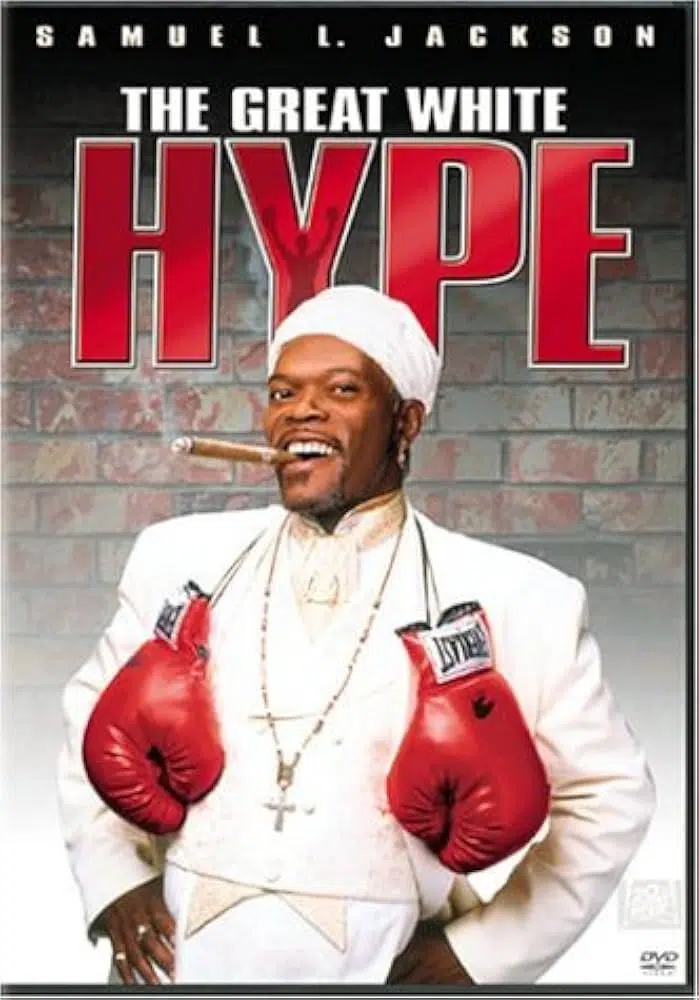
The Great White Hype (1996) — Samuel L. Jackson as Rev. Fred Sultan, a thinly veiled Don King parody who manufactures a white challenger to generate pay-per-view interest when his heavyweight champ’s fights stop selling. Damon Wayans, Jeff Goldblum, Peter Berg, Jon Lovitz, and a young Jamie Foxx round out the cast. The film was directly inspired by the Holmes-Cooney hype machine in 1982 and Tyson’s comeback fight against Peter McNeeley in 1995. The satire of boxing’s promotional machine — the manufactured rivalries, the racial marketing, the sportswriters who know it’s a scam but play along anyway — is sharper than most people gave it credit for at the time. If you’ve ever watched a press conference and thought “this is all fake,” this movie is for you.
Old Hollywood
Boxing was one of the first sports filmed, and Hollywood has been making boxing movies since the silent era.
The Champ (1931) — Wallace Beery won the Academy Award for his performance as a washed-up fighter trying to prove himself worthy of his devoted young son (Jackie Cooper). Directed by King Vidor. This is the template for every “broken-down fighter gets one more shot” story that followed — the original boxing redemption arc that Hollywood has been remaking in one form or another for almost a century.
Champion (1949) — Kirk Douglas as a ruthless boxer who destroys every relationship on his way to the title. Douglas earned his first Oscar nomination. The character study — a man whose ambition poisons everything around him — still holds up.
The Harder They Fall (1956) — Humphrey Bogart’s final film. He plays a sportswriter hired to promote a talentless heavyweight being propped up by the mob. Based loosely on the career of Primo Carnera. A damning indictment of boxing’s corruption that remains relevant because nothing has changed.
Gentleman Jim (1942) — Errol Flynn as James J. Corbett, the boxer who defeated John L. Sullivan and helped transition the sport from bare-knuckle brawling to the modern gloved era. Flynn’s natural athleticism and charisma make this one of the most watchable old Hollywood sports films.
I’m If we missed your favorite, that’s what the comments section is for.