Bites, riots, phantom punches, loaded gloves, and a man who parachuted into a heavyweight title fight. These are the moments that stopped the sport cold.
Boxing has given us some of the greatest athletic achievements in human history. It has also given us moments so bizarre, so infuriating, and so downright surreal that the only reasonable response is: What the hell just happened?
This isn’t a list of bad decisions or controversial scorecards — that’s its own encyclopedia. These are the moments that stopped the sport cold, the ones that transcended boxing and became part of the larger cultural conversation. The moments where you had to rewind and watch again because you weren’t sure you’d actually seen what you thought you saw.
Here are the 10 biggest WTF moments in the history of boxing.
10. Julio Cesar Chavez vs. Meldrick Taylor — The Two-Second Stoppage (1990)
Meldrick Taylor was winning the fight. That wasn’t a matter of opinion — he was ahead on all three scorecards heading into the final round of their junior welterweight unification bout at the Hilton in Las Vegas. Taylor had outboxed one of the most feared fighters in the sport for 11 rounds. All he had to do was survive three more minutes.
He almost did. Chavez caught Taylor with a devastating right hand that dropped him late in the 12th. Taylor beat the count, but when referee Richard Steele asked if he was okay, Taylor — dazed and with his trainer Lou Duva already climbing onto the apron — failed to respond clearly. Steele waved it off with two seconds remaining on the clock.
Two seconds. Taylor went from winning a unified title to losing everything in the time it takes to blink. The stoppage remains one of the most debated calls in boxing history, and it effectively destroyed Taylor’s career. He was never the same fighter afterward.
9. Buster Douglas Knocks Out Mike Tyson (1990)
The odds were 42-to-1. Mike Tyson was considered invincible — a force of nature who had demolished every man put in front of him, most of them in terrifying fashion. Buster Douglas was a talented but inconsistent heavyweight who most people assumed would fold the moment Tyson hit him.
Douglas didn’t fold. Fighting through the recent death of his mother and channeling what he later described as the best shape and focus of his life, Douglas outboxed Tyson for nine rounds in Tokyo. Tyson did knock Douglas down in the eighth — and there was a controversial long count that remains debated — but Douglas got up and finished the job in the 10th, dropping Tyson with a combination and watching the baddest man on the planet crawl around the canvas looking for his mouthpiece.
It wasn’t just an upset. It was a rupture in the fabric of the sport. Tyson’s aura of invincibility was gone forever, and the heavyweight division was never quite the same.
8. The Fan Man Crashes Holyfield-Bowe II (1993)
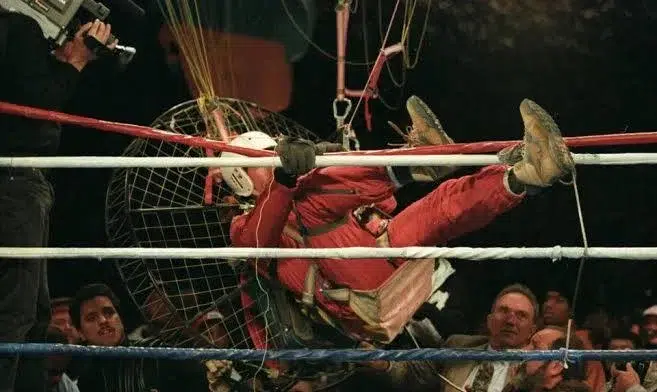
Evander Holyfield and Riddick Bowe were in the middle of one of the best heavyweight fights of the 1990s — an outdoor battle at Caesars Palace in Las Vegas — when, in the seventh round, a man named James “Fan Man” Miller descended from the sky in a motorized paraglider and crashed directly into the ring ropes.
That sentence is 100 percent real.
Miller got tangled in the ropes, and what followed was 21 minutes of pure chaos. Fans and security beat Miller before he was removed from the ring. Bowe’s pregnant wife fainted in the crowd. The fight was delayed while officials tried to figure out what had just happened, because nobody had ever planned for a man parachuting into a heavyweight championship fight. When the bout resumed, Holyfield — who had been winning before the interruption — seemed rattled. Bowe won by majority decision.
Miller, a serial stunt pilot who had previously disrupted other events, was arrested and fined. He died in 2002. The Fan Man incident remains the single most bizarre in-ring interruption in boxing history, and it’s hard to imagine anything ever topping it.
7. Oliver McCall’s In-Ring Breakdown (1997)
This one is more heartbreaking than anything else, but it belongs on any list of moments that left everyone watching completely stunned.
Oliver McCall had shocked the world three years earlier by knocking out Lennox Lewis to win the WBC heavyweight title. In their rematch in Las Vegas, McCall came in as the underdog but was expected to at least compete. Instead, he fell apart in front of a global audience.
Starting in the third round, McCall began crying uncontrollably. He wandered around the ring, dropped his hands, and refused to throw punches. Referee Mills Lane pleaded with him to fight. McCall’s corner couldn’t get through to him. By the fifth round, Lane had no choice but to stop it.
McCall later acknowledged that he had been battling substance abuse and severe mental health issues in the lead-up to the fight. It was a deeply uncomfortable moment that raised serious questions about the sport’s ability — or willingness — to protect fighters from themselves. The fact that McCall was allowed in the ring at all remains disturbing.
6. Andrew Golota’s Self-Destruction and the MSG Riots (1996)
Andrew Golota was winning the fight. Comfortably. The Polish heavyweight was beating Riddick Bowe on points and demonstrating exactly the kind of talent that had made people believe he could be a serious contender. There was just one problem: Golota couldn’t stop punching Bowe in the groin.
Despite multiple warnings and point deductions, Golota continued to land blatant low blows throughout the fight. Referee Wayne Kelly finally disqualified him in the seventh round. What happened next was worse than anything in the fight itself.
Bowe’s entourage stormed the ring and attacked Golota. The violence spread to the crowd. Chairs were thrown. Fans fought each other and security. Madison Square Garden descended into a full-scale riot that required NYPD reinforcements to contain. Multiple people were hospitalized.
Incredibly, Golota and Bowe fought a rematch five months later. Golota was DQ’d again — for low blows. Again. Another riot broke out. You genuinely cannot make this up.
5. Roy Jones Jr. Robbed at the 1988 Olympics
Roy Jones Jr. put on one of the most dominant performances in Olympic boxing history in the 164-pound gold medal bout against South Korea’s Park Si-hun at the Seoul Games. Jones landed 86 punches to Park’s 32. He controlled every second of the fight. By every conceivable metric, Jones won going away.
The judges gave it to Park, 3-2.
Park himself apologized to Jones after the decision was announced, which tells you everything you need to know. The IOC later suspended three of the judges who voted against Jones, and an investigation revealed that two of them had been wined and dined by South Korean boxing officials before the bout. The scandal led to a complete overhaul of Olympic boxing’s scoring system.
Jones recovered — he went on to become one of the greatest pound-for-pound fighters in professional boxing history. But the robbery in Seoul remains arguably the most egregious judging scandal in the history of the Olympic Games, across all sports.
4. Roberto Duran Says “No Más” (1980)
Five months earlier, Roberto Duran had beaten Sugar Ray Leonard in their first fight — one of the greatest welterweight bouts ever — through sheer will and ferocity. Duran was “Manos de Piedra,” Hands of Stone, one of the most feared fighters alive. He didn’t quit. He didn’t stop coming. That was the whole point of Roberto Duran.
Then, in the eighth round of their rematch at the Superdome in New Orleans, Duran turned away from Leonard, waved his glove, and quit. The words attributed to him — “No más,” no more — became the most infamous two words in boxing history.
Duran blamed stomach cramps. Nobody bought it. Leonard had been clowning him, showboating and making the proud Panamanian look foolish. Most observers believe Duran couldn’t handle the humiliation and chose to walk away rather than endure more of it.
It tarnished Duran’s legacy for years, though he eventually rebuilt it with great performances at higher weights, including victories over Davey Moore and Iran Barkley. But the image of one of boxing’s all-time warriors simply quitting in the middle of a world title fight remains one of the sport’s most incomprehensible moments.
3. Ali vs. Liston II — The Phantom Punch (1965)
The rematch between Muhammad Ali and Sonny Liston in Lewiston, Maine was suspicious before the opening bell. Their first fight had ended when Liston refused to come out for the seventh round, citing a shoulder injury. Rumors of mob involvement had already shadowed Liston’s career.
What happened in the rematch only made things worse. One minute and 44 seconds into the first round, Ali threw a short right hand that dropped Liston. The punch was so fast that most of the crowd didn’t see it, and the photograph of Ali standing over a downed Liston — screaming at him to get up — became one of the most iconic images in sports history.
Referee Jersey Joe Walcott lost control of the situation. He never gave a proper count. Liston stayed down, then got up, and the fighters actually resumed before the timekeeper informed Walcott that Liston had been down for more than 10 seconds. Walcott then stopped the fight.
Was it a legitimate knockout? Was it a dive? The debate has never been settled. Liston had deep ties to organized crime. Ali himself taunted the conspiracy theories. Slow-motion replay suggests the punch did connect, but whether it carried enough force to drop a man of Liston’s size and toughness remains genuinely unclear more than 60 years later.
2. Luis Resto & Panama Lewis — The Loaded Gloves (1983)
This is the darkest entry on this list, and it’s one every person in boxing should know by heart.
On June 16, 1983, undefeated prospect Billy Collins Jr. fought journeyman Luis Resto on the undercard of Duran-Moore at Madison Square Garden. Collins was 14-0 and expected to win. Instead, he took a savage beating over 10 rounds from a light-punching fighter who had never shown that kind of power.
After the fight, Collins’ father and trainer, Billy Sr., went to shake Resto’s hand — and immediately felt that something was wrong with the gloves. He grabbed on and started shouting. The gloves were impounded, and an investigation revealed that Resto’s trainer, Panama Lewis, had removed padding from both gloves. Years later, Resto admitted that Lewis had also soaked his hand wraps in plaster of Paris, effectively turning his fists into casts.
Collins suffered a torn iris and permanent blurred vision. His career was over. He spiraled into depression and alcoholism, and nine months later, at 22 years old, he drove his car into a creek near his Tennessee home and died. His family has long believed it was suicide.
Resto and Lewis were both convicted of assault, criminal possession of a weapon, and conspiracy. They served prison time. Resto eventually visited Collins’ grave and apologized. The wraps, notably, were never confiscated by investigators.
The Resto-Collins tragedy led directly to improved glove inspection protocols and remains the sport’s starkest cautionary tale about what happens when the people entrusted to protect fighters become the ones trying to destroy them. The Margarito plaster scandal of 2009 — discovered before his fight with Shane Mosley — inevitably drew direct comparisons, and retroactively cast doubt on his brutal 2008 victory over Miguel Cotto.
1. Mike Tyson Bites Evander Holyfield’s Ear (1997)
There was a time when Mike Tyson was the most feared man in sports. By their second meeting, that fear had been replaced by something closer to desperation.
Holyfield had stunned the world by stopping Tyson in their first fight six months earlier. In the rematch — billed as “The Sound and the Fury” at the MGM Grand in Las Vegas — Tyson was again being outfought and outclassed by the bigger man. In the third round, frustrated and losing, Tyson spat out his mouthpiece, lunged at Holyfield, and bit a chunk of cartilage off his right ear. He spat it onto the canvas.
Referee Mills Lane deducted two points but allowed the fight to continue. Tyson then bit Holyfield’s other ear. Lane disqualified him, and the MGM Grand erupted into chaos. The crowd rioted, and police in riot gear were called in to restore order.
Tyson was fined $3 million and had his license suspended for over a year. But the damage to his legacy — already eroded by his prison sentence and the first Holyfield loss — was permanent. The image of Iron Mike Tyson, the man who once seemed invincible, reduced to biting another man’s ear off in frustration, remains the single most shocking moment in boxing history.
Nothing else comes close.
Honorable Mentions
Antonio Margarito’s Plaster Scandal (2009): Trainer Javier Capetillo was caught with an illegal substance on Margarito’s hand wraps before his fight with Shane Mosley. Margarito was banned for a year, and the discovery retroactively haunted his devastating win over Cotto. The parallels to the Resto-Collins case were impossible to ignore.
Mayweather’s Cold Shot on Ortiz (2011): After Victor Ortiz headbutted Floyd Mayweather and was penalized, Ortiz kept trying to apologize with his hands down. Mayweather touched gloves once, then immediately cracked Ortiz with a left hook-right hand combination that knocked him cold. Legal? Technically yes. Dirty? The debate still rages.
Chavez-Whitaker Draw (1993): Pernell Whitaker clearly outboxed Julio Cesar Chavez over 12 rounds in San Antonio. The judges called it a majority draw. Nobody outside of Team Chavez agreed. One of the most blatant hometown robberies in modern boxing.
The Long Count — Dempsey vs. Tunney II (1927): Jack Dempsey knocked down Gene Tunney in round seven but refused to go to a neutral corner, delaying the referee’s count. Tunney got up to 14 seconds of recovery time instead of 10, survived, and won the decision. The controversy birthed the modern neutral corner rule and nearly a century of debate.