
Inside the $5 Billion Machine That Just Sat Down at Boxing’s Table
Ask anyone in boxing who’s behind Zuffa Boxing and you’ll get the same answer: Dana White.
They’re not wrong. White is the face, the voice, and the force of personality driving the promotion’s entrance into the sport. But if that’s where your understanding stops, you’re missing the story entirely.
Because behind Dana White sits the most formidable corporate infrastructure ever assembled in the history of combat sports. TKO Group Holdings isn’t a promotion. It’s a publicly traded, multi-billion-dollar sports and entertainment conglomerate that just decided boxing is its next growth vertical. And on the other side of the venture is Turki Alalshikh, the man who has already reshaped the economics of the sport through Riyadh Season and is now co-founder of Zuffa Boxing.
The people running this aren’t just fight guys. They’re some of the most powerful operators in global entertainment and sports finance.
The Numbers That Should Get Your Attention
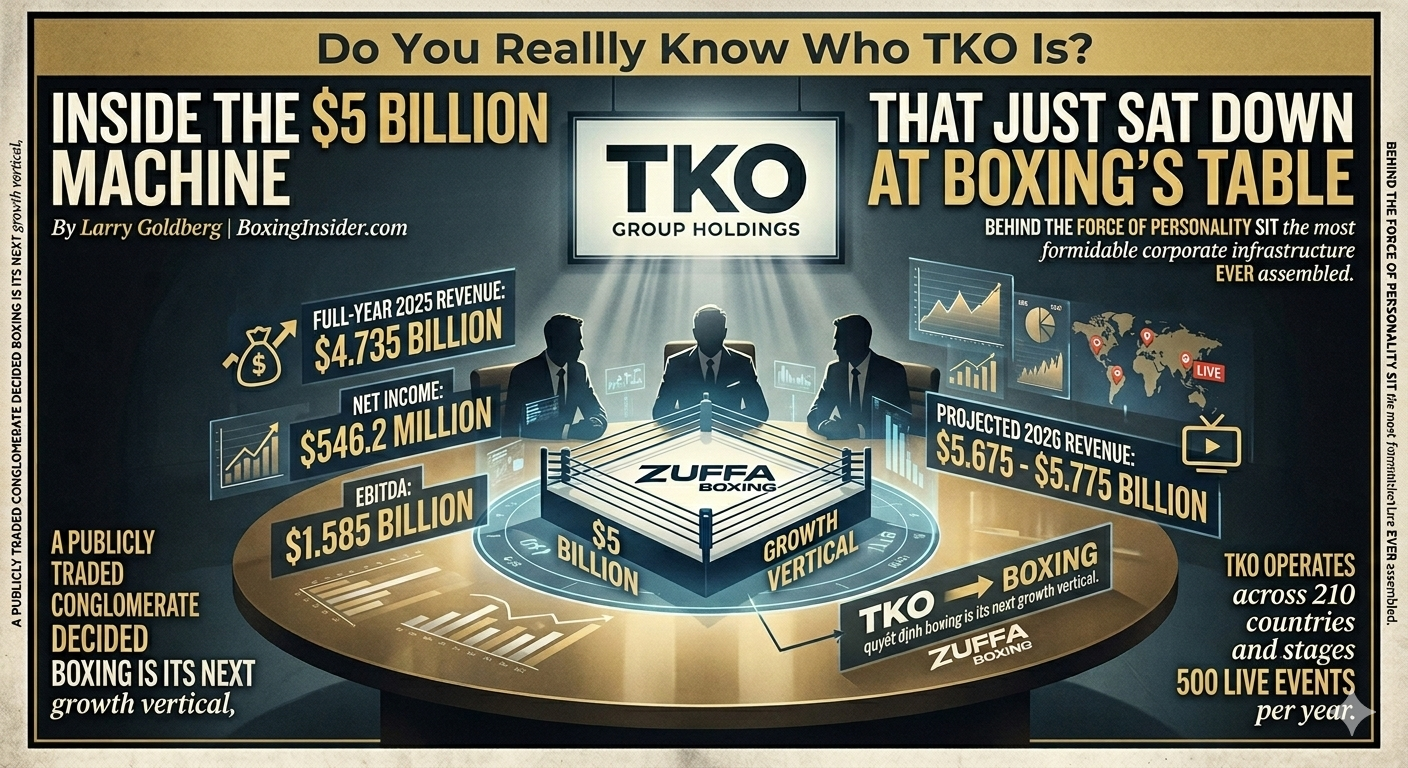
TKO Group Holdings just reported its full-year 2025 results on February 25, 2026. The numbers tell you everything about the scale of what boxing is now dealing with.
Full-year 2025 revenue: $4.735 billion. Net income: $546.2 million. Adjusted EBITDA: $1.585 billion, up 47% year over year. Free cash flow: $1.159 billion. And here’s the forward-looking number — 2026 revenue guidance of $5.675 to $5.775 billion, with EBITDA projected to grow another 41–44%.
For context, those numbers dwarf everything else in boxing combined. TKO operates across more than 210 countries and territories, stages over 500 live events per year, and reaches more than one billion households globally. The company returned over $1.3 billion to shareholders in 2025 alone through buybacks and dividends, and just announced plans for another $1 billion in share repurchases launching this month.
This is the entity that now has a boxing promotion.
The Power Players Boxing Doesn’t Know
The boxing industry reduces TKO to one name. But the actual leadership structure runs much deeper.
Ari Emanuel, CEO of TKO Group Holdings. Emanuel is the co-founder of Endeavor, one of the most influential figures in Hollywood and global entertainment, and the man sitting atop an empire that now encompasses UFC, WWE, IMG, On Location, Professional Bull Riders, and Zuffa Boxing. He’s not a boxing guy. He’s the guy who built the holding company that treats combat sports as one piece of a much larger entertainment portfolio.
Mark Shapiro, President and COO. Shapiro is the strategic architect. He’s the executive on the earnings calls explaining how Zuffa Boxing fits into TKO’s broader growth strategy, how the company earns a $10 million management fee just for serving as the managing partner of the boxing JV, and how each promoted super fight is expected to net an average of $10 million. It was Shapiro who called boxing “a strategic opportunity to reimagine the sport globally.” When you hear those words from the president of a $5 billion company, that’s not hype. That’s a business plan.
Nick Khan, WWE President and TKO Board Member. Here’s where boxing people really miss the plot. Most know Khan, if they know him at all, as “the WWE guy.” What they don’t know is that Khan negotiated Top Rank’s media rights deal before joining WWE. He has deep relationships across the boxing landscape and is formally listed as one of the executive leaders anchoring Zuffa Boxing alongside White. Khan understands the boxing business from the inside, and he brings the media rights negotiation expertise that has already transformed how UFC and WWE monetize their content.
Turki Alalshikh, Chairman of the Saudi General Entertainment Authority. Alalshikh is the co-founder of Zuffa Boxing, and his role in this venture — and in the broader transformation of boxing’s economics — is significant enough to warrant its own conversation. For the purposes of this piece, know that Zuffa Boxing is a formal joint venture between TKO and Sela, the Saudi entertainment conglomerate backed by Alalshikh’s GEA. He is not a silent investor. He is a driving force. We’ll have much more to say about Turki’s impact on the sport in an upcoming piece.
The Infrastructure Nobody Talks About
Beyond the C-suite, TKO has put together a team with serious boxing credentials.
Tom Loeffler, president of 360 Promotions, has been the one actually building this thing on the ground. Loeffler has promoted numerous cards on UFC Fight Pass, developed Callum Walsh into the face of the Zuffa Boxing launch, and has a track record that includes the Klitschko brothers and Gennadiy Golovkin. White has called him boxing’s “best matchmaker.” His 360 Promotions stable is the foundation of the Zuffa roster.
Marc Ratner served as Executive Director of the Nevada State Athletic Commission from 1992 to 2006 and is a member of the International Boxing Hall of Fame. He’s been the UFC’s VP of Regulatory Affairs since 2006. Ratner was the one who appeared before the Nevada commission to secure TKO’s promoter’s license and laid out the plan: 12 to 15 fights in 2026, the majority in Las Vegas, building fighters from the ground up.
Then there’s the media and production infrastructure. TKO acquired IMG — one of the world’s premier sports marketing agencies — and On Location, a global leader in premium experiential hospitality, as part of a $3.25 billion deal that closed in February 2025. IMG handles media rights negotiations. On Location handles the premium event experience. Both are now in service of Zuffa Boxing alongside everything else TKO does.
The broadcast team features Joe Tessitore on play-by-play with Max Kellerman and Andre Ward as analysts. Rian Scalia, formerly of ProBox TV, is also part of the matchmaking operation.
And the distribution? A media rights agreement with Paramount Skydance puts Zuffa Boxing on Paramount+ with simulcasts on CBS — 12 events per year guaranteed, with up to 16 planned for 2026 including international cards and up to four marquee super fights annually. For the full breakdown of Zuffa Boxing’s 2026 roadmap, see our coverage: “Zuffa Boxing Plans Up to 16 Events in 2026 with Global Expansion.”
What This Means for Boxing
None of this means the rest of boxing is going away. Far from it.
Eddie Hearn and Matchroom aren’t closing shop. PBC continues to operate at the highest levels. Top Rank has been in business for over 50 years and has survived every seismic shift the sport has thrown at it. Frank Warren and Queensberry remain a force in the UK and beyond — though as we covered in “Zuffa Boxing Outflanked British Boxing,” the competitive landscape is already shifting. Boxing has always been resilient, and the promoters who’ve kept this sport alive through its toughest stretches deserve enormous respect for what they’ve built.
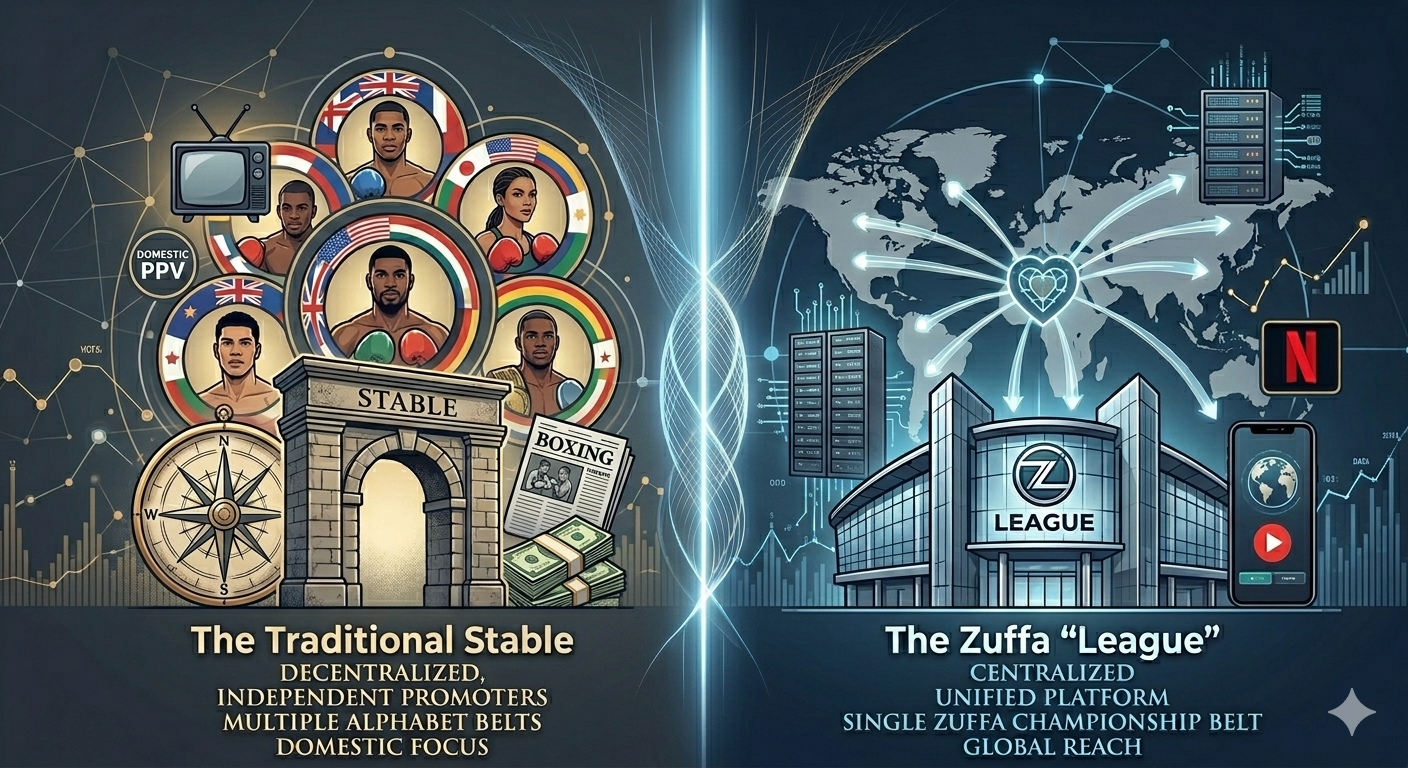
But what’s happening now is something genuinely new. For the first time in boxing’s history, a company with the infrastructure, capital, media expertise, and production capacity of a major professional sports league has decided that boxing is worth its full investment. As we examined in “The League vs. The Stable: Boxing’s Great Architectural Shift,” the NFL has its league office. The NBA has its corporate structure. Boxing, for all its greatness, has always been a collection of independent operators working deal by deal, fight by fight.
TKO represents something different. Not better or worse — different. It’s the arrival of institutional-level infrastructure in a sport that has never had it. And there’s an argument to be made that this is the ultimate validation of boxing’s value. A company projecting nearly $6 billion in revenue doesn’t enter a sport it doesn’t believe in.
The Real Question
Dana White could go toe to toe with Eddie Hearn or Oscar De La Hoya on a solo “Dana White Promotions” alone. But that’s not what’s happening here. What’s happening is all of the above — every name, every division, every dollar mentioned in this article — working together under one roof.
Good luck with that.
The question isn’t whether boxing will survive the arrival of TKO. Of course it will. Boxing always survives. The question is whether the people inside the sport understand what just walked through the door — and whether they’re ready for what comes next.
Because if all you see is Dana White, you’re not looking hard enough.