The League vs. the Stable: Boxing’s Great Architectural Shift
The headlines in February 2026 have been dominated by lawsuits, poached fighters, and public feuding between promoters. That noise obscures the real story. What is unfolding in professional boxing right now is not simply a promotional war — it is a fundamental restructuring of how the sport is organized, how fighters are managed, and how money flows through the business.
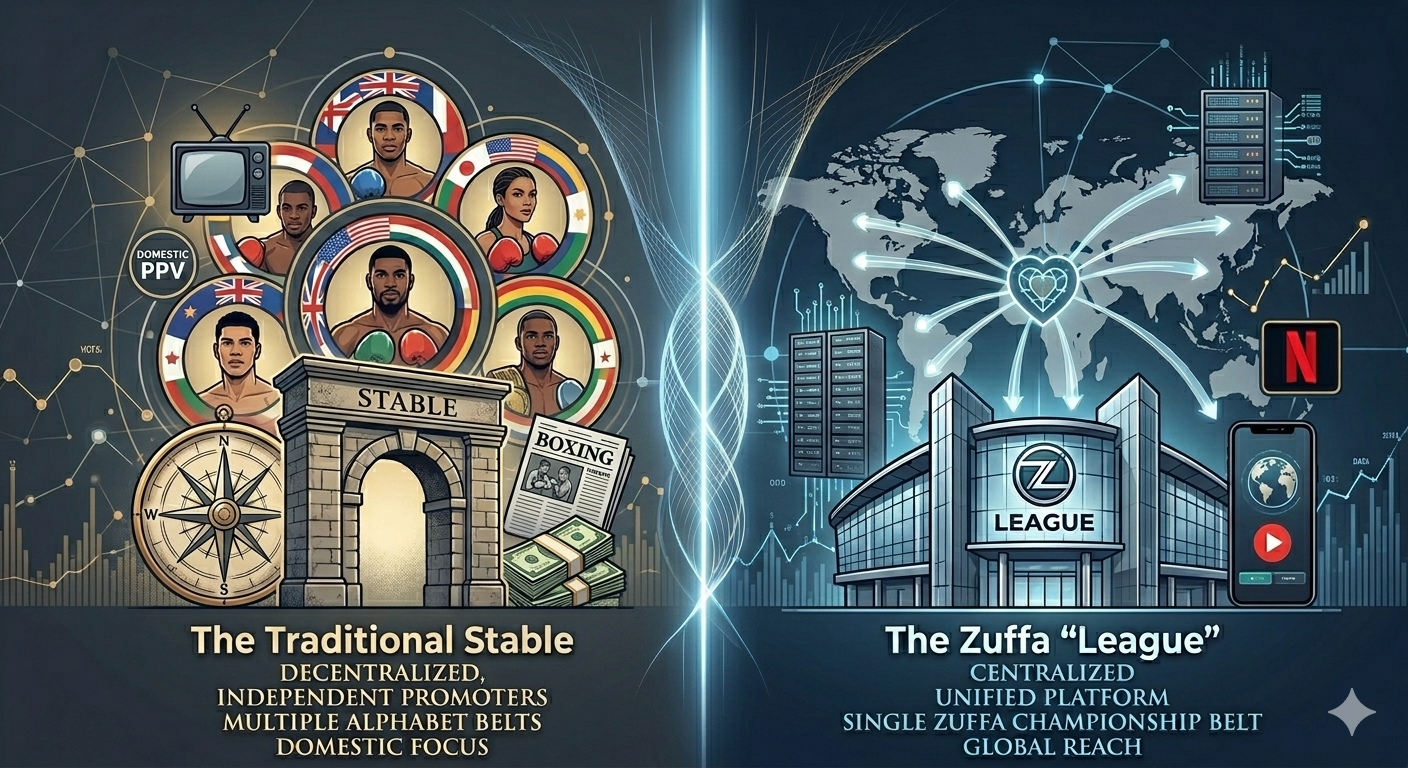
For the better part of a century, boxing has operated on the “stable” model: independent promoters sign fighters, develop them through domestic and regional title fights, and leverage exclusive broadcast deals to monetize the journey. In 2026, that model is being challenged — perhaps existentially — by something that looks less like a rival promotion and more like a centralized league.
Zuffa Boxing, the joint venture between TKO Group Holdings and Saudi Arabia’s Sela entertainment conglomerate, is not merely competing for fighters. It is attempting to redesign boxing’s entire operating system.
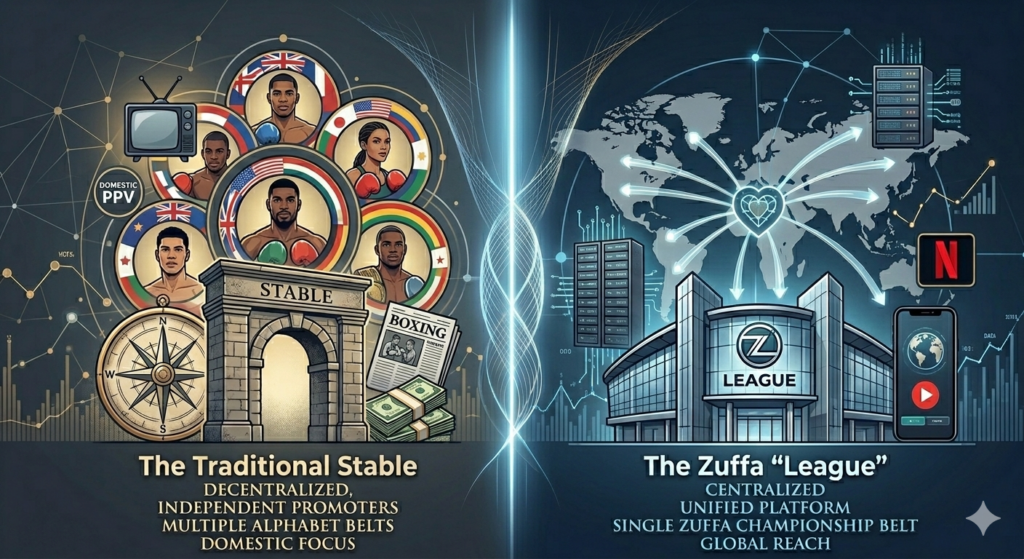
At a Glance: The Architectural Divide
| Feature | The Traditional Stable (Matchroom / Queensberry) | The Zuffa “League” (TKO / Sela) |
|---|---|---|
| Talent Strategy | Long-term development — prospect to champion | Dual-track: large developmental roster plus marquee one-fight acquisitions |
| Weight Classes | 17 recognized divisions (WBC/WBA/IBF/WBO standard) | 8 consolidated core divisions |
| Titles | Traditional sanctioning body belts | Zuffa Championship belt / Ring Magazine rankings |
| Revenue Model | Exclusive TV deals, gate receipts, domestic PPV | Global streaming platforms, sovereign wealth funding |
| Broadcast Home | DAZN (Matchroom + Queensberry) / Sky Sports (Top Rank UK) | Paramount+ (regular series) / Netflix (super-fights via Sela) |
| Primary Goal | Build a fighter’s brand and mandatory title status | Maximize platform content and global reach |
| Key Risk | Cross-promotional gridlock — best fights don’t get made | Centralized control — fighters trade independence for access |
How the Traditional Stable Works
The promotional stable model is built on long-term relationships and exclusive broadcast partnerships. A promoter identifies a prospect — sometimes as young as eighteen — signs them to a multi-fight deal, and builds the fighter’s record methodically against progressively tougher opposition, steering them toward regional titles and eventually a mandatory position for a world championship. The revenue engine is the television deal. Matchroom’s long-term partnership with DAZN and Queensberry’s move to DAZN in April 2025 — after years with TNT Sports — provide the financial infrastructure that makes the enterprise work. The promoter controls the fighter’s journey; in return, the broadcaster gets a steady pipeline of content.
The broadcast landscape was already fragmenting before Zuffa arrived. ESPN’s eight-year partnership with Top Rank ended in July 2025, following the earlier exits of HBO in 2018 and Showtime in 2023. As of early 2026, Top Rank and ESPN are reportedly in talks to reunite — driven in part by ESPN’s loss of UFC content to Paramount+ — but the promotion has spent months without a permanent broadcast home. The traditional model’s reliance on stable, exclusive television deals looks increasingly vulnerable in a streaming-first era.
This model has produced some of the sport’s most compelling arcs. Frank Warren guided Naseem Hamed and Joe Calzaghe from obscurity to world titles. Eddie Hearn built Anthony Joshua from an Olympic gold medal into one of the most commercially successful heavyweights in history. The system rewards patience, matchmaking acumen, and the slow cultivation of a fighter’s brand.
But it has a well-documented flaw. When the best fighters in a division are signed to rival stables, the fans lose. Cross-promotional negotiations are notoriously difficult, frequently collapsing over purse splits, broadcast rights, and promotional credits. The years-long saga of trying to make Anthony Joshua versus Tyson Fury is perhaps the most costly example in recent memory — a fight that, in the end, never happened when both men were at their peak.
The League Model Arrives
Zuffa Boxing does not operate like a traditional promotional stable. It operates like a centralized sports league — the same structural blueprint that Dana White and the Fertitta brothers used to transform the UFC from a fringe spectacle into a multibillion-dollar enterprise. The differences are not cosmetic. They are architectural.
Zuffa is running two parallel tracks. The first is a growing developmental roster — reportedly approaching 100 fighters, mostly prospects and mid-level contenders — who compete on the promotion’s regular numbered cards at Meta Apex in Las Vegas, streamed exclusively on Paramount+. Three events have already aired in 2026, headlined by names like Callum Walsh, José Valenzuela, and Efe Ajagba. This track resembles the UFC’s weekly content model: consistent programming, controlled matchmaking, and a clear internal path to a Zuffa championship.
The second track is where the disruption is most visible. Separate from the Paramount+ series, Zuffa and Sela are staging marquee “super-fights” with established stars on massive short-term contracts. The Conor Benn signing is the clearest example. After spending his entire career under Matchroom, Benn signed a one-fight deal with Zuffa reportedly worth $15 million — a figure that TKO president Mark Shapiro pointedly declined to confirm or deny during a quarterly earnings call, while noting that the purse is being covered by Sela rather than TKO’s balance sheet.
That deal structure reveals the logic. Zuffa is not investing in Benn’s long-term development. It is purchasing his brand for a single event — a “super-fight” at Tottenham Hotspur Stadium on April 11, where Benn will face Regis Prograis on the undercard of Tyson Fury’s Netflix comeback against Arslanbek Makhmudov. If the relationship proves fruitful, Benn may eventually compete on the Paramount+ cards that form Zuffa’s regular programming. If not, he reverts to free agency after one bout. It is acquisition-based, event-driven, and built for global platform distribution rather than domestic television schedules.
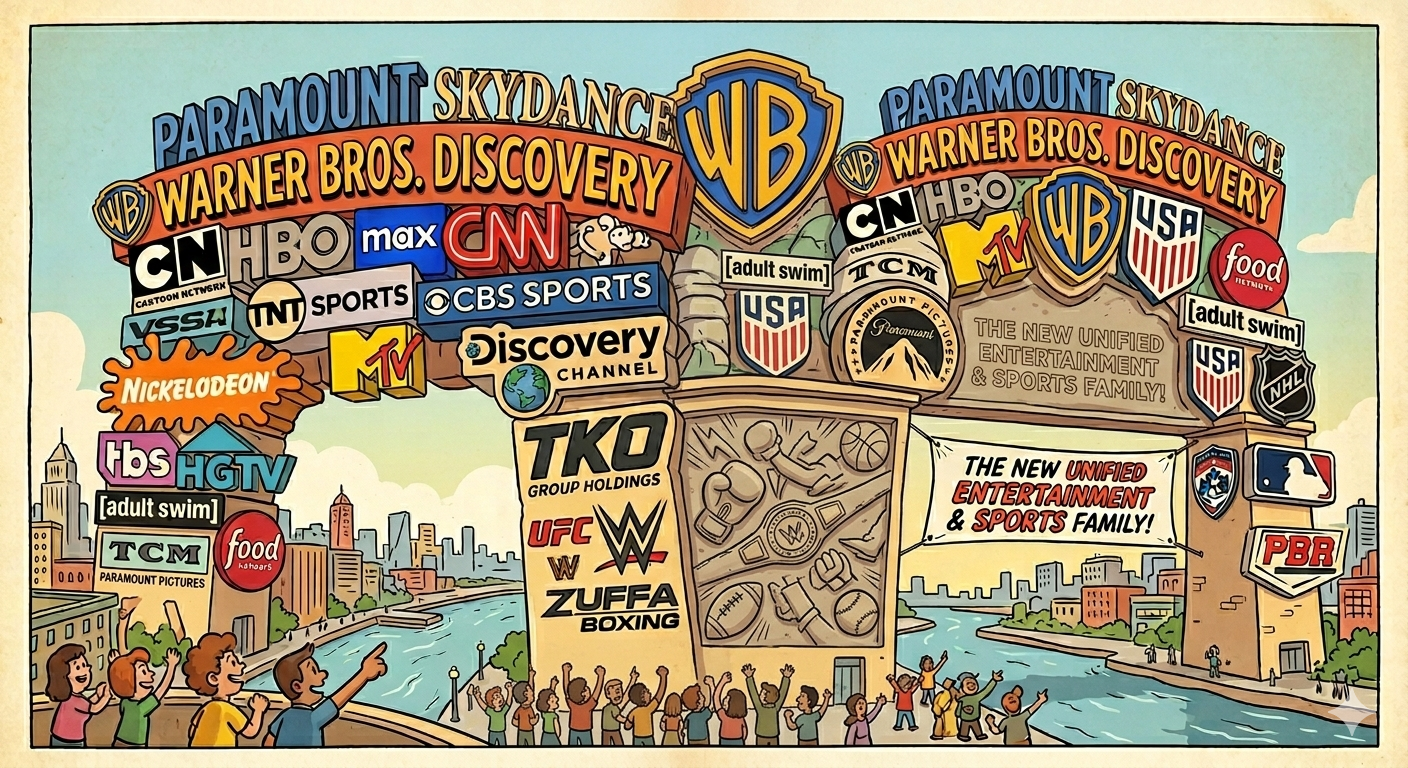
The financial architecture reinforces this two-tier structure. TKO has secured a reported five-year, $500 million media rights agreement with Paramount+ for the regular numbered series. A UK broadcast deal with Sky Sports is reportedly imminent. The marquee super-fights — like Canelo Álvarez versus Terence Crawford, which inaugurated the Zuffa brand in September 2025 — are funded separately by Sela and distributed through Netflix. In this model, the gate and traditional pay-per-view are secondary. The platform becomes the product. The fight is the content.
Eight Divisions, One Belt, Zero Sanctioning Bodies
Perhaps the most revealing structural decision Zuffa has made is its approach to weight classes. Where the four major sanctioning bodies — the WBC, WBA, IBF, and WBO — recognize 17 divisions, Zuffa will operate with just eight: heavyweight, cruiserweight, light heavyweight, middleweight, welterweight, lightweight, featherweight, and bantamweight.
The consolidation eliminates nine “in-between” divisions, including super welterweight (154 pounds), super middleweight (168 pounds), and junior welterweight (140 pounds). Fighters who built careers at those weights must now choose a lane. Callum Walsh, a natural 154-pounder, moved up to 160 for his Zuffa debut. Others will face similar decisions.
More significantly, Zuffa does not recognize titles from any existing sanctioning body. It awards its own belt in each of its eight divisions, with Jai Opetaia set to contest the first-ever Zuffa championship — in cruiserweight, against Brandon Glanton — on March 8 in Las Vegas. For rankings, Zuffa is using Ring Magazine’s independent system as its starting framework while building its own internal hierarchy.
This is where the UFC analogy becomes most precise. In mixed martial arts, being “in the UFC” carries more weight than holding any external title. Zuffa appears to be betting that the same dynamic can be created in boxing — that the platform and the brand will eventually matter more than an alphabet belt most casual viewers cannot distinguish from the others.
The Collateral Damage
The disruption is already producing casualties. Eddie Hearn, who stood by Benn through a two-year doping suspension and reportedly lent him hundreds of thousands of pounds during his time away from the ring, was blindsided by the Zuffa signing. Hearn told iFL TV that he learned of the deal through Benn’s lawyer and that the fighter refused to take his call. His candid admission — “I blame myself, because I just forgot it was boxing” — spoke to the fundamental tension between the stable model’s reliance on personal loyalty and the league model’s raw financial leverage.
Hearn responded by extending Matchroom’s partnership with DAZN through 2031 in a deal calling for more than 30 shows per year globally. “If you’re a great promoter with a great TV deal, you’re unstoppable,” Hearn told Boxing Scene. His roster still includes Anthony Joshua, Dmitry Bivol, Jaron Ennis, Jesse Rodriguez, and Shakur Stevenson. But the Benn departure demonstrated that no relationship is safe when the other side can write an eight-figure check for a single fight.
Frank Warren’s situation is more precarious. His Queensberry Promotions has filed letters of intention to sue TKO and Sela for $1 billion, alleging that both companies breached contracts they had signed with Queensberry. The claim centers on a 2023 exclusive agreement Warren signed with Sela to provide boxing services, which led to the Fury-Ngannou event in Riyadh that October. Queensberry contends that TKO was given access to the details of that arrangement, and that the two companies then went behind Warren’s back to create Zuffa Boxing as a standalone venture.
Sela has denied the allegations, calling the claims “unfounded” and stating confidence that “the facts will fully vindicate our position.” If the case reaches the High Court, it will be one of the largest legal battles in boxing history — and a potential precedent for how promoters’ rights are protected in an era of sovereign wealth-backed disruption.
Why 2026 Is the Hybrid Year
The two models are not yet in open conflict on every front. In many ways, 2026 is a hybrid year — a transition period where the old and new architectures coexist, sometimes in direct competition on the same calendar.
Consider the spring schedule. On April 11 at Tottenham Hotspur Stadium, Tyson Fury returns from retirement against Makhmudov in a fight promoted by Ring Magazine and streamed globally on Netflix — a production of the new league ecosystem, funded by Sela and broadcast on a platform that treats boxing as premium entertainment content. On the same card, Conor Benn fights under the Zuffa Boxing banner in his first bout since leaving Matchroom.
Four weeks later, on May 9 at Co-op Live Arena in Manchester, WBO heavyweight champion Fabio Wardley defends his title against Daniel Dubois — an all-British clash between two Queensberry fighters, promoted by Frank Warren, broadcast on DAZN. This is the traditional domestic route at its purest: two homegrown punchers, a recognized world title on the line, a British arena, and a promoter who built his career on exactly these kinds of nights. As Wardley told The Ring, he selected Dubois from a list of available opponents because “he’s the most dangerous one on the list” — a matchmaking philosophy rooted in legacy and proving oneself through the toughest available competition, not in platform strategy.
Those two events, separated by less than a month, represent the clearest snapshot of boxing’s architectural divide. One is a global entertainment product distributed to hundreds of millions of streaming subscribers. The other is a domestic grudge match built on the traditions of British prize-fighting. Both are legitimate. But they are built on fundamentally different assumptions about what boxing is and how it should work.
What Comes Next
The question is not whether Zuffa Boxing will survive — TKO and Sela’s financial backing makes that a near certainty. The question is whether it can pull enough elite talent into its ecosystem to make the league model self-sustaining, or whether boxing’s ingrained fragmentation will resist centralization as it has resisted every previous attempt.
Dana White has been characteristically blunt about his intentions. “I talked a lot of smack about the things that I didn’t like about boxing,” he said ahead of Zuffa’s first numbered event. “But I also said, if you look at the UFC — and not just the success of it, but the sustainability of it — I took everything that I loved about boxing and everything that I hated about boxing and how we built the UFC.”
The established promoters are not going quietly. Hearn has locked in his DAZN deal through 2031 and commands arguably the deepest roster in the sport. Warren’s lawsuit, if successful, could reshape the legal landscape around promotional rights and sovereign-funded ventures. The sanctioning bodies, meanwhile, have yet to publicly reckon with the possibility that a major promotion might simply render them irrelevant by refusing to recognize their belts.
Boxing has always been a sport of independent kingdoms — promoters, sanctioning bodies, broadcasters, and managers operating in shifting and sometimes antagonistic alliances. What Zuffa is proposing is not another kingdom. It is a different form of government entirely. Whether the sport ultimately looks more like the UFC or continues to resist consolidation will be determined not in courtrooms or press conferences, but by fighters making individual calculations about where their careers and their money are best served. The talent goes where the terms are best. And right now, the terms are changing faster than at any point in the modern era.