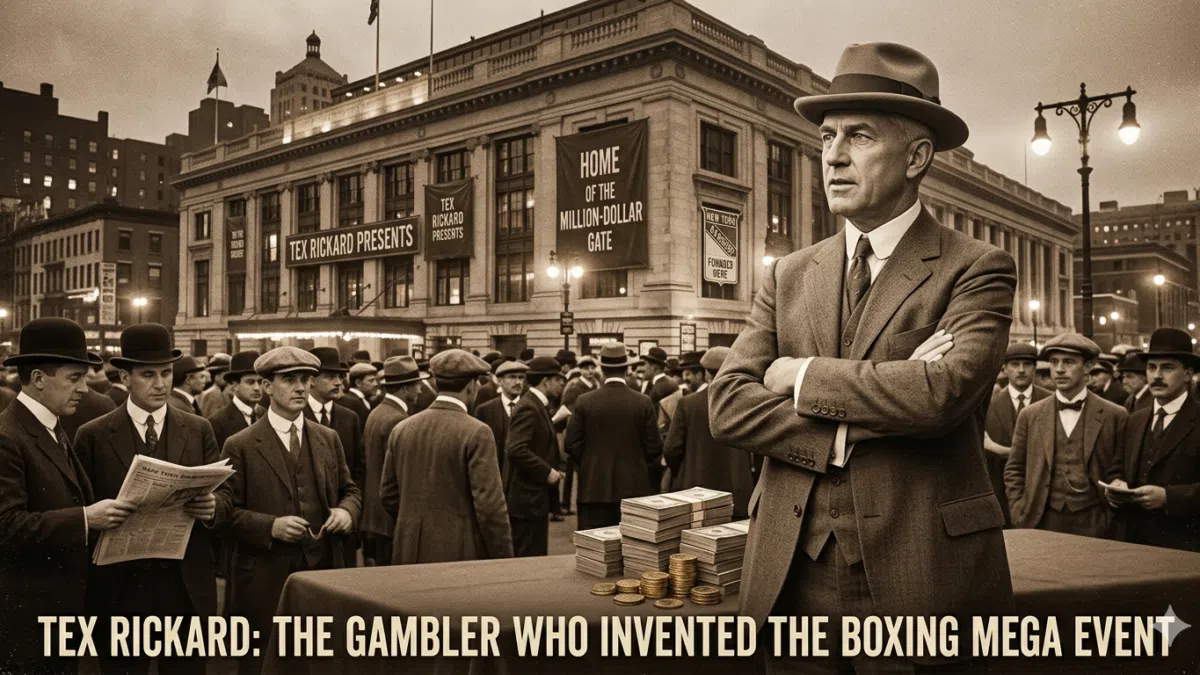
Before Don King or Bob Arum, before television contracts and pay-per-view, there was a grey-eyed gambler from the frontier who turned prizefighting into the biggest spectacle in American sports. George Lewis “Tex” Rickard didn’t just promote fights. He invented a way of selling them that every promoter since has copied, consciously or not. He staged the first million-dollar gate, the first two-million-dollar gate, and the first live radio broadcast of a championship fight. He built Madison Square Garden. He founded the New York Rangers. And he did all of it in roughly a decade, dying at 59 before the empire he created had time to outlive its founder.
Rickard’s biography reads less like a boxing story than a novel about the American frontier, and that’s because it was both.
From Kansas City to the Klondike
Rickard was born on January 2, 1870, in Kansas City, Missouri, and raised in Sherman, Texas, where he worked on the family cattle ranch as a boy. He was elected city marshal of Henrietta, Texas, at 23, earning a reputation as an honest lawman and a superior poker player. The combination of those two qualities, the ability to keep order and the willingness to gamble, defined everything he did for the rest of his life.
When gold was discovered in the Klondike in the late 1890s, Rickard headed north. He opened gambling houses in Alaska, ran what was widely considered the only square game in the territory, and accumulated roughly $500,000 in four years. Then he lost it all on worthless gold claims. He drifted to California, then to Goldfield, Nevada, where he opened another gambling establishment. It was in Goldfield that he stumbled into the business that would make him immortal.
The Goldfield Experiment
On September 3, 1906, Rickard staged a world lightweight championship fight between Joe Gans and Battling Nelson in Goldfield. His primary motive wasn’t boxing. It was publicity for the mining town and his casino. Rickard offered an unheard-of purse of $30,000 and famously displayed the cash in gold coins in a store window. The fight drew national attention and grossed over $62,000. More importantly, it taught Rickard something that no one in boxing fully understood yet: the fight itself was only part of the product. The spectacle around it, the anticipation, the narrative, the sense of event, was where the real money lived.
Four years later, in 1910, Rickard staged his second major promotion: the heavyweight championship fight between Jack Johnson and James J. Jeffries in Reno, Nevada. Jeffries, the retired and undefeated former champion, had been lured back to the ring as the “Great White Hope” to dethrone Johnson, the first Black heavyweight champion. Rickard offered a purse of $101,000. The racial dynamics made the fight a national obsession, and Rickard understood how to channel public emotion into ticket sales. Johnson won easily. Riots followed in cities across the country. Rickard walked away with a profit and a permanent understanding that controversy, properly managed, was the most powerful promotional tool in sports.
Jack Dempsey and the Million-Dollar Gate
After a detour to South America, where he ran a cattle ranch in Paraguay and befriended Teddy Roosevelt, Rickard returned to boxing in 1916. He promoted the Jess Willard vs. Frank Moran heavyweight fight at the second Madison Square Garden, drawing a record indoor gate of $152,000. Then, in 1919, he staged Willard vs. Jack Dempsey in Toledo, Ohio. Dempsey destroyed Willard in three brutal rounds to win the heavyweight title. Rickard made about $100,000 on the fight. He also made the connection that would define the rest of his career.
Dempsey was the perfect promotional vehicle: a ferocious puncher with a compelling backstory and an audience that either loved or hated him. Rickard understood that polarization sold tickets better than affection did. On July 2, 1921, he staged Dempsey vs. Georges Carpentier in a specially built arena in Jersey City, New Jersey. Carpentier was a decorated French war hero. Dempsey had been accused of being a draft dodger during World War I. Rickard played the contrast for everything it was worth. Over 90,000 fans attended. The gate was $1,789,238, the first million-dollar gate in boxing history. The fight was also the first world title bout broadcast on live radio, reaching an estimated audience of 300,000 listeners.
It was the birth of the modern mega-fight. Every supersized promotion that has followed, from Ali-Frazier to Mayweather-Pacquiao, runs on the template Rickard built that afternoon in Jersey City.
Building the Garden
In July 1920, shortly after the Walker Law reestablished legal boxing in New York State, Rickard secured a ten-year lease on Madison Square Garden, then in its second incarnation at 26th Street and Madison Avenue. He promoted championship fights, amateur bouts, six-day bicycle races, and other events, turning the Garden into the most important indoor sports venue in the country.
But Rickard wanted something bigger. On May 31, 1923, he filed incorporation papers for the New Madison Square Garden Corporation. With backing from circus magnate John Ringling and other investors, Rickard purchased a car barn block on Eighth Avenue between 49th and 50th Streets, tore it down, and built the third Madison Square Garden. The arena opened on November 28, 1925. Its first major boxing event, Paul Berlenbach vs. Jack Delaney on December 11, drew a record indoor crowd of 20,000 and a gate of $148,155.
The third Garden became the cathedral of American boxing. For the next four decades, every fighter who mattered fought there. Rickard built it, and boxing filled it.
In 1926, Rickard also founded the New York Rangers hockey franchise, originally nicknamed “Tex’s Rangers.” The team, owned by the Madison Square Garden Corporation, remains one of the NHL’s flagship franchises a century later.
The Long Count and the Two-Million-Dollar Gate
By 1926, Dempsey had not fought in three years. Gene Tunney, a cerebral ex-Marine and former American light heavyweight champion, had emerged as the top contender. Rickard arranged for Tunney to challenge Dempsey at Sesquicentennial Stadium in Philadelphia on September 23, 1926. The crowd was staggering: over 120,000 fans, paying a gate of $1,895,733. Tunney outboxed Dempsey for ten rounds and won a unanimous decision. The upset shocked the boxing world.
To set up the rematch properly, Rickard first promoted Dempsey vs. Jack Sharkey at Yankee Stadium in July 1927, another million-dollar gate. Dempsey won controversially, and the stage was set. On September 22, 1927, Dempsey and Tunney met again at Soldier Field in Chicago. The gate was $2,658,660, the first and, for nearly half a century, the only two-million-dollar gate in boxing history. Tunney’s purse alone was over $1 million.
The fight produced boxing’s most famous single moment. In the seventh round, Dempsey dropped Tunney with a combination. But Dempsey failed to retreat to a neutral corner, and referee Dave Barry refused to begin the count until he did. By the time the count started, Tunney had been on the canvas for an estimated 14 seconds. He rose at the count of nine, survived the round, and went on to win a unanimous decision. The “Long Count” remains the most debated sequence in boxing history.
Between 1921 and 1927, Rickard promoted five Dempsey fights that each exceeded $1 million in gate receipts. Total revenue from those five events was approximately $8.4 million, an almost incomprehensible figure for the era.
The 1922 Indictment
Rickard’s career was not without scandal. On February 17, 1922, he was indicted on charges of abducting and sexually assaulting four underage girls. He lost his boxing license in New York and gave up control of Madison Square Garden during the proceedings. Rickard was acquitted at trial, and his supporters maintained the charges were fabricated by rivals. He regained his license and resumed promoting within the year. The episode remains an uncomfortable footnote in boxing history, largely overshadowed by the scale of what Rickard built afterward, but it is part of the record.
Death in Miami
By the late 1920s, Rickard was investing heavily in Florida real estate and had built a dog-racing track in Miami Beach. He envisioned a chain of “Madison Square Gardens” in cities across the country. On January 6, 1929, Rickard died in Miami from complications following an appendectomy. He was 59.
His body was placed in a $15,000 bronze casket and displayed at the center of Madison Square Garden. Thousands filed past to pay their respects. Jack Dempsey held Rickard’s hand as he died and later admitted he wept. Rickard’s death came ten months before the stock market crash that would have destroyed the economic model he had built. He never had to watch the million-dollar gates disappear.
The Rickard Template
Before Rickard, boxing events were chaotic and often dangerous affairs. Rickard professionalized the experience: numbered seats, printed tickets with prices and sections, uniformed security, and a deliberate effort to attract high-society audiences alongside the traditional fight crowd. He promoted fights the way Broadway promoted shows, courting newspaper coverage and building anticipation through carefully managed publicity campaigns. He understood that a fight needed a story, a hero and a villain, a reason for people who didn’t normally watch boxing to care about the outcome.
He promoted over 200 fights in his career, including some of the most historically significant bouts of the 20th century: Gans-Nelson, Johnson-Jeffries, the five Dempsey gates, and the Long Count. He built the arena that became synonymous with boxing itself. He created a business model that generated more revenue in a single night than most industries produced in a year.
When Rickard died, Damon Runyon, the great sportswriter who had covered him for years, wrote that Rickard was the only man who could make a fight between two unknowns sound like the most important event in the world. That was the gift. Not matchmaking. Not management. The ability to make people believe that what was about to happen mattered more than anything else, and to charge them accordingly.
Every promoter who has followed, from Mike Jacobs to Don King to the streaming-era dealmakers of today, has worked within the framework Tex Rickard built from a gambling hall in Goldfield, Nevada. The million-dollar gates led to the billion-dollar pay-per-view era. The Garden he built became the most famous arena in sports. The Rangers he founded still play there. A century later, the template holds.