On Thursday, Netflix walked away from its $83 billion bid for Warner Bros. Discovery. Hours later, Paramount Skydance — led by David Ellison, son of Oracle co-founder Larry Ellison — emerged as the winner of the most significant media consolidation in a generation, with an all-cash offer of $31 per share for the entirety of WBD. The deal, valued at approximately $111 billion, is expected to close by the end of 2026.
For most of the entertainment industry, this is a story about streaming wars, news divisions, and job losses. For boxing, it is something more specific and more consequential: the final piece of an infrastructure that positions TKO Group Holdings, Turki Alalshikh, and Zuffa Boxing at the center of the sport’s media future.
To understand why, you have to follow the money — and the ownership.
The Ownership Web
Start with TKO Group Holdings (NYSE: TKO), the publicly traded company that owns UFC, WWE, Professional Bull Riders, and now Zuffa Boxing. TKO’s controlling shareholder is Endeavor Group Holdings, which owns a 61 percent stake. Endeavor, in turn, was taken private by Silver Lake Partners in March 2025 in a $25 billion transaction — the largest private equity take-private deal in media and entertainment history.
Silver Lake is also a major investor in Paramount Skydance. The private equity firm has been a financial backer of David Ellison’s Skydance Media since before the Skydance-Paramount merger closed in 2025.
This means Silver Lake now sits on both sides of the table: it controls TKO (through Endeavor), and it holds a significant financial position in the media company that broadcasts TKO’s content. When Paramount signed a long-term media rights deal with Zuffa Boxing in September 2025 — making Paramount+ the exclusive home of the promotion in the U.S., Canada, and Latin America — the overlap was already visible. With the WBD acquisition, it becomes massive.
What Paramount Now Owns
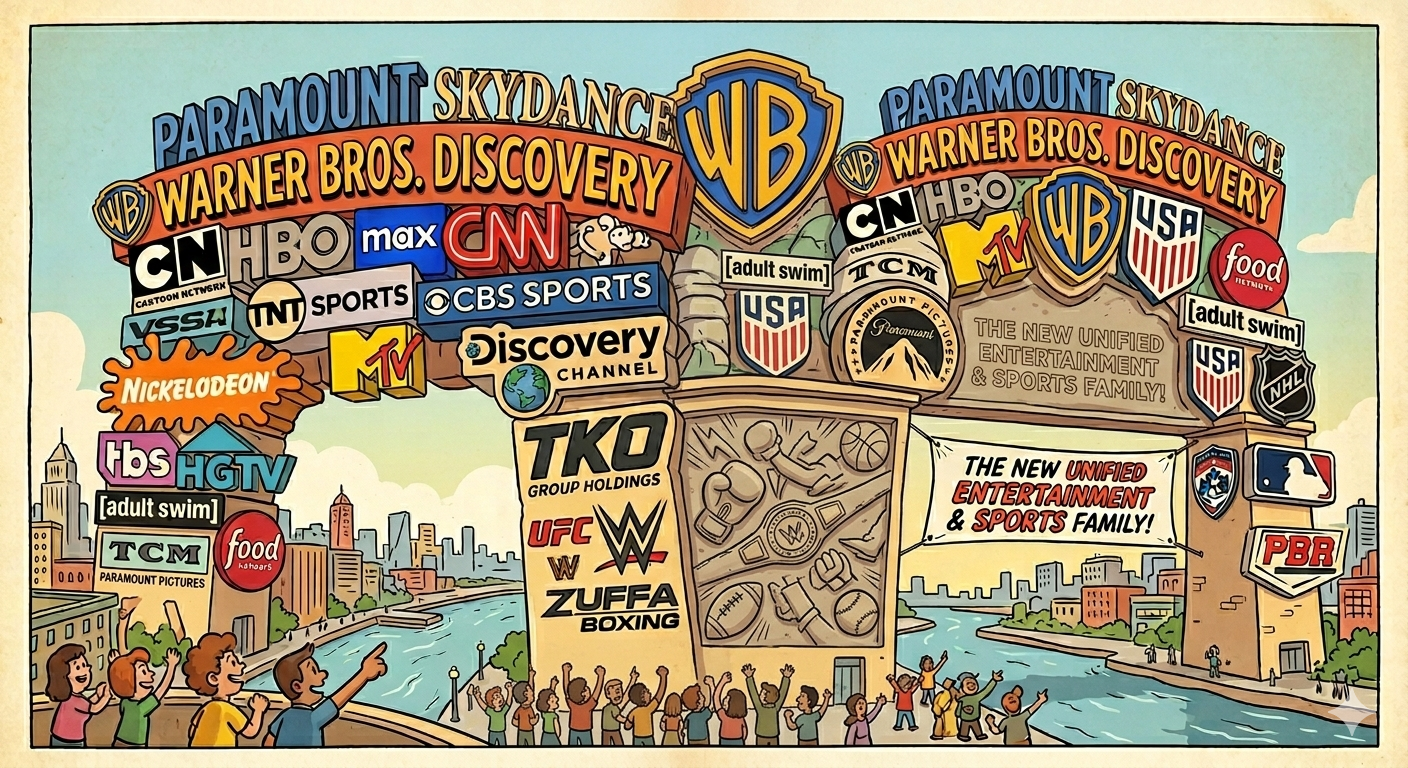
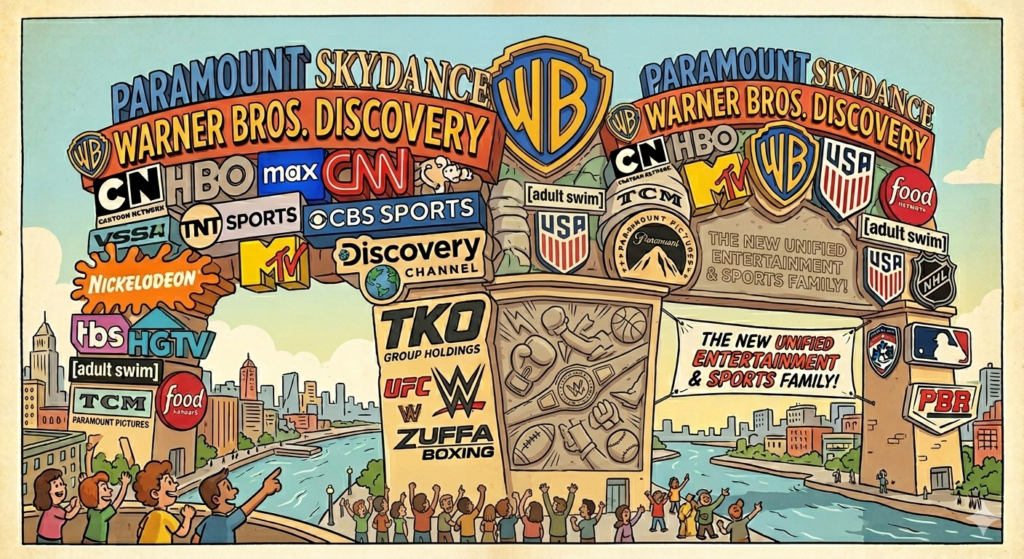
If the merger clears regulatory approval, Paramount Skydance will control an empire of media assets that includes, as reported by Variety:
- Broadcast: CBS — the most-watched broadcast network in the United States
- Cable: TNT, TBS, CNN, HBO, Showtime, MTV, Nickelodeon, Comedy Central, Cartoon Network, Discovery Channel, Food Network, HGTV, Adult Swim, TCM
- Streaming: Paramount+, HBO Max
- Studios: Warner Bros., Paramount Pictures
- Sports branding: TNT Sports (formerly Turner Sports), CBS Sports, Bleacher Report
Two of those assets carry particular weight for combat sports. TNT Sports currently holds the U.S. broadcast rights to the Champions League and has historically been a major platform for combat sports content, including All Elite Wrestling. Showtime — the network that broadcast boxing for 37 years before exiting the sport at the end of 2023 — now returns to the same corporate family as the promotion trying to reshape the entire sport. And then there is HBO, which for decades was synonymous with the highest level of the sport. HBO Boxing launched in 1973 and became the definitive home of the sport’s biggest nights — Leonard-Hearns, Holyfield-Tyson, De La Hoya, Mayweather, Pacquiao. When HBO exited boxing in 2018 after 45 years, it left a void that no single platform has filled since. Under the Paramount-WBD umbrella, there is nothing stopping the revival of HBO as a boxing brand — and the historical equity of that name is worth more than any new promotion could build from scratch.
What It Means for Boxing
Zuffa Boxing already had a deal with Paramount+ for 12 events in 2026, with the option for CBS simulcasts. TKO president Mark Shapiro told The Ring that plans include 16 to 18 events and up to four Saudi-backed super fights per year. Paramount’s seven-year deal for UFC rights — also signed in 2025 — already made the company TKO’s primary broadcast partner.
With the WBD acquisition, the platform math changes entirely. Where Zuffa Boxing previously had access to Paramount+ and potential CBS simulcasts, the combined company would give TKO access to:
CBS for free, over-the-air broadcast of marquee events — the only current path for boxing to reach a non-streaming audience. TNT for regular cable programming, the kind of consistent weekly or biweekly slot that boxing has not had since ESPN’s Top Rank deal expired in July 2025. HBO Max for streaming distribution to an entirely different subscriber base than Paramount+. Showtime as a legacy boxing brand that could be revived or folded into a combined streaming platform. And Bleacher Report for digital content, social media amplification, and a younger audience.
None of this is confirmed. The merger has not closed, regulatory review has not begun, and no one from TKO or Paramount has announced expanded boxing distribution across WBD properties. But the infrastructure is now there in a way it was not 48 hours ago.
The Competitive Landscape
Before this deal, boxing’s broadcast ecosystem was already fragmented and unstable. Boxing in 2026 is spread across a half-dozen platforms with no single dominant home.
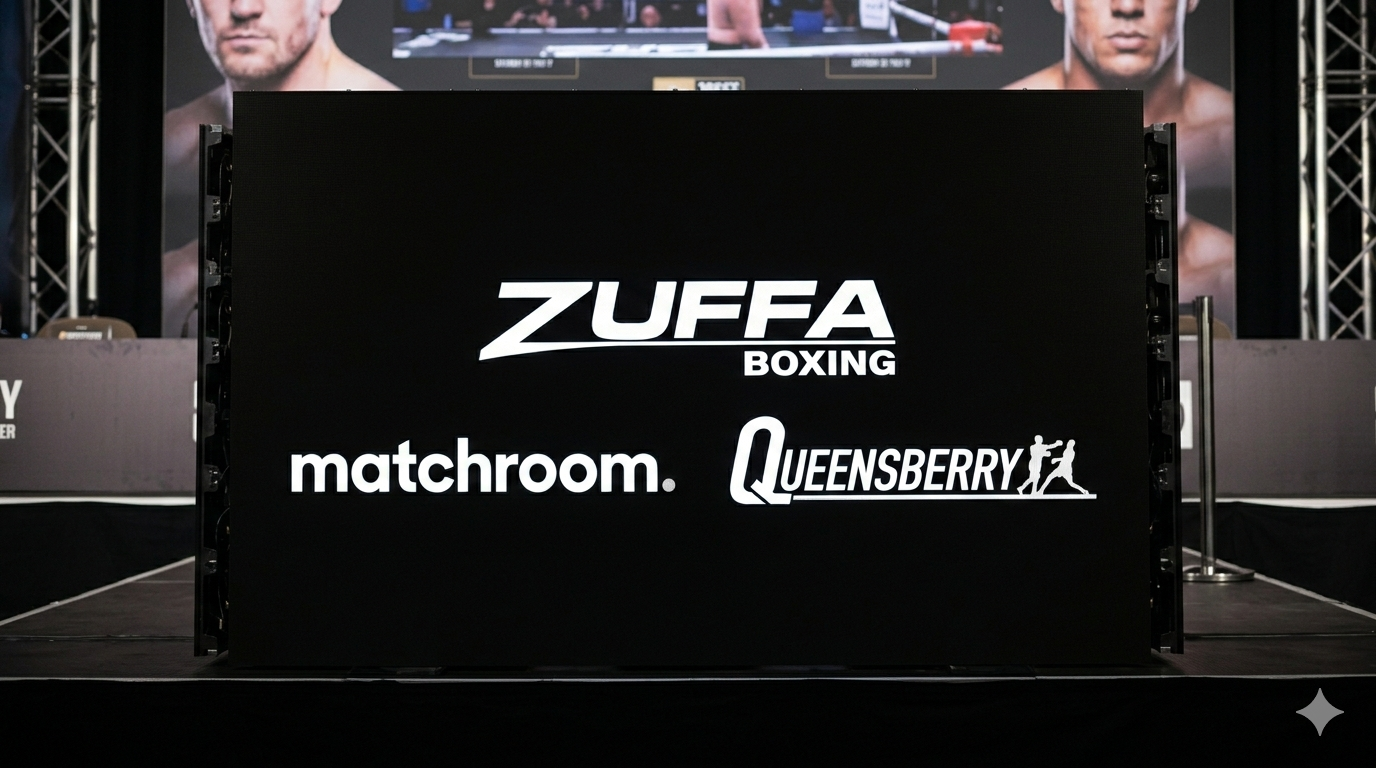
DAZN carries Matchroom, Golden Boy, and Queensberry content — over 50 cards per year. Amazon Prime Video has the PBC relationship, mostly on a PPV basis. Netflix broadcasts select mega-events like Riyadh Season shows. ESPN has no current boxing deal after its Top Rank partnership ended. ProBox TV and TrillerTV service niche audiences. And Zuffa Boxing lives on Paramount+.
The Paramount-WBD merger does not directly affect any of those existing deals. DAZN’s contract with Matchroom runs through 2031. PBC’s relationship with Amazon is ongoing. Netflix’s event-by-event model operates independently.
But what it does is create a single corporate entity with enough platforms, enough reach, and enough financial muscle to offer boxing what no one else currently can: consistent programming across broadcast, cable, streaming, and digital — all under one roof. That is the advantage promoter Lou DiBella pointed to in a post on X Thursday, noting that TKO and its partners are now “perfectly situated to reset and control boxing because no one has more resources, partnerships, and platforms with which to do so.”
The Saudi Connection
The financial engine behind Zuffa Boxing’s biggest events is not TKO or Paramount. It is Turki Alalshikh and the Saudi General Entertainment Authority, operating through entertainment conglomerate Sela. As Shapiro told The Ring, the Saudis fund the fighter purses for the super fights while TKO handles promotion, production, and media rights — a model that lets Zuffa Boxing operate at a level its competitors cannot match on economics alone.
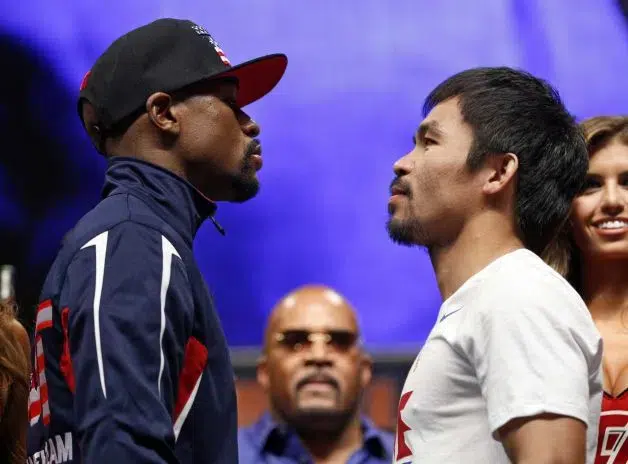
Alalshikh’s Riyadh Season banner has already produced Canelo Álvarez vs. Terence Crawford on Netflix and is lined up to deliver Floyd Mayweather vs. Manny Pacquiao at the Sphere in September 2026 — events that operate independently of Zuffa Boxing but draw from the same Saudi funding apparatus. That willingness to spend — combined with TKO’s promotional infrastructure and now Paramount’s media distribution — creates a triangle of resources that traditional promoters like Matchroom and Queensberry are already struggling to compete with.
What This Does Not Mean
This is not a monopoly. DAZN, Amazon, and Netflix all remain in boxing. Matchroom, Golden Boy, and PBC all have active rosters and existing broadcast deals. The four major sanctioning bodies — WBC, WBA, WBO, and IBF — still control the championship belts that drive the biggest fights, even as Zuffa Boxing experiments with its own titles.
The merger itself still faces significant regulatory hurdles. Combining two major studios, two news networks, and two streaming services under one corporate umbrella will draw scrutiny from the Justice Department, the FCC, and the European Commission. Senator Elizabeth Warren has already called the deal “an antitrust disaster.” The close is projected between September and December 2026 — if it is approved at all.
And the boxing-specific implications depend entirely on decisions that have not been made yet. Will Paramount consolidate HBO Max and Paramount+ into a single streaming platform? Will TNT get a regular boxing slot? Will CBS commit to broadcasting title fights? None of that is on paper.
The Bigger Picture
What is on paper is a corporate structure that gives one interconnected group of entities — Silver Lake, TKO, Zuffa Boxing, Paramount Skydance, and the Saudi General Entertainment Authority — access to the largest collection of media platforms in American entertainment, the deepest pockets in global sports promotion, and a boxing promotion that is expanding aggressively on every front.
Whether that translates into boxing dominance depends on execution, regulatory approval, and the decisions of fighters and their advisors about where they want to compete. But the infrastructure is now in place in a way that has no precedent in the sport’s history — not during HBO’s golden era, not during Showtime’s championship boxing run, not during ESPN’s Top Rank years.
As Lou DiBella put it: just great timing to be making their move, whether you like it or not.