By Eric Bottjer
SAM HAILSTOCK, 72, Pennsylvania welterweight, died “peacefully” in September. Hailstock was 10-12-2 (3 KO) from 1975-1983, including losses to future belt holder Colin Jones and previous belt holder Angel Espada in 1979. Hailstock worked for 25 years at Bethlehem Steel.
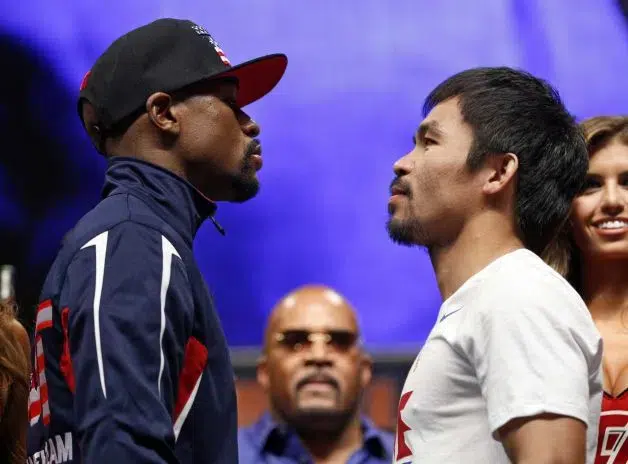
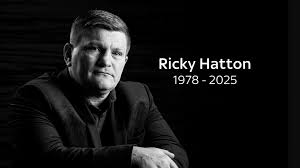
RICKY HATTON, 46, British boxing legend from Manchester and Boxing Hall of Fame, died suddenly in September at his home. He was discovered there by his manager. Hatton had taken his own life. Hatton had been public about his battles with depression and suicidal thoughts, but most friends and family felt he had cleared those hurdles as he headed toward middle age. Hatton was training for a one-off boxing match in Dubai that would have paid him about $2 million and had told a reporter three days before his death that he “had never felt better.” Ricky Hatton was England’s most popular boxing champion, a strong title to wear from a country that produced beloved heavyweight legends Henry Cooper and Frank Bruno. Hatton turned pro in 1997 and won a minor title in 2001, a belt he defended 15 times before meeting legend and reigning IBF 140-pound champion Kostya Tszyu in England in 2005. In front of 20,000 fans, Hatton, a 5-1 underdog, battered Tszyu into retirement and cemented his own claim as an elite fighter. Hatton’s kill-or-be-killed style produced memorable moments, but also shortened his career. Less than three years after the Tszyu fight, Hatton lost his first match – a mega-fight with Floyd Mayweather Jr. – and he was never the same. He lost two of his final four fights, including a devastating second-rojnd knockout to Manny Pacquiao, which effectively ended his ring career. Hatton said later the Pacquiao loss also sent him adrift in his personal life and he began abusing alcohol and drugs. An ugly court battle with his own father over money further depressed the popular boxer. Hatton became a promoter after he quit boxing, but found the business side of boxing much more difficult that fighting in the ring. His post-career battles and his openness about these personal conflicts only endeared him more to his fans, who were shocked by his sudden death. His funeral attracted basically the entirety of Manchester.
GREG HAUGEN, 64, former lightweight title-holder, died in February in a Washington state hospital from cancer. Haugen had been diagnosed with renal cancer less than three year earlier. Haugen grew up poor in Auburn, Washington and discovered boxing after getting tossed from high school and winning some Toughman matches in Alaska. He turned pro in 1982 in Alaska and beat a 13-3 foe – in a scheduled 10-rounder (45 of Haugen’s 50 pro bouts were scheduled for 10 or 12 rounds). Haugen introduced himself to the boxing world in 1985 by beating Jeff Bumpas on ESPN, beginning a series of wins on the network that resulted in an IBF title shot against Jimmy Paul in December 1986. Haugen won a 15-round decision, with two of the judges giving Haugen the belt by a single point. He lost the belt to Vinny Pazienza (a rival in trash-talking that endured to Haugen’s death), regained it from Paz eight months later and then took $400,000 to travel to Norfolk and lose to Pernel Whitaker. By 1991, Haugen was a “name” opponent, perfect for unbeaten Hector Camacho to defend a 140-pound title. Haugen scored the upset – and then was stripped of his belt after testing positive for marijuana (Haugen admitted to smoking on a daily basis since age 16). Greg beat a older Ray Mancini in 1991, his last significant win. He earned $1 million to get bludgeoned by Julio Cesar Chavez in front of 130,000 in Mexico City a year later and retired in 1999 at 39-10-1 (19 KO’s). Haugen settled in Las Vegas, spent his money, divorced (his wife Karen tried to run him over when Haugen returned home one day and ended up plowing the car into their kitchen) and returned to Auburn. He trained fighters and raised four kids. He and Karen mended fences and found peace as friends instead of partners.
THOMAS HAYES, 43, Chicago heavyweight, died in March in a car accident. Hayes was 27-2 (18 KOs) from 2002-2007, but his record was deceptive as he fought mostly on local club shows against “opponents.” Hayes stepped up to meet contender Chris Arreola in 2007 and was knocked out in 3 rounds. He had a final fight four years later (a decision win over a boxer with a 4-20 record) before retiring for good. Hayes was known in his neighborhood as a big-hearted volunteer. He spent part of his retirement training youth boxers for the city’s parks department and had planned to enter the police academy before his untimely death.
ALFONSO HAYMAN, 76, Philadelphia welterweight journeyman and the first man to last the distance with Thomas Hearns, died in May. Hayman served as a paratrooper in Vietnam before turning pro at age 22. The talented and erratic Hayman went 21-19-5 (12 KOs) from 1970-1980, and was on the verge of a world rating after beating Johnny Gant in 1974. But he lost a rematch to Gant and became a “name” for future champions like Hearns, Maurice Hope, Milt McCrory, Angel Espada and Rocky Mattioli. In 1980, Hayman retired from boxing and was almost immediately arrested for robbing a jewelry store (where he worked at the time) and then compounded his trouble by punching a Deputy Sheriff in court and pulling a gun. He was caught the same day and eventually did time for the robbery and assault.
JOSUE DAVID HERNANDEZ, 20, promising Mexican amateur boxer, was stabbed to death in San Luis Potosi, Mexico, during a family dispute in December. Hernandez died at a hospital after being attacked with a machete. Hernandez was defending a sister during a violent argument when the assailant turned on Hernandez.
CLIVE HOGBEN, 74, British featherweight, passed “peacefully” in October. Hofben, a southpaw from Northamptonshire, was 10-7-1 (3 KOs) from 1972-1977. A knee injury cut short his boxing career and led him to work selling advertising for newspapers and magazines.
JOHN HOGG, 78, Australian judge, died in May. Hogg, an amateur boxing historian, worked as a pro judge from 1989-2024.
JIMMY HOWELL, 87, Missouri club promoter, died in April. Howell, a St. Louis postman, worked for 60 years in boxing as a trainer, manager and, later on, promoter. He promoted 36 shows from 2000-2010, all of them in Missouri (his debut promotion was in 1962 in Omaha, but he didn’t try his luck again in the pro ranks for 38 years after).
MIKE IGO, 87, Binghamton, New York, amateur trainer, passed in August after battling dementia. Igo trained youth at the local Boy’s Club and was a beloved figure in his hometown.
ROLAND JANKELSON, 86, Washington state manager, passed away in November. Jankelson got involved in boxing in the 1980s by helping a friend finance the career of Pinklon Thomas. Jankelson’s business success in the health field helped him fund his boxing ventures (in addition to Thomas, Roland managed Joe Hipp, Alex Bunema and Chauncey Welliver, among others).
CARSON JONES, 38, Oklahoma welterweight, died in February as he was about to undergo stomach surgery. Jones had battled stomach issues for two years, during which he could barely eat or digest food and he lost 35 pounds. Jones elected to have surgery on his esophagus, but Jones’s heart stopped literally before the surgery was about to begin and he as lost. Jones turned pro in 2004 and went 44-16-3 (32 KO’s) in a 20-year career, achieving a top 10-rating in 2011 when he stopped Said Ouali and Ricardo Wiliams Jr. The wins led to a shot in England against British star Kell Brook in 2012 – Brook won a controversial decision (Jones was stopped in a rematch a year later).
CHRIS JORDAN, 92, Texas referee who worked some of his state’s biggest fights from 1964-1991, died in May. Jordan was third man in the ring for Muhammad Ali-Buster Mathis at the Houston Astrodome in November 1971, one of Ali’s comeback bouts that eventually led to Ali regaining the heavyweight championship. Ali obviously carried Mathis the final few rounds of their 12-rounder, and Jordan gave Mathis multiple counts in the 11th and 12th rounds, but allowed Mathis to last the distance. Jordan referred fights in involving George Foreman, Lupe Pintor, Frank Tate and Orlando Canizales, but never did a world title fight.
ANTONIO RENE JUAREZ, 68, Argentine welterweight, known as the “Monkey of the Mountain Range,” died in April. Juarez was 25-31-13 (4 KOs) from 1977-1988, finishing his career with a decision loss to a young Jorge Castro. Juarez fought out of Cordoba, but passed in his adopted hometown of Esquel.
JERRY JUDGE, 77, Philadelphia heavyweight who was one of the “5” in the “Foreman v. 5” show that saw a comebacking George Foreman fight five heavyweights for a scheduled three rounds each in one night, died in September from dementia. A 6-foot, 200 lbs, Judge would have been a cruiserweight today. He was 16-7-2 (13 KOs) from 1969-1979, with his biggest win coming over Chuck Wepner in 1971 (Wepner was stopped on cuts, of course). In 1973, Judge lost a 6-round decision to a 5-0 Larry Holmes at the Scranton CYC, an impressive showing in that the referee was the sole judge and he had Holmes winning by a single point. Judge was a career police officer in Bensalem. Judge was stopped by Foreman in two rounds, but he did take the fight on short notice. Despite the circus-like atmosphere that surrounded “Foreman vs. 5,” and the bizarre scenes of Foreman being taunted at ringside by Ali while struggling with some of his hand-picked opponents, Judge remembered Foreman as “a class act.”