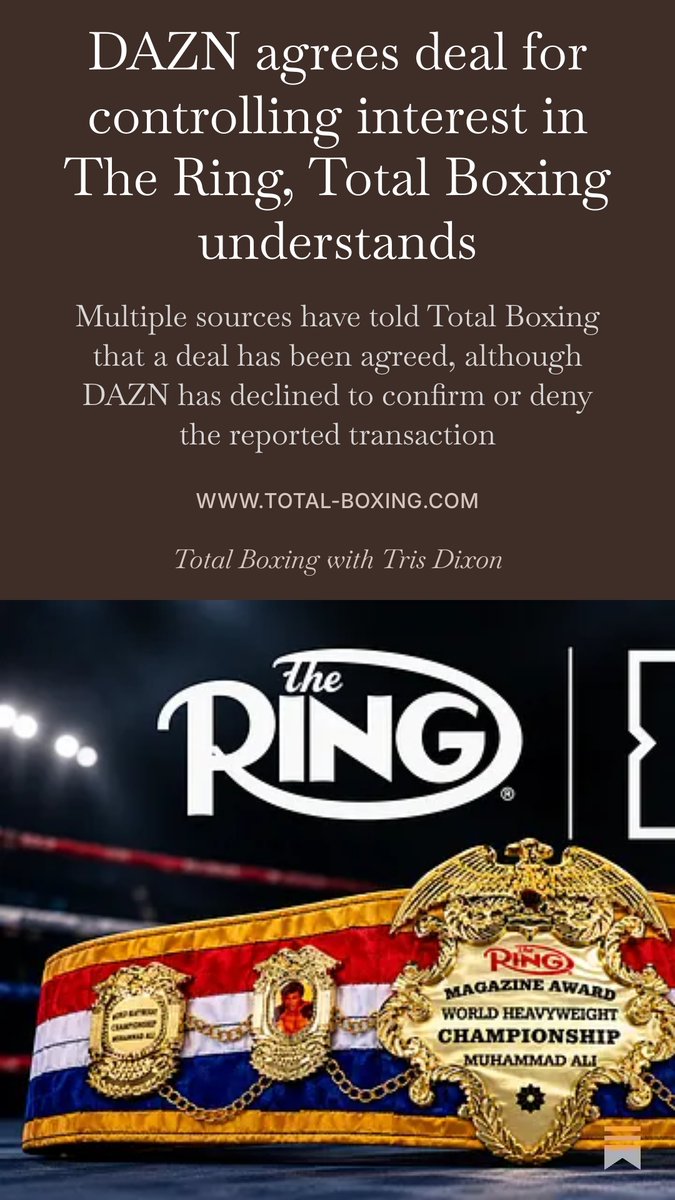
Two stories broke in sports media this week that had almost nothing to say about boxing. Read together, they say a great deal about where the sport now lives.
The first is the closing of Paramount’s acquisition of Warner Bros. Discovery. According to an analysis by The Desk, the combined company, Skydance, now controls 36 premium sports rights properties. That is nearly double its closest competitor. Comcast, NBC Universal and Versant rank second with 19, followed by ESPN and ABC with 14 and Fox with 13.
The second is DAZN’s coming out party in New York. The streamer that built its American identity on fight nights held a media event in Manhattan on Wednesday to present its plan for local team sports. It was about the Knicks and the Yankees, not about a ring.
Start with Skydance. Its portfolio includes the NFL on CBS, exclusive control of March Madness, MLB, the NHL, the PGA Tour, the Big Ten and the Big 12. It also includes UFC, under a seven year agreement valued at $7.7 billion, and Zuffa Boxing. That places a boxing promotion inside the largest collection of sports rights in the United States, on the same corporate roster as the NFL and the NCAA tournament.
The Desk is careful to note that its ranking counts the number of properties, not their dollar value or audience. Even so, the position is hard to miss. TKO now has its boxing product sitting next to the most watched programming in the country, with every cross promotional opportunity that comes with it.
Now look at DAZN. Front Office Sports reports that in the last six months the London based company has acquired local rights to 19 teams across MLB, the NBA, the NHL and the WNBA. The list includes the Yankees, Knicks, Nets, Rangers, Devils, Islanders and Sabres through its agreement with the YES Network and MSG Networks, along with clubs such as the Cavaliers, Pacers, Grizzlies, Timberwolves and Spurs.
DAZN is not finished. “We’re in active talks with a number of teams, plus a number of leagues,” DAZN CEO of growth markets Pete Oliver told Front Office Sports. The company has also bought EverPass Media, the commercial distributor of NFL Sunday Ticket, and the streaming technology firm ViewLift.
The larger target is the centralized local streaming hub the NBA plans to launch for the 2027-28 season. Amazon, ESPN and YouTube are also reported to be interested. Sports Business Journal reports that Oliver described the coming season as a chance to “show people how to do regional sports right.”
The product reflects the new priority. Fans can buy a single team on a standalone basis. A Cavaliers subscription, for example, is listed at $19.99 per month. Each team gets its own hub with live games, replays and original programming. Front Office Sports described DAZN as building beyond its original base in combat sports, soccer and international distribution.
None of this means DAZN is leaving boxing. It remains one of the most active buyers of fights in the world. But a company chasing the NBA’s national streaming hub has different priorities than one whose American pitch was a fight every weekend. Attention, marketing money and home page space are finite.
So the picture for boxing in the fall of 2026 looks like this. One major home for the sport has just become part of the biggest sports rights holder in America. The other is working to become the place where fans watch their local basketball, hockey and baseball teams. In both cases boxing is one property among dozens.
That can cut either way. A fight card promoted during an NFL window or inside a Knicks hub can reach people who would never go looking for boxing. It can also get lost. For fighters, managers and promoters outside those two systems, the question is no longer which platform loves boxing most. It is how much room either one has left for it.