Three weeks ago, Dana White took Conor Benn from Eddie Hearn with a reported $15 million one-fight deal. Hearn called it a dagger in the heart. Last week, Hearn fired back — not with a press conference rant, but with a business move that put him directly inside the UFC.
On March 5, Hearn announced the formation of Matchroom Talent Agency and unveiled its first client: UFC undisputed heavyweight champion Tom Aspinall. Two days later, he accused White of pre-screening media interviews to avoid tough questions about fighter pay. By the weekend, he was telling Ariel Helwani that 1,000 MMA fighters had reached out for representation and that White was “spiraling.”
The promoter war between Matchroom and Zuffa just opened a second front.
The Aspinall Signing
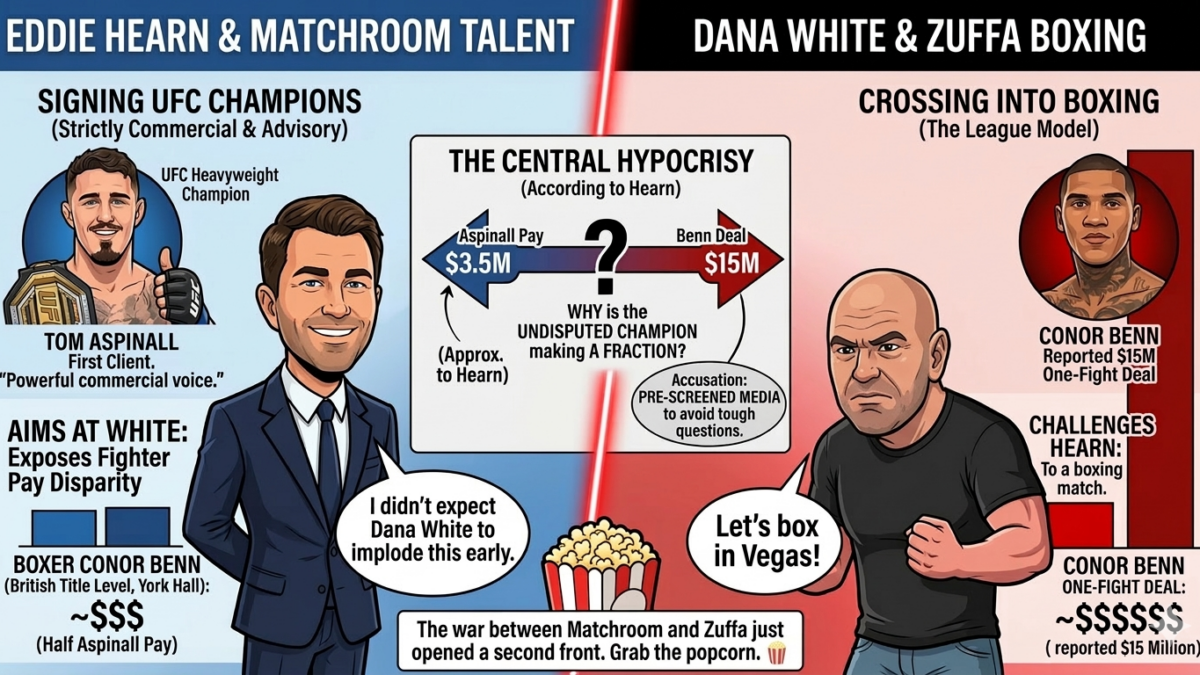
Aspinall, 32, is recovering from double eye surgery after his UFC 321 main event against Ciryl Gane was stopped due to repeated eye pokes last October. He remains under contract with the UFC and will continue fighting in MMA. The Matchroom deal is strictly commercial and advisory — Hearn and his team will handle Aspinall’s business dealings, brand development, and negotiations outside the cage, with an open question about whether Hearn will eventually sit across from the UFC at the negotiating table for fight contracts.
According to ESPN’s detailed breakdown of the deal, the two men had never spoken until February 26 — nine days before the announcement. Hearn connected with Aspinall on a Zoom call, and the deal was done within 48 hours. Reporter Ariel Helwani noted that every major MMA manager had tried and failed to sign Aspinall, who had been represented by his father Andy throughout his career.
Aspinall was direct about his motivation. He told assembled media on March 7 that he needed “a more powerful voice in my corner to grow commercially inside and outside the Octagon” and expressed hope that other MMA fighters would look at the money he stands to make and follow suit.
The Fighter Pay Argument
This is where the story moves from promotional chess to something with real implications. Hearn said he had access to Aspinall’s UFC contracts and was stunned by what he saw.
Speaking on March 7, Hearn said that when Aspinall was headlining pay-per-view cards in front of 20,000 people, he was earning roughly half of what Matchroom would pay a boxer for a British title fight at York Hall in front of 1,200. According to estimates published by ESPN and BetMGM’s Sports Blog, Aspinall’s total payout for UFC 321 — including base salary, pay-per-view share, and bonuses — was approximately $3.5 million. Benn’s one-fight Zuffa deal is reportedly worth $15 million. Benn has never held a world title.
Hearn framed the disparity as the central hypocrisy of White’s position. White has entered boxing presenting himself as a disruptor who will fix the sport’s broken economics. Hearn’s counter-argument is straightforward: if Zuffa can pay a boxer $15 million for one fight, why is the UFC heavyweight champion of the world making a fraction of that?
The Pre-Screening Accusation
Hearn escalated further on March 10, appearing on The Ariel Helwani Show and accusing White of tightly controlling UFC media interviews. Hearn claimed that reporters covering the UFC are told what questions they can ask and that segments are pre-screened before publication.
He challenged MMA journalists to put a specific question to White: if Aspinall is driving comparable or greater revenue than Benn, why is he earning ten times less money? Hearn argued that the UFC’s media environment is structured to prevent exactly that kind of interrogation.
Veteran MMA journalist Luke Thomas weighed in on X, writing that when the UFC talks about its commitment to free speech, the public should understand precisely what that means. White and the UFC have not publicly responded to the pre-screening accusation.
White’s Response (So Far)
At the UFC 326 post-fight press conference on March 8, White addressed the Aspinall signing directly and said he had “no issue” with Hearn representing the heavyweight champion. He framed the arrangement as unremarkable, comparing it to when Tito Ortiz once represented fighters.
On the broader rivalry, White maintained his position that Hearn started the public feuding and that he had originally intended to leave Matchroom alone. He also reiterated his challenge for Hearn to fly to the UFC’s Apex facility in Las Vegas and box him — a proposition both men seem to simultaneously take seriously and treat as a joke.
The Bigger Picture
White took Hearn’s fighter. Hearn responded by taking White’s champion — not for boxing, but for management. Then he weaponized the fighter pay data he gained access to through that deal.
In fairness, the comparison between UFC and boxing economics is not perfectly clean. The UFC provides fighters with health insurance, a global platform, production infrastructure, and a level of organizational consistency that boxing has never offered. White has also pointed to the UFC’s new $7.7 billion Paramount+ deal as evidence that fighter pay will rise. But those structural benefits do not explain a five-to-one pay gap between a UFC heavyweight champion and a boxer who has never held a world title — and Hearn knows it.
The Matchroom Talent Agency is not a one-off stunt. Hearn claims 1,000 MMA fighters have reached out since the Aspinall announcement — a number reported by Ariel Helwani, though unverified and likely inflated for effect. Even at a fraction of that figure, the implication is deliberate: if Zuffa is going to cross into boxing, Matchroom is going to cross into MMA. Not as a promoter, but as the person sitting across the table from Dana White when his own fighters negotiate their next contracts.
Hearn summed up his read on the situation during the Helwani interview with a line that will either age brilliantly or terribly: “I didn’t expect Dana White to implode this early.”
The war between Matchroom and Zuffa is no longer just about boxing. As BoxingInsider has covered, the structural battle between the league model and the traditional stable model was already reshaping the sport. Now it is a two-front conflict over fighters, money, media access, and which side controls the future of combat sports. Grab the popcorn. 🍿