
The 1920s didn’t just change boxing—they invented modern boxing. Before the decade began, prizefighting was a semi-legal spectacle held in back rooms and on barges, tolerated more than accepted, watched by gamblers and roughnecks. By the time the stock market crashed in 1929, boxing had become America’s biggest sport, its champions were national celebrities, and a single fight could generate more money than most businesses saw in a decade.
The transformation had many authors: a brutal champion from the Colorado mining camps, a cerebral ex-Marine who treated fighting like chess, a carnival barker turned promoter who understood spectacle better than anyone alive, and a nation flush with postwar cash and hungry for heroes. Together, they created boxing’s first golden era—a decade of million-dollar gates, legendary knockouts, and two fights that still define what heavyweight championship boxing can be.
This is the story of how it happened.
America Before the Boom
To understand what the 1920s meant for boxing, you have to understand what boxing was before them.
At the turn of the century, prizefighting occupied a strange legal gray zone across most of the United States. New York had banned professional boxing in 1900, and most other major states followed. Fights happened anyway—in private clubs, on boats anchored in international waters, in states like Nevada that looked the other way—but the sport couldn’t grow without legitimacy.
The heavyweight championship, boxing’s ultimate prize, had been held by Jack Johnson from 1908 to 1915. Johnson was the first Black heavyweight champion, a fact that white America found intolerable. His reign was marked by racial hatred, legal persecution under the Mann Act, and a desperate search for a “Great White Hope” to take back the title. When Jess Willard finally beat Johnson in Havana in 1915—in a fight Johnson later claimed to have thrown—boxing’s establishment breathed a sigh of relief.
Willard was big, white, and dull. He defended the title once in four years and showed little interest in fighting. Boxing drifted, waiting for something to happen.
In 1919, something did.
The Manassa Mauler
William Harrison Dempsey was born in 1895 in Manassa, Colorado, a Mormon farming town near the New Mexico border. His family was poor. By his teens, Dempsey was riding the rails, working in copper mines, and fighting for money in saloons and mining camps across the West. He fought under the name “Kid Blackie” before settling on Jack Dempsey—borrowed from a famous 19th-century middleweight named Jack “Nonpareil” Dempsey.
Dempsey wasn’t big for a heavyweight—about 6 feet tall and 185 pounds at his peak. What he had was violence. He fought in a low crouch, threw punches from odd angles, and hit with a ferocity that terrified opponents. His left hook to the body was a fight-ender. His style was constant aggression, walking through punishment to deliver worse.
In 1919, Dempsey got his title shot against Willard in Toledo, Ohio. The fight on July 4, 1919, became one of boxing’s most famous massacres. Dempsey dropped Willard seven times in the first round alone, shattering his cheekbone, breaking his jaw, and knocking out several teeth. Willard, who outweighed Dempsey by nearly 60 pounds, couldn’t answer the bell for the fourth round.
The brutality of the beating made Dempsey a star. Newspapers called him the “Manassa Mauler”—a nickname that captured both his origins and his savagery. America had found its new heavyweight champion, and unlike the cautious Willard, Dempsey would fight.
Tex Rickard and the Million-Dollar Gate
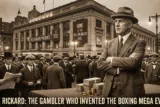
Dempsey’s rise coincided with the emergence of the man who would shape boxing promotion for a generation: George Lewis “Tex” Rickard.
Rickard’s biography reads like a novel. Born in Missouri in 1870, he worked as a cowboy in Texas, ran a gambling hall in Alaska during the Klondike Gold Rush, operated saloons in Nevada, and somehow drifted into fight promotion. He staged the Joe Gans vs. Battling Nelson lightweight championship in Goldfield, Nevada, in 1906—a fight famous for its $30,000 purse displayed in gold coins in a store window.
Rickard understood something that previous promoters hadn’t: boxing wasn’t just a sport—it was entertainment, and entertainment could be sold to people who had never watched a fight in their lives. He promoted fights like Broadway shows, courting society crowds and newspaper coverage, building anticipation through carefully managed publicity.
With Dempsey as his drawing card, Rickard set out to make boxing respectable and profitable. The vehicle would be a series of fights that shattered every financial record the sport had known.
Dempsey vs. Carpentier: The First Million-Dollar Gate
Georges Carpentier was a French war hero, handsome and cultured, the light heavyweight champion of the world. He was also significantly smaller than Dempsey and had no realistic chance of winning a heavyweight title fight. None of that mattered to Rickard.
Rickard sold the July 2, 1921 fight as a morality play: the brutal American draft dodger (Dempsey had faced accusations of avoiding World War I service) against the gallant French soldier. He built a temporary arena in Boyle’s Thirty Acres in Jersey City, New Jersey, that held over 90,000 spectators. He charged unheard-of prices and watched the money pour in.
The gate was $1,789,238—boxing’s first million-dollar gate. The fight itself was predictable: Dempsey absorbed Carpentier’s best shots in the second round and then knocked him out in the fourth. But the financial model had been proven. Boxing could generate serious money.
Dempsey vs. Firpo: The Most Violent Two Rounds in History
If the Carpentier fight proved boxing’s commercial potential, the Luis Ángel Firpo fight proved its dramatic potential.
Firpo was an Argentine heavyweight nicknamed the “Wild Bull of the Pampas.” He was crude but enormously powerful, with a right hand that could end fights. On September 14, 1923, at the Polo Grounds in New York, he met Dempsey for the heavyweight championship in front of 85,000 fans.
What followed was chaos.
Dempsey dropped Firpo seven times in the first round. Firpo got up each time and kept swinging. Then, with Dempsey pressing forward, Firpo landed a massive right hand that sent the champion through the ropes and into the press row. Sportswriters—including Grantland Rice and Damon Runyon—shoved Dempsey back into the ring. Under modern rules, Dempsey would have lost by knockout. In 1923, there was no rule against outside assistance.
Dempsey barely beat the count. In the second round, he recovered and knocked Firpo out for good. The fight lasted less than four minutes total.
The image of Dempsey flying through the ropes became one of boxing’s most iconic moments, immortalized in a famous painting by George Bellows titled “Dempsey and Firpo”. The fight’s primitive violence captured something essential about boxing’s appeal—the possibility that anything could happen, that even the invincible champion could be seconds from defeat.
The Fighting Marine
After the Firpo fight, Dempsey went quiet. He didn’t defend his title for three years, choosing instead to pursue Hollywood opportunities and enjoy his celebrity. The layoff would cost him.
James Joseph Tunney—known as Gene—was everything Dempsey wasn’t. Born in Greenwich Village, New York, he was the son of a longshoreman but carried himself with middle-class respectability. He read Shakespeare, quoted literature to sportswriters, and studied boxing as an intellectual exercise. He served in the Marines during World War I and fought in armed services competitions in France, building the foundation for his nickname: the “Fighting Marine.”
Tunney’s style was the opposite of Dempsey’s chaos. He was a boxer, not a puncher—a technician who controlled distance, used footwork to avoid trouble, and won rounds with jabs and movement. He wasn’t exciting, but he was extraordinarily difficult to hit cleanly.
By 1926, Tunney had won the American light heavyweight title and beaten every heavyweight contender available. Rickard, sensing another blockbuster, arranged for Tunney to challenge Dempsey at Sesquicentennial Stadium in Philadelphia on September 23, 1926.
The gate was $1,895,733—a new record. Over 120,000 fans packed the stadium. Dempsey was the heavy favorite. The assumption was that Tunney’s skills wouldn’t survive Dempsey’s power.
The assumption was wrong.
Tunney boxed beautifully for ten rounds, staying on the outside, making Dempsey miss, and piling up points with his jab. Dempsey, rusty from the long layoff and unable to cut off the ring, never found his range. By the middle rounds, Dempsey’s face was a swollen mess. The decision was unanimous: Gene Tunney was the new heavyweight champion of the world.
The boxing world was stunned. The Manassa Mauler, the most feared puncher of his era, had been outclassed by a boxer who made fighting look like science.
The Long Count
The rematch was inevitable. Rickard staged it for September 22, 1927, at Soldier Field in Chicago. The gate—$2,658,660—set a record that would stand for decades. An estimated 104,000 fans attended, with millions more listening on radio broadcasts that reached across the nation.
What happened in the seventh round became the most analyzed, debated, and controversial moment in boxing history.
Tunney was winning the fight, boxing as effectively as he had a year earlier. Then Dempsey caught him. A left hook followed by a flurry of punches sent Tunney to the canvas—the first knockdown of his professional career. Dempsey, following his instincts, stood over Tunney waiting to continue the assault the moment Tunney rose.
Here the rules intervened. Illinois had recently adopted the neutral corner rule, requiring a fighter who scores a knockdown to retreat to the farthest corner before the referee begins counting. Referee Dave Barry refused to start the count until Dempsey complied. Precious seconds ticked away.
By the time Barry began counting, Tunney had been on the canvas for approximately five seconds. He rose at Barry’s count of nine—but the total time down was somewhere between 13 and 15 seconds, depending on whose account you believe.
Tunney survived the round, recovered, and dominated the rest of the fight. He knocked Dempsey down in the eighth round—following the neutral corner rule himself—and won a clear decision. But the controversy lingered.
Did the long count cost Dempsey the championship? Would Tunney have beaten a normal ten-count? The debate has never been settled. What’s certain is that the fight—and the controversy—cemented both men’s legends. Dempsey became the noble warrior who might have won if the rules had been different. Tunney became the cerebral champion who kept his wits when it mattered most.
The Supporting Cast
Dempsey and Tunney dominated the decade, but the 1920s produced other notable fighters who deserve mention.
Harry Greb
Harry Greb—the “Pittsburgh Windmill”—may have been the best middleweight in boxing history. He fought an estimated 300 times (many fights went unrecorded), won the middleweight championship, and beat Gene Tunney in their first meeting in 1922. Their five-fight series—Tunney won the other four—was one of the decade’s most compelling rivalries.
Greb fought the last years of his career nearly blind in one eye, a secret he kept from opponents and commissions. He died in 1926 during surgery to repair damage from his fighting career. The World Boxing Association calls him “one of the most prestigious exponents” the sport has ever produced, and he remains a fixture on every serious pound-for-pound all-time list.
Benny Leonard
Benny Leonard was the lightweight champion from 1917 to 1925 and one of the most technically skilled boxers of any era. Jewish and from New York’s Lower East Side, Leonard was a hero to immigrant communities and one of the first boxers to achieve crossover fame. He is ranked among the greatest lightweights ever and was an inaugural inductee of the International Boxing Hall of Fame.
Mickey Walker
Mickey Walker—the “Toy Bulldog”—won the welterweight championship in 1922 and the middleweight title in 1926. He was known for his toughness, his nightlife, and his willingness to fight anyone at any weight. His partnership with manager Doc Kearns (Dempsey’s former manager) produced some of the decade’s most entertaining fights.
Why the 1920s Mattered
The 1920s transformed boxing from a disreputable fringe entertainment into America’s premier spectator sport. Several factors converged to make it happen.
Legalization
The Walker Law, passed in New York in 1920, legalized professional boxing under state regulation. Other states followed. For the first time, boxing could operate openly in major population centers, with proper venues, ticket sales, and newspaper coverage.
Radio
Commercial radio broadcasting emerged in the early 1920s, and boxing was perfectly suited to the medium. The second Dempsey-Tunney fight was one of the first major sports events broadcast nationally, reaching an audience estimated at 50 million people—roughly half the U.S. population. Radio made boxing stars into national figures in a way print media never could.
Postwar Prosperity
The Roaring Twenties brought unprecedented prosperity to America. People had money and leisure time. They wanted entertainment, heroes, spectacle. Boxing provided all three.
The Right Champions
Dempsey’s primal violence and Tunney’s cool intelligence represented two archetypes that audiences found compelling. Their rivalry—the brawler against the boxer, the western roughneck against the eastern intellectual—provided perfect dramatic tension. Neither man could have created the golden era alone. Together, they defined it.
The End of the Era
Tunney retired undefeated in 1928, walking away from boxing to marry a steel heiress and live as a wealthy businessman. He never fought again.
Dempsey attempted a comeback but never regained the title. He retired in 1927 after the second Tunney fight, returned briefly in 1931 for a few tune-up bouts, then quit for good. He became a successful restaurateur in New York, where Jack Dempsey’s Broadway Restaurant became a landmark for decades. He remained one of the most beloved figures in American sports until his death in 1983.
Tex Rickard died in 1929, just before the stock market crash that ended the era he’d built. The Great Depression devastated boxing’s economics. The million-dollar gates vanished. It would be years before the sport recovered.
But the model Rickard created—the mega-fight, the celebrity champion, the carefully built anticipation—never disappeared. Modern promoters from Don King to Bob Arum to today’s streaming-era dealmakers all work within frameworks Rickard established a century ago.
Legacy
The 1920s gave boxing its template for greatness. The sport learned that it needed stars with contrasting styles and personalities, that promotion was as important as matchmaking, and that a single fight could capture national attention in a way no regular season of any team sport could match.
Dempsey and Tunney both entered the International Boxing Hall of Fame as charter members. Their fights remain required viewing for anyone who wants to understand what heavyweight championship boxing can be at its best—two men, completely different in method and temperament, each operating at the peak of their abilities.
The Long Count remains boxing’s most famous single moment, replayed and analyzed nearly a century later. The Firpo knockdown, immortalized in Bellows’ painting, hangs in the Whitney Museum of American Art. The million-dollar gates Rickard pioneered led directly to the billion-dollar pay-per-view era that followed.
Boxing’s first golden era didn’t just entertain the 1920s—it built the sport that entertains us still.
—–
Key Fights of the 1920s
| Date | Fight | Result | Significance |
|---|---|---|---|
| July 4, 1919 | Dempsey vs. Willard | Dempsey TKO 3 | Dempsey wins heavyweight title |
| July 2, 1921 | Dempsey vs. Carpentier | Dempsey KO 4 | First million-dollar gate |
| Sept 14, 1923 | Dempsey vs. Firpo | Dempsey KO 2 | Most violent fight of the era |
| Sept 23, 1926 | Tunney vs. Dempsey I | Tunney UD 10 | Tunney wins heavyweight title |
| Sept 22, 1927 | Tunney vs. Dempsey II | Tunney UD 10 | The Long Count |
—–
Further Reading and Resources
- The Long Count Fight – Wikipedia
- Jack Dempsey (1895–1983) – PBS American Experience
- Jack Dempsey – Colorado Encyclopedia
- Jack Dempsey – Colorado Sports Hall of Fame
- Gene Tunney: Fighting Marine and Heavyweight Champion – The Fight City
- Gene Tunney – HeavyweightBoxing.com
- Tex Rickard: Boxing’s Greatest Ever Promoter – Boxing News Online
- Tex Rickard – Reemus Boxing
- 100 Years Ago: The First Million-Dollar Gate – Boxing247
- Harry Greb: The Pittsburgh Windmill – World Boxing Association
- Harry Greb: The Enduring Appeal – Boxing News Online
- Harry Greb: The Pittsburgh Windmill Is Forever a Legend – The Fight City
- “Dempsey and Firpo” by George Bellows – Whitney Museum of American Art
- The Heavyweight Golden Age (1960s–70s) – BoxingInsider.com
- The History of Boxing in New York City – BoxingInsider.com