
Before the big paydays and television contracts, before the pay-per-view era, there was a short, blinking man from South Philadelphia who operated in the shadows. Frank “Blinky” Palermo didn’t stand in the center of the ring waving a contract or shouting into microphones. He didn’t need to. From the 1940s through the 1960s, Palermo quietly owned pieces of champions, fixed fights, and helped run one of the most notorious monopolies in sports history. He was Frankie Carbo’s most trusted lieutenant, a numbers racket boss turned undercover fight manager whose influence stretched from Madison Square Garden to the heavyweight division. When he died in 1996 at age 91, boxing had long since moved on, but the scars he left on the sport never fully healed.
Every era of boxing has had its fixers. Palermo was one of the most effective.
Numbers King of Philadelphia
Born Frank Palermo on January 26, 1905, in Philadelphia to Italian immigrant parents, he grew up in the city’s tightly knit South Philadelphia neighborhoods. By the late 1920s he had a criminal record and had already established himself as the man who ran Philadelphia’s largest illegal numbers racket, the street-level lottery that took small bets from factory workers, bartenders, and grandmothers across the city. It was a cash business built on trust, intimidation, and volume. Palermo understood both sides of the equation.
The nervous eye twitch that earned him the nickname “Blinky” became his trademark. So did his ability to stay just far enough in the background to avoid the spotlight while controlling everything that mattered. By the 1940s, Palermo had expanded into boxing, using the same mix of muscle, money, and hidden ownership that had made him rich in the numbers game.
The LaMotta Fox Fix and the Birth of a Legend
Palermo’s most infamous moment came on November 14, 1947, at Madison Square Garden. He secretly managed undefeated light heavyweight Billy Fox. Working with his partner Frankie Carbo, Palermo arranged for Fox to face Jake LaMotta, the rugged middleweight contender and heavy early betting favorite. What the near-capacity crowd of 18,340 saw that night was one of boxing’s most notorious dives. LaMotta barely threw a punch. Fox stopped him in the fourth round. Bookmakers had stopped taking action on Fox hours earlier because the fix was so widely rumored; the odds had swung from pick-em to 3-to-1 in Fox’s favor by fight time.
Years later, testifying under oath before a U.S. Senate subcommittee investigating organized crime’s influence in boxing, LaMotta admitted he had taken the dive in exchange for a promised shot at the middleweight title. He named Palermo and associate Bill Daly as the men who had offered him $100,000 to go in the tank; LaMotta said he refused the cash but agreed to lose in exchange for the title opportunity. The bout became a symbol of everything wrong with boxing in the postwar years, and it made Palermo and Carbo richer and more powerful.
The Secret Stable
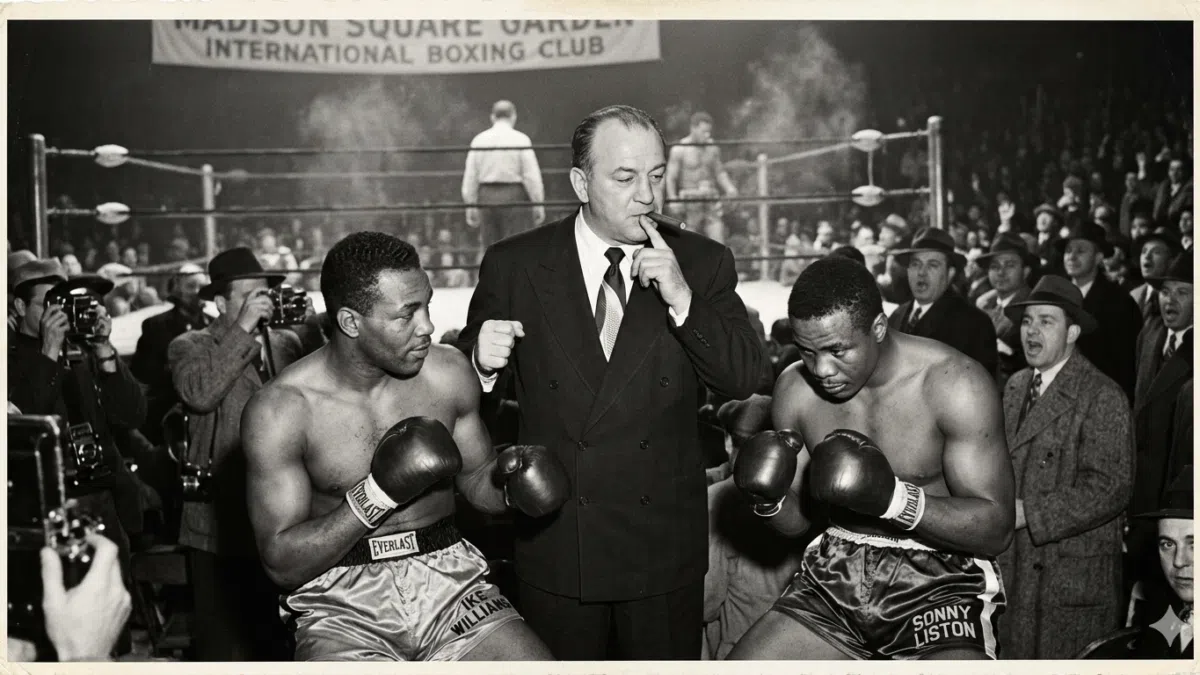
Palermo didn’t just fix one fight. He quietly controlled an entire stable of fighters through frontmen and hidden contracts. According to his BoxRec profile, among the fighters he managed were lightweight champion Ike Williams, welterweight champion Johnny Saxton, Billy Fox, Virgil Akins, Clarence Henry, Coley Wallace, and Arthur King. Palermo took large cuts of their purses, often leaving fighters broke despite big paydays.
Williams, one of the most talented lightweights of his generation, testified before the Kefauver Commission in 1960 that he was broke and working for $46 a week despite having earned roughly $1 million in purses during his career. He told the committee that Palermo had kept approximately $40,000 owed to him from just two fights alone, the Beau Jack and Jesse Flores title defenses in 1948. Williams never tried to collect the money. As Sports Illustrated noted at the time, he was a circumspect man who clearly had no wish to anger Blinky, even years later.
The fighters’ post-career lives were often tragic. Fox ended up in a Long Island mental institution. Saxton’s circumstances were similarly bleak. Palermo’s method was simple and ruthless: own the fighter on paper through a licensed manager, dictate the outcomes when betting money was on the line, and skim the earnings. It was the numbers racket with gloves on.
The IBC Monopoly
In 1949, Palermo, Carbo, and arena promoter Jim Norris formed the International Boxing Club. On paper it was a legitimate promotional company. In reality it was a near-monopoly that controlled the best venues, including Madison Square Garden, the biggest television contracts, and most of the top fighters. The IBC dominated boxing for nearly a decade, staging title fights and weekly cards while squeezing out independent promoters.
The combination of Palermo’s hidden fighter ownership, Carbo’s matchmaking influence, and Norris’s arenas created a machine that decided who fought whom, and often who won. Antitrust investigations in the 1950s eventually dismantled the IBC, but by then the damage to boxing’s credibility was deep.
The Heavyweight Prize: Sonny Liston
By 1959, Palermo and Carbo had acquired a secret majority interest in the contract of a terrifying young heavyweight named Sonny Liston. Originally controlled by St. Louis mob figure John Vitale, Liston became the syndicate’s prize. Palermo helped guide Liston’s career as he climbed the rankings. When Liston knocked out Floyd Patterson in 1962 to win the heavyweight title, the two Philadelphia and New York mob figures were among the real winners. Liston fought twelve times under their influence before the relationship eventually frayed.
The Fall: The Don Jordan Case
Palermo’s empire began to crumble in 1959 when he, Carbo, and others tried to muscle in on welterweight champion Don Jordan’s contract in Los Angeles. The attempted shakedown involved the beatings of witnesses and strong-arm tactics. The FBI built the case. In 1961, federal prosecutors brought charges of conspiracy and extortion. Palermo was convicted and sentenced to 15 years. Carbo received 25. Palermo served roughly seven and a half years in federal prison before his release in 1971.
The conviction was a body blow to the old mob structure in boxing. The era of open syndicate control was effectively over.
Later Years and the Last Try
After his release, Palermo returned to Philadelphia. In the 1970s he still had underworld connections and even owned a piece of heavyweight contender Jimmy Young. In 1978 he brazenly applied for a manager’s license in Pennsylvania. The public outcry was immediate and the application was denied. He largely faded from the spotlight but remained a legendary and feared figure in boxing circles.
Palermo died on May 12, 1996, in Philadelphia at the age of 91. No grand funeral or ringside tributes marked his passing. The man who had once helped run boxing from the shadows left the sport the same way he had operated: quietly.
The Cost of the Fix
Blinky Palermo never built arenas or created million-dollar gates. He never negotiated record purses for his fighters. What he did was simpler and more corrosive: he treated boxing as another racket. Fighters were inventory. Fights were betting opportunities. The sport was a vehicle for numbers money and syndicate power.
His story is a dark chapter, but an essential one. The Senate hearings, the antitrust cases, and the convictions that followed helped drag boxing out of the mob’s grip and into the television and pay-per-view era that followed. Every modern promoter who operates in the open, every fighter who actually gets paid what he earns, owes a small debt to the reformers who finally exposed men like Blinky Palermo.
He was never the face of boxing. But for a long, ugly stretch of its history, he was one of the men who controlled it.