The pound-for-pound debate is boxing’s oldest and most unsolvable argument. Strip away the weight advantages, remove the era, ignore the gloves and the rules changes — who was the best pure fighter ever to step between the ropes? There is no official metric. There never will be. But there is a rough consensus among historians, trainers, and fighters themselves, and it starts with one name that almost nobody argues about.
1. Sugar Ray Robinson
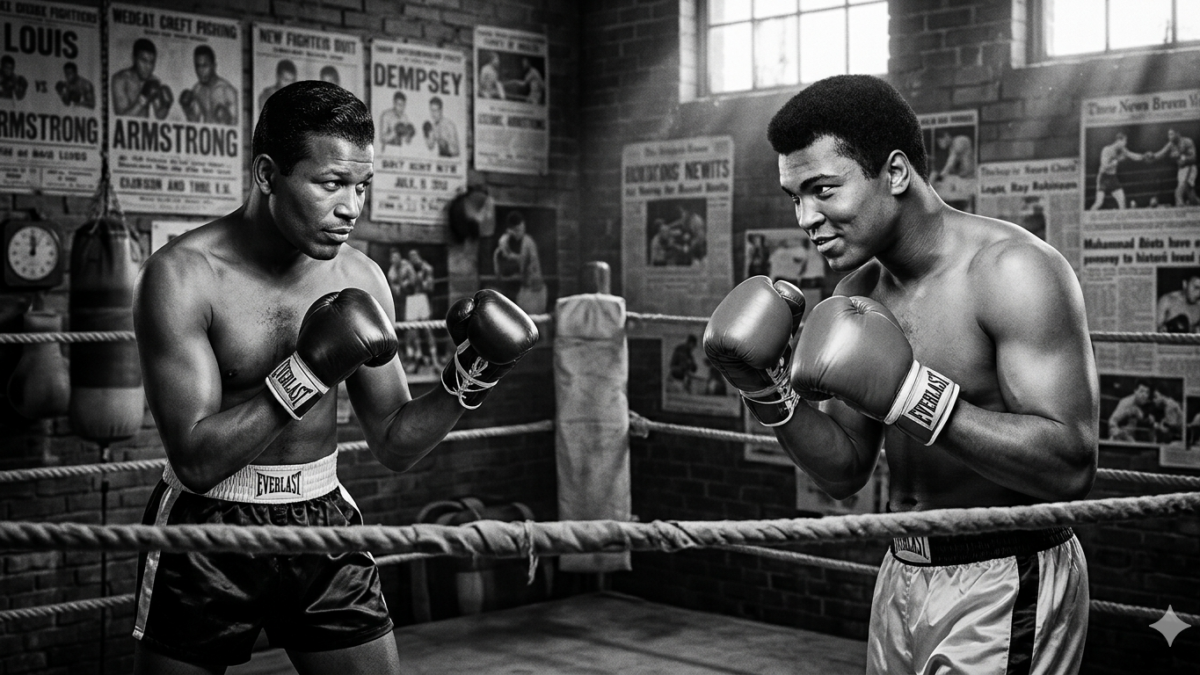
Robinson held the welterweight title from 1946 to 1951 and won the middleweight championship five times. His professional record of 174-19-6 with 109 knockouts was compiled against the deepest talent pool in the sport’s history, during an era when fighters routinely competed 15 to 20 times a year. Robinson could box, brawl, counter, and finish. He knocked out opponents with either hand and from any range. His footwork was studied by Muhammad Ali. His combination punching was studied by everyone.
The defining stretch came between 1943 and 1951, when Robinson went 91 consecutive fights without a loss. That run included victories over future Hall of Famers Jake LaMotta, Kid Gavilan, and Sammy Angott — a streak that remains one of the most remarkable in boxing history. When trainers say a fighter is “the complete package,” Robinson is the standard they are measuring against.
2. Muhammad Ali
Ali’s resume at heavyweight is unmatched in depth, quality, and historical significance. He defeated Sonny Liston, Joe Frazier, George Foreman, Ken Norton, Floyd Patterson, Archie Moore, Cleveland Williams, and Ernie Terrell — the deepest collection of elite heavyweights any single fighter has ever navigated. He did it across three separate reigns spanning 1964 to 1978, interrupted by a three-and-a-half-year exile during the prime of his career.
What separates Ali from other heavyweights in the pound-for-pound conversation is adaptability. The Ali who dazzled with speed and movement against Liston in 1964 was a fundamentally different fighter from the one who used the rope-a-dope to exhaust Foreman a decade later. Both versions were brilliant. Very few fighters in any division have reinvented themselves as completely as Ali did, and none did it against opposition of that caliber. For the full scope of the era that Ali, Frazier, and Foreman defined, the heavyweight division has never seen a comparable concentration of talent.
3. Henry Armstrong
Armstrong simultaneously held world titles in three weight classes — featherweight, lightweight, and welterweight — during 1938. No fighter before or since has matched that feat. He made 19 consecutive welterweight title defenses, a division record that stood for decades. Armstrong fought 181 professional bouts and recorded 101 knockouts, many of them against naturally bigger opponents.
What made Armstrong extraordinary was volume. He overwhelmed opponents with relentless, swarming pressure, throwing punches from every angle in every round. Modern fighters who are praised for high output would be embarrassed by Armstrong’s work rate. His 1938 triple-crown campaign — beating Petey Sarron at featherweight, Barney Ross at welterweight, and Lou Ambers at lightweight in the span of ten months — remains the most ambitious single year any fighter has ever attempted.
4. Roberto Duran
Duran’s four-decade career encompassed world titles at four different weight classes: lightweight, welterweight, junior middleweight, and middleweight. His lightweight reign from 1972 to 1979 is considered one of the greatest title runs in boxing history — 12 successful defenses, most by knockout, against a division loaded with credible contenders. At 135 pounds, Duran may have been the most dangerous fighter who ever lived.
The welterweight era added depth to his legacy. Duran defeated Sugar Ray Leonard in their first meeting in 1980 — outworking, outfighting, and outmanning a fighter who was considered boxing’s golden boy. The “No Mas” rematch five months later is the asterisk that follows Duran everywhere, but it has never overshadowed the breadth of what he accomplished across weight classes. His final record of 103-16 with 70 knockouts spanned from 1968 to 2001.
5. Floyd Mayweather Jr.
Mayweather retired 50-0 with titles in five weight classes, from super featherweight through junior middleweight. His defensive mastery — the shoulder roll, the pull counter, the ability to make elite fighters miss by fractions of an inch — was the most refined the sport has seen since Pernell Whitaker. Mayweather rarely lost rounds. He almost never got hit clean.
The resume bears out the record. Mayweather defeated Oscar De La Hoya, Manny Pacquiao, Shane Mosley, Miguel Cotto, Canelo Alvarez, and Diego Corrales, among others. The Corrales fight at 130 pounds in 2001 may be his most complete performance — a shutout of a fighter who would go on to produce one of the decade’s best fights against Jose Luis Castillo. Mayweather’s defensive brilliance made him polarizing, but it never made him beatable. With a professional rematch against Pacquiao now scheduled for September 2026, his unblemished record will face its most consequential test.
6. Manny Pacquiao
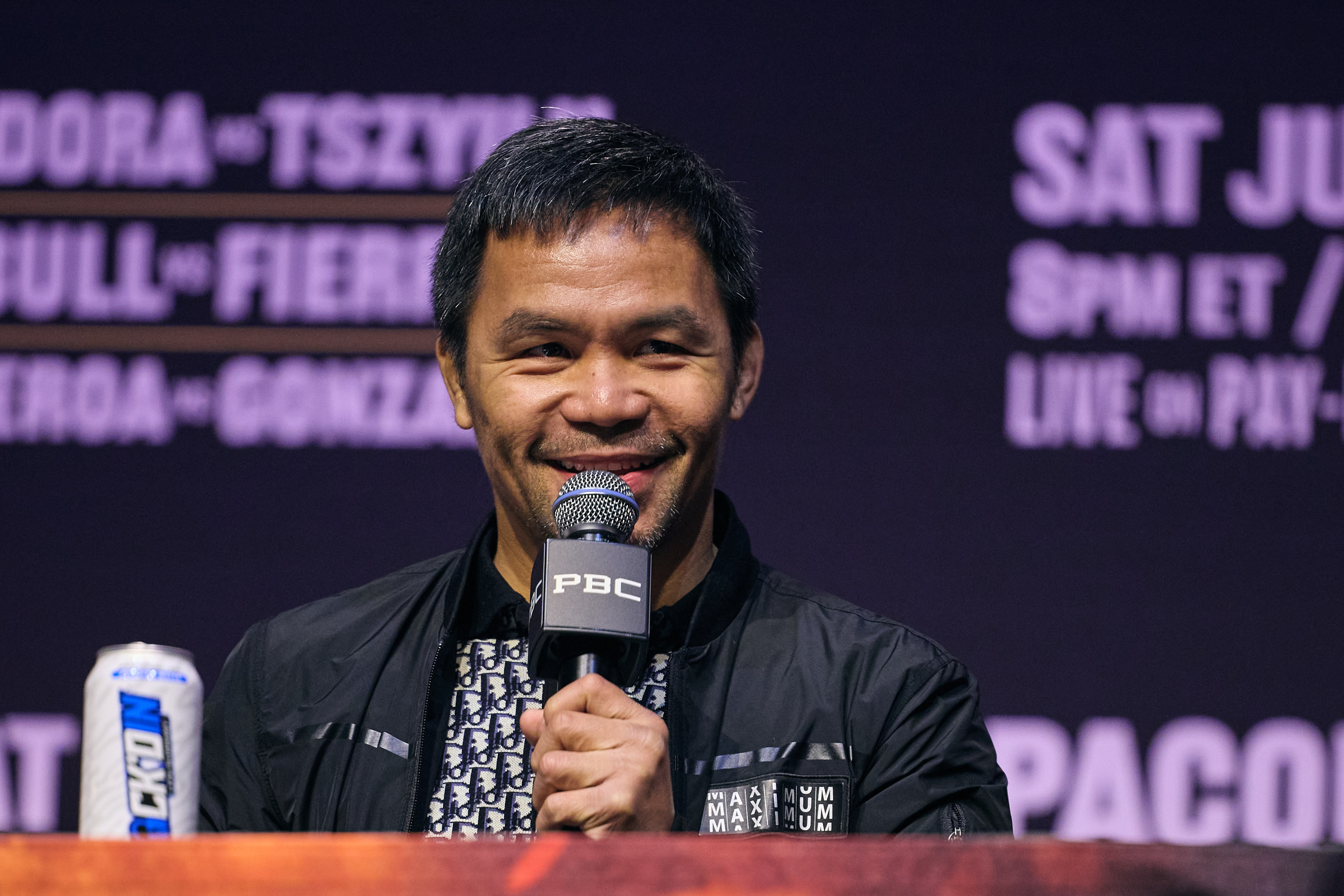
No fighter in boxing history has won world titles in eight weight divisions. Pacquiao did — from flyweight at 112 pounds to junior middleweight at 154, a 42-pound spread that remains without precedent. His explosive southpaw style, built on speed, angles, and power that translated across weight classes, made him the most versatile offensive fighter of his generation.
The peak years — 2008 to 2010 — produced consecutive knockouts or dominant victories over Oscar De La Hoya, Ricky Hatton, Miguel Cotto, and Antonio Margarito. Pacquiao moved through weight classes the way most fighters move through opponents. His four-fight series with Juan Manuel Marquez, which stretched from 2004 to 2012, was the defining rivalry of the modern era and produced one of the sport’s most dramatic knockouts when Marquez ended their fourth meeting with a counter right hand that became an instant classic.
7. Sugar Ray Leonard
Leonard won world titles at welterweight, junior middleweight, middleweight, super middleweight, and light heavyweight — five divisions in an era when moving up in weight was considered genuinely risky. His defining victories came against three other members of this list: he defeated Duran twice, stopped Hearns in the 14th round of their 1981 welterweight unification, and outpointed Hagler in 1987 to win the middleweight title after a three-year layoff.
The Hearns fight is routinely cited as the greatest welterweight bout ever contested. Leonard, trailing on the scorecards and in danger of being outpointed, turned the fight around with a furious rally in the 13th and 14th rounds that remains one of the most dramatic finishes in championship boxing. Leonard’s ability to make tactical adjustments in real time — to shift from boxer to brawler mid-fight — was rivaled only by Ali among fighters of the post-war era.
8. Willie Pep
Pep’s career record of 229-11-1 with 65 knockouts is staggering in its volume. The Connecticut featherweight won his first 63 professional fights and was 134-1-1 before losing to Sandy Saddler — and his footwork, head movement, and ring generalship influenced every defensive fighter who followed him, from Whitaker to Mayweather.
The legend of Pep includes a round he allegedly won without throwing a punch, using nothing but movement and feints to control his opponent. Whether apocryphal or not, the story captures what made Pep different: he treated boxing as geometry rather than violence. His four-fight series with Saddler — two wins apiece, all four brutal — proved he could fight on the inside when forced to, but his preference was always to make the other man miss, and no one in history did it more beautifully at 126 pounds.
9. Joe Louis
Louis made 25 consecutive heavyweight title defenses between 1937 and 1949 — a record that will never be broken. He fought all comers in an era when the heavyweight champion was expected to stay active, defending his title an average of four times per year during his peak. His first-round destruction of Max Schmeling in their 1938 rematch, widely seen as a symbolic battle between democracy and fascism, remains one of the most culturally significant sporting events in American history.
Louis’s jab was the best the heavyweight division has seen. His right cross was among the most efficient finishing punches ever thrown. He was not flashy, and he did not need to be. He was simply better than everyone he fought for twelve consecutive years, and the quality of his opposition — Billy Conn, Jersey Joe Walcott, Ezzard Charles, Buddy Baer — holds up across generations.
10. Julio César Chávez
Chávez began his career with an 87-0 record and two draws before suffering his first loss to Frankie Randall in 1994 — an unbeaten streak that ranks among the longest in boxing history. He won world titles at super featherweight, lightweight, and junior welterweight, and his body attack was as systematic and punishing as any fighter’s in any era.
The super featherweight and lightweight reigns established Chávez as Mexico’s greatest fighter. His 1987 stoppage of Edwin Rosario to win the WBA lightweight title is considered one of the finest performances in division history — a methodical breakdown of a dangerous puncher. Chávez brought a blue-collar aesthetic to championship boxing: no flash, no wasted motion, just relentless pressure and precision until his opponent broke. His cultural significance in Mexico is unrivaled by any athlete in any sport.
The Next Tier
Any list like this demands acknowledgment of the fighters who belong in the conversation but fall just outside the top ten. Marvin Hagler dominated middleweight with a ferocity that defined the 1980s. Thomas Hearns carried legitimate one-punch knockout power across five weight classes. Roy Jones Jr., at his peak from 1993 to 2003, may have been the most athletically gifted fighter in the sport’s history — his speed and reflexes were supernatural before age and weight gains diminished them.
Pernell Whitaker’s defensive mastery at lightweight and welterweight rivaled Mayweather’s. Carlos Monzón went 14 years undefeated as middleweight champion. Archie Moore holds the all-time knockout record. Lennox Lewis was the last undisputed heavyweight champion before Oleksandr Usyk, and his resume — victories over Holyfield, Tyson, and Vitali Klitschko — stands with any heavyweight’s. Usyk himself, having unified all four belts at both cruiserweight and heavyweight, is building a case for this conversation in real time.
The pound-for-pound rankings have always been boxing’s way of asking a question that cannot be answered with certainty. Robinson at 147, Ali at 215, Pacquiao at 135, Chávez at 140 — these fighters operated in different eras, under different rules, against different competition. What they share is dominance. They were the best of their time, across weight classes, against the best opposition available. That is as close to a pound-for-pound standard as the sport has ever produced, and it is the only standard that matters.