Los Angeles has produced more world champions, hosted more legendary fights, and shaped boxing’s American identity more than any city outside of New York.
From the bloody weekly cards at the Grand Olympic Auditorium to the title fights at the Forum, from the Main Street Gym’s dark staircase to the Mexican-American fight culture that built the Olympic’s golden era, LA boxing is its own story. It’s a story of immigration and identity, of Hollywood glamour colliding with working-class violence, of venues that shaped how the sport was seen on television and fighters who rewrote what was possible inside the ring.
This is the complete history of boxing in Los Angeles.
The Early Era: 1914 to 1932
Professional boxing had been illegal in Los Angeles for more than a decade when California voters repealed the law in 1924. From 1914 to 1925, bouts had been limited to four rounds. When the state finally legalized 10-round professional boxing, LA became one of the most active fight cities in the country almost overnight.
In 1926, Los Angeles was already what one historian called “pugilistic paradise.” Cards ran somewhere in the LA area almost every night of the week. Hollywood Legion Stadium on El Centro Avenue, which opened as an open-air arena in 1921 and was roofed in 1923 thanks to money raised by film industry fight fans, ran fights every Friday night until 1938. Smaller clubs operated in Wilmington, Ocean Park, and Vernon. Outdoor cards ran at the Ascot Speedway and Wrigley Field, LA’s minor league ballpark.
But the venue that would change everything opened on August 5, 1925.
The Grand Olympic Auditorium
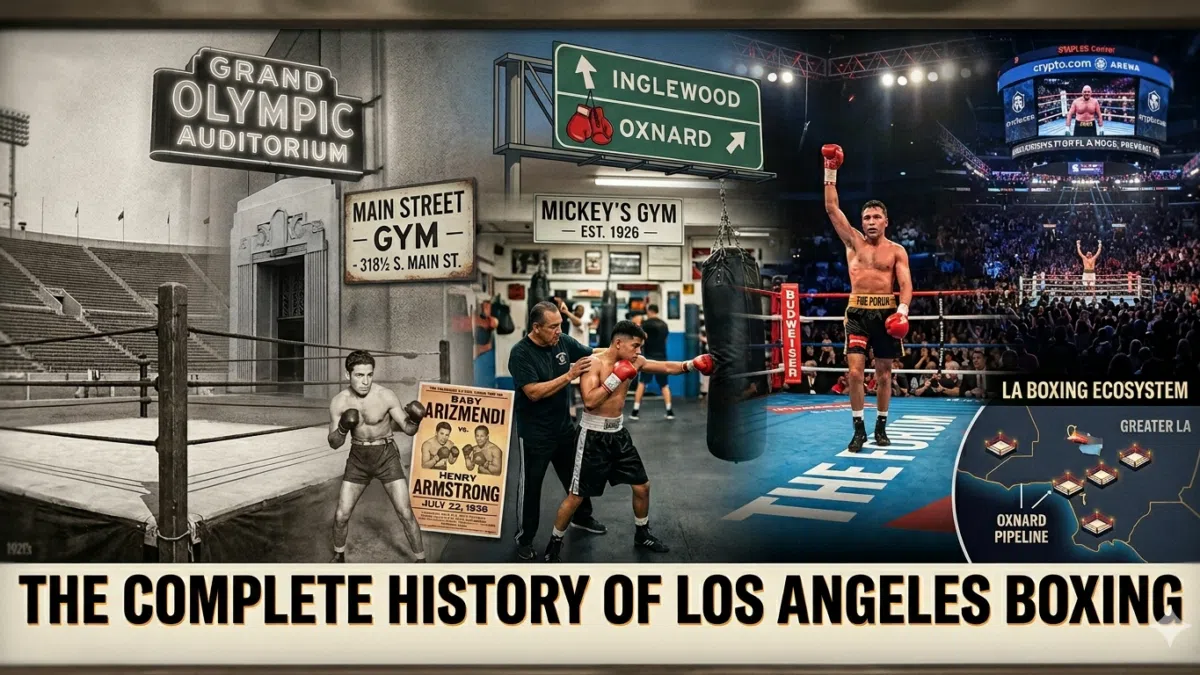
The Grand Olympic Auditorium at 1801 South Grand Avenue was built specifically for the 1932 Olympic Games, where it hosted the boxing, wrestling, and weightlifting competitions. Jack Dempsey, then the reigning heavyweight champion of the world, shoveled the first pile of dirt at the groundbreaking ceremony. When it opened, the venue seated 10,400 and was immediately declared the largest and finest boxing stadium in the world, drawing comparisons to the original Madison Square Garden.
By 1936, the Olympic was generating more gate entries than Chicago Stadium and Madison Square Garden combined. It became the center of gravity for West Coast boxing for the next eight decades.
The venue’s greatest era began in the 1940s, when the Los Angeles Athletic Club, which owned the building, sent a woman named Aileen Eaton to figure out why the Olympic was losing money. Eaton had zero boxing experience. She would become the most powerful fight promoter in the country.
Eaton ran the Olympic from World War II through the 1970s. She turned Los Angeles into the boxing capital of America and made herself a national force in a sport where women simply did not exist in leadership roles. According to the documentary “18th and Grand”, Eaton was the first person to make the Muhammad Ali “I Am The Greatest” pins and convinced Ali to pass them out. She was known to intimidate Don King.
The Olympic was where Henry Armstrong, one of the greatest fighters who ever lived, fought his famous rival Baby Arizmendi twice in 1938 and 1940. It was where Bert Colima, the “Whittier Flash,” became one of the first Mexican-American superstars in American sports. It was where Fidel LaBarba, Danny “Little Red” Lopez, Bobby Chacon, Ray “Boom Boom” Mancini, Alberto Davila, Frankie Duarte, and dozens of LA’s greatest fighters either made their names or defended their titles.
The venue earned the nickname “the bucket of blood.” When fans didn’t like a decision, they showered the ring with beer, sometimes urine. Knives made it inside in the years before venue searches. Riots broke out. It was boxing in its rawest form, a fight crowd that wanted its money’s worth and was not shy about demanding it.
The Olympic ran weekly cards from the 1920s through 1980. It hosted Oscar De La Hoya’s WBO super featherweight title fight against Jimmi Bredahl in 1994 when the venue was briefly revived. In 2005, the building was sold to the Glory Church of Jesus Christ, a Korean-American evangelical congregation, ending 80 years of West Coast boxing history.
The Olympic appears in “Raging Bull,” “Rocky,” “Rocky II,” “Ali,” and “Million Dollar Baby.” It’s arguably the most filmed boxing venue in American cinema.
The Main Street Gym
If the Olympic was where LA’s fights happened, the Main Street Gym at 318½ South Main Street was where its fighters were made.
Carlo Curtis opened the original Main Street Gym in 1926 as a training facility and Saturday night pro boxing venue. The gym ran fight cards and training operations simultaneously. The place had two floors. A bar and grill operated downstairs, where fight films played constantly during business hours. Upstairs, the main gym floor, with one ring used for sparring, drew every major fighter who came through Los Angeles.
The original gym burned down in 1951 and was rebuilt across the street. The second Main Street Gym, managed by Howie Steindler, became the most legendary training facility in American boxing.
Muhammad Ali trained there. Roberto Duran trained there every time he was in Los Angeles, especially during his prime. Danny Lopez, Bobby Chacon, Ray Mancini, Sean O’Grady, Esteban De Jesus, and dozens of world champions worked the bags on that second floor. Alexis Arguello trained there. The gym had life-size cutouts of Joe Louis and Jack Dempsey on the walls. Workouts cost one dollar a day. The tradition it established lives on in the boxing gyms operating in Los Angeles today.
The Main Street Gym served as the interior of Mickey’s Gym in the first three “Rocky” films. Sylvester Stallone trained there extensively before filming the original “Rocky” in 1976, absorbing the atmosphere and watching real fighters work. The final fight scenes in both “Rocky” and “Rocky II” were filmed at the Olympic Auditorium, giving both LA venues a permanent place in film history.
The gym was demolished in November 1984. The spot where it stood is now a parking lot.
The Forum Era: 1980s and 1990s
When the Olympic faded in the late 1970s, boxing’s LA center of gravity shifted to Inglewood. The Forum, owned by Los Angeles Lakers owner Jerry Buss, became the West Coast’s premier fight venue through the 1980s and 1990s.
Forum Boxing, the in-house promotional arm, ran cards with Budweiser sponsorship that developed a generation of world champions. Marco Antonio Barrera made his American debut at the Forum. Juan Manuel Marquez fought there repeatedly. Mark “Too Sharp” Johnson built his reputation there. The Banke-Zaragoza wars, the Humberto Gonzalez-Sorjaturong bout, and the inaugural HBO Boxing After Dark card featuring Kennedy McKinney vs. Barrera all happened at the Forum.
The Forum’s boxing program effectively ended when Staples Center opened in 1999 and the Lakers relocated downtown. Jerry Buss stepped away from the fight game. The end of Forum Boxing’s Budweiser series weakened the LA boxing scene significantly, and no venue has fully replaced it since.
The Forum, now the Kia Forum, still occasionally hosts boxing. But its peak as a weekly fight destination belongs to the 1980s and 1990s.
The Oxnard Pipeline
While Los Angeles provided the venues, Oxnard provided the fighters.
The small agricultural city 60 miles northwest of Los Angeles became the most important producer of world champions in modern American boxing. La Colonia Youth Boxing Club, founded in 1972, has trained Fernando Vargas, Robert Garcia, Mikey Garcia, Victor Ortiz, Brandon Rios, and dozens of other world champions and contenders. Robert Garcia Boxing Academy has become one of the most respected training facilities in the world, with Garcia himself named Trainer of the Year multiple times.
The Oxnard style is distinctive. Aggressive, Mexican-influenced body punching. Conditioning drilled to the point of obsession. A willingness to get into fights that other fighters would avoid. The city produces warriors, not stylists, and its fighters are among the most respected in the sport.
Oxnard’s story is inseparable from the broader Mexican-American boxing tradition that runs through Southern California. The region’s fighters, trainers, promoters, and fans are overwhelmingly Mexican-American, and the sport’s cultural identity in LA is fundamentally shaped by that community. The Olympic Auditorium’s entire golden era was built on Mexican-American fight cards. Bert Colima in the 1920s. Baby Arizmendi in the 1930s. Danny Lopez and Carlos Palomino in the 1970s. Oscar De La Hoya in the 1990s. The Garcia brothers and Canelo Alvarez today.
The Modern Era: Crypto.com Arena
Downtown Los Angeles reclaimed the city’s boxing crown when Staples Center, now Crypto.com Arena, opened in 1999. The venue has hosted more than 34 nights of boxing since its opening, with a 21,000-seat boxing configuration that makes it the only LA venue capable of staging the sport’s biggest fights.
Lennox Lewis made his final title defense there in 2003, stopping Vitali Klitschko in the sixth round due to a brutal cut in a fight where Klitschko was ahead on the scorecards. Oscar De La Hoya and Shane Mosley traded leather there in their epic rivalry. In December 2018, the venue produced one of the most indelible images in heavyweight boxing history when Tyson Fury, seemingly unconscious on the canvas after a devastating 12th-round knockdown from Deontay Wilder, rose to finish the round and earn a controversial draw. Gervonta “Tank” Davis has headlined major cards there in recent years.
The arena’s location in the heart of L.A. Live, surrounded by restaurants, hotels, and entertainment options, makes it a natural destination for the sport’s biggest nights on the West Coast.
LA’s Greatest Fighters
No single list can capture the depth of the LA fighter pool, which is why we’ve dedicated an entire piece to the best boxers from Los Angeles. Oscar De La Hoya, born and raised in East Los Angeles, won Olympic gold at the 1992 Barcelona Games and went on to capture world titles in six weight classes. Shane Mosley, from Pomona, was considered one of the pound-for-pound best in the world for a decade. Fernando Vargas from Oxnard. Mikey Garcia from Oxnard. Robert Garcia from Oxnard. Victor Ortiz from Oxnard. Seniesa Estrada from East LA, one of the best female fighters in the world today.
The historical roster goes deeper. Henry Armstrong held three world titles simultaneously in the late 1930s. Bobby Chacon, the Featherweight Hall of Famer. Danny Lopez, “Little Red,” the Vietnam veteran who became a featherweight legend. Carlos Palomino, the welterweight champion who fought at the Olympic Auditorium throughout the 1970s. The list continues for pages.
The 1984 Olympics and LA’s Amateur Legacy
When the Summer Olympics returned to Los Angeles in 1984, the boxing tournament at the LA Memorial Sports Arena produced one of the most successful American Olympic boxing teams in history. The United States won nine gold medals, including Mark Breland at welterweight, Pernell Whitaker at lightweight, Meldrick Taylor at featherweight, Tyrell Biggs at super heavyweight, Evander Holyfield (bronze after a controversial disqualification) at light heavyweight, and Steve McCrory at flyweight.
The 1984 Games cemented LA’s position as a global boxing stage. The tournament’s success helped launch the professional careers of a generation of American world champions, and the Sports Arena itself joined the Olympic Auditorium and the Forum as venues that helped define LA boxing.
LA Boxing Today
Los Angeles remains one of the most important boxing markets in the world. The sport is regulated by the California State Athletic Commission, which maintains some of the most rigorous medical and licensing standards in the country. The gym infrastructure is unmatched outside of New York, with over 45 professional and amateur boxing facilities operating across the greater LA area. The fighter pipeline remains deep. Oxnard continues producing champions. Coachella and the Inland Empire have emerged as boxing strongholds. San Diego, just south, maintains a cross-border pipeline with Tijuana.
And while the Olympic Auditorium and the Main Street Gym are long gone, their influence runs through every LA gym still operating today.
From Aileen Eaton running the Olympic to Robert Garcia running the Oxnard Boxing Academy, from Dempsey shoveling the first dirt at 18th and Grand to Canelo Alvarez headlining at Crypto.com Arena, Los Angeles boxing is still being written.