
By Larry Goldberg and BoxingInsider Staff
This is Part 2 of BoxingInsider.com’s ongoing series on the Muhammad Ali American Boxing Revival Act. Read Part 1: What the Revival Act Actually Does to Club Promoters and Independent Boxing.
Fighters still pee in a cup. That hasn’t changed. What’s changed is what happens after. The drug testing available in combat sports today is remarkable—sophisticated, comprehensive, and capable of detecting substances that didn’t even have names ten years ago. The science has come a long way. So have the costs.
And look—anyone who’s been around this sport long enough knows the history. We’ve all heard the Whizzinator jokes. There’s an entire cottage industry built around beating drug tests, and for years the testing was easy enough to beat that nobody took it seriously. I could write ten articles about the ways people have cheated. But this isn’t that story. This is about the Ali Act and how to make testing better—not how it’s been gamed.
Let me say this upfront so there’s no confusion: I am for drug testing in boxing. Expanded drug testing. Mandatory drug testing. There is no place in this sport for roided-up fighters or fighters competing under the influence of anything that gives them an unfair advantage or puts their opponent at greater risk. None. If you take that away from this article, we’re good.
Now let me say the part that gets people yelled at.
Not all drug testing is the same. Not all drug testing costs the same. And the Muhammad Ali American Boxing Revival Act, as currently written, points toward a standard of testing that was designed for the Olympics and elite international sport—not for a six-fight card in a hotel ballroom in Atlantic City. That’s not an argument against drug testing. It’s an argument about economics, scale, and what’s actually achievable at every level of the sport.
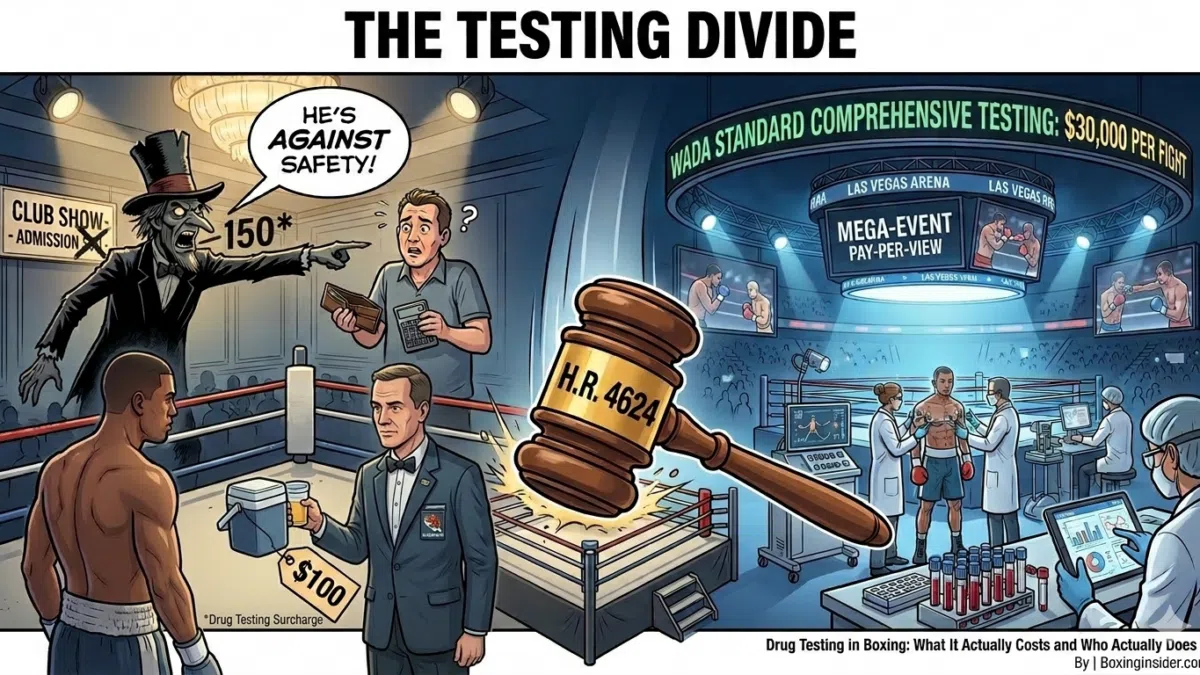
The moment anyone raises this point, the strawman shows up: oh, they’re against drug testing. They want dirty fighters. They don’t care about safety. Nothing could be further from the truth. But that’s the accusation that gets thrown around because it’s easier to attack a cartoon villain than to engage with the actual math.
So let’s do the math.
What states actually do right now.
The drug testing landscape in American boxing is a patchwork—and some of the patches are blank. According to the Association of Boxing Commissions’ own published records, states like Arkansas have no blood work requirements, no urinalysis, and no drug testing protocols at all. Colorado has no urinalysis. Several tribal commissions have unconfirmed requirements across the board. These are real gaps, and they should bother everyone. And if you think a lack of testing oversight only exists domestically, wait until you see what’s happening in the jurisdictions nobody controls—Colombia, the Dominican Republic, Mexico—where American fighters are already flying to rack up wins with zero testing, zero oversight, and zero accountability. But that’s a story for the next installment of this series.
On the other end, you have states that take it seriously. New Jersey conducts random urinalysis at events using a standard 10-panel screen, with steroid and ephedra testing at the commission’s discretion. California tests for EPO, testosterone, and SARMs, and uses the WADA-standard 4:1 testosterone-to-epitestosterone ratio. New York screens fighters and uses a 6:1 T/E threshold. Nevada has conducted what it calls “advanced PED testing” for high-profile bouts.
There are commissions that already do this right. New Jersey, New York, California, Nevada—these are the adults in the room. They test fighters, they have real protocols, and they have the authority to act on the results. If you asked me what the national standard should look like, I’d start with what those four commissions already do and build from there. That would be a massive improvement over what exists in most of the country right now. And it would be affordable, because they’re already doing it.
What testing actually costs.
A standard 10-panel urinalysis—the kind that catches cocaine, marijuana, opiates, amphetamines, benzodiazepines, barbiturates, PCP—costs between $30 and $150 per test through a certified lab. This is the same test an employer gives you. It’s the same test you can buy at a drugstore. It tells you whether a fighter is competing under the influence of recreational drugs that could impair judgment or mask pain. It is a real drug test and it serves a real purpose.
A comprehensive WADA-level testing program is a different universe. The WADA prohibited substance list covers hundreds of compounds. A full program through VADA—the Voluntary Anti-Doping Association—involves multiple rounds of unannounced random testing over 8 to 10 weeks, blood and urine collection, and analysis at a WADA-accredited laboratory. Eddie Hearn has said publicly that a full VADA program costs between $20,000 and $30,000 per fight. A single sample collection costs $600 to $1,200. For comparison, California’s entire annual anti-doping budget—covering roughly 1,200 athletes and 130 professional events—is approximately $175,000.
Both are drug testing. One costs $100 a fighter. The other costs $10,000 a fighter. The bill doesn’t distinguish between them.
What the bill actually requires.
This is where the legislative history matters, because the drug testing language in the version of H.R. 4624 heading to the House floor is not what was in the bill when it was introduced.
The original bill—introduced by Reps. Brian Jack and Sharice Davids on July 23, 2025—created a framework for Unified Boxing Organizations and included anti-doping requirements in Section 24(e), which applies only to UBO-promoted events. Under the introduced version, a UBO was required to maintain “a comprehensive anti-doping program” and test at least half the boxers on each UBO card. But the original bill did not specify the WADA prohibited substance list as the testing standard. It left the substance list up to the UBO, subject to whatever the state commission already required. And critically, it did not touch Section 7 of the Professional Boxing Safety Act—the section that governs every professional boxing event in the country, not just UBO cards.
That changed on January 21, 2026, when Chairman Tim Walberg offered an amendment in the nature of a substitute—a complete rewrite—that the committee adopted 30–4. Among the changes: Walberg’s substitute added Section 4(b), which amends Section 7 of the existing PBSA to require drug tests at every title bout and at random for all other matches. The screening standard follows a cascade: at a minimum, the test must screen for each substance prohibited by the state commission with jurisdiction over the match. If no substance is prohibited by the commission, the test screens for each substance prohibited by the Association of Boxing Commissions. And if neither has a prohibited list, the test defaults to the full WADA Prohibited List. Most states don’t maintain a comprehensive prohibited substance list—which means for many commissions, the WADA standard becomes the default in practice.
Read that again. The WADA testing standard wasn’t in the bill TKO helped draft. It was added by the committee chairman—probably because it sounded like the gold standard for clean sport, which it is. But nobody in that markup room asked what it costs to screen for hundreds of WADA-listed compounds at a club show in a hotel ballroom. Nobody asked what that does to a promoter whose total gate is $8,000. The WADA language landed in the bill because it sounded right, not because anyone modeled the economics.
The result: the version of H.R. 4624 heading to the House floor applies drug testing requirements—with the WADA list as the practical default for most states—to every professional boxing event in America, not just UBO cards. If you’re a club promoter putting on a six-fight show, you’re subject to the same screening requirements as a TKO pay-per-view. The bill doesn’t create a separate tier for small shows. It sets one standard and applies it everywhere.
For TKO, which already funds a comprehensive anti-doping program through the UFC, this is a rounding error. They have the infrastructure, the lab relationships, and the budget to test every fighter on every card to WADA standards without blinking. That’s what happens when you have billions of dollars in media rights revenue. It’s worth noting who benefits from a federal mandate that costs them nothing but prices out everyone else.
But if Congress believes WADA-level testing is important enough to legislate for boxing, why only boxing? Why not MMA? Why not kickboxing and full-contact martial arts sanctioned by ISKA and similar organizations? Every one of those sports puts fighters in a ring or a cage with the same risks. If this standard matters—and it does—then it should apply to every combat sport, not just the one Congress chose to regulate.
For the rest of the sport—and I mean the vast majority of professional boxing that doesn’t take place on a TKO card—this is a cost that didn’t exist yesterday. An eight-fight club card with testing on at least half the bouts means a minimum of four bouts tested, eight fighters, with sample collection alone running several thousand dollars before the lab work even starts. Add comprehensive analysis for WADA-listed substances and you’re looking at a testing bill that could exceed the total fighter purses for the entire event.
And here’s the question nobody in Congress is asking the fans: are you willing to pay an extra hundred dollars per ticket to cover drug tests? Because that’s where this money comes from. It doesn’t come from thin air. It comes from the gate, and the gate comes from you.
A practical conversation.
Is an independent baseball league subjected to the same drug testing as Major League Baseball? Is a regional MMA show tested to the same standard as a UFC pay-per-view? In every sport, at every level, the testing reflects the tier. That’s not a loophole. That’s how organized athletics works. You don’t impose a $30,000 testing program on a league where the total gate is $8,000. You build a standard that’s real, that’s enforceable, and that scales to the level of competition. The bill doesn’t do that. It sets one standard and applies it everywhere, which in practice means only the biggest operators can comply.
What should actually happen.
And let me say this before anyone else does: a roided-up fighter in a four-rounder is just as dangerous as a roided-up fighter on pay-per-view. PEDs don’t care about purse size. Nobody is arguing otherwise. The question is whether WADA-level screening is the only way to catch it, or whether a real urinalysis backed by commission authority to escalate already does the job at a price the sport can actually pay.
Boxing needs more drug testing, not less. The states that do nothing need to be brought up to a real standard. Every fighter should be subject to at least a comprehensive urinalysis on fight night—real, mandatory, no exceptions—with the commission having the authority to escalate to more rigorous testing if something triggers suspicion. That’s how it should work: a baseline that catches what needs to be caught, and the ability to go deeper when the results or the circumstances warrant it. At the elite level—title fights, national broadcasts, UBO-contracted fighters—WADA-standard testing makes sense. The money is there. Nobody is arguing otherwise.
But at the club level, the standard has to be achievable. A four-round fighter making a few hundred dollars in front of 300 people is not a world champion making millions on pay-per-view. The testing should reflect the level—real, mandatory, and funded, but designed for the world it’s operating in.
The Revival Act gets this wrong by pointing every level of boxing toward a testing standard that only billion-dollar operators can afford. That doesn’t make the sport cleaner. It makes the sport smaller. And a smaller sport with fewer regulated shows isn’t a safer sport—it’s a sport that pushes fighters into a gymnasium in Colombia where there’s no testing at all. I want every fighter on every card I promote to be clean. I want the commissions to have the resources to enforce it. What I don’t want is a federal mandate that treats a standard urinalysis as inadequate while pricing out the shows where testing actually happens.
That’s not being against drug testing. That’s being for drug testing that works.
— — —
Next: Where American fighters actually go when there’s no show to fight on.
Larry Goldberg is the founder of Boxing Insider Promotions and owner of BoxingInsider.com. BoxingInsider.com is an independent boxing news platform and the home of Boxing Insider Promotions, which stages professional boxing events in Atlantic City and New York City. We are not covering this legislation from the outside. We are one of the promoters it will directly affect.
Read the full series:
Part 2: Drug Testing in Boxing: What It Actually Costs
Part 3: The Muhammad Ali Revival Act Just Made Win Tourism the Business Model for Independent Boxing
Part 4: The Muhammad Ali Revival Act Turns the ABC Into America’s De Facto National Boxing Commission
Part 5: Boxing Needs Reform. This New Ali Act Revival Bill Needed a Debate.