This is Part 3 of BoxingInsider.com’s series on the Muhammad Ali American Boxing Revival Act. Part 1 examined what the bill means for club promoters and independent boxing. Part 2 broke down what drug testing actually costs at every level of the sport. This piece is about where the fighters go when the domestic shows disappear—and what’s waiting for them when they get there.
There’s a term in boxing that most fans have never heard. It’s called win tourism. It refers to the practice of American fighters traveling to countries like Colombia, the Dominican Republic, and Mexico to fight opponents who have no business being in a ring—and coming home with padded records. It’s an open secret. And the Muhammad Ali American Boxing Revival Act is about to make it the default path for every young fighter at the bottom of the professional ladder.
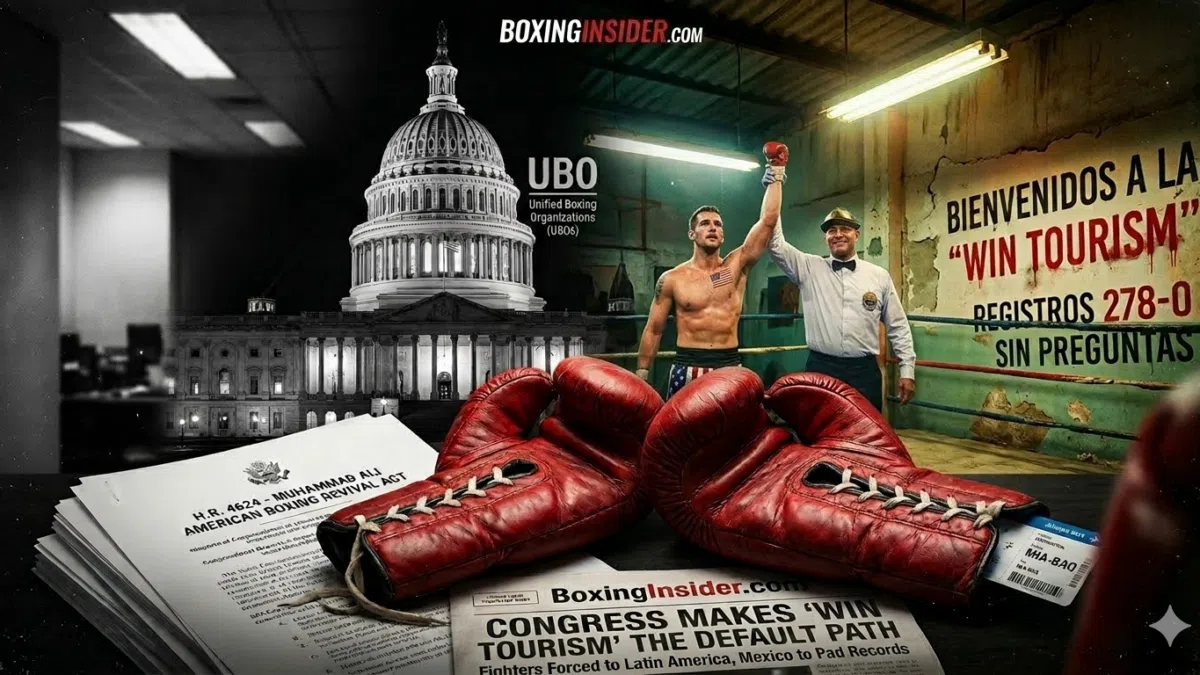
The numbers are not subtle. Thomas Hauser, the Hall of Fame journalist, reported that according to BoxRec founder John Sheppard, from 2018 through 2020 there were roughly a dozen fights per year in Colombia involving an American boxer. By 2024, that number had exploded to 278. The American fighter won all 278. Sheppard coined the term win tourism, and he’s blunt about what it represents: complicity at every level of the sport.
That’s the landscape before H.R. 4624 passes. Now imagine what happens after.
The Muhammad Ali American Boxing Revival Act cleared the House Education and Workforce Committee by a vote of 30 to 4 and landed on the Union Calendar on February 25, 2026. It’s heading for a full House vote with strong bipartisan support. The bill’s centerpiece is the creation of Unified Boxing Organizations—UBOs—entities that can handle promotion, rankings, titles, and sanctioning all under one roof. It mandates minimum per-round payments. It requires certified ringside physicians. It requires training facilities and rehabilitation access for contracted fighters. It requires health insurance.
The bill was sold as fighter protection. In reality, it’s a compliance framework designed for billion-dollar operators and dropped on an ecosystem that runs on tight margins and local hustle.
Club boxing in America—the four-round fights, the six-rounders, the small shows in hotel ballrooms and music venues—already operates under state athletic commissions. Those commissions already require licensed referees, ringside physicians, pre-fight medicals, post-fight medicals, and insurance policies. The system isn’t perfect, some commissions are much better than others, but it’s real. It functions. Fighters are examined before they step in the ring in NJ and NY and examined again after. Suspensions are tracked across state lines. There are adults in the room.
The Revival Act doesn’t strengthen that system. It creates a parallel one built for corporate-scale operators while layering new mandates onto the existing one—mandates that don’t distinguish between a TKO production in a 20,000-seat arena and a club show in a 300-seat room. The costs of compliance don’t scale down. The paperwork doesn’t scale down. And when independent promoters can’t absorb the overhead, they stop putting on shows.
And then there’s drug testing. The original bill didn’t include it. But during committee markup, Representative Walberg’s substitute amendment added Section 4(b), which amends the Professional Boxing Safety Act to require testing against the WADA prohibited substance list at every title bout and at random for all other matches. A separate provision in Section 24(e) requires testing of at least 50 percent of participants on UBO cards specifically. That’s not a suggestion. That’s a federal mandate. A standard ten-panel urinalysis costs a commission $30 to $150. WADA-compliant testing—the kind required under this bill—runs $20,000 to $30,000 per fight. As Part 2 of this series laid out in detail, California’s entire annual drug testing budget is $175,000 for roughly 130 events. This bill would burn through that in a handful of cards. Whether those costs land on commissions or promoters, the result is the same: the small shows go dark.
When those shows disappear, the fighters don’t disappear with them.
They get on a plane. They fly to Barranquilla or Santo Domingo or Tijuana, where a local operator puts them on a card for cash, where there’s no commission, no drug testing, no post-fight MRI, and no one asking whether the opponent has ever had a boxing lesson. They come home with a win and a record that looks legitimate to anyone who doesn’t know better.
And what’s waiting for them on the other end of that plane ticket is worse than most people in Washington can imagine.
John Sheppard runs BoxRec—the closest thing boxing has to an official record-keeper. He’s spent years publicly documenting what happens in the jurisdictions that American fighters are already flying to, both on BoxRec and in interviews with boxing media. The stories that follow are not rumors from gym corners. They are documented incidents from the organization responsible for maintaining the integrity of professional boxing records worldwide.
In one case, Sheppard sent a BoxRec editor to observe a fight card at a venue that a commission had been submitting results from. The building was locked. There were no fights. No ring, no crowd, no fighters. But on Monday morning, the commission sent event results to BoxRec—with every “professional loser” listed as the winner. The entire card was fabricated.
At another event, a BoxRec editor attended a card and counted six fights. The supervising commission submitted results for seven—with corroborating photos for each bout. The discrepancy? At the end of the night, two fighters entered the ring, were sprayed with water, had their photo taken, and left. No punches thrown. The fight was recorded.
An American boxer contacted BoxRec to report that he had been “defrauded” in Mexico. He had paid a promoter to secure a win. The opponent tanked for four rounds as agreed. But the judges gave the decision to the opponent anyway. The promoter then told the fighter he could get the decision reviewed—for an additional $400.
A Mexican commission submitted an event report that included a loss for “Jose Lopez.” There are more than a hundred Jose Lopezes in BoxRec’s database. Sheppard asked which one. The commission’s response: “We don’t know. But he lost. It doesn’t matter. Just pick one.”
And a new commissioner, working her first event, asked the experienced commissioner training her how to determine who won a fight. The answer she received: “The referee will raise the winner’s hand.” Nobody taught her about draws.
This is the system American fighters are already using to pad their records. This is where the Revival Act pushes more of them.
It’s not just a record-keeping problem. It’s a safety crisis. WBC President Mauricio Sulaimán has warned publicly that when fight results go unrecorded—which happens routinely in unregulated jurisdictions—fighters who have been knocked out don’t carry the knockout on their official record. That means they can be scheduled to fight again two or three weeks later without a mandatory suspension. Sulaimán said this has already happened.
A 2024 study published in the journal Brain and Spine put it in clinical terms: “An unknown number of fatalities go undetected in unofficial bouts.” The researchers called for “improved and systematic registration of boxing-related fatalities.” In other words, we don’t even know how many people are dying in these fights because nobody is counting.
This is the part that should bother every member of the House. The original Muhammad Ali Boxing Reform Act of 2000 was built on a principle of separation of powers. Promoters couldn’t be managers. Sanctioning bodies couldn’t be promoters. The firewalls existed because history proved what happens when one entity controls the whole chain—fighters get exploited. The Revival Act tears down those firewalls and hands the framework to a company that already controls MMA and professional wrestling. TKO—the parent company of the UFC and WWE—lobbied for this legislation. The UBO model is their model.
And it’s worth noting who’s raising alarms. The WBC opposes it. Independent promoters oppose it. Fighter advocates oppose it. The MMA Fighters Association—representing the UFC’s own athletes—circulated a petition urging opposition, calling the bill an extension of the UFC’s model rather than genuine fighter protection. Even USA Boxing—the national governing body for amateur boxing and the amateur-to-pro pipeline—has withdrawn its support. Thirty to four doesn’t suggest anyone is listening to the people who actually work in boxing.
Senator Ted Cruz—who has spent his career warning about legislation that exports American jobs overseas—sat down with Dana White this week on his podcast to praise how exciting the Revival Act is for boxing. TKO will surely create some high-profile opportunities. But this bill will export far more grassroots jobs—fighters, trainers, and small-show infrastructure—pushed out of the country. We already know the pattern: 278 fights in Colombia in 2024, every one won by an American. The Revival Act doesn’t stop that. It accelerates it by making it more expensive to fight at home than to buy a plane ticket.
The fundamental problem is that Congress looked at a sport with a regulation gap and decided the answer was more regulation only where regulation already exists. American club boxing is regulated. Colombian gymnasiums are not. Dominican hotel conference rooms are not. Mexican venues where commissions fabricate results and spray water on fighters for photographs are not. The fighters who are most vulnerable—the ones just starting out, the ones without connections, the ones who need ring time to develop—are the ones who will be pushed into those environments when the domestic opportunities dry up.
Win tourism is already an epidemic. 278 fights in Colombia in a single year, with a 100% American win rate. Fabricated fight cards submitted by commissions that don’t exist. Fighters knocked out in unregulated bouts with no record of the knockout and no suspension to protect them. An American fighter paying a promoter for a guaranteed win and getting scammed by the judges. A commission that can’t tell you which fighter lost because they don’t know and don’t care.
That’s not a trend. That’s an industry. And H.R. 4624 is about to pour gasoline on it.
Reagan had a famous line: “Government is not the solution to our problem; government is the problem.” In boxing, right now, he’s right. But he was also wrong—because there is a version of government that works in this sport. I see it every time I put on a show. That’s a story for the next piece in this series.
This bill isn’t the answer. It’s being fast-tracked by a Congress that thinks it’s doing something good. That’s what makes it scary.
They’re calling it the Revival Act. From the grass roots, it’s also the Export Act. And the guys who’ll pay for it are the ones nobody in Washington has ever heard of.
H.R. 4624 is heading for a full House vote. Contact your representative before it gets there. Tell them this bill deserves serious debate before it becomes law—not a rubber stamp.
Next in the series: Government in boxing—what it looks like when it works, and what this bill gets wrong about who should be running the sport.
Larry Goldberg is the founder of Boxing Insider Promotions and owner of BoxingInsider.com. BoxingInsider.com is an independent boxing news platform and the home of Boxing Insider Promotions, which stages professional boxing events in Atlantic City and New York City. We are not covering this legislation from the outside. We are one of the promoters it will directly affect.
Read the full series:
Part 2: Drug Testing in Boxing: What It Actually Costs
Part 3: The Muhammad Ali Revival Act Just Made Win Tourism the Business Model for Independent Boxing
Part 4: The Muhammad Ali Revival Act Turns the ABC Into America’s De Facto National Boxing Commission
Part 5: Boxing Needs Reform. This New Ali Act Revival Bill Needed a Debate.