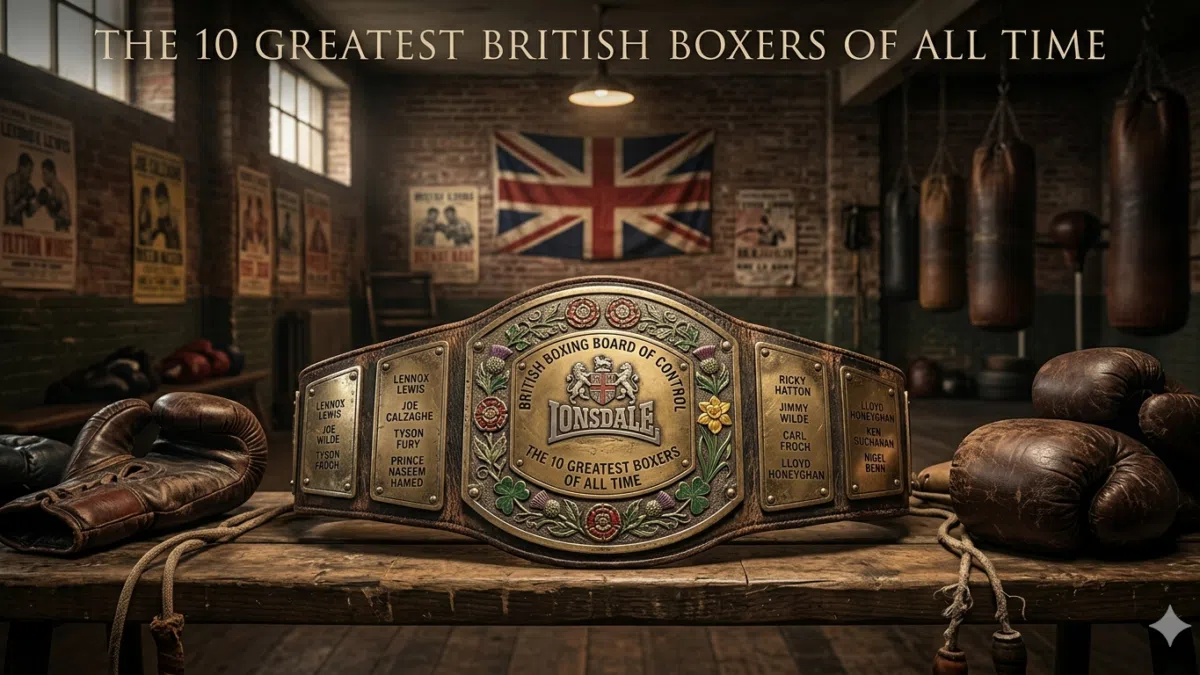
Britain did not just produce great boxers. It produced boxing itself. The Marquess of Queensberry Rules, drafted in 1867, created the framework that still governs the sport today. From the bare-knuckle era through the golden age of heavyweights and into the modern boom, British fighters have competed at the highest level in every weight class. Here are the 10 greatest.
1. Lennox Lewis
The last undisputed heavyweight champion of the 20th century and the most accomplished British heavyweight in history. Lewis won the WBC, WBA, and IBF titles and defeated Mike Tyson, Evander Holyfield, and Vitali Klitschko, a resume that includes three of the most significant heavyweights of his era. Born in London and raised in Canada, Lewis was a calculated technician who used his size, reach, and jab to break opponents down. He avenged both of his career losses, stopping Oliver McCall and Hasim Rahman in rematches. He retired with a record of 41-2-1 with 32 knockouts and was inducted into the International Boxing Hall of Fame in 2009.
2. Joe Calzaghe
Calzaghe retired with a perfect record of 46-0 and held the WBO super middleweight title for over 10 years, making 21 successful defenses before vacating to move up to light heavyweight. He then beat Mikkel Kessler, Bernard Hopkins, and Roy Jones Jr. in succession. His hand speed was extraordinary, his work rate relentless, and his chin never cracked. He was never knocked out, never stopped, and never lost. The pride of Wales is the longest-reigning super middleweight champion in boxing history and was inducted into the International Boxing Hall of Fame in 2014.
3. Tyson Fury
The “Gypsy King” dethroned Wladimir Klitschko in 2015 to become unified heavyweight champion, ending Klitschko’s decade-long reign in one of the biggest upsets in heavyweight history. After battling mental health issues and a dramatic weight gain, Fury returned to the ring and stopped Deontay Wilder twice to win and defend the WBC heavyweight title. At 6-foot-9 with the footwork of a middleweight, Fury is the most unorthodox heavyweight champion the sport has ever seen. His two losses to Oleksandr Usyk in 2024 prevented him from becoming undisputed, but his comeback story and his peak performances place him among the greatest British fighters ever.
4. Prince Naseem Hamed
Hamed brought something British boxing had never seen before: a featherweight from Sheffield with the charisma of a heavyweight champion and a fighting style that defied every textbook in the sport. Hands down, chin up, throwing power shots from angles that should not have generated force. He held the WBO featherweight title and compiled a record of 36-1 with 31 knockouts. His theatrical ring entrances made him a global star, and his knockout power at 126 pounds was genuinely frightening. His 2001 loss to Marco Antonio Barrera exposed the limits of his approach against elite opposition, but at his peak, Hamed was one of the most electrifying fighters in the world.
5. Ricky Hatton
“The Hitman” from Manchester was the people’s champion. Hatton held the WBA, IBF, IBO, and Ring magazine light welterweight titles and was one of the most popular British fighters of his generation. His relentless body attack and non-stop aggression made him a nightmare at 140 pounds, and his fans traveled in the tens of thousands to watch him fight in Las Vegas. His losses came against Floyd Mayweather Jr. and Manny Pacquiao, two of the greatest fighters of all time. Against everyone else at his weight, Hatton was virtually unbeatable. He retired with a record of 45-3 with 32 knockouts.
6. Jimmy Wilde
“The Ghost with the Hammer in His Hand” is widely considered the greatest flyweight who ever lived. Fighting in the early 20th century, Wilde stood barely five feet tall and weighed under 108 pounds, yet he compiled a record that includes roughly 150 recorded bouts with nearly 100 knockouts, many against men who outweighed him by 20 pounds or more. His power at his size was considered freakish, and his willingness to fight anyone regardless of weight made him a legend. He held the world flyweight championship from 1916 to 1923 and was inducted into the International Boxing Hall of Fame in 1990.
7. Carl Froch
“The Cobra” from Nottingham won the WBC, IBF, and WBA super middleweight titles across a career defined by big fights against elite opposition. He defeated Mikkel Kessler, Lucian Bute, Jean Pascal, Jermain Taylor, and Andre Dirrell, and his only losses came against Andre Ward and Kessler (whom he avenged). His rematch victory over George Groves at Wembley Stadium in front of 80,000 fans was the biggest domestic boxing event in British history. Froch was a warrior who always showed up for the biggest fights, and his record against world-class opposition is one of the strongest of any British fighter.
8. Lloyd Honeyghan
Honeyghan’s upset of Don Curry in 1986 is one of the most significant victories in British boxing history. Curry was the consensus pound-for-pound best fighter in the world, and Honeyghan stopped him in six rounds to win the undisputed welterweight championship. The result shocked American boxing and announced that British fighters could compete with and beat the best in the world at any weight. Honeyghan’s career after the Curry fight was inconsistent, but that one performance changed the perception of British boxing forever.
9. Ken Buchanan
Scotland’s greatest fighter. Buchanan won the WBA lightweight title by defeating Ismael Laguna in 1970 and added the WBC title the following year to become undisputed lightweight champion. He headlined at Madison Square Garden six times and was named Fighter of the Year by the Boxing Writers Association of America in 1970, ahead of Joe Frazier and Muhammad Ali. His technical brilliance and conditioning were ahead of his time, and his legacy as one of the most skilled lightweights in history is secure. He was inducted into the International Boxing Hall of Fame in 2000.
10. Nigel Benn
“The Dark Destroyer” was one of the most exciting fighters of the 1990s British boxing boom. Benn won the WBO and WBC middleweight and super middleweight titles and was involved in some of the decade’s most memorable fights, including his wars with Chris Eubank and Gerald McClellan. His 1995 fight with McClellan, which ended with McClellan collapsing and suffering a permanent brain injury, was one of the most harrowing nights in boxing history. Benn’s knockout power and aggressive style made him a fan favorite, and his rivalry with Eubank defined an era of British boxing that brought the sport to a mainstream audience.
Honorable Mentions
Henry Cooper put Cassius Clay on the canvas and became a national treasure without ever winning a world title. Bob Fitzsimmons was the first three-division world champion in history. Chris Eubank’s rivalry with Nigel Benn captivated Britain in the 1990s. Frank Bruno finally won the WBC heavyweight title on his fourth attempt and became one of the most beloved athletes in British history. Anthony Joshua held the unified heavyweight titles and sold out Wembley Stadium. And Daniel Dubois and the current generation continue to add to the tradition.
British boxing has been producing world-class fighters for over 200 years. The styles change. The venues change. The willingness to fight does not.