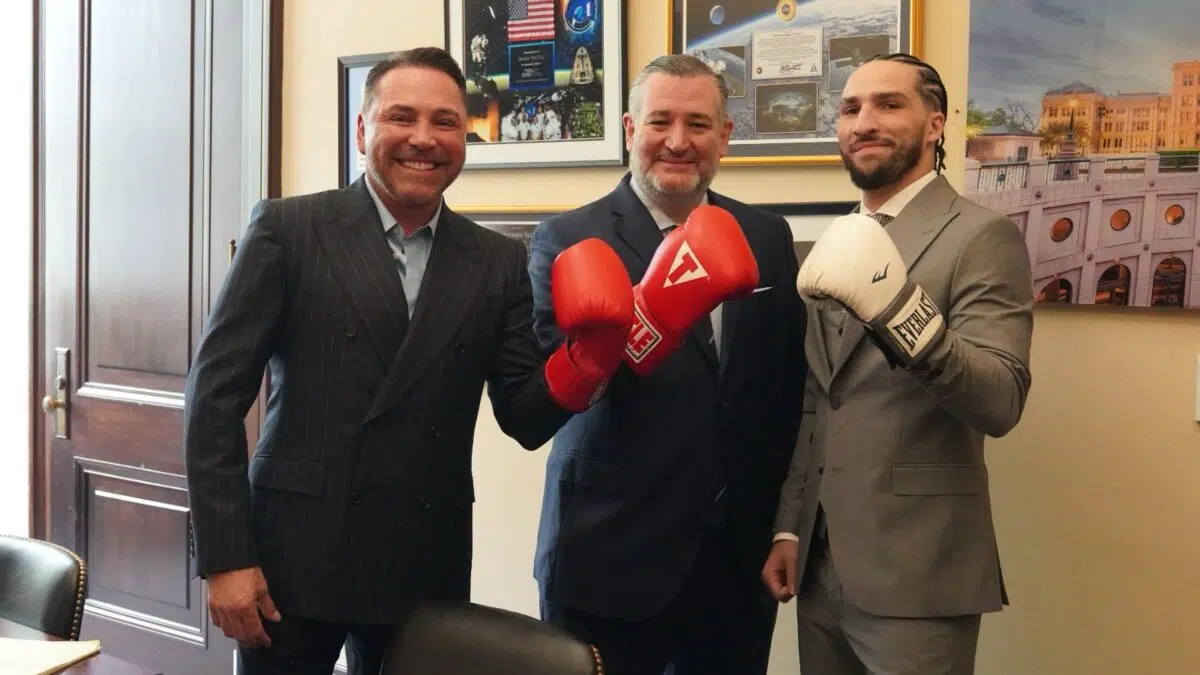
There is an old black-and-white movie from 1939 where Jimmy Stewart plays a regular guy who gets sent to the United States Senate and realizes on arrival that the room is already bought and the deal is already done. He stands up and talks anyway, even though everyone in the chamber knows he is going to lose.
That was Oscar De La Hoya in Washington on Wednesday, except the guy sitting in the Jimmy Stewart chair was a kid from East LA with a gold medal from Barcelona and ten world titles across six weight classes, and the people on the other side of the room worked for a company worth tens of billions of dollars.
Mr. De La Hoya went to Washington. This is a boxing story, and the best way to tell it is to let him tell it.
The Walk-Up
The week before the hearing, Oscar went on camera on his Clapback Thursday show and pre-fought the whole thing like it was fight week at the MGM.
“I’m actually going to Washington D.C. next week to testify in person against it and explain again why this Act does not need to be changed.”
“I’m going to give it my best shot to preserve boxing history and protect the fighters.”
“My clapback after I return from Washington is going to be a forest fire.”
Forest fire. Who talks like that before a Senate hearing? Oscar does, and he always has.
The Room
Picture the scene in Room SR-253 in the Russell Senate Office Building has high ceilings and dark wood, with senators seated up on a curved dais looking down at the witness table. Ted Cruz of Texas ran the room from the middle chair, and instead of using a gavel at 10 a.m. sharp, he rang a boxing bell and introduced the witnesses like a ring announcer working the Forum on a Saturday night.
There were four chairs at the table. Nick Khan, the president of WWE and a senior executive at Zuffa Boxing, was there representing TKO Group Holdings. Next to him was a Florida state commission director named Timothy Shipman, who played it down the middle. On the other side sat Nico Ali Walsh, Muhammad Ali’s grandson and a young pro fighter in a suit.
And next to Walsh sat Oscar, with no corner, no team behind him, and no lobbyist whispering in his ear. If you scored it on paper before the bell, it was not close.
The Mismatch
Let us be honest about the matchup before we get to what Oscar actually said, because the matchup is the whole point of the story.
On one side of the table was Nick Khan. Harvard Law. Twenty years as a Hollywood super-agent at CAA. Architect of the biggest television rights deals in the history of professional wrestling. Currently sits on the board of a publicly traded company valued in the tens of billions. He has spent his entire professional life sitting in rooms exactly like SR-253 and walking out with what he came for. He had a legal team. He had a communications team. He had prepared answers for every question Cruz was going to ask, because most of those questions were coordinated with his side before the hearing ever started. This was his home game.
On the other side of the table was Oscar. A fighter. A guy who spent his life training to punch other guys in the face for money, and who has spent the last two decades running a boxing promotion. He is not a lawyer. He did not go to Harvard. He does not do Sunday shows. He runs a YouTube segment called Clapback Thursday where he puts on a backwards hat and yells into a ring light.
How is that guy supposed to go into a United States Senate hearing, alone, against a corporate apparatus that has been building this bill for two years, and win?
The honest answer is he is not. Nobody should have expected him to. You do not ask a retired fighter to show up by himself, without a legal team behind him, and cross-examine a Harvard Law corporate executive on federal legislation the other side has been drafting for two years. That is not a fair fight and nobody said it was.
Here is what he did instead. He got on the plane. He sat down at the table. He looked Nick Khan in the eye and said what he believed. That is something almost nobody else in this sport with real skin in the game was willing to do. Bob Arum wrote a letter. The WBC put out a statement. Holyfield spoke publicly. When the Senate actually opened the door and said come testify, in person, under oath, on the record, two guys walked through it. Oscar was one of them. The other was Muhammad Ali’s grandson.
The Fight, In His Words
He swung from the opening bell.
On what the bill would actually do to the sport:
“By creating the UBO, it’s segregation, basically. Some fighters are going to want to stay in the current system and other fighters are going to want to fight for TKO or for Zuffa. Therefore, we will not see the very best fighting the very best.”
On why the original Ali Act exists in the first place:
“The Ali Act addresses real problems, including conflicts of interest, lack of transparency, and the exploitation of fighters.”
On who actually wins if the new bill passes:
“This is a fundamental shift in power that, if enacted, would put corporate profits first and fighters second.”
Then he put the UFC’s own legal history right on the table in front of the senators:
“The UFC and its parent company agreed to a $375 million anti-trust settlement after fighters accused them of suppressing wages and restricting competition.”
And he did not let the money sit quiet in the corner either. He named exactly where the checks were coming from.
“Zuffa Boxing is fully funded by Saudi Arabia. We’ve already seen how that kind of funding reshaped another sport through LIV Golf. We should be honest about what is happening here. That was sportswashing, a clear effort to use sports to reshape reputations.”
Nick Khan came back with everything you would expect from a career executive with a legal team behind him. The new Paramount deal and its 80 million subscribers. Merchandise, trading cards, video game revenue. A grassroots pipeline modeled on the UFC Performance Institute. He had a polished answer for every question, because he was supposed to. That is literally his job.
Oscar kept coming anyway. He went back and forth with Khan on sanction fees, on why super fights take longer to make than they used to, and on whether boxing is actually broken in the first place. He did not have a prepared counter for every move Khan made, because he is not a lawyer. He is a fighter. He threw what he had.
Nico Ali Walsh, sitting right next to him, landed the cleanest punches of the day.
“This new law is designed for billionaires, not boxers.”
“Boxing is not broken. If it were, UFC champions, at the height of their careers, would not be actively targeting boxing fights because of the fair pay.”
“Multiple promoters competing for fighters creates leverage and fair market value.”
And the one that cut to the bone:
“The people controlling fighters should not also control the entire marketplace those fighters depend on.”
The Buzzsaw
Oscar flew home to Los Angeles Wednesday night, and by Thursday afternoon he was back on camera. The video he posted did not sound like a victory lap. It sounded like a fighter sitting on a stool in the locker room after a fight he did not think was called straight.
“Yo, what’s up guys? Just got back from Washington D.C. I am super tired. Clapback will continue next week, but I do want to thank Nico Ali Walsh. Thank you for fighting the good fight, man. You really did a great job. But we walked into a buzzsaw.”
Then he went at the chairman directly.
“It was crazy how Chairman Cruz, we meet him beforehand, and all he can talk about was President Donald Trump, what a great time they had at the UFC event.”
“The questions felt scripted. The corruption that I felt in the room was just disgusting.”
And he teased what is coming next.
“I have videos next week that I will show you. I will put together all the lies that Nick Khan told. It’s going to be pretty interesting, but I can’t wait for next week.”
That is the forest fire he promised, loaded and cued up and waiting for the match.
The Decision
Here is the end of the movie. Jimmy Stewart collapses on the Senate floor, the bad guys confess to everything, the crowd in the gallery cheers, and the idealist wins the day.
Wednesday did not end that way. Cruz closed the hearing by announcing he will introduce a Senate version of the bill and said he is open to bipartisan modifications, which means the bill is moving forward. Oscar knew that walking in, and the video he shot Thursday made it clear he felt it walking out.
On the scorecards that count, the ones held by the people with the votes, Oscar lost the round. But that is what happens when you send one fighter, by himself, into a room built for career lawyers and corporate executives. The fix was not exactly hidden. The bell was rung, the ring announcer did his bit, and the judges had already turned in their cards before the opening bell.
The Last Frame
That is not why you remember the old movie, though. You remember the old movie because one guy, with nothing in his corner, stood up in a room built to run him over and refused to sit back down.
Oscar De La Hoya is not a lawyer. He is not a lobbyist. He is not a Senate witness by trade. He is a retired fighter who runs a boxing promotion and yells into a camera on Thursdays. He flew to Washington anyway, by himself, across from a corporation that could buy his promotion out of petty cash, across from a senator he now says was already sold before the opening bell. He sat in the chair. He said what he came to say. Then he came home and said it the way only he says it.
“We walked into a buzzsaw.”
You do not have to agree with Oscar about the bill, and you do not have to like his promotion. What you should not do is hold it against him that a fighter did not out-lawyer a Harvard Law corporate executive in a room that executive was built for. Nobody walks into that matchup and comes out with a W. The only people who belong there are the ones the other side pays to be there.
Oscar went anyway. That is the whole point.
Mr. De La Hoya went to Washington. The old movies had it right, and that is the part worth telling.