Boxing and trading cards go back further than any other sport in the hobby. Before Topps ever printed a Mickey Mantle, before Fleer wrapped a Michael Jordan rookie in cellophane, tobacco companies were slipping illustrated cards of bare-knuckle fighters into cigarette packs in the 1880s. For nearly 140 years, the sweet science has maintained a presence in the collectibles world — sometimes booming, often overlooked, and always carrying an underground appeal that mirrors the sport itself.
What follows is the full arc of boxing’s trading card history, from its origins in the tobacco trade to the mass-market experiments of the 1990s, the decades when boxing’s biggest names survived only as guest appearances in baseball and multi-sport products, and the recent return of a dedicated Topps boxing set for the first time in 74 years.
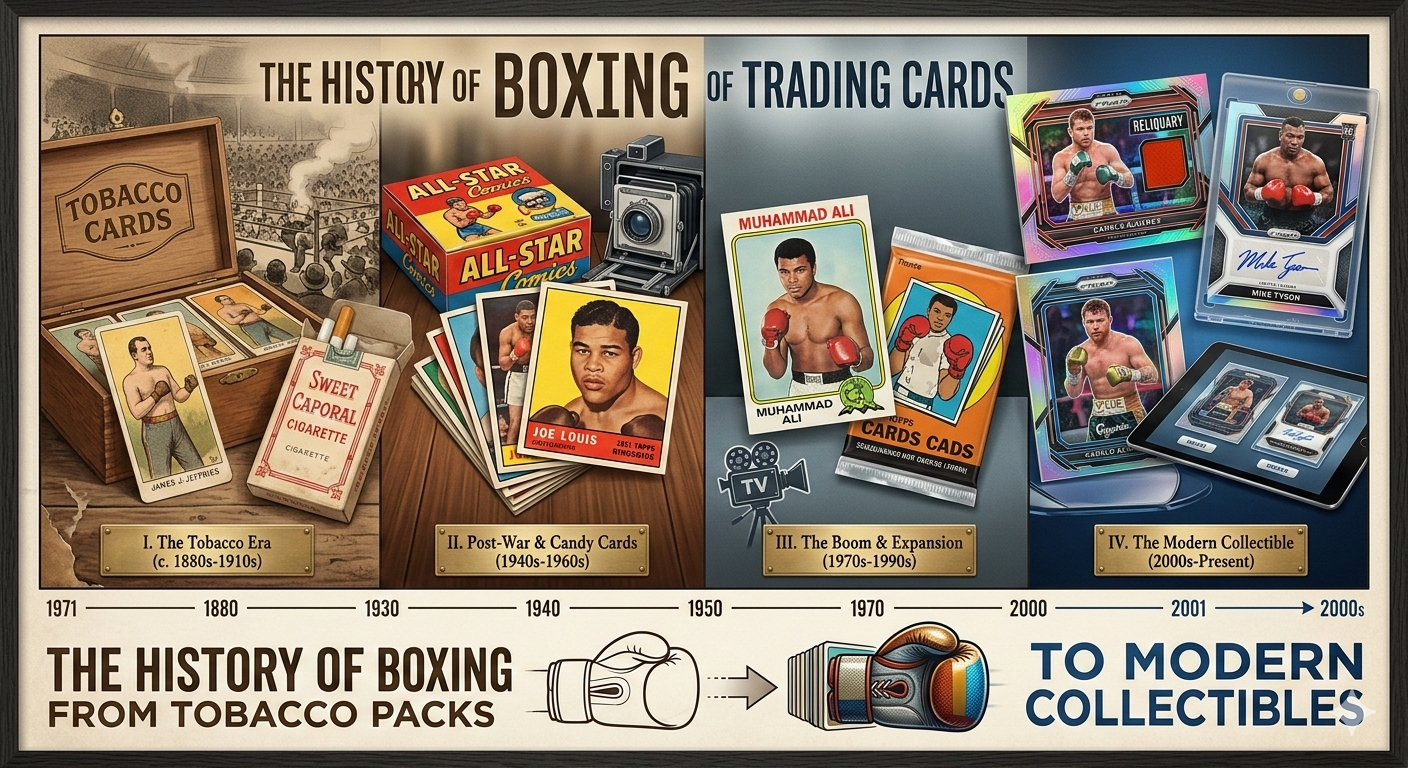
The Tobacco Era: 1880s–1930s
The earliest boxing cards were marketing tools. Tobacco companies inserted small illustrated cards into cigarette packs to stiffen the packaging and encourage brand loyalty, and prizefighters — the most famous athletes of the era — were natural subjects.
Allen & Ginter, a Richmond, Virginia tobacco firm, produced the N28 and N29 sets between 1887 and 1888, featuring boxing subjects alongside other athletes and curiosities of the day. The cards were lithographed in color, roughly the size of a modern business card, and meant to be collected, traded, and pasted into albums — a Victorian-era version of the same impulse that drives today’s hobby.
By the early 1900s, the American Tobacco Company and its competitors had turned card inserts into an industry. The 1910 T220 Mecca Prize Fighters set featured 150 cards with an innovative fold-over design: the top half showed one fighter, and by folding the card along a perforation, a second fighter was revealed. The companion T225 Prizefighter Series offered more traditional single-subject cards.
The crown jewel of the pre-war tobacco sets is the 1911 T9 Turkey Red series. Printed on oversized cabinet-style stock with rich, full-color lithography, the Turkey Reds were premium items redeemed by mail in exchange for coupons from cigarette boxes. The set included heavyweight champion Jack Johnson, whose card remains one of the most valuable pre-war boxing collectibles.
Other significant pre-war issues include the 1924 Franklyn Davey set from Great Britain, the 1938 Churchman’s Boxing Personalities series, and a variety of caramel, strip, and exhibit card issues that appeared sporadically through the 1930s and 1940s.
1948 Leaf: The Bridge Between Eras
The 1948 Leaf Boxing set occupies an unusual place in the hobby — widely acknowledged as historically important, yet overshadowed by the set that would follow it three years later. The issue consists of 50 cards featuring fighters from the 1930s and 1940s, printed with a skip-numbered checklist that has confused collectors for decades. The roster is stacked: Joe Louis, Sugar Ray Robinson, Rocky Graziano, Henry Armstrong, and Jack Dempsey are all represented.
Robinson’s Leaf card (No. 64) is recognized as his rookie and has sold for as much as $15,000 in high grade. Graziano’s No. 50 reached $87,000 at its peak sale in 2019, according to Sports Illustrated’s collectibles coverage. The set’s scarcity in top condition keeps it relevant in the vintage market, even if it never achieved the cultural status of its successor.
1951 Topps Ringside: The Gold Standard
If there is one boxing card set that every serious collector knows, it is the 1951 Topps Ringside issue. The 96-card set featured full-color illustrations of fighters spanning from bare-knuckle legend John L. Sullivan to the reigning champions of the early 1950s. It is Topps’ only dedicated vintage boxing set, and it remains widely regarded as the most prestigious issue the sport has ever produced.
The cards were issued in two series of 48, distributed in both one-cent single-card packs and five-cent two-card panels separated by a perforation. Cards from the panel configuration can still be found with perforated edges, and intact panels command a premium. Five wrestlers were also included in the set, a quirk that has never been fully explained but doesn’t seem to bother anyone.
The illustrations are the set’s signature. Unlike the photographic cards that dominated later decades, the Ringside fronts are hand-drawn, rendered in vivid color against painted backgrounds. The effect is more sporting art than trading card. Card backs are dense with information — hometown, record, knockout totals, and a biographical paragraph packed with trivia. Rocky Marciano’s card (No. 32) notes he had a tryout with the Chicago Cubs in 1946. Henry Armstrong’s (No. 2) mentions he became a gospel preacher after retiring from the ring.
Marciano’s No. 32 is the set’s centerpiece — considered the only trading card produced of him during his active career. A PSA 9 copy, one of only four graded at that level with none higher, sold for $33,600 in 2022, according to PSA’s card registry. The second series (cards 49–96) is generally tougher to find, and several short prints — Bob Murphy (No. 49), Bob Fitzsimmons (No. 55), Pete Mead (No. 61), and Carlos Chavez (No. 89) — add to the difficulty of completing the set.
One notable omission is Jack Johnson. Despite his historical significance as the first African American heavyweight champion, Johnson does not appear. Collectors have speculated that Topps avoided the inclusion due to the legal controversies that followed Johnson throughout his life, though no official explanation has ever been offered.
The Quiet Decades: 1952–1984
After the Ringside set, boxing essentially vanished from the American trading card market for more than three decades. The sport produced some of its greatest fighters during this period — Muhammad Ali, Joe Frazier, Sugar Ray Leonard, Roberto Duran, Marvin Hagler, Thomas Hearns — but no major card company saw enough commercial demand to justify a dedicated boxing release.
European and international markets produced scattered issues. The most significant is the 1960 Hemmets Journal set from Sweden, which includes a card of a young Cassius Clay (No. 23) — recognized as Muhammad Ali’s true rookie card. A PSA 9 copy sold for $210,000 at its 2021 peak, making it the single most valuable boxing card in the hobby. The 1983 Topps Greatest Olympians set brought Ali back onto American cardboard for the first time in a mainstream product, picturing him as Cassius Clay celebrating his 1960 gold medal — though widespread centering issues make high-grade copies difficult to find.
The domestic gap is striking. Baseball, football, and basketball all had continuous annual production throughout this period. Boxing had nothing — the result of fragmented promotion, no centralized league structure, and the difficulty of licensing individual fighters across multiple promoters.
Brown’s Boxing: The One-Man Operation That Kept the Hobby Alive
In 1985, a small card company in Knob Noster, Missouri, run by a man named Johnny Brown, began issuing sets of boxing trading cards. Print runs were claimed at 2,000 sets or fewer. The cards were basic — black-and-white or lightly tinted photographs on simple colored borders. They looked homemade, because they were.
In 1987, Brown incorporated as a nonprofit to raise money for needy ex-boxers. Between 1985 and 2002, he issued 13 sets — quietly, methodically, with almost no mainstream hobby attention. The first set contained 35 cards with blue borders. The 1986 Gold Border set was the breakout, featuring rookie cards of 1984 Olympic medalists Evander Holyfield (No. 62), Pernell Whitaker (No. 66), and Mark Breland (No. 63). Holyfield’s card is recognized as his true rookie, with PSA 9 copies selling for as much as $2,000.
The most valuable Brown’s card — and one of the most important modern boxing cards in the hobby — is Floyd Mayweather Jr.’s rookie in the 1997 11th Set (No. 51). Issued in a print run of fewer than 2,000, it is the earliest recognized trading card of the fighter who would retire 50-0. A PSA Mint 9 copy commands serious money on the secondary market, and fewer than 10 uncut sheets of the 1997 set are believed to exist.
Brown continued with Red Border, Orange, and Green sets through the late 1980s, each one adding roughly 30 cards to a running checklist. By the early 1990s, Brown’s Boxing had become the de facto annual record-keeper of professional boxing. If a fighter was active and notable, there was a reasonable chance Johnny Brown had put him on a card.
Brown’s final sets came in 2001 and 2002, the latter a 32-card Prizefighters Series that included Ricky Hatton, Chad Dawson, Jermain Taylor, and, in a characteristic deep cut, John Carlo — a Bronx heavyweight whose primary claim to fame was being the only man to knock out a former heavyweight champion in his professional debut, having stopped Leon Spinks. Johnny Brown never got rich. His sets never appeared in hobby shops next to Upper Deck basketball or Topps baseball. But for nearly two decades, Brown’s Boxing was often the only game in town — and the rookie cards it produced for Holyfield, Whitaker, and Mayweather are now the foundation of many serious boxing card collections.
Kayo and the 1991 Boom
The early 1990s brought a brief explosion of boxing card production, riding the same speculative wave that was inflating baseball card prices to absurd levels. The most notable product was the 1991 Kayo set — 250 cards covering active fighters and all-time greats, with two hologram inserts (Ali vs. Liston, Holyfield vs. Foreman) serving as the signature chase pieces.
The roster was deep: first cards of Roy Jones Jr. (No. 116), Arturo Gatti, and Lennox Lewis (No. 68), alongside Ali, Dempsey, Louis, Liston, Marciano, Chavez, and Leonard. Promoters, trainers, and referees also appeared — a comprehensive approach that treated boxing as an ecosystem.
Kayo was not alone. The same year saw the Ringlords set, notable for its full-bleed design showing a celebrating Tyson with Don King at his side, as well as the All World Boxing set with 149 cards. A Ringlords version without the “Sample” stamp on the back, inserted only in limited five-card cello test packs, remains particularly scarce. Each company bet that boxing collectors existed in sufficient numbers to sustain an ongoing product line. They did not. The speculative bubble burst hard, and boxing was hit disproportionately. Most of the companies that entered the boxing market in 1991 were gone within a few years. A complete Kayo set in near-mint condition still sells for roughly $25 to $30 — a price point that tells you everything about the set’s long-term trajectory.
But as a historical document, the Kayo set endures. It is the one moment when boxing cards got genuine retail shelf space alongside the major sports, and its comprehensive checklist makes it a useful reference for the era’s fighters.
Boxing’s Biggest Names, Scattered Across Other People’s Products
For the better part of two decades after the 1990s bubble burst, the only way to pull a card of Muhammad Ali, Mike Tyson, or Floyd Mayweather from a fresh pack was to buy someone else’s product. Baseball sets, multi-sport releases, and premium autograph-driven lines became the unlikely homes for boxing’s biggest names — guest appearances in a hobby that had no permanent address for the sport.
It started with the 2000 Upper Deck Muhammad Ali Master Collection, an ultra-premium box set housed in a wooden box. Each contained 30 base cards serial-numbered to 250, an on-card Ali autograph, and three memorabilia cards featuring swatches from fight-worn gloves, trunks, and robes numbered to 50. Given the extreme scarcity, most sets went directly into personal collections and have rarely resurfaced.
Then came Topps Allen & Ginter. When the modern revival of the tobacco-era brand launched in 2006, boxing found an annual home inside a baseball product. The debut set included Mike Tyson as a short-print base card (No. 301) and as part of the autograph insert set — with a stated print run of just 200 copies, it became his first-ever signed trading card. Floyd Mayweather followed in 2017 Allen & Ginter, receiving his first Topps cards and on-card autographs as he prepared for his crossover bout with Conor McGregor. The online-exclusive Allen & Ginter X version, with black card stock and silver ink, gave the autograph an even more premium feel. Laila Ali appeared as a short-print in the 2007 set. Year after year, Allen & Ginter became the place where boxing intersected with mainstream cardboard — even if it meant sharing checklist space with competitive eaters.
Upper Deck’s multi-sport lines provided another avenue. The 2012 Goodwin Champions included Tyson with base cards and autographed versions. The 2012 and 2016 Upper Deck All-Time Greats offered multiple Tyson autograph configurations, including silver versions limited to 40 copies and gold numbered to 10. Tyson’s most expensive card of all came from a product never sold to the public: the 2013 Upper Deck Employee Exclusive Precious Metal Gems autograph, numbered to 125, which sold for $58,800 in PSA 9 — the highest-priced Mike Tyson card ever recorded.
Leaf carved out its own niche as arguably the most consistent producer of signed boxing cards during this period. The 2011 Leaf Muhammad Ali and Ali Metal sets were premium releases built around Ali’s career, with on-card autographs, cut signatures, and a “Fans of Ali” subset featuring signers like Tyson, Sugar Ray Leonard, and Larry Holmes. The 2012 Leaf Inscriptions featured Tyson autographs with handwritten quotes, including references to The Hangover and the infamous “I want to eat your children” line. Leaf continued producing boxing cards through its Pro Set, Art of Sport, and History Book lines into the 2020s, often featuring multi-fighter autograph cards pairing Tyson, Mayweather, and Fury on a single piece numbered to 12 or fewer.
The 2010 Ringside Boxing Round One and 2011 Round Two sets attempted something more comprehensive — full boxing-specific products with base sets, autographs, and memorabilia cards featuring Ali, Tyson, Mayweather, Frazier, Holmes, Jones Jr., Lewis, and LaMotta. Ringside included Turkey Red-style inserts, fight-worn robe and trunk relics, and 1/1 “Moniker” cards with individual letters cut from fight-worn gear. Ali’s hard-signed autographs, found approximately one in every two TKO-version boxes, were the marquee selling point. For hardcore boxing collectors, Ringside was the most satisfying dedicated product since the 1991 boom — even if it lasted only two years.
The 2021 Topps Muhammad Ali “The People’s Champ” collection, featuring artwork by Tyson Beck, brought the Topps name back to boxing for the first time in 70 years. It was a tribute release rather than a roster-based set — but it proved the Topps brand and boxing were not incompatible.
2024 Topps Chrome Boxing: The Return
In September 2025, Topps released 2024 Topps Chrome Boxing — its first dedicated boxing set since the 1951 Ringside issue. The 95-card base set featured fighters from Top Rank, Golden Boy, and Matchroom, spanning legends like Tyson, Mayweather, Sugar Ray Leonard, De La Hoya, and Hearns alongside current champions like Jaron “Boots” Ennis, Dmitry Bivol, and Naoya Inoue. Autograph subsets included 1951 Ringside Autographs borrowing the original set’s design, Ring Generals featuring Tyson, and Stablemate Signatures with dual autographs from fighters sharing the same gym.
The set was not without controversy — Gervonta Davis was publicly dropped from the checklist before release — but as a statement of intent, Chrome Boxing was significant. For the first time since the early 1990s, boxing’s biggest active names and its historical legends occupied the same dedicated set from a major manufacturer.
The Market Today and What Comes Next
Boxing cards exist in a strange but increasingly healthy place. The vintage market is strong. The Ali rookie is a six-figure card. Mayweather’s 1997 Brown’s issue is a hobby staple. Topps Chrome Boxing gave the sport its first proper modern product in decades, and Leaf’s ongoing releases keep signed boxing cards flowing to collectors annually.
TKO Group Holdings struck an exclusive multi-year trading card partnership with Fanatics and Topps in 2024, producing Chrome, Finest, and Royalty lines for UFC. TKO also owns Zuffa Boxing, and Dana White — himself an avid collector with a personal collection valued above $1 million — has hinted that Zuffa Boxing trading cards are coming. No details have been announced, but for a hobby that spent the better part of a century operating in the margins — kept alive by tobacco companies, a nonprofit in Missouri, and a handful of manufacturers who believed boxing deserved a place in the card aisle — even the possibility qualifies as significant.