By Larry Goldberg
Part One of a series mapping the Zuffa vs. DAZN power shift reshaping boxing. One side built a machine to reach everybody. One side holds the vault.
There is a new Cold War in boxing, and like the old one it is not really about who can punch. It is about who controls the territory.
On one side you have a mainstream powerhouse forming. Paramount, about to own Warner Bros. Discovery, funded in part by Saudi Arabia’s Public Investment Fund, with the UFC’s owner TKO bringing the muscle and the political reach. On the other side you have the world boxing already knew, DAZN and the traditional promoters, the same names who ran the sport for fifty years, all gathered behind one app now. Two camps, two completely different ideas about how the sport is supposed to reach you. Call it the machine versus the vault. One is built to move and reach everybody. One is built to hold the treasure and keep it locked up tight. Both are real. Only one of them is winning.
This first piece is not here to argue for either side yet. It is here to map them. Who owns what, who is built on what, and where the power is really heading. Once you can see the map, the rest of this series makes a lot more sense.
| The Machine | The Vault | |
|---|---|---|
| Who’s in it | Paramount, TKO, Zuffa Boxing | DAZN plus eight promoters: Matchroom, Queensberry, Top Rank, Golden Boy, BOXXER, Salita, Eye of the Tiger, MF Pro |
| Where you watch | Paramount+ and CBS now, HBO Max and the Warner library once the merger closes | DAZN, $449.99 a year for the top tier with pay-per-views included, or a cheaper plan that still charges around $74.99 for the big fights, plus PBC on Amazon, MVP on ESPN, and the megafights drifting to Netflix |
| The money | Saudi PIF, the building money with the ambition behind it | Saudi PIF too, a roughly $1B stake, but bleeding around $936M in 2024 |
| The edge | Mainstream reach, distribution, TKO’s institutional power | The deeper roster, the history, the historical night of fights |
| The catch | Still has to digest the Warner merger, and the league format is on hold | A great product almost nobody can find |
Zuffa vs. DAZN: How the Two Sides Line Up
For fifty years, if you wanted to know who ran boxing, you just learned a few names. And the most extreme example of them all was Don King. He turned his wild hair and nonstop hype into a full-blown act, screaming “Only in America” while he made and broke champions. He didn’t just promote the fights. He was the show. The others ran the same way, just with the volume turned down.
It was romantic and it was rotten at the same time, usually for the same reason. The egos that built the spectacle could also freeze it solid. Mayweather vs. Pacquiao was the clearest example. The fight the entire sport wanted sat on ice for years while rival promoters and networks fought over money, drug testing, and ego. By the time it finally happened in 2015, both men were past their prime and the moment had already passed. The sport ran on personality, and personality was usually the thing holding it back.
That is the world now lining up on one side of this Cold War. And it already lost the first battle without really noticing.
The Vault: DAZN and the Eight Promoters
The first move already happened, and it looked like a victory.
DAZN gathered the traditional promoters under one roof. Eight of them are on the platform now: Matchroom, Queensberry, Top Rank, Golden Boy, BOXXER, Salita, Eye of the Tiger, and MF Pro, with the Riyadh Season cards on top of that. Bob Arum spent years insisting nobody had DAZN, and now his Top Rank shares a login with Eddie Hearn’s Matchroom and Frank Warren’s Queensberry, guys who spent their whole careers refusing to even share a building.
On paper that is strength. Every big traditional fight in one place. But look closer and it is a vault, not an empire. Here is how it actually works. The top plan, DAZN Ultimate, runs $449.99 a year and folds the pay-per-views in at no extra charge. Drop to a cheaper plan and the big fights are not included, you pay around $74.99 a pop on top of what you already spend. So either you pay top dollar up front, or you pay less and still get hit every time a real fight comes around. The platform has lost more than a billion dollars a year since 2019, narrowing to around $936 million in 2024, with its first profitable year finally in sight. It has the fighters and the history. What it lacks is mainstream reach. This is the vault, the good stuff locked inside, sold at a premium to the people who already love boxing.
And the rest of the old world is scattered all over the place, which is the real tell. PBC is on Amazon Prime, mostly behind pay-per-view. Most Valuable Promotions is building its women’s series on ESPN. The biggest one-off events drift over to Netflix, which can put a fight in front of more homes in one night than DAZN reaches in a year. So you have a deeper sport than the machine has, just spread across four different logins, with no unified front and no single place to find any of it. That is the side that still thinks of itself as the establishment.
And Netflix is where the wall really traps the people stuck behind it. The megafights are landing there, but the promoters who built them cannot follow. Warren and Hearn recently admitted their DAZN exclusivity leaves them unable to promote Fury vs. Joshua once it moves to Netflix. By default, that hands the lane to Dana White and Zuffa. The biggest night in the sport, and its own two biggest promoters are locked out of their own fight while Zuffa walks right in.
The Machine: Paramount, TKO and Zuffa
The other side is not trying to win the vault. It is just going over the top of it.
Paramount did not come up through boxing. Paramount+ is the exclusive United States home of Zuffa Boxing, a five-year deal reported at around $100 million a year for 12 cards in 2026, and that sits on top of the seven-year, $7.7 billion deal Paramount signed for the UFC. Then came the move that changes the whole math. Paramount’s roughly $110 billion purchase of Warner Bros. Discovery cleared the Justice Department this month and won shareholder approval, with only the EU and a few state attorneys general still circling. When it closes, one company controls CBS, Paramount+, HBO Max, the Warner library, the UFC, and a boxing promotion.
That is the whole difference right there. DAZN is an app you have to go find and pay a premium to get into. The machine does not wait around to be found, it reaches the living room that never subscribed to a fight app in its life, through channels people already pay for.
Now to be fair to the vault, it is not just sitting there waiting to lose. DAZN made a real move this spring. It cut a deal with TNT Sports for a monthly U.S. series called The Fight, launching July 4, that finally puts its roster of promoters on American linear television, the one thing the vault never had. That is smart, and it is genuinely good for them. It hands DAZN’s fighters a mainstream window they could never have built on their own.
Here is the catch though. TNT Sports belongs to Warner Bros. Discovery, and Warner is the company Paramount is buying. So the vault’s new road to the mainstream runs right through a network the machine is about to own. A lifeline today, a tenant in your rival’s building tomorrow. That is the whole map in one deal. Even the vault’s smartest move depends on infrastructure the other side is busy buying up.
The Money and the Power Behind Each Side
Underneath all the logos sit the two advantages that really decide this.
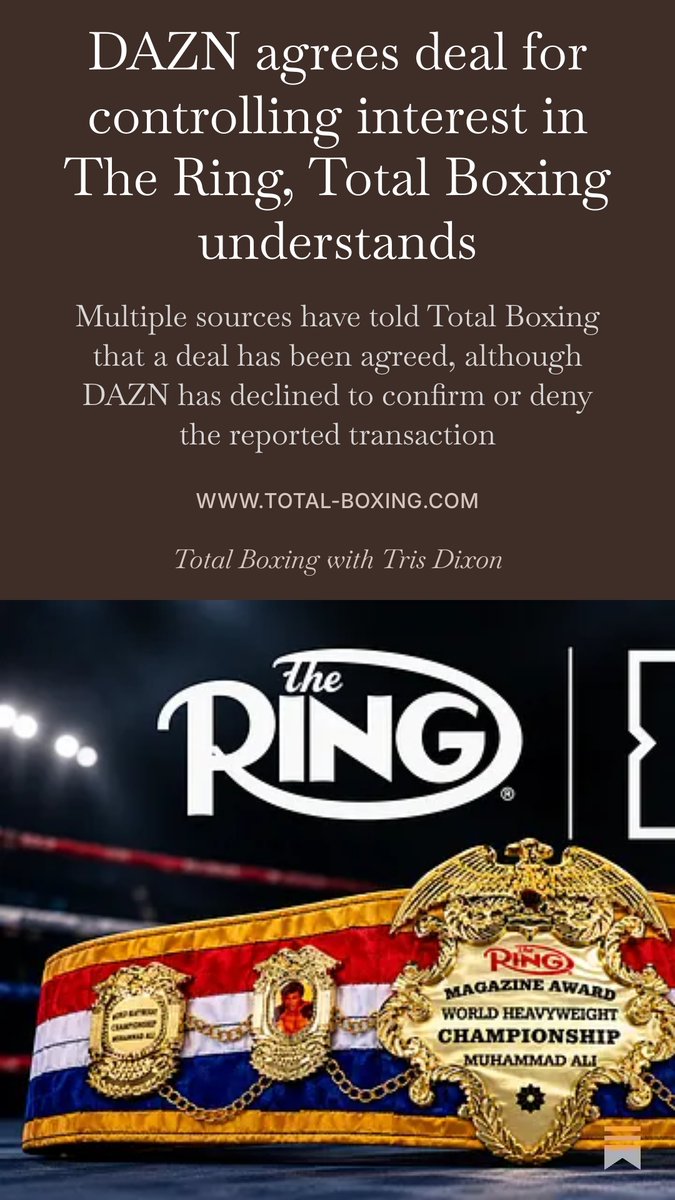
The first is money. Saudi Arabia’s Public Investment Fund, through SURJ, holds a stake of around a billion dollars in DAZN. It also owns Sela, the partner funding Zuffa Boxing, and it was named alongside Abu Dhabi and Qatar as a backer of the Paramount and Warner deal. So the same fund has a hand on both sides. But the building money, the real money with the ambition behind it, is going to the machine. Turki Alalshikh, the man steering Saudi boxing, also owns The Ring, the sport’s oldest record of itself. It might be the most fascinating money story in sports right now, and it is pointed straight at boxing.
The second is power, and this is where you have to understand what TKO actually is. It is not a fight promoter. It is a publicly traded conglomerate that owns both the UFC and WWE, which means it already runs live television every single week, fills arenas around the world, moves a touring production from city to city like clockwork, and trains champions in its own performance centers. A traditional promoter rents all of that one show at a time. TKO owns it outright and runs it year round. That is not a company that promotes fights. That is a machine built to manufacture live events at scale, and it just pointed itself at boxing.
The old guard built the sport around big personalities and then locked the fights behind a paywall. The machine is not trying to beat them inside that wall, it is reaching fans through platforms they already use and pay for. In a contest between boxing depth and distribution, distribution wins. That is the clearest read of the map right now, whether you like where it is heading or not.
But here is the thing about a machine. A machine is powerful and a machine is rigid, and it will never own this sport the way it owns the UFC. Boxing is too old, too global, too full of independent operators and national scenes and stubborn lifers for any one company to swallow it whole. There will be no monopoly here. A machine built for the top has holes, and those holes are exactly where everyone else still gets to live.
The Man Who Can Call Both Armies to the Table
Last week gave the clearest sign yet of where the gravity actually sits. Alalshikh went public with a plan to put Dana White, Nick Khan, Frank Warren, Eddie Hearn, and DAZN at one table to make peace and, in his words, “revolution for boxing,” borrowing the Vatican’s image of white smoke rising when a deal is struck. Sit with that one for a second. The same man helping fund Zuffa, partnered with DAZN, and holding The Ring just offered to broker a truce between every camp in the sport at once. That is not a man fighting in the Cold War. That is the man who can call both armies to the table.
And the man he most needs at that table all but said good luck. Asked about the summit at his UFC post-fight press conference Saturday night, Dana White gave Alalshikh his due and then set the bar. “He’s made some pretty big things happen in the sport of boxing. This is his biggest challenge yet. That I guarantee you.” Read that how you want. The most powerful man in the UFC just framed peace in boxing as Turki’s mountain to climb, nobody else’s. Even the doubt points right back to the same guy.
Is the Machine Good for Boxing?
If the machine wins, and the map says it will, the next question is whether that is good for the sport. The machine brings real things boxing has needed for decades. Best fighting best. A schedule you can trust. Rankings that mean something. One place to watch instead of four. That is real, and pretending it is not would make me a liar. But good for the sport is not the same as good for everybody in it. And there is a real fight coming over fighter compensation and rights, tied up in an Ali Act that is being rewritten as we speak, but that is a story for another day. I am not rooting for it. I am telling you what it is.
None of it is guaranteed though. Merging two debt-heavy giants is hard, and there is a version of the next two years where boxing gets starved at the top while Paramount digests Warner and fights regulators. And the one thing a machine built for the top has never done well is the slow work down at the bottom, taking a fighter from a small-room club card all the way up to the main stage. That is not really a flaw in the plan so much as a gap in it. Somebody still has to build the floor, and that is the opening for anyone independent enough to do it.
Those are real questions, but they are not reasons to bet against the machine.
So keep the map. Two camps. The machine and the vault. One side built to move and reach everybody, the other holding the treasure behind a wall. The same fund has a hand in both, but it is only seriously building one of them. And one man who, as of today, can call every side to a single table. It is here, it is winning, and the smart move is not to deny it or rage at it. It is a new reality, and the sooner everyone admits that, the better.
Larry Goldberg is the founder of Boxing Insider Promotions and publisher of BoxingInsider.com. He is also the 2023-2024 New York State Boxing Hall of Fame Promoter of the Year.