
By Larry Goldberg and Boxing Insider Staff
Before Senator John McCain spent a decade trying to create a federal boxing commission. Before H.R. 4624 passed the House. Before anyone debated what a Unified Boxing Organization should look like. There was a question that Congress had been asking since the 1950s and still has not fully answered:
Who is supposed to be in charge of boxing?
This is the story of how Congress first got involved, what it found, what it did about it, and what it left unfinished. It is the prequel to our Brief History of Congress Trying and Failing to Fix Boxing, which picks up the story in 2004 and carries it through the current Senate fight over the Ali Revival Act.
The Mob Takes Over: 1940s and 1950s
Boxing has never had a commissioner. It has never had a league office. It has never had a players’ union. That is not an accident. It is the result of how the sport was built, and who built it.
In the late 1940s, a convicted killer named Frankie Carbo became the most powerful man in professional boxing. Carbo was a soldier in the Lucchese crime family who had worked as a gunman with Murder, Inc. before moving into the fight business. His partner, Frank “Blinky” Palermo, was a Philadelphia numbers racket boss who operated as an unlicensed manager.
Together, Carbo and Palermo built a system that controlled the sport from the inside. They placed frontmen as managers of top fighters, took large cuts of purses, fixed fights when it suited them, and used threats and violence against anyone who resisted. The business end of this operation ran through the International Boxing Club, a promotional company formed in 1949 by Chicago millionaire James D. Norris and his partner Arthur Wirtz.
On paper, the IBC was a legitimate business. In reality, it was a near-monopoly. The IBC controlled Madison Square Garden, the biggest television contracts, and most of the top fighters in the country. Between May 1953 and 1957, the IBC had a financial interest in 36 of the 37 championship fights held in the United States. Norris was the front. Carbo was the power.
The damage was enormous. Lightweight champion Ike Williams testified years later that he was broke and working for $46 a week despite having earned roughly $1 million in purses during his career. He told Congress that Palermo had kept approximately $40,000 owed to him from just two fights alone. Coley Wallace, who had beaten Rocky Marciano in the amateurs, said he was told that if he wanted a heavyweight title shot, he would have to take a dive. He refused and never got the fight.
Fighters who cooperated lost their money. Fighters who did not cooperate lost their careers. Independent promoters who tried to compete risked physical harm. Ray Arcel, one of the great trainers and an independent operator, had his skull fractured in a mob-style attack.
Kefauver and the First Congressional Investigation: 1960-1964
In 1957, a federal court ruled that the IBC was an illegal monopoly under the Sherman Antitrust Act and ordered it dissolved. Carbo was convicted of unlicensed managing and matchmaking and served two years on Rikers Island. But the real reckoning came in 1960.
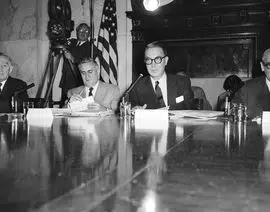
Senator Estes Kefauver of Tennessee, who had already become a national figure through his televised organized crime hearings a decade earlier, launched an investigation into boxing through the Senate Judiciary Committee’s Subcommittee on Antitrust and Monopoly. In four hearings between 1960 and 1964, witness after witness described the mafia’s stranglehold on the sport.
Carmen Basilio, a former welterweight and middleweight champion, testified that his managers had to pay off organized crime figures for his title shots. He revealed that he essentially had a behind-the-scenes manager in Gabriel Genovese, a cousin of mafia boss Vito Genovese. Basilio’s on-the-record managers paid Genovese and others more than $64,000 during the time Basilio fought for and defended his titles.
Jake LaMotta testified that he had thrown a fight against Billy Fox in 1947 at Madison Square Garden in exchange for a promised shot at the middleweight title. LaMotta named Palermo as one of the men who arranged the dive.
Carbo himself was subpoenaed. He invoked the Fifth Amendment 25 times.
In 1961, a federal prosecution brought by Attorney General Robert Kennedy resulted in a 25-year sentence for Carbo and 15 years for Palermo. The era of open syndicate control was effectively over.
But Congress did not pass legislation. There were calls to create a national governing body for boxing, but nothing happened. The hearings exposed the problem. They did not produce a solution.
The Vacuum: 1960s Through 1980s
The mob was gone, but the structural problems remained. By the late 1980s, four sanctioning bodies, the WBA, WBC, IBF, and WBO, were crowning champions with no coordination and no federal oversight. Promoters controlled access to title shots. Fighters under suspension in one state could cross the border and fight in another within weeks. State commissions varied wildly in quality, and the voluntary Association of Boxing Commissions had no enforcement power.
A Fighter Dies on National Television: 1982
On November 13, 1982, South Korean challenger Duk Koo Kim fought WBA lightweight champion Ray Mancini at Caesars Palace. The fight was broadcast live across the country. Kim had struggled to make weight. He had written on his hotel lampshade before the fight.
The bout was savage. In the 14th round, after absorbing sustained punishment, Kim collapsed. He was rushed to the hospital with a subdural hematoma and underwent emergency brain surgery. Five days later, he was pronounced dead. His mother flew from South Korea to Las Vegas. Three months later, she took her own life. The fight’s referee, Richard Green, killed himself in July 1983.
Kim’s death forced immediate changes within the sport. The WBC reduced championship fights from 15 rounds to 12. The WBA and IBF followed. Nevada imposed new medical protocols, including mandatory brain scans and a 45-day suspension after knockout losses. Pre-fight checkups, which had previously consisted of little more than blood pressure and heart rate, were expanded to include electrocardiograms and neurological screening.
But those reforms came from sanctioning bodies and state commissions, not from Congress. The House Commerce Committee held seven hearings on boxing between 1983 and 1996, receiving testimony on fraud and fighter safety. Legislation was reported to the full House three times during this period. None of it became law.
Fighters kept dying. The pattern that Kim’s death exposed, uneven medical standards, commission shopping, and no national database tracking suspensions or injuries, continued.
The Professional Boxing Safety Act: 1996
It took 14 more years, but Congress finally acted. The Professional Boxing Safety Act, sponsored by Senator John McCain and Senator Richard Bryan of Nevada, was signed into law on October 9, 1996.
The law established minimum health and safety standards for professional boxing. Matches could only be held in states with a boxing commission, or under the supervision of a commission from another state. Each boxer had to pass a physical examination. A physician had to be present at ringside. An ambulance or medical personnel with resuscitation equipment had to be on site. Every boxer was required to have health insurance covering injuries sustained in the bout.
The law also created a federal identification card system for boxers and required results and suspensions to be reported to boxer registries within 48 hours. The goal was to stop commission shopping, the practice where a fighter knocked out or suspended in one state would simply cross the border and fight somewhere else before his brain had healed.
The Act gave the Attorney General authority to bring civil actions against violators. But it created no federal enforcement staff. It established no federal commission. It relied on state commissions to implement the rules, with the Justice Department and FTC providing limited backup oversight.
As a Congressional Research Service report noted, the law was needed because boxing’s television revenue had made ticket sales less important, meaning promoters could hold fights anywhere, even in states with almost no regulatory infrastructure, and still make money from broadcast rights. States were competing in what amounted to a race to the bottom.
The Scandals That Built the Ali Act: 1997-1999
The 1996 law addressed safety inside the ring. It did nothing about the business practices outside it. Within two years, a series of scandals made the case for Congress to go further.
In June 1997, Mike Tyson bit Evander Holyfield’s ear in their heavyweight rematch. The incident became a global spectacle, but it was the Holyfield-Lennox Lewis fight in March 1999 that directly triggered legislative action. Lewis dominated the fight. The judges awarded a draw. The scoring was so obviously wrong that it prompted an immediate investigation by the New York State Athletic Commission and the Manhattan District Attorney. Congressional hearings followed.
Then, in November 1999, the FBI indicted IBF president Robert W. Lee Sr. and three other IBF officials on federal racketeering charges. Prosecutors alleged that Lee had taken $338,000 in bribes from promoters and managers to manipulate rankings over a 13-year period. Bob Arum testified that he had paid Lee $100,000 as part of a $200,000 bribe to approve a fight. Promoters Cedric Kushner and Dino Duva admitted to making similar payments. Prosecutors described Don King as an unindicted co-conspirator.
Lee was ultimately convicted of money laundering, tax evasion, and interstate travel in aid of racketeering. He was sentenced to 22 months.
Meanwhile, a 1999 Miami Herald investigation found more than 30 prizefights had been fixed or tainted with fraud in the prior 12 years. A Los Angeles Times investigation uncovered promoters routinely paying bribes to sanctioning bodies disguised as lavish gifts or cash payments to manipulate rankings and secure television contracts.
The evidence was overwhelming. The sport’s business practices were as broken as its safety standards had been before 1996.
The Muhammad Ali Boxing Reform Act: 2000
Senator McCain introduced the Muhammad Ali Boxing Reform Act in 1998. Muhammad Ali himself supported the bill. His wife, Lonnie Ali, testified on his behalf at a Senate hearing, describing Ali’s belief that the sport he had dedicated his life to had reached rock bottom.
The bill aimed to do what the 1996 law had not: regulate the business side of boxing. It passed the Senate. But in the House, its companion bill, introduced by Representative Mike Oxley, hit a wall. Senator Harry Reid of Nevada placed an anonymous hold on the Senate version. Reid denied responsibility but had received a $50,000 soft money donation from Don King Productions the previous year. Reid eventually agreed to support the bill after securing an amendment exempting casinos that merely hosted fights from being classified as promoters.
President Bill Clinton signed the Muhammad Ali Boxing Reform Act into law on May 26, 2000.
The law did three things that still define the structure of boxing today: it banned coercive long-term contracts, limiting promotional agreements to 12 months. It required financial transparency, forcing promoters to file all contracts with state commissions and disclose payments to fighters and sanctioning bodies. And it created a firewall between promoters and managers, prohibiting the same entity from representing a fighter’s interests while also organizing events for profit. The law also required sanctioning organizations to establish objective ranking criteria and disclose their bylaws publicly.
Pat English, the attorney who helped write both the 1996 and 2000 laws, described the three business protections as the core of what the Ali Act was designed to provide.
What the Ali Act Left Undone
The Ali Act was a landmark, but it was incomplete. It created no federal enforcement body, no national medical registry, and no new resources for the state commissions it relied on to implement the rules. A 2003 Government Accountability Office report found that many commissions were not consistently enforcing the law. The same structural problem that had plagued boxing since the Kefauver hearings remained: Congress was willing to set standards but not willing to build the apparatus to make sure they were followed.
And that is exactly where the next chapter begins. Starting in 2002, Senator McCain tried to solve this problem by creating a federal boxing commission. He tried four times. The House voted him down or ignored him every time. Representative Markwayne Mullin tried to extend the Ali Act’s protections to MMA fighters. The UFC killed it.
For the full story of what happened next, including the six bills that failed, the $34 million federal commission that was never built, and the legislation that finally reached the Senate in 2026, read our companion piece: A Brief History of Congress Trying and Failing to Fix Boxing.
Larry Goldberg is the founder of Boxing Insider Promotions and owner of BoxingInsider.com, established in 1998. He is a licensed boxing promoter in New Jersey and New York.