
No American city of its size has produced more world champions than Oxnard.
Sixty miles up the coast from Los Angeles, wedged between Ventura and Santa Barbara, sits an agricultural town of 200,000 people that has quietly become the most important fighter factory in modern American boxing. The locals call it “Boxnard.” The nickname is earned and officially embraced by the city.
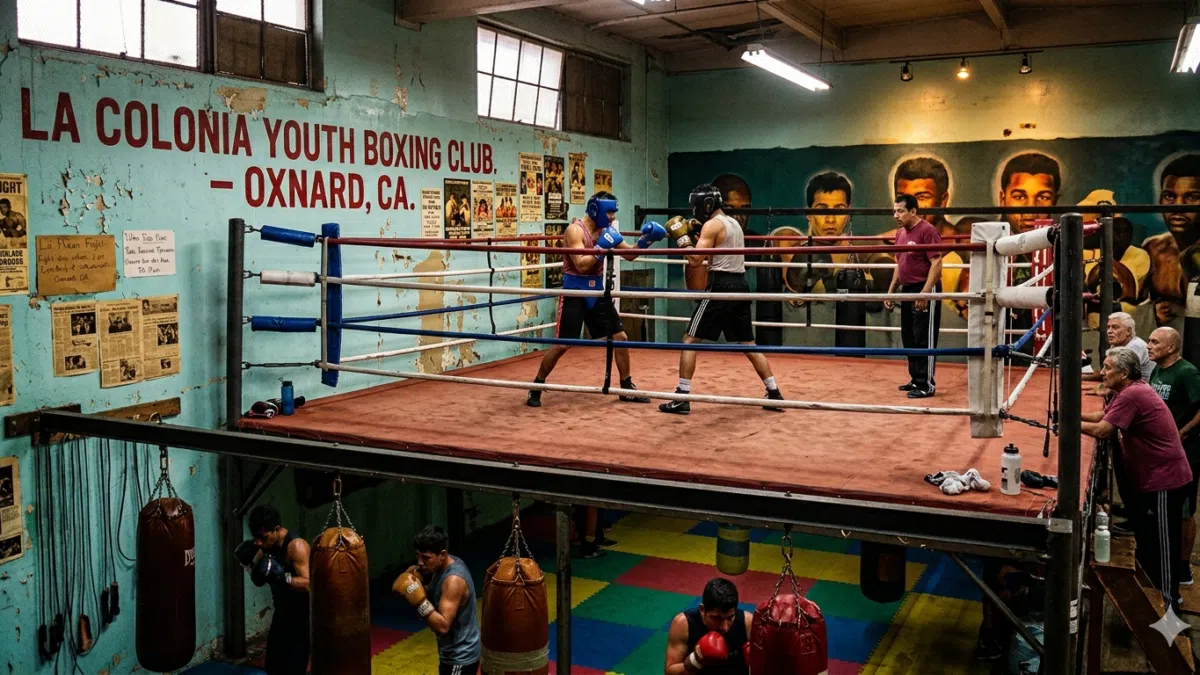
Fernando Vargas. Robert Garcia. Mikey Garcia. Victor Ortiz. Brandon Rios. Hugo Centeno Jr. Vasyl Lomachenko trained here. Vergil Ortiz Jr. built his career here. The list is deeper than the city’s population should allow. What Kronk Gymnasium was to Detroit in the 1980s, La Colonia Youth Boxing Club has been to Oxnard for nearly 50 years, and the lineage it produced changed the sport.
This is the complete guide to the best boxers from Oxnard.
La Colonia Youth Boxing Club: The Engine
You cannot understand Oxnard boxing without understanding La Colonia Youth Boxing Club.
Founded in 1977 by Bedford Pinkard, a former boxer and longtime recreation supervisor for the City of Oxnard, the gym was born out of a specific problem. Oxnard’s La Colonia neighborhood had one of the highest crime rates in Ventura County, plagued by gang violence and street fights. Pinkard watched local teenagers beating each other up in unstructured fights and decided to give them somewhere structured to channel it. The original gym operated out of a dilapidated two-room building on East First Street, a space that had previously been a market and then an abandoned fire station.
The gym’s philosophy from day one was not about winning fights. It was about discipline, self-respect, and keeping kids alive. Pinkard’s dual-trophy system rewarded effort as much as competition results. That culture, more than any single trainer or fighter, is what turned La Colonia into what it became.
Eduardo Garcia, an immigrant from Michoacán and former amateur boxer, became the gym’s defining trainer. His sons Robert and Mikey grew up there. His fighters grew up there. Every champion Oxnard has produced passed through that building. The gym is still operating today and is currently undergoing a full city-funded renovation that will rename it the La Colonia Boxing Gym, Dr. Manuel Lopez Youth Center. The project includes ADA compliance, life-safety upgrades, new gym flooring, a modern boxing ring, and interior remediation after years of deferred maintenance.
The gym’s cultural footprint extends well beyond the building itself. A civil rights mural in Colonia Park features Cesar Chavez, Robert F. Kennedy, and Martin Luther King Jr. alongside Robert Garcia. Local artists Judy Suzuki and Horacio Martinez are currently restoring the mural, which was first painted in 1999.
Fernando Vargas
No Oxnard fighter carried the city’s identity harder than Fernando “Ferocious” Vargas.
Born in 1977 and raised in Oxnard after his family moved from Mexico, Vargas compiled an amateur record of 100-5, won the triple crown of amateur boxing in 1993, and represented the United States at the 1996 Atlanta Olympics at just 18 years old. He turned professional immediately after and became the youngest junior middleweight world champion in history in December 1998, stopping Yori Boy Campas in seven rounds for the IBF title at age 21.
Vargas wore “La Colonia” on his trunks. He was Oxnard in every possible sense, a kid from a broken home who credited the gym with keeping him off the streets and giving him a path. Local outlet The Acorn described him as “Ventura County’s original badboy” and a “modern-day gladiator, a fighter whose foundation was his heart.”
His career peaked in a 12-round war against Felix Trinidad at Mandalay Bay on December 2, 2000. Vargas was knocked down twice in the first round, dropped Trinidad in the fourth (the fourth knockdown of Trinidad’s entire career), and kept coming until Trinidad finally stopped him in the 12th. Trinidad won the Ring Magazine Fighter of the Year award for that performance. Vargas walked away with the respect of everyone who watched it.
Vargas ended his career with a record of 26-5 (22 KOs). He lost twice more to Oscar De La Hoya and Shane Mosley in fights that defined the early-2000s welterweight and light middleweight divisions. His son, Fernando Vargas Jr., is now an active professional boxer trained by his father.
Robert Garcia
Robert Garcia’s career as a fighter was distinguished. His career as a trainer changed boxing.
Born in San Pedro in 1975 and raised in Oxnard from age 2, Garcia trained at La Colonia under his father Eduardo from age 5. He turned professional in 1992 and built a record of 34-3 with 25 knockouts, capturing the IBF super featherweight title in 1998. He retired in 2001 at age 26 and opened the Robert Garcia Boxing Academy in Oxnard in 2005.
What happened next was something the sport hadn’t quite seen before. Garcia trained his younger brother Mikey to world titles in four weight classes. He trained Brandon Rios to a world title. He trained Nonito Donaire, Antonio Margarito, Marcos Maidana, Jose Ramirez, Tony Ferguson, and more than 17 total world champions. The Ring Magazine named him Trainer of the Year in 2011 and 2024, and the Boxing Writers Association of America named him Trainer of the Year in 2012, 2024, and 2025.
Garcia relocated the academy from Oxnard to Riverside in 2010 and recently expanded to a new 6,500-square-foot facility at the Moreno Valley Mall in March 2025. His current stable includes Jesse “Bam” Rodriguez, Vergil Ortiz Jr., Jose Ramirez, and Raymond Muratalla.
His commitment to Oxnard never ended. Garcia brought his House of Champions boxing event back to Oxnard in 2023, staging ten-bout cards at the Oxnard Performing Arts Center to showcase local talent. His father Eduardo still corners fighters alongside him. The lineage from the La Colonia fire station to a Moreno Valley megaplex is unbroken.
Mikey Garcia
Robert Garcia’s younger brother Mikey became one of the most technically refined American fighters of his generation.
Born in Oxnard in 1987 and trained by his father and brother from childhood, Mikey Garcia won world titles in four weight classes: featherweight, junior lightweight, lightweight, and junior welterweight. He is also a graduate of Oxnard Community College and the Ventura County Police Reserve Academy, making him one of the most educated world champions of his era.
His finest hour came in January 2017 when he knocked out Dejan Zlaticanin in the third round to win the WBC lightweight title, dropping Zlaticanin with a right hand that became one of the most replayed knockouts of the decade.
Mikey’s jump to welterweight in 2019 to face Errol Spence Jr. ended in a one-sided decision loss, but the fight itself demonstrated the ambition Oxnard fighters are known for. He was the smaller man jumping two weight classes to challenge a pound-for-pound opponent in Spence’s home state of Texas. He lost every round. He also walked away with his career intact and his reputation as a technician untouched.
Mikey Garcia retired with a record of 40-2. His respect for Canelo Alvarez and his analytical takes on the sport have made him one of the most quoted fighters of his era, even years into retirement.
Victor Ortiz
Victor Ortiz wasn’t born in Oxnard. He was born in Garden City, Kansas, and arrived in Oxnard as a young man through the Robert Garcia Boxing Academy after his parents abandoned him. He became Oxnard in the way only the adopted sons of a place can.
Ortiz trained under Robert Garcia and won the WBC welterweight title in April 2011 with a majority decision over Andre Berto in one of the most exciting fights of that year. The fight was later named the Ring Magazine Fight of the Year. His subsequent September 2011 loss to Floyd Mayweather Jr. at the MGM Grand ended in controversial fashion when Mayweather knocked him out after a referee break, but the fight itself was one of the highest-grossing pay-per-view cards of Mayweather’s career.
Ortiz’s career cooled after the Mayweather fight, but his place in the Oxnard pipeline was permanent. He was the bridge between the Vargas-Garcia generation and the prospects Robert Garcia is training today.
Brandon Rios
Brandon “Bam Bam” Rios followed the same path as Victor Ortiz: born in the Midwest, delivered to Oxnard by Robert Garcia, transformed by the culture.
Rios was born in Lubbock, Texas, in 1986, moved with his family to Garden City, Kansas, as a toddler, and trained at the same Kansas boxing gym where Victor Ortiz started. He compiled an amateur record of 230-35, won the 2004 U.S. National Amateur Featherweight championship, and was a United States Olympic alternate. He met Robert Garcia at the Olympic trials in Mississippi. Garcia invited him to Oxnard. He was 18 and knew no one in Ventura County.
Local outlet Amigos805 documented his Oxnard arrival and transformation, noting how Rios struggled to commit to the move at first before finally settling in and dedicating himself to the sport.
Rios captured the WBA lightweight title in 2011 with a 10th-round TKO of Miguel Acosta. He became an action-fight staple in the early 2010s. His 2012 war with Mike Alvarado in Carson was named Fight of the Year by multiple outlets. The rematch in Las Vegas was nearly as good. His fight with Manny Pacquiao in Macau in 2013 drew a massive international audience, and though Pacquiao won clearly, Rios walked forward for 12 rounds and cemented himself as one of the most entertaining fighters of his era.
Rios retired with a record of 34-5-1. His Bam Bam Rios Boxing Academy still operates on South A Street in Oxnard, continuing the local tradition of champions opening gyms and training the next generation.
Hugo Centeno Jr.
Hugo Centeno Jr., born and raised in Oxnard, fought for the WBA middleweight title against Daniel Jacobs in 2018 and has been a world-ranked contender for most of the past decade. Centeno represents the second wave of Oxnard fighters who came up after Vargas and the Garcia brothers, fighters who grew up watching the generation ahead of them and walked into gyms that champions already owned.
His career record stands at 28-3. His connection to Oxnard is deep enough that the city’s tourism campaigns have featured him on the cover of the Oxnard Visitors Guide.
Vergil Ortiz Jr.
Though Vergil Ortiz Jr. was born in Texas, his career is an Oxnard story. Trained by Robert Garcia since his teenage years, Ortiz built a perfect knockout record through his first 21 fights and became one of the most avoided welterweights in the world.
He moved up to junior middleweight and captured the WBC interim title in 2024. BoxingScene profiled his continued work with Garcia in 2025, detailing how Ortiz still travels to train with the Oxnard-rooted team at their new Moreno Valley facility. He remains one of the most dangerous punchers in boxing and is considered a future pound-for-pound name.
Vasyl Lomachenko: The Adopted Son
Vasyl Lomachenko is Ukrainian. He grew up in Bilhorod-Dnistrovskyi and trained under his father Anatoly Lomachenko, who shaped his revolutionary footwork and movement. But for critical stretches of his professional career, Lomachenko trained in Oxnard.
The city attracted Lomachenko the same way it attracted fighters for generations: the gyms, the sparring, the Mexican-American fight culture that demands high-level work every day. When Lomachenko was preparing for the biggest fights of his career at lightweight and junior lightweight, he was doing it in Oxnard. The Lomachenkos rented a house there. They integrated into the local boxing community.
The fact that one of the greatest pound-for-pound fighters of the 2010s chose Oxnard as his American training home says more about the city’s boxing infrastructure than any ranking or list can.
Graciela Casillas: The Pioneer
Before the Garcia brothers, before Vargas, before La Colonia was widely known outside of Ventura County, Graciela Casillas was already fighting out of Oxnard.
Casillas became the International Women’s Boxing Association bantamweight champion in 1976 and the World Karate Association bantamweight champion in 1980. She grew up in Oxnard, graduated from Hueneme High School, and spent over 20 years as a professor and academic counselor at Oxnard College. She developed the martial arts curriculum that the college still teaches.
Casillas was fighting for titles in an era when women’s professional boxing barely existed as a recognized sport. Her work predates the Christy Martin and Laila Ali era of women’s boxing by nearly two decades. She is one of the most important figures in the history of women’s combat sports, and she came out of Oxnard before Oxnard was “Boxnard.”
Oxnard Today
Walk through Oxnard today and the boxing infrastructure is visible everywhere. Murals on Fourth Street between B and C. A “Boxnard” utility box wrap designed by local artist Andrea Mendoza on Sixth and A. The “Dinastia Garcia” mural by Huicho Le behind 333 West Fourth Street honoring the Garcia family. Boxing tourism campaigns run by the city. The renovated La Colonia Boxing Gym reopening with full ADA compliance and a new ring.
The active gym network remains deep. La Colonia Youth Boxing Club. Bam Bam Rios Boxing Academy on South A Street. Danny Garcia Boxing Club on Williams Drive. Real Deal Fitness and Boxing on Pacific Avenue. World Crown Sports on East Gonzales. CORE Athletics Academy on Cabot Place. Every one of these gyms is part of a pipeline that produces fighters who end up in world title fights.
Oxnard is part of the broader Southern California boxing ecosystem that includes Los Angeles, the Inland Empire, and San Diego. But Oxnard is its own place. The Mexican-American boxing tradition that runs through the city is older, deeper, and more specifically rooted than anywhere else on the West Coast. It starts with the families. It runs through the gyms. It produces champions.
Fernando Vargas said it best when he credited La Colonia with saving his life. The gym got him off the streets. It gave him discipline. It made him the man he became. Thousands of kids have said the same thing about the same building. And some small fraction of those kids ended up as world champions.
That is what Oxnard is. That is what “Boxnard” means.