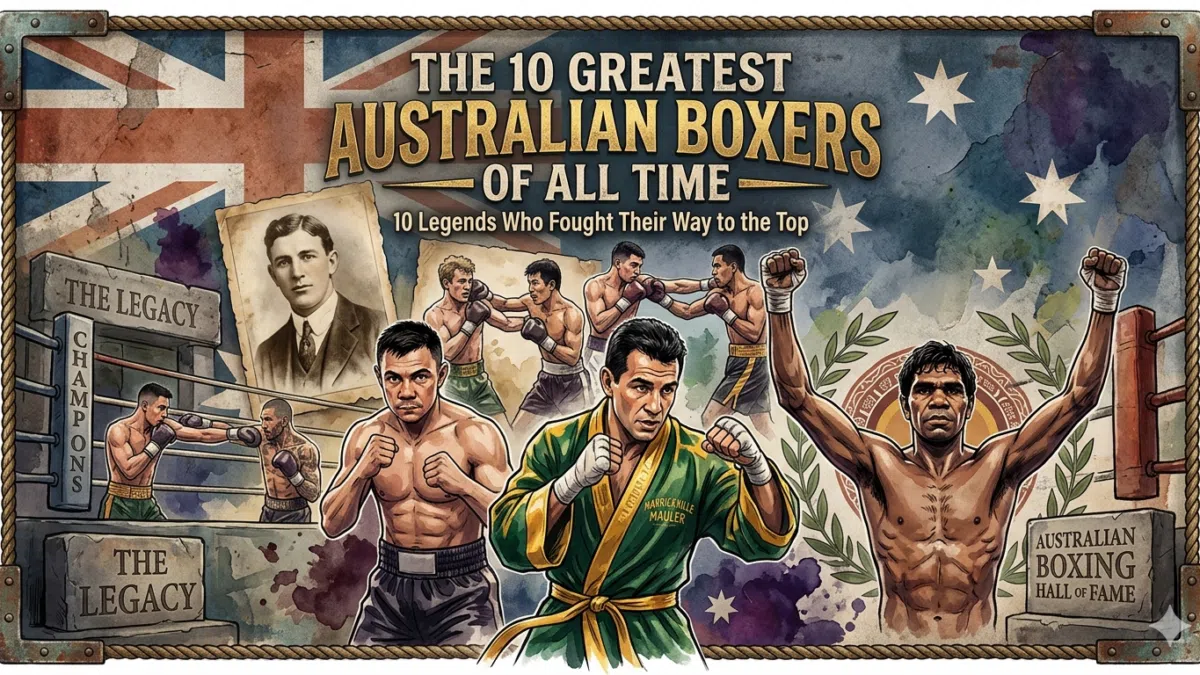
Australia has never been a traditional boxing powerhouse, but the fighters it has produced have been among the most exciting, courageous, and technically skilled in the sport’s history. From a teenager who died before he ever got his shot at a world title to a Russian-born destroyer who became a national hero, Australian boxing punches well above its weight. Here are the 10 greatest.
1. Jeff Fenech
The “Marrickville Mauler” is the consensus greatest Australian boxer of all time. Fenech won world titles in three weight classes: IBF bantamweight, WBC super bantamweight, and WBC featherweight. He was ferocious, relentless, and walked through punches to deliver his own. His trilogy with Azumah Nelson produced one of the most controversial decisions in boxing history when their first fight in Las Vegas was ruled a draw despite Fenech appearing to dominate. Even Mike Tyson, who fought in the main event that night, said Fenech was robbed. Fenech finished his career 29-3-1 with 21 knockouts. He was inducted into the International Boxing Hall of Fame in 2002.
2. Kostya Tszyu
Born in Russia, built in Australia. Tszyu moved to Sydney after a decorated amateur career that included a gold medal at the 1991 World Championships. As a professional, he became the first undisputed light welterweight champion in over 30 years when he knocked out Zab Judah in two devastating rounds in 2001. That knockout remains one of the most replayed finishes in boxing history. Tszyu held his titles for eight years and was known for his precision, timing, and frightening power. His only losses came to Vince Phillips and Ricky Hatton, the latter in what would be his final fight. He was inducted into the International Boxing Hall of Fame in 2011. His son Tim would later follow him into the championship ranks.
3. Lionel Rose
Rose’s story transcends boxing. In 1968, at 20 years old, he traveled to Tokyo and beat Fighting Harada by unanimous decision to win the world bantamweight title. He became the first Indigenous Australian to win a world championship in any sport. When he returned to Melbourne, crowds lined the streets to welcome him home. He was named Australian of the Year, only the second athlete ever to receive the honor at that time. Rose’s victory in Tokyo was a cultural milestone for Indigenous Australians and remains one of the most significant moments in the country’s sporting history. He passed away in 2011.
4. Les Darcy
“The Maitland Wonder” is the great tragedy of Australian boxing. Darcy became the Australian middleweight champion as a teenager and quickly established himself as one of the best fighters in the world, defeating a string of top American and international opponents who traveled to Australia to face him. He also won the Australian heavyweight title by knocking out Harold Hardwick in 1916. But Darcy never got to fight for a world title. He traveled to America in 1917 seeking bigger fights, contracted septicemia, and died at the age of 21. What he accomplished before his death at that age remains one of the most remarkable careers in boxing history. We will never know how great he could have been.
5. Johnny Famechon
French-born and Australian-raised, Famechon turned professional at 16 and built a career that would see him win the WBC featherweight championship in 1969. He defeated Fighting Harada, the same Japanese legend Lionel Rose had beaten the year before, making back-to-back Australian victories over one of Japan’s greatest fighters a defining chapter in both countries’ boxing histories. Famechon compiled a record of 56 wins and just 5 losses before retiring in 1970 after a narrow points loss to Vicente Saldivar. He passed away in 2022 at the age of 77.
6. Jeff Harding
“Australia’s Rocky” earned his nickname the hard way. Harding won the WBC light heavyweight title in 1989 by stopping Dennis Andries in the 12th round, becoming the first Australian to win a world title on American soil. He lost the rematch to Andries in 1990, then won the rubber match in 1991 to reclaim the belt. That trilogy defined his career. Harding was not the most technically gifted fighter, but his toughness and determination made him one of the most respected light heavyweights of his era. He eventually lost the title to Mike McCallum and retired shortly after.
7. George Kambosos Jr.
In November 2021, Kambosos walked into Madison Square Garden as a massive underdog against undefeated unified lightweight champion Teofimo Lopez and walked out as the new champion. The split decision victory was one of the biggest upsets in recent boxing history and put Australian boxing back on the global map. Kambosos dropped Lopez in the first round and survived a knockdown of his own in the tenth to earn the win. The Sydney native’s willingness to travel anywhere and fight anyone made him a throwback to the Australian fighters of earlier generations who never waited for the big fights to come to them.
8. Anthony Mundine
No Australian boxer has ever been more polarizing. Mundine was a professional rugby league player before switching to boxing with virtually no amateur experience. He challenged for the IBF super middleweight title after just 10 professional fights, losing to undefeated Sven Ottke in Germany. He went on to win world titles at super middleweight and cruiserweight and compiled a record of 48-10. His mouth made him famous. His talent made him legitimate. His willingness to fight anyone, anywhere, at any weight made him one of the most active and dangerous fighters Australia has produced, regardless of what you think of him outside the ring.
9. Tim Tszyu
The son of Kostya, Tim has built his own legacy in the super welterweight division. He won the WBO super welterweight title and has established himself as one of the top fighters in the 154-pound division. Fighting out of Sydney like his father, the younger Tszyu carries the pressure of one of boxing’s most famous last names and has handled it with professionalism and skill. He is the current face of Australian boxing and the standard-bearer for the next generation.
10. Vic Darchinyan
Armenian-born and Australian-based, Darchinyan was one of the most feared punchers in the lower weight classes during the 2000s. He won the IBF flyweight title in 2004 and defended it six times before losing to Nonito Donaire. He then moved up and won the unified WBA, WBC, IBF, and lineal super flyweight titles. Darchinyan’s power was absurd for a fighter competing below 115 pounds. His wild style and devastating left hand made him appointment viewing, and his willingness to fight the best, including multiple bouts against fellow champions, cemented his reputation as one of Australia’s most exciting fighters.
Honorable Mentions
Jeff Horn shocked the world by upsetting Manny Pacquiao in Brisbane in 2017. Danny Green won the WBA light heavyweight title and knocked out Roy Jones Jr. in one round. Daniel Geale traveled to Germany and won the IBF middleweight title as a massive underdog. Tony Mundine, Anthony’s father, won Commonwealth titles at middleweight and light heavyweight and challenged the great Carlos Monzon for the world title. And Skye Nicolson is currently building a case as one of the best female featherweights in the world.
Australian boxing has always been defined by fighters who were willing to get on a plane, fight in someone else’s backyard, and prove they belonged. From Les Darcy’s doomed trip to America in 1917 to George Kambosos walking into Madison Square Garden a century later, the tradition has never changed. Australians fight.