
Bare knuckle boxing spent more than a century outside the law in the United States. The last major sanctioned bare knuckle prizefight of the old era came in 1889, when John L. Sullivan beat Jake Kilrain over 75 rounds under the London Prize Ring Rules. From that point forward, gloved boxing under the Marquess of Queensberry rules became the legal standard, and fighting without gloves was pushed into the underground. That changed in 2018, when Wyoming became the first state to permit a regulated bare knuckle event and Bare Knuckle Fighting Championship staged the first legal, state sanctioned bare knuckle card in the country since the Sullivan era. Eight years later, the sport is licensed by athletic commissions across most of the country, airs on mainstream broadcast platforms, and is signing former boxing world champions at a steady clip.
How the Modern Sport Works
Modern bare knuckle boxing is punching only. No kicks, no elbows, no grappling. The Association of Boxing Commissions and Combative Sports, the umbrella body for state and tribal commissions in North America, has adopted unified bare knuckle rules so that commissions regulate the sport consistently. Under the ABC unified bare knuckle rules, bouts run a maximum of six rounds and eighteen total minutes of competition, with one minute rest between rounds. Fighters may wrap the wrist for support, but the knuckles themselves must remain uncovered.
BKFC, the largest promotion in the sport, typically stages five two-minute rounds inside a circular four-rope ring. Each round opens with both fighters required to “toe the line” at scratch lines in the center of the ring, a nod to the Broughton Rules that governed the sport in the 19th century. Rounds are short and the pace is high, and because the bare fist opens skin in a way a padded glove does not, cuts and doctor stoppages are a routine part of the sport.
Who Runs It
BKFC, founded in Philadelphia in 2018 by former professional boxer David Feldman, is the sport’s dominant promotion. It restricts its roster to established professionals from boxing, MMA, kickboxing and Muay Thai, broadcasts on DAZN, and counts Conor McGregor among its owners after he acquired a stake in 2024. BKB Bare Knuckle Boxing, which grew out of the Miami based BYB Extreme organization, stages its fights inside a patented triangular “Trigon” ring and airs in the United States on VICE TV and talkSPORT, with Spanish language coverage on Telemundo platforms. The United Kingdom has its own established bare knuckle circuit as well, one BoxingInsider examined back in 2019 in a look at the UK’s BKB promotion as it pushed for legal sport status.
The Regulatory Map
Wyoming opened the door in 2018, and early adopters included Mississippi, Florida, Kansas, Missouri and Alabama. Tribal commissions, which hold their own licensing authority, provided another pathway. Today more than 30 states have hosted sanctioned bare knuckle events, and the two most recent additions are significant ones.
New Jersey sanctioned its first bare knuckle event in October 2025, when BKFC 82 drew a crowd to Prudential Center in Newark. The promotion is coming back. BKFC announced this month that BKFC 95 will return to Prudential Center on October 17. “We’re thrilled to return to Prudential Center, one of the premier sports and entertainment venues in the world with another tremendous event,” Feldman said in the announcement. “Our first show at Prudential Center last October was one our company’s most exciting and successful and we can’t wait to see all of our New Jersey supporters on October 17.”
The venue confirmed the appetite is there. “We’re excited to welcome BKFC back to Prudential Center after making history last year with New Jersey’s first sanctioned bare-knuckle event,” said Dylan Wanagiel, Vice President of Sports Properties and Special Events for HBSE and Prudential Center. “The enthusiastic response from our patrons further demonstrated the appetite for combat sports in New Jersey.”
California has become an active market as well. On July 18, BKB staged a sold out card at The Novo at L.A. Live in Los Angeles, a show that put three former boxing world champions in the Trigon on the same night.
The Boxers Crossing Over
Paulie Malignaggi was the first name boxer to make the jump. The former two-division titleholder signed with BKFC in 2019, two years into retirement. “I didn’t have a lot of desire to come back and box, so something had to tickle my fancy. This did,” Malignaggi told ESPN at the time. He lost a unanimous decision to Artem Lobov in his debut that June, but the signing established the template: a recognizable boxing name, a payday, and a second act.
Austin Trout made the model work. The former WBA junior middleweight champion, who fought Canelo Alvarez, Erislandy Lara and both Charlo brothers in the gloved sport, debuted for BKFC in February 2023 and won the promotion’s welterweight title in his second bare knuckle outing. He held it until this month, when Ben Bonner of the UK stopped him at BKFC’s Liberty Brawl card in Philadelphia. The roster of former boxers who have taken bare knuckle fights now includes James DeGale, who won his BKFC debut on points against Matt Floyd in Manchester last September, along with Jamel Herring, Lee Selby, Yuriorkis Gamboa, Hank Lundy, Lucas Browne and John Molina Jr. The crossover traffic runs from MMA too, as it did when Paige VanZant made her bare knuckle debut after leaving the UFC.
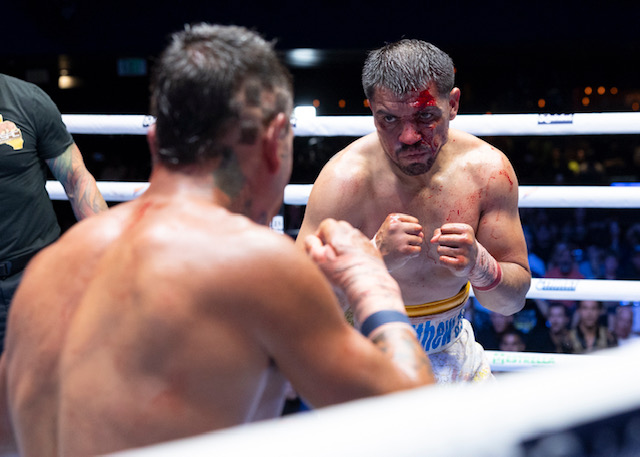
The Los Angeles card in July marked the biggest single night of boxing names yet. Victor Ortiz, the former WBC welterweight champion who discussed his career on Boxing Insider Radio in 2020, headlined BKB 56 and went the full five rounds with Dominic Salcido, sweeping the scorecards but absorbing heavy facial damage along the way. “Glory be to God, he gave me the victory. It was a hard one but I enjoyed it,” Ortiz said afterward, per the post-event report. On the same card, former IBF junior lightweight titleholder JoJo Diaz knocked out Nate Williams with a first round body shot, and former interim junior middleweight titleholder Alfredo Angulo stopped Rashad Bowens in two.
Ortiz went in with his eyes open. “Bare knuckle boxing is dangerous,” he said in a special report on the sport’s rise published this month. “I know it’s gonna be a war, and there are going to be fireworks. We’re gonna be two bloody individuals, but I will hold my hands up high in victory.”
Feldman believes the pipeline of boxers is only beginning. “Anthony Joshua did an interview and said, ‘My favorite sport is boxing, and my second favorite is bare-knuckle fighting.’ He said it. To the public,” Feldman told Uncrowned. “There’s guys like that out there, and I don’t think it’s far-fetched to see some of the best boxers take the gloves off and fight for BKFC.”
What the Injury Data Shows
The sport’s visual toll is undeniable. Cuts are frequent, deep and bloody, and Ortiz left his debut with the kind of facial damage that circulated widely on social media. The peer reviewed data, however, tells a more complicated story than the optics suggest. A study published in The Physician and Sportsmedicine, which reviewed 141 state sanctioned bare knuckle bouts from 2018 through 2020, found that lacerations and hand fractures were the most common injuries while concussions were relatively uncommon compared to other injuries. Ringside physicians who presented related data to the Association of Ringside Physicians reported concussion rates below those recorded in gloved boxing and MMA, a finding often attributed to fighters throwing fewer full-power head shots to protect their unprotected hands.
The record is not spotless. Justin Thornton, a 38-year-old heavyweight, died in October 2021 from injuries sustained in a 19-second knockout loss at BKFC 20 in Biloxi, Mississippi, the first death of the sport’s regulated era. In response, the ABC’s medical advisory committee urged commissions to proceed with caution, citing the limited data on the sport’s medical risks. Commissions that sanction bare knuckle events now generally require ringside physicians, pre-fight medical screening and post-fight suspensions consistent with the ABC unified rules.
Whatever any individual fan or promoter thinks of the product, the regulatory question has largely been answered. State athletic commissions from New Jersey to California have decided bare knuckle boxing belongs in the same licensed, supervised ecosystem as the gloved sport, and the fighters, including a growing list of former world champions, keep signing up.