There was a moment, sometime before the pandemic shut the world down, when the mere mention of Jake Paul’s name on an episode of Boxing Insider Radio was enough to trigger genuine outrage. The co-hosts weren’t just skeptical — they were offended. The idea that a YouTuber would dare lace up gloves and call himself a boxer was treated as an insult to the sport’s history, its fighters, and its fans. The reaction was understandable. Boxing has always been a proud, sometimes insular world, and Paul was the loudest uninvited guest it had ever seen.
That was a different era. Not just in years, but in boxing’s entire economic and cultural landscape. Today, Jake Paul and Nakisa Bidarian’s Most Valuable Promotions sits at the center of a media empire that spans Netflix, DAZN, Sky Sports, and — as of March 6, 2026 — ESPN, where MVP’s newly launched MVPW women’s boxing platform will serve as the network’s return to the sport through at least 2028. MVP now occupies the very programming real estate that Bob Arum’s Top Rank held for eight years before that partnership dissolved in July 2025.
It bears repeating. Jake Paul. On ESPN. The old Top Rank spot. The same network that once broadcast Manny Pacquiao, Vasiliy Lomachenko, and Terence Crawford has handed its boxing real estate to the kid who started by knocking out Nate Robinson on a Triller card.
If that doesn’t qualify as one of the most improbable arcs in modern sports business, nothing does.
The Business Case No One Saw Coming
The timing makes perfect sense, even if the optics still make some purists uncomfortable. When the UFC officially moved to Paramount+ on January 1, 2026, under a seven-year, $7.7 billion agreement, ESPN was left with a massive void in its combat sports programming. Key executives, including Matt Kenny and Glenn Jacobs, followed the UFC to Paramount. ESPN had already let its Top Rank deal expire after eight years and 54 annual events. The network that once anchored itself in boxing and MMA suddenly had neither.
Paul saw it clearly. In late February, he posted on X in the wake of the Mayweather-Pacquiao 2 Netflix announcement, writing that he hoped ESPN would get back into boxing soon. The tone was not combative. It was almost diplomatic — a promoter positioning himself as the solution to a problem the industry’s biggest sports network was actively trying to solve.
The new power dynamic in boxing’s broadcast wars is fascinating. Zuffa Boxing operates on Paramount+, backed by the TKO Group Holdings infrastructure and a closed-league model that mirrors what was built in MMA. Paul and MVP occupy the opposite lane — open matchmaking, platform flexibility, spectacle-driven promotion married to legitimate championship boxing. With MVP now on ESPN, the rivalry is structural: Zuffa vs. MVP. Paramount+ vs. ESPN. Two fundamentally different visions for how boxing should operate in the streaming age, competing for the same audience on different networks.
The Night Everything Changed
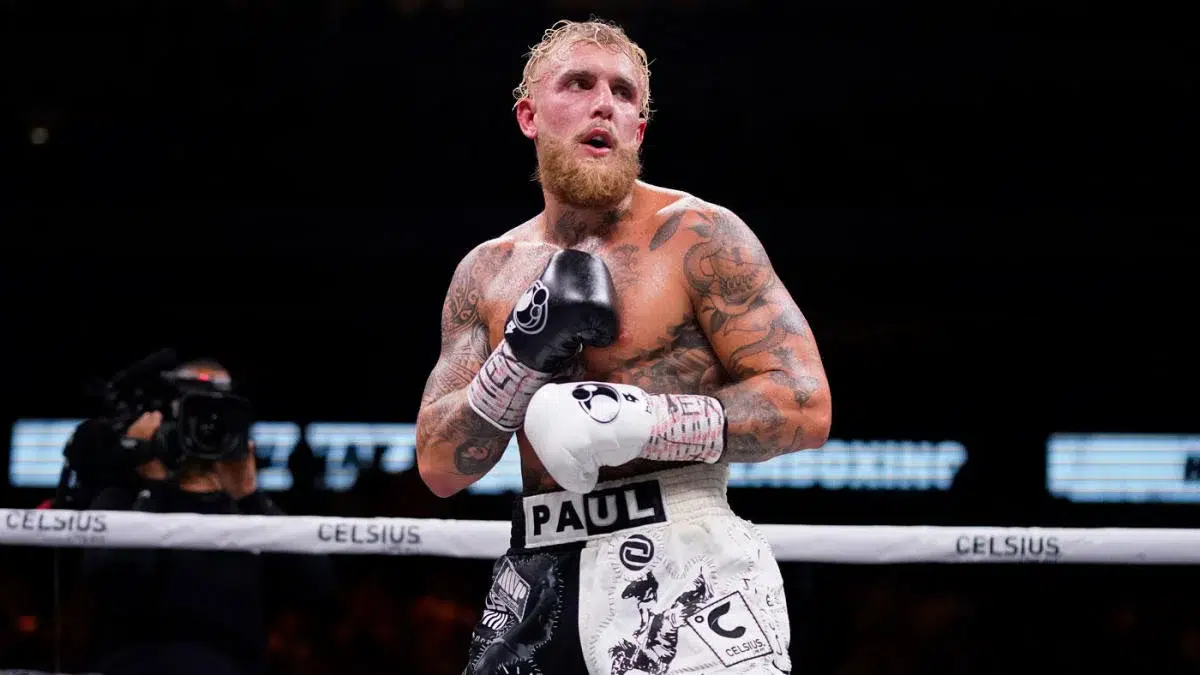
None of this means the article of faith should go unchallenged. On December 19, 2025, at the Kaseya Center in Miami, Anthony Joshua knocked Jake Paul out in the sixth round. Paul suffered a double broken jaw, had titanium plates installed in his mouth, and lost teeth. He was dropped four times. The size difference alone — Joshua outweighed Paul by nearly 30 pounds and towered five inches above him — made the fight a physical mismatch from the opening bell.
And yet, that night may have done more for Paul’s credibility than any of his twelve wins combined.
Paul survived three rounds of a former two-time unified heavyweight champion hunting him. He moved, he jabbed, he made Joshua miss repeatedly in the early rounds. He got up every time he went down. When Joshua finally ended it with a devastating right hand that sent Paul crumbling in the corner, the Brit’s post-fight comments were telling. Joshua praised Paul’s heart, said he kept getting up, and acknowledged the courage it took to step into the ring against a fighter of his caliber.
Paul’s post-fight X post, written from a hospital bed with a shattered jaw, read: “Jaw broken. Heart and balls intact. Time to rest, recover and return to cruiserweight.” Then, because he’s Jake Paul, he added: “Give me Canelo in 10 days.”
After that night, the argument that Jake Paul doesn’t belong in boxing effectively ended. Critics can still question his skill level, his opponent selection, his weight-class tourism. But no one can credibly question whether he’s willing to put himself in real danger for this sport. He did, and he paid for it.
The Promoter Who Outpaced the Establishment
The fighter story is compelling. The promoter story is extraordinary.
When Paul and Bidarian launched MVP in August 2021, their first signing was Amanda Serrano. That decision alone looks prophetic now. In 2022, MVP co-promoted Serrano vs. Katie Taylor at Madison Square Garden — the first women’s boxing match to ever headline the Garden. Sports Illustrated named it Fight of the Year. The Ring Magazine named it Event of the Year. It wasn’t a novelty act. It was historic.
In November 2024, Paul vs. Mike Tyson at AT&T Stadium drew 65 million simultaneous viewers on Netflix — the most-streamed sporting event in history at the time, later peaking at 125 million viewers in the live-plus-one count. The event generated the largest boxing gate in U.S. history outside Las Vegas. Critics called the fight a circus. Netflix saw it as proof of concept for live sports streaming. Both things were true. Both things mattered.
Since then, the expansion has been relentless. Serrano signed a lifetime deal with MVP, with a future role as chairwoman of the company’s women’s boxing initiatives. MVP signed Alycia Baumgardner, Ellie Scotney, Chantelle Cameron, and Savannah Marshall — assembling what is arguably the deepest women’s boxing roster in the sport. By early 2026, MVP had four of ESPN’s top ten pound-for-pound women’s fighters under contract. The promotion now boasts nearly 60 fighters, 16 world champions, and 26 top contenders.
In February 2026, MVP formally announced its partnership with Sky Sports in the UK, filling the gap left by Ben Shalom’s BOXXER, which had moved to the BBC after Sky declined to renew their four-year deal. MVP’s first UK card — now designated MVPW-01 under the new women’s platform — is set for April 5 at London’s Olympia, airing on Sky Sports in the UK and streaming on the ESPN App in the United States. It features Caroline Dubois vs. Terri Harper for unified lightweight titles, and Scotney vs. Mayelli Flores for undisputed super bantamweight honors.
Then came the Rousey-Carano announcement for May 16 on Netflix — MVP’s first MMA event, a crossover spectacle that signals Paul and Bidarian are thinking well beyond boxing.
Netflix. DAZN. Sky Sports. ESPN. No other promotional company in boxing history has assembled a broadcast portfolio like that in under five years.
The Partnership That Made It Work
Any honest assessment of MVP’s rise has to account for Nakisa Bidarian. The former UFC CFO brought institutional knowledge, financial discipline, and credibility in the executive suites where broadcast deals get done. Paul brought the audience, the marketing instincts, and the willingness to be the product. Together, they built something that neither could have built alone.
Bidarian’s fingerprints are on every structural decision MVP has made — from the Netflix partnership model that bypasses traditional pay-per-view to the Sky Sports deal that gave MVP an international broadcast footprint without surrendering domestic rights. The Most Valuable Prospects series on DAZN created a development pipeline for young fighters. The women’s boxing investment wasn’t performative; it was strategic, built around title fights and meaningful matchups rather than one-off curiosities.
Paul, for his part, evolved. The early opponents — Robinson, Ben Askren, the retired MMA fighters — were fair targets for criticism. But the trajectory was unmistakable. Anderson Silva. Tommy Fury. Julio César Chávez Jr. Then Gervonta Davis was scheduled before domestic abuse allegations forced the cancellation. Then Anthony Joshua, a former two-time unified heavyweight champion who hits like a freight train. Win or lose, the degree of difficulty kept climbing.
Boxing’s Uncomfortable Truth
This is the part that makes the sport’s traditionalists squirm, and it deserves to be stated plainly: boxing needed Jake Paul more than Jake Paul needed boxing.
When Paul entered the sport, HBO had already left. Showtime would follow in 2023. ESPN would eventually let Top Rank walk. The pay-per-view model was eroding. Young audiences were shrinking. The sport’s biggest fights were increasingly concentrated in the Middle East, funded by sovereign wealth rather than domestic commercial interest.
Paul didn’t just bring eyeballs. He brought a business model. He proved that boxing could thrive on streaming platforms. He proved that a promotional company could hold deals with multiple networks simultaneously. He proved that women’s boxing, properly invested in and properly promoted, could draw massive audiences. He proved that the sport didn’t need to wait for two promoters to spend three years negotiating before a big fight could happen.
Did he also bring spectacle, controversy, and fights that sometimes pushed the boundaries of competitive legitimacy? Absolutely. That’s part of the package. The sport has survived worse. What it might not have survived is irrelevance — and Paul, regardless of what his detractors say, made sure that didn’t happen.
What Comes Next
On March 6, 2026, Paul and Bidarian stood at a podium inside Madison Square Garden and made it official. MVP launched MVPW — a dedicated women’s boxing platform — and announced a multi-year deal with ESPN as its U.S. broadcast home through 2028. The deal includes linear ESPN distribution, not just streaming, and a strategic partnership with MSG Entertainment for annual events at the Garden. Three cards were immediately announced: MVPW-01 on April 5 in London (Dubois vs. Harper, Scotney vs. Flores for undisputed), MVPW-02 on April 17 at MSG (Baumgardner vs. Shin), and MVPW-03 on May 30 in El Paso (Han vs. Holm rematch). Forty-three women are on the roster.
It is the final piece of a media puzzle no one thought a 29-year-old former Disney Channel actor could assemble. Netflix for the mega-events. DAZN for prospect development. Sky Sports for UK penetration. ESPN for American combat sports programming on linear and streaming platforms. It is a distribution model that Bob Arum and Top Rank spent decades building with one network. Paul and Bidarian have it across four, in a fraction of the time.
The irony is almost too clean. For years, the established powers in boxing dismissed Paul as a gimmick, a fad, a threat to the sport’s credibility. Now, as ESPN fills its combat sports void and boxing’s broadcast landscape continues to fragment, the outsider who once enraged the hosts of Boxing Insider Radio by simply existing in their sport is the one giving the sweet science its biggest stage yet.
So yes — the sport owes Jake Paul a thank you. Not for every fight. Not for every headline. But for betting on boxing when the smart money was running the other direction, for building something real alongside Bidarian when nobody believed it would last, and for being willing to get his jaw broken in front of millions to prove he meant it.
Boxing owes him more than most in the industry are willing to admit. That’s starting to change.