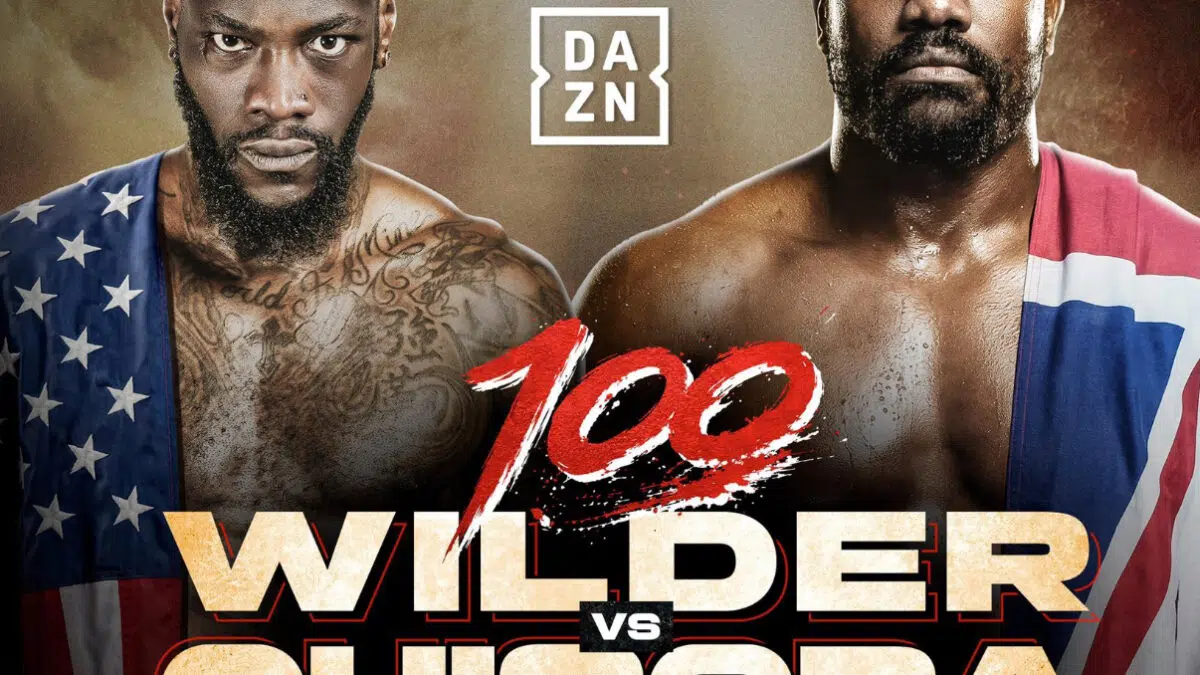
When Derek Chisora and Deontay Wilder touch gloves on Saturday night at London’s O2 Arena, each man will be stepping through the ropes for the 50th time as a professional. It is a fitting milestone for two fighters who have given more to the heavyweight division than the division has sometimes given back. The card, aptly billed as “100,” streams live and exclusively on DAZN pay-per-view worldwide, and it arrives at a moment when both men need the outcome more than they would likely admit.
For Chisora, 42, this is supposed to be the farewell. He has said as much repeatedly, though the sport has heard retirement announcements from “Del Boy” before. For Wilder, 40, it is an audition, a chance to prove the right hand that once terrorized an entire weight class still carries the voltage to matter at the highest level. A win could position the former WBC champion for a summer showdown with unified heavyweight titleholder Oleksandr Usyk. A loss almost certainly sends him into permanent retirement, whether he acknowledges it or not.
The Case for Chisora
Chisora (36-13, 23 KOs) enters on a three-fight winning streak that has quietly rebuilt his standing in the division. His unanimous decision over Otto Wallin in February 2025, in which he scored knockdowns in the ninth and twelfth rounds, was the kind of stubborn, grinding performance that has defined his best nights. Before that, he stopped Gerald Washington and outworked a faded Joe Joyce, stringing together enough wins to reclaim space in the heavyweight rankings.
There is a temptation to dismiss that run given the quality of opposition. Washington was a career gatekeeper. Joyce was coming off consecutive stoppage losses to Zhilei Zhang and looked nothing like the fighter who once gave the division’s elite fits. Wallin, while respected, had been stopped by Anthony Joshua in his previous outing. The context matters. But what also matters is that Chisora, at 42, is still competitive against credentialed heavyweights, and he brings something intangible that the record alone does not capture: the absolute refusal to take a backward step.
His style presents a specific problem for a fighter like Wilder. Chisora’s engine is relentless. He comes forward behind a high guard, throws heavy hooks to the body, and makes opponents work every second of every round. His chin, tested by Vitali Klitschko, Usyk, Tyson Fury (three times), and Dillian Whyte (twice), remains one of the most durable in heavyweight history. If any fighter alive can walk through Wilder’s right hand and keep pressing, it is Chisora.
Ahead of the February press conference at Glaziers Hall in London, Chisora struck an unusually reflective tone. He told reporters he wanted to sell the fight differently than the table-flipping spectacles of his past.
He also framed the fight in the simplest terms possible. When asked by DAZN what motivated him to pick Wilder for his final fight, his answer was one word: legacy. He told the outlet that some fighters chase titles without fighting real opponents, and that for him, the goal was always to be the man who fought everybody in his era.
The Case for Wilder
Wilder (44-4-1, 43 KOs) arrives in London carrying both the most devastating weapon in the heavyweight division and the most troubling recent trajectory. His record over his last nine fights reads 4-4-1, a stretch that includes three knockout losses, two of them at the hands of Fury and the most recent a fifth-round stoppage by Zhang in June 2024. Against Joseph Parker in December 2023, Wilder threw only 204 punches across 12 rounds, connecting on a meager 39. That is a staggering lack of output from a fighter who was once the most feared puncher on the planet.
His most recent outing, a seventh-round TKO of Tyrrell Herndon in June 2025, snapped a two-fight losing skid but raised as many questions as it answered. Herndon, a solid enough club-level heavyweight, was not the kind of opponent who reveals whether the old magic remains. The stoppage was competent, not emphatic. It was enough to get Wilder back in the win column and nothing more.
The training camp changes are significant. Wilder has replaced Malik Scott, his head trainer since the third Fury fight, with Don House, a veteran cornerman with experience across boxing and MMA. The split was amicable, and Wilder was emphatic about crediting Scott’s role in his mental recovery. As he told BoxingScene, even having the legendary Emanuel Steward in his corner would not have changed the results, because mentally he was no longer present during those losses.
At the press conference, Wilder was candid about the stakes. He told ESPN that this was not just a must-win but that he needed a devastating victory, a knockout, because that is what fans come to see from him. He also acknowledged that he needs Chisora more than Chisora needs him, because the fight would reveal where he truly stands.
The physical advantages remain considerable. Wilder stands 6-foot-7 with an 83-inch reach, giving him roughly five inches in height and nine inches in wingspan over Chisora. If the right hand still travels with the same authority that produced 43 knockouts across 48 wins, Chisora’s chin may not be enough. Wilder has proven throughout his career that one clean shot can erase every round on every scorecard. Against a fighter who plods forward and invites counters, that threat is magnified.
The Central Question
The dynamic is straightforward: pressure against power, volume against precision, durability against the single shot that changes everything. Former heavyweight contender Malik Scott, who fought both men during his career, framed the matchup in binary terms. He said the fight was really black and white: if the equalizer still exists, Wilder knocks Chisora out, and if it does not, then Chisora could make it a very long night for his former champion.
Queensberry Promotions chairman Frank Warren echoed that sentiment, telling reporters at the press conference that both men are walk-forward fighters, and as soon as the bell sounds, a war is inevitable.
The betting market has settled on Chisora as a clear favorite, in the range of -230 to -250 depending on the book, with Wilder sitting as a +170 to +180 underdog. That pricing reflects less confidence in Chisora’s boxing ability than skepticism about what Wilder has left. At 40, with diminished punch resistance and increasingly tentative output, the burden of proof falls entirely on the Bronze Bomber to demonstrate that the layoff, the new trainer, and the change of scenery have produced a tangible reset.
Chisora, for his part, acknowledged that their friendship would be suspended for the duration of the fight. He told the crowd at Glaziers Hall that when Wilder arrives in April for that first press conference, the friendship goes out the window, and only after four, five, or six rounds, when they hug and shake hands, would they go back to being brothers.
It is the kind of heavyweight fight that does not need a title belt to matter. Both men have everything on the line. Chisora wants a storybook ending in front of a sold-out London crowd. Wilder wants to prove the doubters wrong one last time and earn his way back to a title shot. Only one of them will walk away with what they came for.
Undercard Preview
The supporting card features two bouts with genuine divisional significance, along with a slate of prospects and developing fighters filling out a deep card on DAZN.
The co-feature is an intriguing cruiserweight contest between British champion Viddal Riley (13-0, 7 KOs) and Poland’s Mateusz Masternak (50-6, 33 KOs) for the EBU European cruiserweight title. The bout was elevated in significance on March 11, when it was confirmed as an IBF world title eliminator following the stripping of Jai Opetaia. Riley, 28, is unbeaten and riding the momentum of a unanimous decision over Cheavon Clarke in April 2025 that earned him the British strap. Masternak is a grizzled 38-year-old veteran with more than 50 professional fights to his name. This is a classic step-up fight, and it could position the winner for a crack at the vacant IBF cruiserweight title later this year.
The other notable title fight on the card pits Denzel Bentley (21-3-1, 17 KOs) against Venezuela’s Endry Saavedra (17-1-1) for the vacant WBO interim middleweight championship. Bentley, a three-time British middleweight titleholder and current European champion, is the WBO’s number one contender for unified champion Janibek Alimkhanuly. A win over Saavedra would strengthen his case for a rematch with the Kazakh, who outpointed Bentley in November 2022. Bentley’s power and improved ring intelligence since that loss make him one of the more interesting domestic fighters at 160 pounds, and this fight could serve as his gateway to a second world title opportunity.
Elsewhere on the bill, unbeaten super lightweight Ashton Sylve faces Raul Galaviz, heavyweight Matty Harris meets Franklin Ignatius, and several British prospects fill out the earlier portion of the broadcast, including Amir Anderson against Jordan Dujon at middleweight and Dan Toward versus Misael Da Veiga at super welterweight.
The DAZN pay-per-view broadcast begins at 2:00 p.m. ET, with main event ring walks expected around 5:00 p.m. ET. In the UK, the show kicks off at 7:00 p.m. BST, with Chisora and Wilder expected to walk to the ring at approximately 10:00 p.m. local time.