This is part of BoxingInsider.com’s ongoing series on the Muhammad Ali American Boxing Revival Act. Part 1 examined what the bill means for club promoters and independent boxing. Part 2 broke down what drug testing actually costs at every level of the sport. Part 3 covered how the bill turns win tourism into the default path for young fighters. Part 4 investigated who runs the ABC and why Congress is giving them federal power. This piece is different. This one asks what the bill gets right—and why the people who work in boxing deserved a seat at the table before Congress votes.
Boxing has real problems. The regulatory patchwork across states is inconsistent, sometimes dangerously so. Drug testing standards don’t match. Insurance requirements vary wildly. In states with proper commissions, the system works—the commission chooses the ringside physicians, the doctors are competent and hands-on, and the oversight is real. The problem isn’t those states. The problem is the states without that infrastructure, and a bill that doesn’t build on what the good commissions already do. The sanctioning body title system is a mess that confuses fans and exploits fighters. There is no federal minimum pay.
The Muhammad Ali American Boxing Revival Act identifies most of these problems correctly. TKO is a serious company with serious resources, and some of their proposals have genuine merit. This is not a bad bill because the people behind it are bad. It’s an incomplete bill because the debate never happened.
Every provision in this legislation has two sides. Here’s what both of them sound like.
Minimum Pay
The case for: $200 per round gives every professional boxer in America a floor. A four-round fighter makes at least $800. It protects the fighters at the bottom of the ladder who have no leverage and no representation. Some promoters already pay more than this. Many don’t. A federal minimum fixes that.
The question nobody asked: Should a UBO backed by a $20 billion parent company have the same minimum as a club promoter running a six-bout show in a hotel ballroom? Is $200 a round the right number when the fight is on Paramount+ generating millions in advertising revenue? A minimum pay floor is right. Whether it should be one-size-fits-all is a conversation that never happened—and the fighters who would benefit most weren’t in the room to have it. And there’s a wrinkle in the bill text that makes this even messier: under the UBO system, the bill requires that a UBO “ensure that such boxer is paid an amount that is not less than 10 times the minimum payment for such boxer for 1 round.” That means the $200-per-round floor is really a $2,000-per-fight floor for UBO fighters. But the exceptions nearly swallow the rule—the 10x doesn’t apply if the fighter is injured, collecting insurance, refuses a fight, can’t travel, or fails to maintain licensure. Who declares what the “minimum” actually is when the statute automatically multiplies it and then carves out half a dozen ways around it? Who calculates it? Who enforces it? This is sloppily written legislation on a provision that directly affects every fighter’s paycheck.
Insurance
The case for: Fighters get hurt. They should be covered. The bill requires $50,000 in medical coverage and $15,000 in accidental death coverage per fighter, promoter pays the premium. In states with loose or nonexistent insurance requirements, this is a significant upgrade for fighter safety.
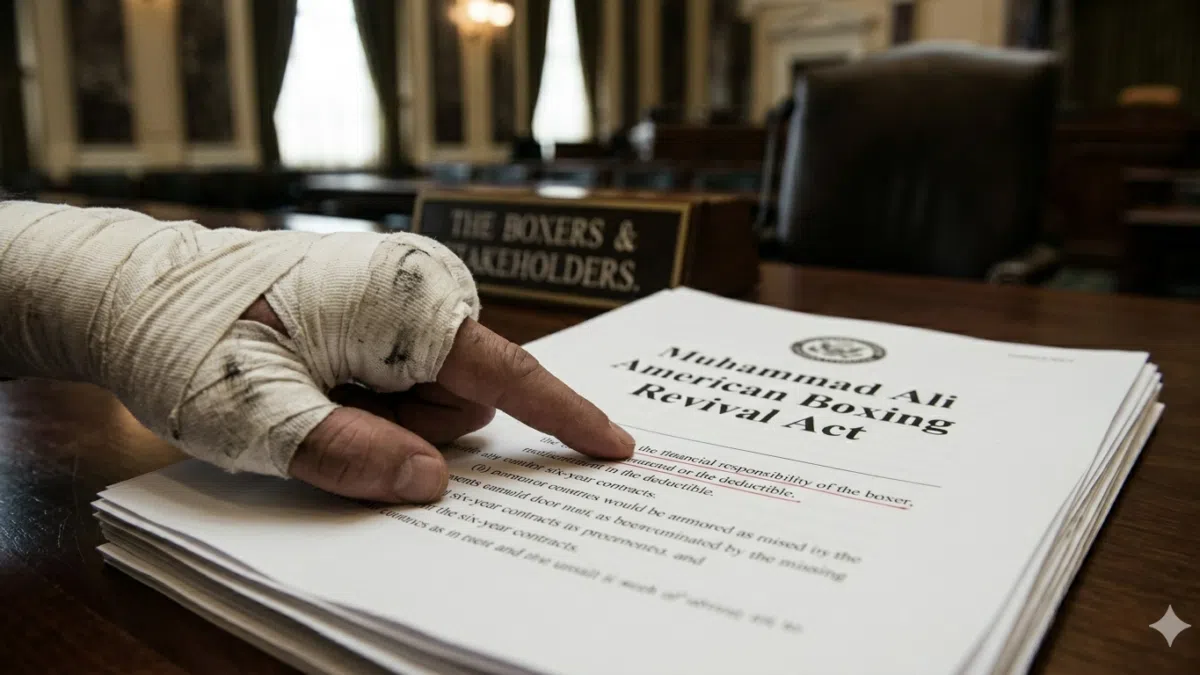
The question nobody asked: The ABC’s own published regulatory guidelines set the minimum insurance at $10,000 in health coverage and $10,000 in accidental death benefits per boxer. That’s the floor the trade organization sets for its own members. New York requires $50,000 in medical coverage, $50,000 in accidental death benefits, and $1,000,000 in life-threatening brain injury coverage. The bill sets a federal floor of $50,000 medical and $15,000 accidental death—which raises the standard for states following the ABC minimum but includes no brain injury provision at all. The most catastrophic injury in boxing isn’t covered under the federal floor. Was an insurance underwriter asked to compare these numbers? Did anyone call the specialty carriers who actually write these policies and ask what works, what doesn’t, what the real premiums look like from club shows to arenas, what happens when a fighter actually files a claim, what gets paid, what gets denied, and how much red tape stands between an injured fighter and the coverage they were promised? The people who write these policies and the people who pay for them should have been the first call, not an afterthought. And buried in the bill text is a detail that undermines the entire premise: “the cost of any deductible for any health insurance required to be provided by the UBO for a boxer shall be the financial responsibility of the boxer.” The headline is $50,000 in coverage. The fine print is the fighter pays out of pocket before the coverage kicks in. A four-round fighter making $800 on a show gets hit with a deductible on a policy they didn’t choose. Was a fighter asked whether that’s protection or a cost shift?
Drug Testing
The case for: One national standard for prohibited substances. Title fights tested automatically. Random testing across cards. A fighter shouldn’t be clean in Florida and suspended in Nevada for the same substance. Standardization protects fighters and protects the integrity of the sport.
The question nobody asked: What does random testing cost at scale? Who pays for it on a club show? Part 2 of this series broke down real costs from real laboratories and real commissions. The bill routes the prohibited substance cascade through the ABC’s list as the practical national default. Was a drug testing laboratory consulted on feasibility and turnaround? Was a state commission from one of the big four states asked whether this structure works? The goal is right. The implementation was drafted without the people who would have to execute it.
Physician Certification
The case for: A ringside doctor should know what they’re looking at. The difference between a qualified physician and an unqualified one is the difference between a fighter going home and a fighter going to the ICU. A national certification standard raises the floor everywhere.
The question nobody asked: In states with proper commissions, this system already works. The commission chooses the ringside physician. The doctor is qualified, hands-on, and accountable to a government regulator—not a trade organization. New York requires referees to have 400 rounds of experience, a 12-lead EKG, dilated eye exam, blood work, a neurological seminar, a background check, and a commission examination. In Florida—the home state of the ABC president—a referee gets a temporary certificate and officiates under observation. The bill hands national certification authority to the ABC instead of building on what the best commissions already do.
One Title Per Weight Class
The case for: The four-belt system—WBC, WBA, WBO, IBF—is boxing. It’s been that way for decades and it’s not going away. The problem is when one organization claims four world champions at the same weight. The WBA hands out Regular, Super, and Gold titles in the same division, plus interims on top of that—each one carrying sanctioning fees that come out of the fighter’s purse. That’s not competition. That’s a fee machine. One title per weight class per organization is overdue.
The question nobody asked: There’s a difference between four world titles per weight class and ranking belts like the WBC Silver. The Silver belt is a ranking tool—it identifies who’s in the top 15 and creates a pathway to a mandatory shot. Think of it like the Intercontinental Championship in the WWF in the 1980s—everyone knew if you held that belt, you were the number one contender. It serves a function in the competitive structure. The WBA handing out Regular, Super, and Gold titles at the same weight is a different problem entirely—that’s belt proliferation for the sake of sanctioning fees. The bill doesn’t distinguish between the two. It says one title per weight class, full stop. How does the transition work? What happens to existing title holders? Who enforces it when a sanctioning body keeps issuing belts anyway? The sanctioning bodies have earned plenty of criticism, but this bill effectively legislates them out of the American market—and they weren’t given a public hearing to defend themselves, propose reforms, or respond to the charges against them. That’s not how legislation is supposed to work. Neither were the promoters who work with them every day.
Six-Year Contracts
The case for: Long-term contracts give UBOs the stability to invest in fighters—training facilities, medical coverage, rehabilitation, career development. A promoter who commits resources to a fighter for six years has an incentive to develop them, not just use them.
The question nobody asked: Which fighter requested this? Which manager said their client needs less flexibility and a longer commitment to a single promoter? The bill allows UBOs to sign fighters for six years at $200 per round and replaces the fighter’s right to sue in federal court with mandatory arbitration. The current Ali Act specifically gave fighters a Private Right of Action—the ability to take a promoter to federal court. This bill takes that away for UBO fighters. It’s worth remembering that UFC fighters used antitrust litigation to win a $375 million settlement from the same parent company now lobbying for this bill. Under the UBO system, that lawsuit could never have been filed. Was an active fighter consulted? A manager? A labor attorney who represents athletes?
Enforcement
The case for: The current Ali Act has been criticized for decades as unenforceable. A stronger bill needs teeth. Criminal penalties for UBO officials who violate the law—up to one year in prison and $20,000 in fines—signal that Congress is serious about accountability.
The question nobody asked: This is the biggest issue nobody wants to address—in the current Ali Act or the Revival Act. If you are a fighter, a promoter, or a manager harmed by someone violating the Act, what do you do? Who is your voice? Who do you call? The bill cites the Federal Trade Commission, implies roles for the Department of Justice, leaves room for State Attorneys General and local District Attorneys, and delegates authority to the ABC—but never clarifies who has jurisdiction, who investigates, or who a harmed party actually goes to for remedy. The federal and state pathways are a mess, and there is no existing case law to sort them out. Zach Arnold at The MMA Draw flagged this directly: the ambiguity is a feature, not a bug. The more entities cited, the greater the risk of politicized enforcement—and the easier it is for the biggest players to exploit the confusion. A club promoter who gets squeezed doesn’t have a legal department on retainer. A four-round fighter who gets locked into a bad contract doesn’t have a lobbyist. The bill gives them rights on paper and no clear path to enforce them.
The Debate That Never Happened
This bill was introduced in July 2025, passed committee 30–4 in January 2026, was quietly rewritten on March 17, and is heading for a floor vote with no public hearings involving the people it regulates.
Cutmen, ringside physicians, matchmakers, managers, active fighters, insurance underwriters, drug testing laboratories, state commissioners from the states that actually regulate the sport, former commissioners who know what works and what doesn’t, sanctioning body representatives, and promoters at every level from club shows to pay-per-view—none of them were in the room.
That doesn’t mean the bill is wrong about everything. It means the bill is incomplete. Every provision above has a legitimate argument on both sides. Some of them might survive a real debate and come out stronger. Some might need to be rewritten. Some might need to be thrown out entirely. We don’t know, because the debate never happened.
I’m not against reform. I’m a promoter who operates under this system and I know it’s broken. But a bill that reorganizes an entire sport should not be written by one company, endorsed by one trade organization, and rushed to a vote before the people who live in that sport get to speak.
Slow down. Hold public hearings. Let the stakeholders debate each provision on the merits. Let them disagree with each other. Let Congress hear from boxing—not just the biggest company in it.
That’s not asking for much. It’s asking for the bare minimum of how legislation is supposed to work.
Coming next: Government in Boxing — what it looks like when it works, and what this bill gets wrong about who should be running the sport.
Larry Goldberg is the founder of Boxing Insider Promotions and owner of BoxingInsider.com. BoxingInsider.com is an independent boxing news platform and the home of Boxing Insider Promotions, which stages professional boxing events in Atlantic City and New York City. We are not covering this legislation from the outside. We are one of the promoters it will directly affect.
Read the full series:
Part 1: What the Ali Revival Act Means for Club Promoters and Independent Boxing
Part 2: Drug Testing in Boxing: What It Actually Costs
Part 3: The Muhammad Ali Revival Act Just Made Win Tourism the Business Model for Independent Boxing
Part 4: The Muhammad Ali Revival Act Turns the ABC Into America’s De Facto National Boxing Commission