This is part of BoxingInsider.com’s ongoing series on the Muhammad Ali American Boxing Revival Act. Part 1 examined what the bill means for club promoters and independent boxing. Part 2 broke down what drug testing actually costs at every level of the sport. Part 3 covered how the bill turns win tourism into the default path for young fighters. This piece asks who the bill actually empowers—and whether Congress knows the answer.
Is the Muhammad Ali American Boxing Revival Act about to make the Association of Boxing Commissions the de facto national boxing commission?
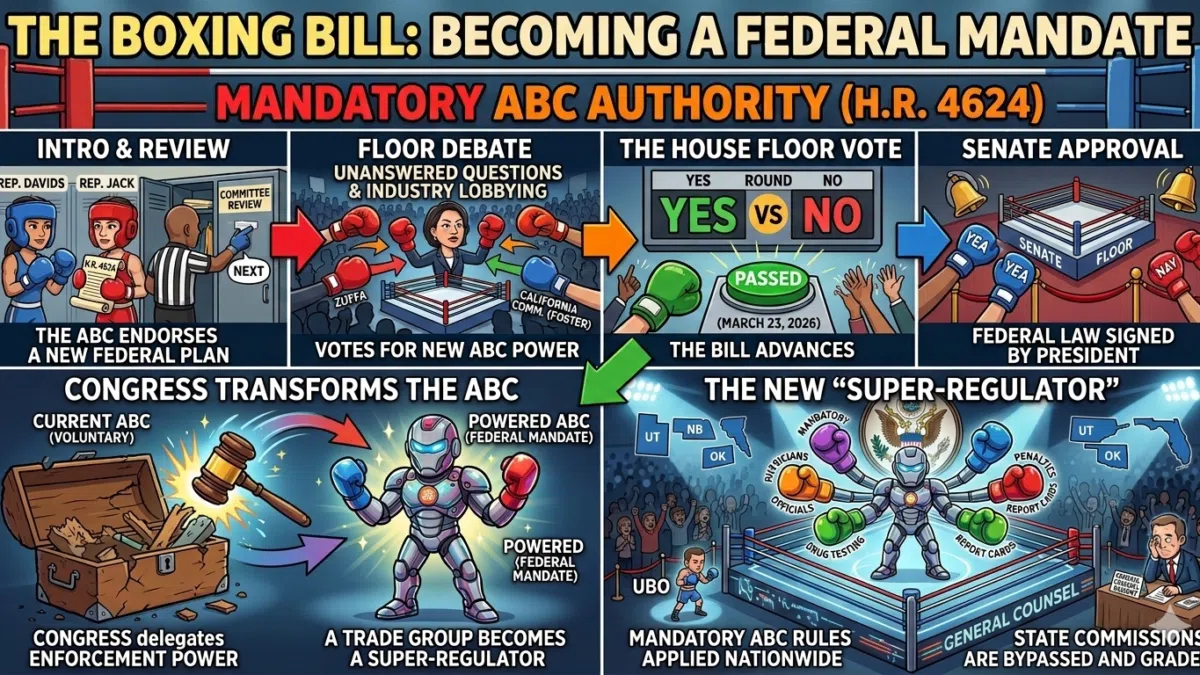
Read the bill text heading for a House floor vote next week and it’s hard to reach any other conclusion. The ABC—a nonprofit trade organization with no regulatory power, no enforcement mechanism, and no legal authority over any state athletic commission—is named throughout the legislation as the body that will certify ringside physicians for all professional boxing in America, certify judges and referees for all professional boxing in America, receive drug test results, impose penalties on fighters, evaluate state commissions, and serve as the gatekeeper for prohibited substance standards nationwide.
And on March 19, we got a preview of what that looks like in practice.
The UFC announced that the ABC will serve as “regulatory advisors” for UFC Freedom 250, the fight card scheduled for the White House South Lawn on June 14. According to reporting by Severe MMA, the UFC’s Vice President of Regulatory Affairs Marc Ratner had a preliminary phone call with DC Combat Sports Commission Chairman Andrew Huff back in November 2025 about the event but could not confirm the commission’s involvement. By February 2026, the UFC notified commission staff it would be proceeding without them, citing the use of federal land. Huff asked directly whether the fights would be unsanctioned and therefore unofficial. He did not receive a response. So instead of working with the commission that has legal jurisdiction, the UFC hired the ABC to fill the role.
The UFC’s press release calls the ABC “the unified regulatory body that oversees and supports the safety, integrity, and standardization of professional boxing and MMA events in the United States.” That description is wrong. The ABC cannot suspend a fighter, revoke a license, or sanction a fight.
And the timeline makes it worse. On March 9, Severe MMA’s Theo Lander asked ABC President Timothy Shipman directly: had the ABC been consulted about oversight for the White House event, and did it have a position on the precedent being set? Shipman’s written response: “The Association of Boxing Commissions and Combative Sports (ABC) does not have a position regarding this event and has no information to provide in response to your proposed questions.” He directed all questions to UFC Vice President of Communications Chris Bellitti. On March 19, 2026—ten days later—Shipman’s name appears on the UFC press release announcing the ABC as the event’s regulatory advisor, declaring that “all bouts on this card are officially licensed and sanctioned contests.”
After the UFC’s announcement, Chairman Huff responded: “The ABC is not a sanctioning body and has no authority in the District of Columbia. While I am relieved to learn that an additional organization will maintain some sort of oversight of the UFC White House event, I am disappointed that the ABC, which represents Commissions across the United States, including in the District of Columbia, has chosen to ignore our Commission’s laws and authority. It sets a dangerous precedent for all commissions and the industry as a whole.”
To be fair, there is precedent for combat sports outside state commission jurisdiction. Events on tribal land—like Tachi Palace in California—have operated this way for years. The UFC has self-regulated in foreign countries where no local commission exists. Mohegan Sun, Foxwoods, and the state of Connecticut all operate independent commissions in the same state. Tribal commissions regulate fights every week in America. None of them call the ABC to do it.
And here’s the other thing: the UFC could have just self-regulated. They do it every time they hold an event in Abu Dhabi, Saudi Arabia, or any other jurisdiction without an athletic commission. They bring their own officials, their own doctors, their own compliance infrastructure. They don’t call the ABC for those events. Their internal operation is bigger and more experienced than most state commissions—certainly more than anything the states of Oklahoma or Nebraska bring to the table. So what does the ABC actually add to the White House event that the UFC doesn’t already have? Not better officials. Not better doctors. Not more experience. The only thing the ABC brings is the word “independent” on the press release—and a trial run for the role Congress is about to give them permanently.
That’s what makes this different. The issue isn’t federal land. The issue is who the UFC chose and when they chose them. A trade organization that endorsed the bill the UFC is lobbying Congress to pass, tapped as “regulatory advisor” the same week that bill is heading for a floor vote. That’s not independent oversight. It’s a dress rehearsal.
What Is the ABC?
The Association of Boxing Commissions is a voluntary membership organization where state, provincial, and tribal commissions share information and coordinate standards. It cannot suspend a fighter, revoke a license, or stop a fight. That’s a perfectly fine thing for a trade organization to be. The problem is that the Revival Act treats it like something else entirely.
What the Bill Gives Them
The suspension version of H.R. 4624 dated March 17, 2026 references the ABC repeatedly and delegates it authority that goes far beyond what a trade organization should hold. And it’s not limited to UBO events. Several of these provisions apply to all professional boxing in America:
Physician Certification — All Boxing. Section 5(a)(3), as rewritten by this bill, requires that every ringside physician at every professional boxing match in America—not just UBO events—hold a certification “obtained through a certification program administered by the Association of Boxing Commissions in partnership with the Association of Ringside Physicians.” This takes effect two years after enactment. A trade organization will control who is allowed to serve as a ringside doctor at your local club show.
Judge and Referee Certification — All Boxing. Section 16 is completely rewritten. Judges and referees for any professional boxing match in America must be certified by the state commission or by the Association of Boxing Commissions. A trade organization can now credential officials for every fight in the country, operating as a parallel certification body alongside state government.
Drug Test Notifications — UBO Events. Positive drug test results from UBO events must be reported to the state boxing commission or to the Association of Boxing Commissions. A trade organization receives the same drug test results as a state regulator.
Drug Test Penalty Authority — UBO Events. The bill authorizes the ABC to impose penalties on boxers for positive test results. A trade organization with no legal enforcement power can penalize professional athletes under federal law.
UBO Registration. When a UBO claims status, it must submit its registration information to the Federal Trade Commission and to the Association of Boxing Commissions. A trade organization receives the same filing as a federal agency.
State Commission Report Cards. Section 7(c)(3)(C) states—in the actual bill text—that the ABC should publish “an annual report card of boxing commission conformance with such model codes and best practices.” That is a trade organization grading sovereign state government agencies. It is the hall monitor provision, written into federal law, and it creates an obvious avenue for political favoritism: commissions that play ball get good grades, commissions that don’t get flagged.
Drug Testing Cascade — All Boxing. Section 4(b) requires drug testing at every title bout and at random for all other matches. The screening standard cascades: state commission’s prohibited list first, then the ABC’s prohibited list, then the WADA list as the default. Most states don’t maintain a comprehensive prohibited substance list. The ABC’s list becomes the gatekeeper for what gets tested at every boxing event in the country.
Who Runs It
Here is the current ABC executive committee as of November 2025:
President: Timothy Shipman — Florida
1st Vice President: Scott Bowler — Utah
2nd Vice President: Brian Dunn — Nebraska
Secretary: Diana Fletcher — Oklahoma
Treasurer: Heather Turner — Oklahoma
Past President: Michael Mazzulli — Mohegan Tribe (Connecticut)
Florida. Utah. Nebraska. Oklahoma. Oklahoma. A tribal commission at a Connecticut casino.
Not a single person from New York. Not New Jersey. Not Nevada. Not California. The four states that regulate the overwhelming majority of significant professional boxing in America have no representation in the ABC’s leadership. The trade organization that Congress is about to hand federal authority to is run entirely by commissions from states where boxing is a secondary activity at best.
And Florida’s presence at the top deserves particular scrutiny. Browse the Florida Athletic Commission’s event results page and you’ll find bare-knuckle fighting, Karate Combat, BYB Extreme, Dirty Boxing Championship, Creator Clash influencer boxing, and what can only be described as circus fights—events that New York, New Jersey, and Nevada would never sanction. And the man running that commission is now president of the organization Congress is about to empower under federal law.
The Endorsement Chain
Follow the connections:
Michael Mazzulli, as ABC president, endorsed the bill on behalf of the organization: “The Association of Boxing Commissions Board of Directors is in unanimous support of the new Muhammad Ali American Boxing Revival Act.”
Andy Foster, the California State Athletic Commission executive officer, led the 6–0 CSAC vote supporting the bill in October 2025. Foster previously nominated Mazzulli for the ABC presidency. Rep. Mark Takano (D-CA) later raised questions in the committee report about communications between Foster and Zuffa or its affiliates. Those questions remain unanswered.
In March 2026—the same month the bill is heading for a floor vote—Mazzulli was appointed to the advisory board of M2MMA Inc., a Dubai-based combat sports technology company traded on the OTC markets (ticker: MMAZ). The company’s press release cited his ABC tenure as a credential.
The people who endorsed this bill are the same people who gain the most institutional power from it.
Their Own General Counsel Disagrees
The ABC’s own general counsel is Pat English—one of the original drafters of the Muhammad Ali Boxing Reform Act of 2000. English submitted a formal letter to Congress calling the Revival Act a “betrayal of the current act and of what McCain and those who worked with him were trying to accomplish.” He wrote that the bill “is designed for a single purpose—to allow the new Zuffa boxing entity to avoid restrictions designed to protect boxers.”
The organization’s board endorsed the bill. The organization’s general counsel—the man who helped write the law this bill amends—calls it a betrayal. Reporting by The MMA Draw has documented that opposition inside the ABC is significant but lacks a megaphone. Multiple commissioners have told industry contacts they can’t speak freely.
Zach Arnold at The MMA Draw—who has tracked the revised bill text line by line—reaches the same conclusion: the Ali Revival Act just turned a trade organization into a quasi-governmental entity overnight.
Why This Matters for the Floor Vote
Every provision detailed above delegates federal authority to a private nonprofit trade organization—one with no regulatory power, no enforcement mechanism, no accountability to voters, and an internal split so deep that its own general counsel calls the bill a betrayal.
If Congress wants to strengthen boxing oversight, strengthen the state commissions. They have the regulatory authority, the medical infrastructure, the institutional knowledge, and the legal accountability. Delegating that work to a trade group is not oversight. It’s a workaround.
Coming next: Government in Boxing — what it looks like when it works, and what this bill gets wrong about who should be running the sport.
Larry Goldberg is the founder of Boxing Insider Promotions and owner of BoxingInsider.com. BoxingInsider.com is an independent boxing news platform and the home of Boxing Insider Promotions, which stages professional boxing events in Atlantic City and New York City. We are not covering this legislation from the outside. We are one of the promoters it will directly affect.
Read the full series:
Part 1: What the Ali Revival Act Means for Club Promoters and Independent Boxing
Part 2: Drug Testing in Boxing: What It Actually Costs
Part 3: The Muhammad Ali Revival Act Just Made Win Tourism the Business Model for Independent Boxing