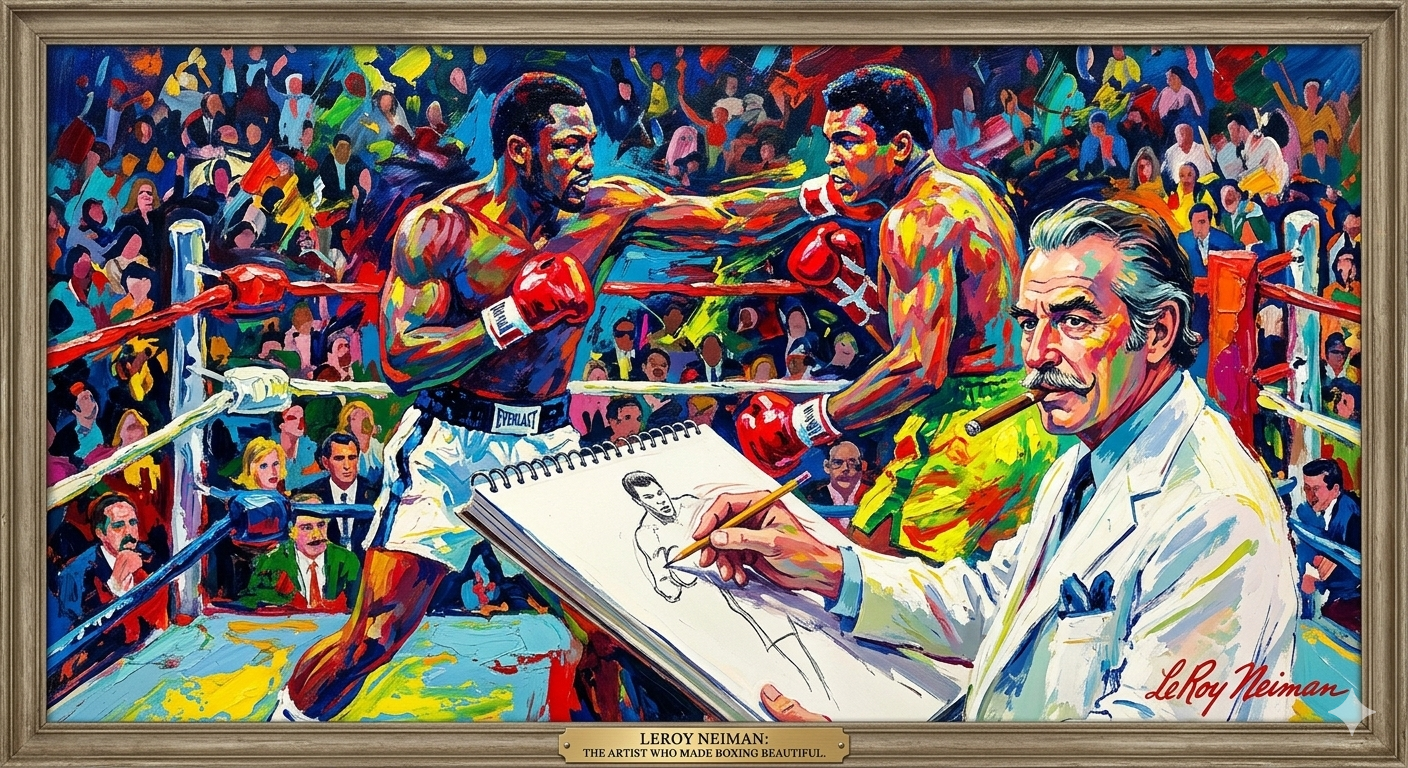
For half a century, no artist was more synonymous with boxing than LeRoy Neiman. With his handlebar mustache, ever-present Cuban cigar, and sketchpad balanced on his knee at ringside, Neiman became as much a fixture of championship fight night as the ring announcer and the corner men. He painted the sport not as brutality, but as spectacle — explosive, colorful, alive with motion — and in doing so, he earned a place in the International Boxing Hall of Fame alongside the fighters he immortalized.
Neiman was inducted in 2007 in the Observer category, sharing the stage that year with Roberto Durán, Pernell Whitaker, and Ricardo López. He remains the only visual artist ever enshrined in Canastota. It was a distinction that surprised no one who had followed the sport since the 1960s, when a young Cassius Clay sat on a rubbing table at St. Nicholas Arena in Manhattan and watched the flamboyant painter sketch his likeness for the first time.
From Frogtown to Fight Night
Born LeRoy Leslie Runquist on June 8, 1921, in Saint Paul, Minnesota, Neiman grew up in the hardscrabble Frogtown neighborhood after his biological father abandoned the family. He took the surname of his mother’s second husband and showed artistic talent early, drawing posters for local merchants at a nickel apiece and inking tattoos on the forearms of schoolmates. Saint Paul was a fight town — it had produced middleweight champion Mike O’Dowd and the legendary Gibbons brothers, Mike and Tommy — and the young Neiman was introduced to boxing through basement bouts at the local Catholic church.
After enlisting in the Army in 1942, Neiman served through D-Day and the Battle of the Bulge, painting sets for Red Cross shows and creating murals on the walls of mess halls. On the G.I. Bill, he enrolled at the School of the Art Institute of Chicago, where he later spent a decade on the faculty teaching figure drawing. His first boxing subject was light heavyweight Bob Satterfield, a fellow classmate at the institute. The pairing of the sport he loved with the craft he was mastering would define the rest of his career.
The Ringside Seat That Changed Art
Neiman’s breakthrough came through his long association with Playboy, which began in 1954 when he met Hugh Hefner. For fifteen years he wrote and illustrated the magazine’s “Man at His Leisure” column, traveling the globe to paint leisure, nightlife, and sport. But it was boxing that drew him back again and again.
His method was distinctive. Neiman worked ringside, sketching on whatever was at hand — fight programs, restaurant menus, press notes, the bout sheet itself. He carried sketchbooks, markers, pens, pencils, and crayons wherever he went, producing rapid mixed-media works that captured the kinetic energy of the ring in real time. Back in his studio at the Hotel des Artistes on Manhattan’s Upper West Side, he would add color and develop the sketches into the vivid oils, enamels, and serigraphs that made him famous. According to the LeRoy Neiman Foundation, he left behind 93 sketchbooks, thousands of drawings, and tens of thousands of posters and prints.
His style — expressionistic, brilliantly colored, layered with thick brushstrokes that seemed to vibrate with movement — was immediately recognizable. Critics in the fine-art establishment sometimes dismissed him as a commercial illustrator, but the public and the boxing world embraced him completely. Gross annual sales of his limited-edition serigraphs alone exceeded $10 million. Original paintings commanded six-figure prices.
Ali and Neiman: A Fifty-Year Friendship
The defining relationship of Neiman’s boxing career began in 1962, when he encountered the 20-year-old Cassius Clay in a dressing room at St. Nicholas Arena before Clay’s fight against Billy Daniels. Neiman was sketching the young heavyweight sitting on the rubbing table, hands taped and ready for his gloves, when Clay asked to see the drawing — and then grabbed the pad to add a sketch of his own at the bottom.
It was the beginning of a friendship that would span nearly fifty years. As documented in the New York Historical Society’s 2017 exhibition, the two men shared an affinity for the limelight, for breaking convention, and, of course, for boxing. Neiman taught Ali to draw, and Ali became a willing student, producing rudimentary but enthusiastic sketches — including prediction drawings before major fights — that he frequently dedicated to the artist. Ali’s father, Cassius Clay Sr., had been a sign painter and muralist in Louisville, and art ran in the family’s blood.
Neiman was there for all of it. He created fight posters and program covers for Ali-Frazier I at Madison Square Garden in 1971, the Rumble in the Jungle against George Foreman in Kinshasa in 1974, the Thrilla in Manila against Frazier in 1975, and Ali-Spinks II in 1978. His ringside sketches from those nights — vivid watercolors capturing Ali’s jab, Frazier’s left hook, the sweat and the crowd — are among the most important visual documents of boxing’s golden age of heavyweights.
The LeRoy Neiman Foundation later donated 21 works valued at more than half a million dollars to the Muhammad Ali Center in Louisville, including the monumental painting Athlete of the Century, which had been on loan to the center since its 2005 opening.
Beyond Ali: A Sport’s Visual Chronicler
Neiman’s boxing portfolio extended far beyond his most famous subject. Over the decades, he created posters and artwork for Hagler-Hearns, Foreman-Moorer, Tyson-Lewis, De La Hoya-Vargas, and De La Hoya-Whitaker, among dozens of other major events. His pre-fight poster of Mike Tyson before the Trevor Berbick fight in 1986 captured the young destroyer at the peak of his Kid Dynamite era. Sylvester Stallone was so taken with Neiman’s work that he tapped the artist to appear in four of his Rocky films, a cameo role that cemented Neiman’s crossover fame with audiences who had never set foot in a boxing arena.
He was also the official painter of five Olympic Games between 1972 and 1984, and at the 1976 Montreal Games, he employed one of his signature techniques — sketching over the official bout sheet for the gold medal boxing lineup, layering his art onto the document itself. The result added historical context that a blank canvas never could.
Neiman continued painting after having his right leg amputated in 2010 due to arterial insufficiency. He died on June 20, 2012, twelve days after his 91st birthday, in Manhattan. His autobiography, All Told: My Art and Life Among Athletes, Playboys, Bunnies, and Provocateurs, was published just fifteen days before his death.
The Lineage: Boxing’s Painters Before Neiman
Neiman did not invent the boxing painting. He perfected it for the modern era, but the tradition stretches back more than a century, rooted in some of the most important movements in American art.
Thomas Eakins and the Realist Foundation
The first major American artist to treat boxing as a serious subject was Thomas Eakins, the Philadelphia realist who attended professional fights at the Arena on Broad and Cherry Streets in the late 1890s. Eakins befriended several fighters, invited them to spar in his studio, and produced three monumental canvases: Taking the Count (1898), now at the Yale University Art Gallery; Salutat (1898), at the Addison Gallery of American Art; and Between Rounds (1899), at the Philadelphia Museum of Art.
Eakins brought the same anatomical precision to the boxing ring that he had applied to his surgical theater painting The Gross Clinic. He insisted on authentic detail — when boxer Billy Smith noticed a dark smear across his upper lip in his portrait and asked about it, Eakins refused to remove it, because it had been there in life. The fighters in his paintings are real men in real fights, and the audience members are identifiable friends, students, and sportswriters whom Eakins placed in the canvas like a theater director blocking a scene. His boxing paintings were radical in their conception — no artist before him had treated prizefighting as worthy of the same monumental treatment given to history painting.
George Bellows and the Ashcan Underground
If Eakins provided the realist foundation, George Bellows built the cathedral. A former Ohio State athlete who turned down a potential career with the Cincinnati Reds to study painting under Robert Henri at the New York School of Art, Bellows arrived in Manhattan in 1904 and soon found his way to Tom Sharkey’s saloon on the West Side. Public prizefighting was illegal in New York at the time, but a loophole allowed bouts between members of private athletic clubs. Sharkey’s formed one, sold one-night memberships to its fighters, and staged matches in the back room.
What Bellows saw there produced some of the most powerful sporting images in American art. Club Night (1907), Stag at Sharkey’s (1909), and Both Members of This Club (1909) — all now in the collection of the National Gallery of Art — captured the underground fight world in dark, atmospheric compositions that owed debts to Goya’s satire and Daumier’s crowd scenes. The brushwork was bold and loose, the lighting theatrical, the faces of the spectators contorted with primal excitement. Bellows produced only six boxing paintings in his lifetime, but they became his signature works and earned him recognition as one of the foremost painters of the Ashcan School.
His final and most famous boxing canvas, Dempsey and Firpo (1924), now at the Whitney Museum of American Art, depicts the electrifying moment when Argentine heavyweight Luis Firpo knocked Jack Dempsey out of the ring at the Polo Grounds on September 14, 1923. Bellows was seated in the press box that night and may have painted himself into the scene — art historians have debated whether the bald figure at the far left or the man beneath Dempsey pushing him back up represents the artist. In a telling detail, Bellows painted Firpo swinging with his left hand, though the actual blow was a right. For Bellows, compositional tension took precedence over anecdotal accuracy. He died of a ruptured appendix in January 1925, just months after completing the painting, at age 42.
Robert Riggs and the Depression-Era Ring
A less celebrated but equally compelling figure in boxing art is Robert Riggs, the Decatur, Illinois-born painter and printmaker who immersed himself in the fight world during the early 1930s. Riggs produced 26 boxing lithographs out of a total output of 84 prints — nearly a third of his life’s work in the medium was devoted to the ring. His technique was unusual: he worked from dark to light on limestone surfaces, applying black lithographic crayon and then scraping away with a razor blade to reveal the image, a subtractive method that gave his prints a moody, dramatic quality perfectly suited to Depression-era fight clubs.
His most important boxing work was The Brown Bomber (1938), a tempera painting depicting Joe Louis’s victory over Max Schmeling, which helped earn Riggs election to the National Academy of Design in 1946. His Baer-Carnera lithograph, now at the Metropolitan Museum of Art, captured the 1934 heavyweight championship at the Madison Square Garden Bowl in Queens with the intensity of a ringside reporter. Where Bellows painted the spectacle, Riggs documented the grit — the sweat, the bruises, the exhausted fighters in their corners. He spent time in training camps, drawing fighters during preparation with the same obsessive attention that Eakins had brought to his studio sessions decades earlier.
Why Neiman Was Different
What separated Neiman from his predecessors was not just talent but access, medium, and timing. Eakins painted boxing at a moment when the sport occupied a contested space between legality and the underground. Bellows captured the raw, illicit energy of the private club era. Riggs worked in the Depression, when boxing was a blue-collar escape. Neiman arrived when the sport became a global television spectacle, and he understood that transition better than any other artist of his generation.
He painted on live television. He sketched ringside at events broadcast to hundreds of millions of viewers worldwide. His handlebar mustache and cigar became part of the visual language of fight night. Where Eakins and Bellows worked in studios with posed models recreating actual fights, Neiman worked in the moment, capturing action as it happened with a speed and confidence that no fine artist before him had attempted on such a public stage.
His color palette was also revolutionary. Eakins worked in somber, realistic tones. Bellows painted in dark, atmospheric washes. Neiman exploded with reds, blues, yellows, and greens — a palette drawn from the Impressionists he admired, from Toulouse-Lautrec and Degas, filtered through the energy of Pop Art and the boldness of Abstract Expressionism. His Ali paintings do not look like photographs of Ali. They look like what it felt like to watch Ali — the speed, the flash, the almost supernatural movement rendered in streaks of pure color.
The fine-art establishment never fully embraced him. He was too popular, too commercial, too closely associated with Playboy and television for the gallery world’s comfort. But boxing embraced him without reservation, and the public bought his prints by the hundreds of thousands. By one estimate, more than 150,000 Neiman prints had been sold during his lifetime, with an aggregate market value exceeding $400 million.
The Art of the Fight, Enduring
Boxing and painting share something fundamental: both are acts of individual expression performed under extreme pressure, demanding split-second decisions that cannot be taken back. Eakins understood this. Bellows felt it in the smoky back rooms of Sharkey’s saloon. Riggs scraped it into limestone with a razor blade. And Neiman, more than anyone, made it accessible to millions who might never have set foot in a museum or an arena.
His legacy endures not just in the paintings and prints that hang in private collections and public museums worldwide, but in the idea that boxing — violent, unpredictable, deeply human — is worthy of serious artistic attention. The sport’s greatest moments are preserved in film and photograph, but it is the paintings of Neiman, Bellows, Eakins, and Riggs that remind us what those moments meant. The camera records. The painter interprets. And in boxing, where so much of the drama lives in the space between what the eye sees and what the heart feels, interpretation may be the more lasting art.