
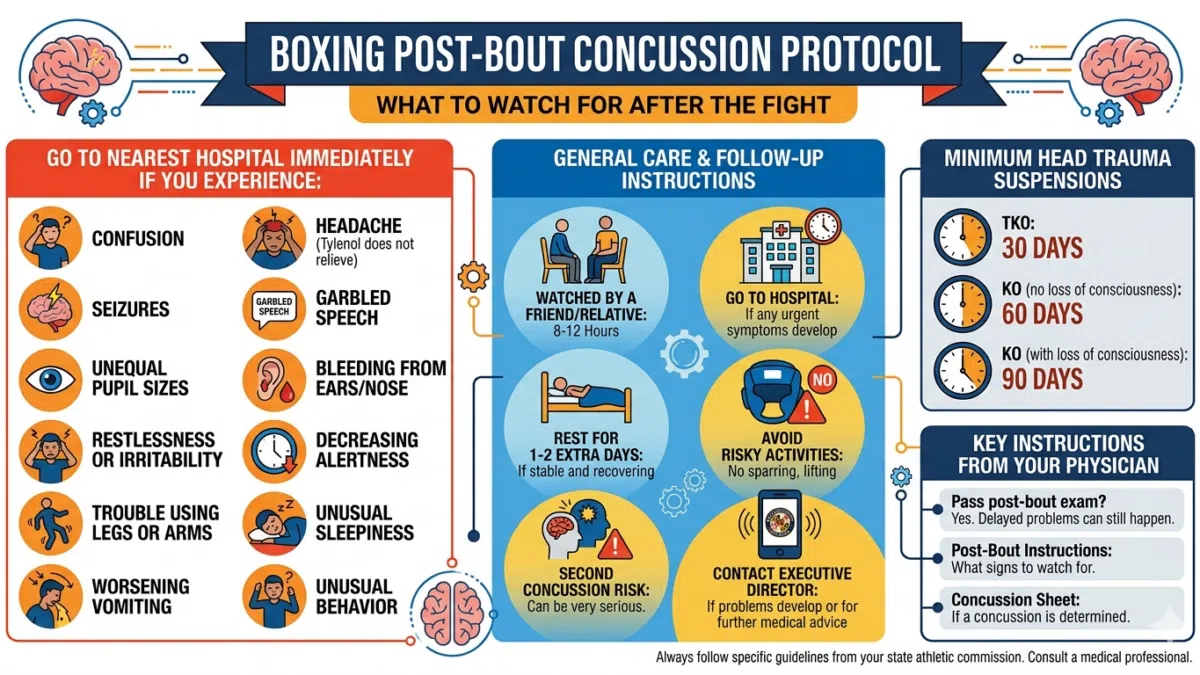
Every state athletic commission in the United States requires a post-bout medical exam for fighters. What happens after that exam varies. In many states, fighters receive written instructions before they leave the venue, outlining what to watch for in the hours and days following a bout.
The Maryland State Athletic Commission provides fighters with a two-page handout. The first page, titled “Post-Bout Instructions,” confirms that the fighter has passed a post-bout exam performed by a ringside physician and warns that delayed problems can arise. It lists symptoms that should prompt an immediate trip to the nearest hospital.
According to the Maryland handout, fighters should immediately proceed to the nearest hospital if they develop any of the following signs or symptoms:
- Confusion
- Seizures
- Unequal pupil sizes
- Restlessness or irritability
- Trouble using legs or arms
- Worsening vomiting
- Headache that will not go away after being treated with acetaminophen (Tylenol)
- Garbled speech
- Bleeding from the ears or nose
- Decreasing alertness
- Unusual sleepiness
- Unusual behavior
The second page is a concussion sheet, issued when the ringside physician determines a fighter may have sustained a concussion. It includes the following instructions:
- The fighter should be watched by a friend or relative for eight to 12 hours
- If any of the above symptoms develop, proceed immediately to the nearest hospital
- If stable and recovering during the next 24 hours, rest for an additional day or two
- Stay away from activities that would risk re-injury, such as sparring or lifting
- A second concussion occurring before the first has healed can be very serious
- Contact the commission’s Executive Director if a delayed problem occurs and further medical evaluation is received
This is standard practice across much of the country. Most commissions provide some version of written post-bout guidance, and the minimum suspension periods for stoppages due to head trauma are generally consistent: 30 days after a TKO, 60 days after a knockout without loss of consciousness, and 90 days after a knockout with loss of consciousness.
What is less consistent is everything that comes after. Whether a fighter sees a neurologist before returning to competition, whether baseline neuropsychological testing is required, and how thoroughly commissions can monitor compliance with no-contact suspensions during training are all questions that different states answer differently, or do not answer at all.