
The information in this article is for educational purposes only and is not intended as medical advice. Always consult a licensed healthcare provider for diagnosis and treatment of any injury.
Boxing is a combat sport. Things break, tear, swell, and bleed. That is not a reason to avoid it — millions of people train safely every day — but it is a reason to understand what can go wrong, how to recognize it, and what you can do to keep yourself out of the doctor’s office.
Most boxing injuries are preventable. They happen because of bad technique, cheap equipment, skipped warm-ups, or the stubborn refusal to rest when something hurts. The fighters who have the longest careers are not always the toughest — they are the smartest about managing their bodies.
Here is what you need to know.
Hands and Wrists: The Most Common Problem
The hands take more punishment than any other part of a boxer’s body. A longitudinal study of Great Britain’s Olympic boxing squad published in the Journal of Hand Surgery tracked injuries over eight years and found that hand and wrist problems accounted for significant training time lost — a median of 29.5 days per injury. Wrist injuries were particularly costly, with a median recovery of 31.5 days.
The four most common diagnoses in that study accounted for nearly 65 percent of all hand and wrist injuries: carpometacarpal instability, boxer’s knuckle (a sprain of the extensor hood and capsule around the knuckle joint), skier’s thumb (a sprain of the thumb’s ulnar collateral ligament), and general wrist sprains.
The most well-known injury — the boxer’s fracture — is a break in the fifth metacarpal, the bone connecting the wrist to the pinky knuckle. It typically happens when a punch lands off-center, loading force through the smaller, weaker knuckles instead of the index and middle knuckles where the hand is structurally designed to absorb impact.
What it feels like: Sharp pain on impact, immediate swelling, bruising across the back of the hand, difficulty making a fist, and sometimes visible deformity or abnormal finger alignment.
How to prevent it:
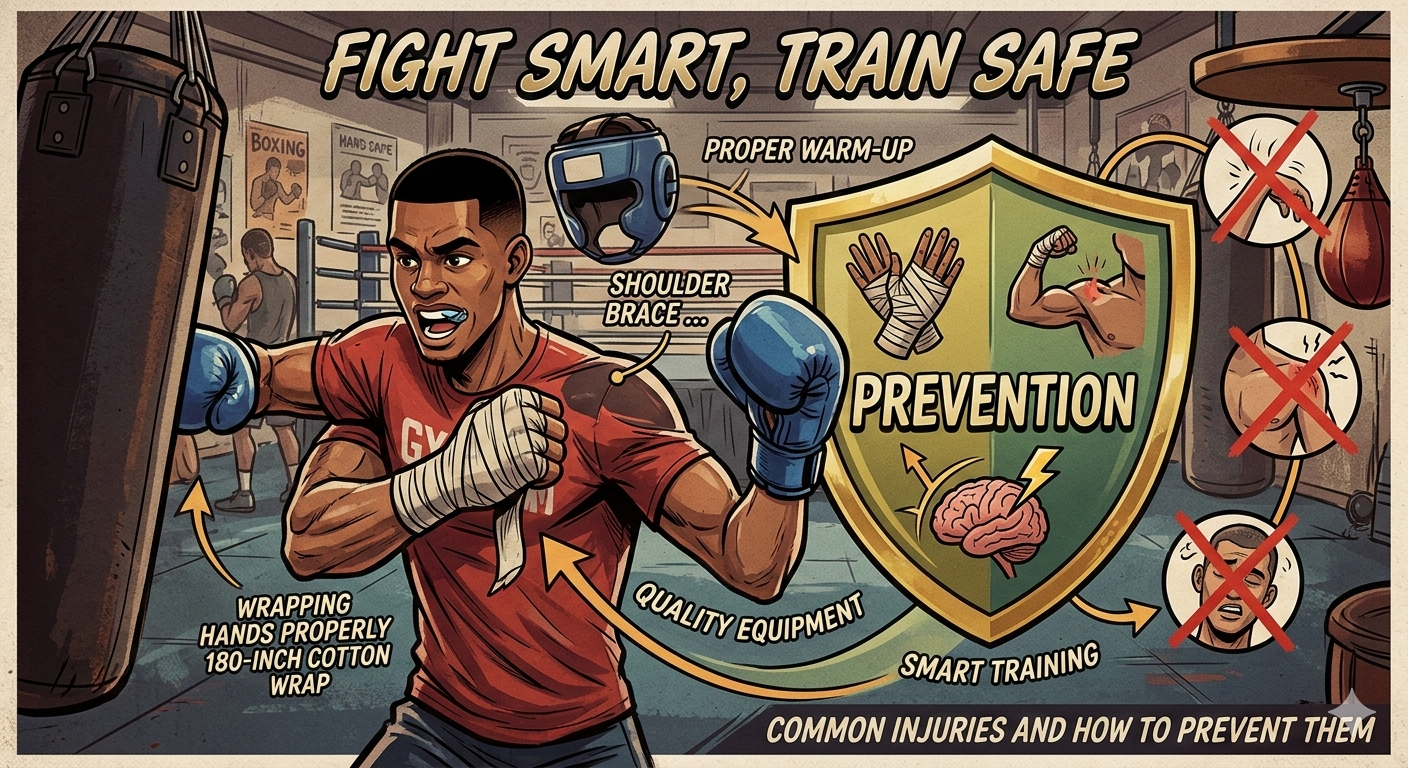
Proper hand wrapping is the single most important thing you can do. Wraps support the small bones and ligaments in the hand and wrist, distributing impact force across a broader area. Cotton wraps should be at least 180 inches long and wound snugly — not so tight they cut off circulation, not so loose they bunch up inside the glove.
Beyond wrapping, the right gloves matter. Heavier gloves with adequate padding absorb more shock. If you are hitting the heavy bag with worn-out 10-ounce gloves, your hands are paying the price. Our complete boxing gloves and gear buying guide covers what to look for in padding, wrist support, and sizing for your training type.
Technique is the other half of the equation. Landing with the index and middle finger knuckles — the two largest — keeps the wrist aligned with the forearm. A bent or angled wrist on impact is how sprains and fractures happen. If you notice wrist pain creeping in after bag work, your alignment is off and a coach should evaluate your form before the problem becomes structural.
Shoulder Injuries: The Silent Career Killer
Shoulder problems do not get the attention hand injuries do, but they sideline fighters just as effectively. The shoulder complex handles every punch thrown, every defensive movement, every clinch and every round with the arms up in guard position. That is an enormous volume of repetitive stress.
According to Boxing Science, 66 percent of boxers they have tested show limited shoulder range of motion — a direct consequence of the rounded posture inherent to the boxing stance and the high volume of punching in training. That tightness creates muscle imbalances where the anterior (front) muscles overpower the posterior (rear) muscles, and the rotator cuff — the group of four muscles that stabilize the ball-and-socket joint — becomes vulnerable.
The most common shoulder injuries in boxing are rotator cuff strains and tears, labrum tears, and impingement syndrome, where the rotator cuff tendons get pinched between the bones of the shoulder during overhead or extended arm movements.
What it feels like: Dull aching in the shoulder that worsens during or after training, pain when raising the arm overhead, weakness when throwing certain punches (especially hooks and uppercuts), or a catching or clicking sensation in the joint.
How to prevent it:
Rotator cuff strengthening should be a non-negotiable part of every boxer’s routine. External rotation exercises with resistance bands, face pulls, and reverse flyes target the posterior muscles that boxing naturally neglects. These are not glamorous exercises, but they are the difference between a healthy shoulder and a torn rotator cuff that requires surgery.
Adequate rest between high-volume sessions is equally critical. The rotator cuff tendons develop microtears with use — that is normal. Without rest, those microtears accumulate and become a real injury. Our stretching and mobility guide covers the shoulder-specific work that keeps these joints healthy.
Head Injuries: The One You Cannot Ignore
Concussions are the most serious acute injury in boxing and the one that demands the most respect. A systematic review published in the Clinical Journal of Sport Medicine found that boxers have a significantly elevated risk of concussion compared to athletes in other combat sports, and that post-concussion symptoms — memory loss, dizziness, difficulty balancing, headaches — can persist for days or weeks after a bout.
Beyond the acute concussion, there is the longer-term concern of chronic traumatic encephalopathy (CTE), a progressive neurodegenerative disease linked to repetitive head trauma. A 2025 study led by UNLV in collaboration with the Cleveland Clinic examined 130 active and retired professional fighters and found that 40 percent met the criteria for traumatic encephalopathy syndrome, a potential precursor to CTE. Over 80 percent of those who met the criteria reported that boxing was their only fighting discipline, according to UNLV’s published findings.
This is not intended to scare anyone away from training. The vast majority of people who box for fitness never spar, and those who do spar recreationally are exposed to far less cumulative impact than professional fighters. But the data is clear: head trauma is serious, cumulative, and not something to tough out.
What it feels like: Headache, confusion, dizziness, nausea, sensitivity to light or noise, feeling “foggy” or “not right,” difficulty concentrating, or brief loss of consciousness. Symptoms do not always appear immediately — they can develop hours after impact.
How to prevent it:
Limit hard sparring. This is the single most impactful thing any boxer can do for long-term brain health. Many modern training camps have moved toward lighter, more technical sparring with heavier gloves (16-ounce or 18-ounce) and an emphasis on skill work over damage. The days of “gym wars” as standard training are fading for good reason.
Defensive skills matter more than headgear. Learning to slip, roll, and block punches reduces the number and severity of impacts far more effectively than any piece of equipment. Interestingly, the same Clinical Journal of Sport Medicine review found that headguard use in amateur boxing actually increased the rate of stoppages, likely because the added bulk creates a larger target and may give fighters a false sense of security.
Never spar when fatigued. Technique deteriorates when you are tired, and the ability to see and react to incoming punches drops. That is when the worst shots land.
Choose sparring partners wisely — and do not let ego make the decision. Many of the worst gym injuries happen when a lighter or less experienced fighter is paired with someone significantly heavier or more aggressive. It is okay to say no to a round. It is okay to ask a partner to dial it back. A good training partner makes you better. A bad one puts you in the hospital. Any gym that punishes you for protecting yourself is not a gym worth training at.
Neck strengthening is an underrated layer of defense. A stronger neck reduces the acceleration of the head on impact — the “snap” that causes concussions. Isometric neck exercises, manual resistance drills, and neck harness work should be part of any fighter’s routine, particularly for anyone who spars regularly.
If you take a hard shot and feel any concussion symptoms, stop immediately. Do not spar again until you are fully symptom-free. Second impact syndrome — where a second concussion occurs before the first has healed — can cause rapid, dangerous brain swelling. This is not a toughness test. This is neurology.
Cuts and Lacerations
Cuts are an occupational hazard in sparring and competition, most commonly occurring around the eyes where the skin sits close to the bone. A clean punch compresses the skin against the orbital ridge, and the skin splits. Scar tissue from previous cuts is even more vulnerable to reopening.
In professional boxing, a cutman handles lacerations between rounds using direct pressure, adrenaline chloride (epinephrine) applied with lint-free swabs to constrict blood vessels, and petroleum jelly to protect the area from further tearing. The enswell — a chilled piece of flat metal — reduces swelling by constricting blood vessels through cold and pressure.
How to prevent it in training:
Apply petroleum jelly to the eyebrows, cheekbones, and bridge of the nose before sparring. This makes the skin more elastic and allows gloves to slide on contact rather than catch and tear. Use well-padded sparring gloves — not bag gloves — and ensure headgear fits properly without shifting during movement. Poorly fitting headgear can cause cuts from the equipment itself rubbing against the skin.
Any cut sustained in sparring should be properly cleaned and closed as soon as possible. Dr. Mike Loosemore, the experienced GB team doctor, has emphasized that cuts should be treated in a clinical environment with proper lighting and sterile equipment — not patched up in the locker room with butterfly bandages, as reported by Boxing News.
Rib and Body Injuries
Body shots are a fundamental part of boxing, and the ribs are the primary target. Bruised ribs are painful enough to compromise breathing and punching for weeks. Fractured ribs can take six to eight weeks to heal with no way to accelerate the process — you cannot cast a rib.
What it feels like: Sharp pain on one side of the torso that worsens with deep breaths, coughing, or twisting movements. Bruised ribs may feel sore to the touch. A fracture often produces a more intense, localized pain that does not improve with rest after several days.
How to prevent it:
Core conditioning is the best defense. Strong obliques and intercostal muscles act as natural armor around the rib cage. Our boxing conditioning equipment guide covers medicine balls, ab wheels, and other tools that build the kind of functional core strength that protects the midsection under impact. Beyond conditioning, learning to turn with body shots rather than absorbing them flat reduces the force transferred to the ribs.
In sparring, a properly fitted body protector takes much of the risk out of the equation, particularly during heavy body-work drills.
Nose Injuries
A broken nose is practically a rite of passage in boxing. The nasal bones are thin and break easily on impact. Nosebleeds can occur even without a fracture, especially when a fighter is dehydrated — a common issue during training camps with weight management demands.
What it feels like: Immediate sharp pain, heavy bleeding (dark-colored blood may indicate a fracture rather than a simple nosebleed), visible swelling or crookedness, and difficulty breathing through the nose.
How to prevent it:
Headgear with a nose bar provides direct protection in sparring. Proper hydration helps maintain skin and mucosal elasticity. The fighters who cut weight aggressively through dehydration are more susceptible to both bleeding and concussion, as a study published in the Clinical Journal of Sports Medicine found that dehydration worsens concussion-related symptoms and can complicate accurate diagnosis.
When to Stop Training and See a Doctor
There is a culture in boxing that rewards toughness and punishes complaint. That culture has produced great fighters. It has also produced fighters who ignored warning signs and turned minor injuries into permanent damage.
See a doctor if you experience any of the following:
- Pain that persists for more than a few days despite rest and icing
- Visible deformity in a hand, finger, wrist, or nose
- Inability to make a full fist or grip objects without pain
- Any concussion symptoms, however mild, after sparring
- Shoulder pain that worsens with activity rather than improving with warm-up
- Sharp rib pain that affects breathing or does not improve within a week
- Numbness, tingling, or weakness in any extremity
- A cut that will not stop bleeding, gapes open, or shows signs of infection
An X-ray, MRI, or evaluation from a sports medicine professional is not a sign of weakness. It is the same thing every professional fighter’s team does when something feels wrong. The difference between a two-week rest and a six-month surgical recovery is often just the willingness to get checked early.
The Bottom Line
Boxing carries inherent risk. That risk is what makes it compelling — the sport demands courage, and training builds a physical and mental resilience that few other activities can match. But the smartest fighters in history have always understood the difference between being tough and being reckless.
Wrap your hands properly every single session. Invest in quality gloves with real wrist support. Warm up before you train and stretch after. Strengthen the muscles that boxing neglects — rotator cuffs, posterior shoulders, and wrists. Limit hard sparring to what is necessary and productive. And when something hurts in a way that does not feel normal, get it looked at before it becomes something worse.
The goal is not to avoid injury entirely — in a sport built on controlled violence, that is unrealistic. The goal is to train smart enough that the minor setbacks stay minor and the serious injuries never happen at all.